Two Houses and One Quiet Heart
A daughter learns to read between the lines of a life split in two
Read more →
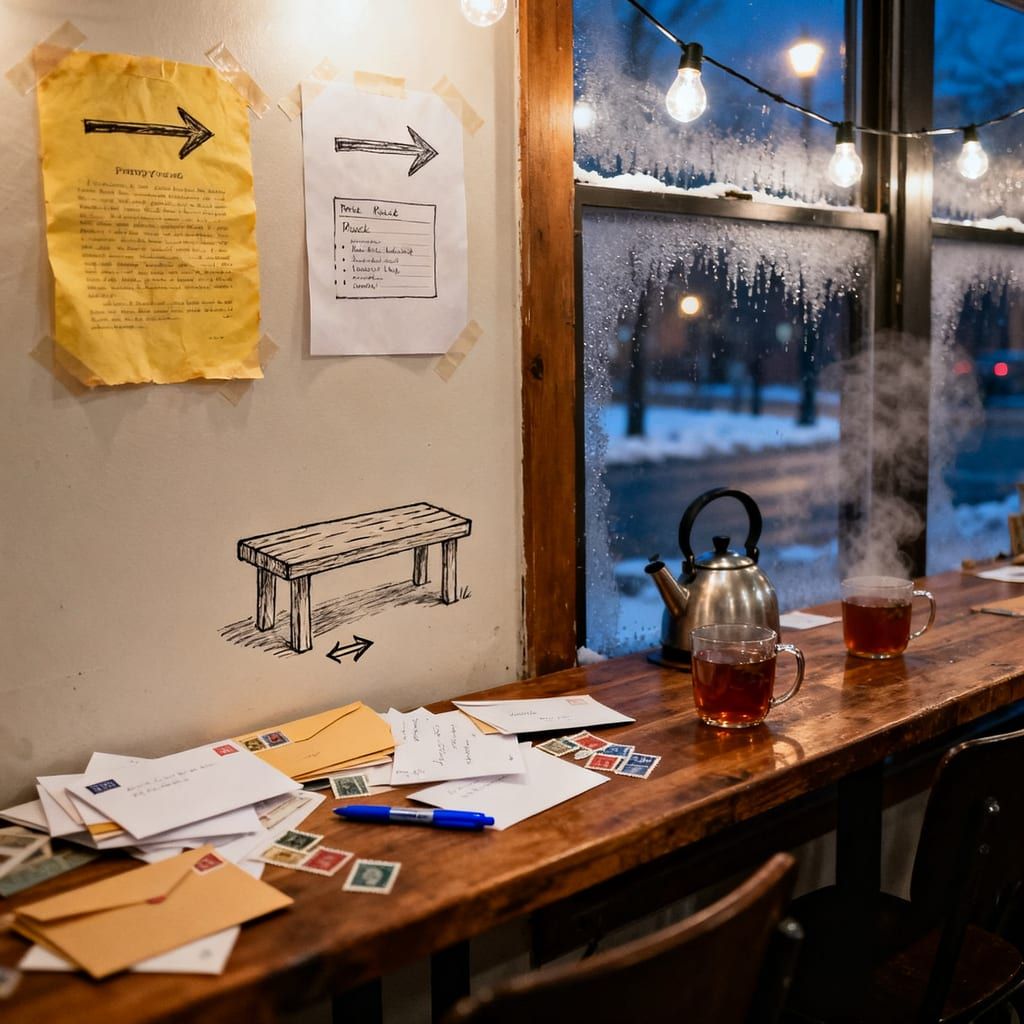
The night Lena Ortiz sets out the cheap pens, she lines them in a row like reeds along a river she is not sure she can cross.
Steam ladders off mismatched mugs. The co-op's long table smells faintly of coffee, paper dust, and an old piano that's lost its middle C.
She prints guidelines on half-sheets-first names only, no money, no promises, kindness with boundaries-and tapes them to the wall. When people trickle in, shy and laughing too loud, she smiles like a hostess at a wake, ushering them toward blank pages.
Outside, Chicago leans against winter. Inside, someone hums over the kettle and a volunteer snaps a pen cap with the practiced jaw of a former nail biter.
By the time Lena writes her own first letter, the room is quieter, the clock dropping quarters of hours into the bowl of night.
"Dear Jonah," she begins, the nib scratching like a small animal testing its cage.
She asks about favorite books, the thick or thin of preferred ink. She explains their rhythm-Tuesdays at seven, tea if you take it, stamps pooled in a chipped saucer by the door. When she signs only "Lena," her hand shakes with a tenderness that surprises her.
By day she makes microinteractions do tricks-buttons swelling like held breath, gradients passing for delight. She knows, too well, how to color a "Maybe later" into a "Yes." Twenty tabs, three stand-ups, a sprint named for a myth where someone always dies.
By night she walks to the co-op with a canvas bag, the corners dark with ink, a stubborn hope riding shotgun.
Letters begin to arrive with the easy humility of catalogues. Jonah writes about light discovering metal-how the afternoon turns the bars into lines of quiet lightning. He describes the personality of oak, patient as an old dog, and the way a mop holds water like it's practicing forgiveness.
He writes, "I'm no good with praise. If I say a good thing, I want to apologize for it first. Like I'm walking on someone else's grass."
Lena reads his lines twice, then a third time with her palm flat against the paper as if smoothing a wrinkled shirt on a dead man's chest.
She begins to measure her week in postmarks. She asks the volunteers to bring tea they like and books they can part with. She arranges the room so the radiators can be leaned against, so the shy ones can face the window and pretend to study the street.
They talk-on paper-like people setting down fragile glass. Questions with handles: What do you miss about rain? What's a small tool you trust?
Jonah tells her how the best soap for carving doesn't fight the blade, how feathers are just leaves that learned a different verb. He scratches a tiny bird into the margin; the graphite makes a soft shadow when Lena tilts the page.
The system holds, loosely. A volunteer writes to her man about poetry and gets a reply that reads like gravel kicked at a door. She quits by text, a single sentence full of speed.
That night, the room is half-full and Lena keeps rearranging the pens. She thinks of shutting it all down, letting the kettle learn stillness again.
Mail slows with the storms. A week snows into two, then three. The prison suspends mail after a fight in the yard, and Lena watches the horizon of the street like it might grow a carrier pigeon.
When the envelopes return-creased, grimy, apologetic-she wants to cry into their corners.
Jonah's letter comes with a photocopy of a soap bird, wings mid-argument with the air. He writes, "I made this because the day was loud. The shavings looked like something leaving and I thought: I could like that."
Heat rises in her chest, misnamed guilt. Later, she finds the right word for it and keeps it in her mouth like a lozenge: courage.
Spring eats away the edges of city snow. Letters quicken like thawed gutters, a steady chatter.
"I never learned to say the good thing first," Jonah admits. "In juvie, there was this teacher who wrote me. She signed with an arrow and 'Go gently, not timid.' I've been aiming at that my whole life and missing by a block."
The phrase needles Lena not for its instruction but its shape-the small arrow, the cadence. The room tilts. She tastes peppermint tea and the iron of panic.
Her mother-a public-school teacher with a voice that could braid hair-used to leave notes on the fridge. Arrows on sticky paper. Go gently, not timid. Take a sweater. The world is drafty.
Her mother's last note had been a grocery list and a question mark, as if tomatoes deserved uncertainty.
Lena writes back with hands that remember hospitals. "Do you have anything from her?" she asks. "Anything with the arrow?"
Weeks later, a thick envelope, soft at the corners. Inside: a photocopy of yellowed paper, the black-and-white of a hand she knew in color. The arrow is there, small and stubborn. The signature reads: Ms. Ortiz.
Lena's throat closes like a fist. She presses the page to her face and breathes in toner and old hope.
She writes Jonah a letter that takes three tries. She does not claim what isn't hers; she does not perform coincidence like a party trick. She says, simply, that her mother loved boys who hid kindness under their coats. That she must have seen him. That the arrow was home signage all along.
What follows is not a miracle, which is why it lasts.
They learn to carry heavier things without splintering. Jonah writes about the night he borrowed a gun and didn't know how to hold it. He describes the weight like a dare, the noise as a decision he couldn't take back.
Lena answers with her own cowardice, the day she ghosted a friend whose father was dying because showing up felt like standing under a skylight with hail in the forecast.
On paper, they rehearse being better. They trade small mercies: a paragraph about the smell of wet cedar, a doodle of a kettle whistling like a first attempt at joy.
When Jonah is granted a parole hearing, Lena drafts a character statement at the co-op table, the night wind arguing at the window. She refuses to make him a project or a province. She writes about his attention to grain and light, his steadying of the fragile glass.
He is denied. The letter comes like falling lumber-sudden, loud, unavoidable.
But he is not crushed. "I'm learning patience that isn't just waiting," he writes. "It's building something where you stand."
They begin a project: a chapbook of letters and sketches to raise money for stamps. Volunteers who drifted return, their shame dissolving in steam and staplers. The bird on the cover looks ready to argue with the sky again.
Summer air fattens the city with heat. Lena tapes two arrows to the co-op wall for the public letter-writing night-one from Jonah's photocopy, one from her mother's recipe card for arroz con pollo.
They point in opposite directions, tugging at the eye like a compass you have to inhabit to understand.
People come steady. A hard-of-hearing painter brings lemon bars. A nurse sets down a stack of postcards meant for a different kind of recovery. A young volunteer, barely twenty, hovers by the pens like a bird not yet ready to trust its wings.
He doesn't meet Lena's eyes but lifts his chin toward the arrows. "Can I write to someone who used to love birds?" he asks, voice the volume of prayer.
"Of course," she says, already picturing the soap shavings like snowfall on concrete.
That night, as the room empties and the kettle gives its last sigh, Lena stands in front of the arrows. She imagines a road that doubles back, the line of it tracing a heart she didn't mean to draw.
Autumn leans in with its copper light. A thick envelope arrives from Jonah, each page edged with pencil shavings that dust the table like residue from a handled star.
He writes that the prison woodshop is closing. "Budget cuts," he says, but the words feel like something heavier falling through a floor.
"They're letting me finish one bench for the yard," he adds. "I get these slivers that sing. I think wood likes being truthful with you if you give it time."
He sketches the bench from three angles, the grain of it like rings of a tree counting its own patience. Under the seat, a tiny arrow. Not timid.
"Not timid," he writes again, "but gentler than I thought I'd be."
Lena reads the pages at the co-op with her palm flat against the table, as if to still the urge to run. She remembers measuring time in app updates, metrics ticking like metronomes she danced for without grace. Now the rhythm is different: envelopes thinning toward weight, weeks punctuated by postmarks.
She hosts another letter night. The kettle fogs the windows until the room is a snow globe that believes in radiators. People lean their shoulders into the table's varnish, the small geography of togetherness.
She tucks Jonah's new pages beside the arrows, the bench drawn clean and sure. A carpenter who never touched a tree runs a finger over the sketch like a blessing.
Later, when she locks up, the hallway lights hum, and the building smells like old paint and freshly decided futures. Lena slips Jonah's letter back into her bag. Her hand lingers on the envelope, the paper warmed, briefly, by the pulse in her fingers.
Outside, the night is a dark pocket. She steps into it, not timid.
And the world-drafty, yes-measures back in replies.

A daughter learns to read between the lines of a life split in two
Read more →
A fog-draped night, two souls found, and the quiet shape of a life
Read more →
Story audiobooks for children of all ages — a new one every day on Smarter Way Stories.