When Silence Became the Downbeat
A drummer learns to listen for the rhythms you can't hear
Read more →
On Tuesdays, the air bites. The sidewalk outside the clinic turns into a throat-raw, loud, alive with voices that try to swallow you. Noor lowers her head, breath steaming, scarf tucked into her coat, the word Nurse stitched in blue on her badge. The volunteer escorts in orange vests nod like buoys in winter water as she slips between the chants and the cardboard signs and the brittle sound of a megaphone.
"Morning," she murmurs, as if the day might be coaxed into civility. Her voice barely carries. It's not for the curb, anyway-it's for inside.
She hums a tune she doesn't remember learning, something from her mother's kitchen where cinnamon found the corners and a kettle clucked to itself. The sound is small, a thread she winds around her wrist as she pushes through the glass door and into the lobby's practiced warmth.
In the waiting room: a college student in a hat with cat ears, one hand locked around a friend's sleeve. A married couple, the husband's jaw set, the wife's fingers kneading a packet of tissues. A grandmother with eyes like wet marbles and a Tupperware of still-warm cookies.
"Good morning," Noor says, and her hands are busy-clipboards, vital signs, a blanket tucked around trembling knees. She doesn't ask about politics. She asks about allergies. She asks where it hurts. She asks where it doesn't.
When the chants surge, the sound shows up in bodies: shoulders near ears, breaths snagging, feet that can't find the floor. Noor hums-soft as steam under a lid-and turns palms upward.
"If you want," she says, and sometimes a stranger's hand finds her like a lost key finds a lock.
Out front, the loudest voice belongs to a gray-haired woman with a megaphone who calls her "Tuesday Nurse," as if the day were a brand burned into skin. Noor never looks at her long enough to inventory her face, just a suggestion-the set of a mouth, the flare of conviction.
The Tuesday that bites hardest, the megaphone is missing. The sidewalk is still busied by men with clipboards and a woman with a rosary pressed bruise-blue into her palm, but the gray-haired voice is gone. The absence is noise of its own.
Inside, a new patient comes in white as the frost on a windshield. "Evelyn," she whispers to the receptionist, one hand cupped low on her belly. "Something's wrong."
By the time the chart reaches Noor, Evelyn is doubled in a chair, whispering about pain like a knife that keeps forgetting where to cut. She is thirty-two. Her coat is still zipped. She looks like someone's substitute teacher.
"Let's get you back," Noor says.
The ultrasound screen blooms with gray, and then a small, silent betrayal. Noor watches before she speaks; she has learned the respectful pause between seeing and saying. The beating is where it shouldn't be, the small life stitched to a fallopian tube, a fuse lit where there should be none.
"Evelyn," she says, voice the pitch of a lullaby. "This is an ectopic pregnancy. It can't grow where it is. It's dangerous. We need to transfer you, okay?"
Evelyn nods as if that motion alone can keep her alive. Shame flickers across her face, unbidden and undeserved, something the world taught her to carry like a backpack full of stones.
"I didn't-" Evelyn starts, and can't finish.
"You don't have to explain," Noor says. "Breathe with me."
She calls the ambulance. She calls ahead to the hospital. She keeps her palm on Evelyn's shoulder, its slope warm under her hand. She narrates like a steady river: what will happen, what might happen, what will not be allowed to happen on her watch.
On the gurney, Evelyn's grip finds Noor's fingers and squeezes so hard her knuckles turn white. Noor keeps humming. In the ambulance bay's wind tunnel, her scarf lifts like a flag.
The procedure is textbook, and then it is miracle, because even textbook procedures sometimes swerve. Hours later, Noor moves a bag of recycling to the back door where the alley summer smells of garbage but in winter smells mostly of iron and wind.
The paper bag is there, collapsed a little, a dent of warmth rising from it like a ghost practicing. Inside: rolls, golden and imperfect, pressed together like sleeping animals. A note tucked between them, ink bleeding at the edges from the cold: Thank you for saving me. I didn't know who you were until you held my hand.
No name. No signature. Just the handwriting of a person who'd been taught to loop her y's with care.
Noor stands in the doorway where the warm air tilts toward winter, steam lifting into the alley light. She doesn't call anyone. She doesn't announce a find. She slices the rolls in the break room, sets butter nearby, and watches her colleagues tear soft middles with their fingers, melt a little at the taste.
Next Tuesday, the protests reassemble like a well-rehearsed choir missing a single alto. The megaphone woman does not return. At dawn, a white flower appears at the threshold-a chrysanthemum maybe, or a carnation that's decided to be more serious than usual-left without a vase, without a word.
Noor tucks it into a chipped mug that used to advertise a real estate firm and doesn't anymore. She says nothing.
Misinformation hits town like sleet-small, cold, hard to see until it stings. Somewhere online, a rumor multiplies. Someone spray-paints the clinic's sign-amateur hieroglyphs in red that wear thin after two rains. Two younger men take the megaphone, auditioning their anger, discovering how words feel when they bounce back off glass.
On a slushy morning, a patient escort is jostled hard enough to split his skin. They end up in the utility closet because all the real rooms are full of people who need them more. Noor steadies the kid's head with one palm and a roll of paper towels with the other.
"It's not as bad as it looks," she says, and it isn't, but blood always looks like a lot when it is yours. She threads a needle. She tells him about the first time she sutured a grape in nursing school, hands shaking and the instructor with a thick watch saying, 'Fruit before flesh, Haddad.'
The kid laughs through the wet shine of his eyes. "I can't believe I'm crying in a broom closet," he says.
"Perfectly respectable place," Noor says. "Brooms keep the world from sticking."
He tips his head, a small bow of gratitude, and lets her pull the last knot tight.
Late one Tuesday, after the last appointment and the smell of lemon cleaner has started to stake its claim, a quiet man lingers across the street with a sign turned inward to his chest. He stands as if unsure how to be perpendicular to the world.
When Noor steps out with the day's collected trash bags, he lowers the cardboard. He walks with the caution of someone who learns floors by testing each board.
"I-" he begins, and stops. He flips the sign. It's not a slogan; it's a photograph: a woman whose hair is gray now but here is caught dark and bright, holding a toddler who has since grown grandchildren. The megaphone woman, before.
"She isn't coming back," he says. "Not for a while." His voice is a careful instrument. "She was here. She-went to the hospital. You-" He swallows. "You saved her."
Noor's mouth opens and closes around a breath. The winter sun salted the sidewalk hours ago; now the streetlamp makes a halo of the snow.
"She's ashamed," he says, eyes wet. "Embarrassed. We lost a baby forty years ago. We never forgave ourselves. We didn't know where to put it. So we-" His hand cups the air, empty. "We put it out there."
He takes another step, boldness borrowed from exhaustion. "Will you take an apology-from her? She can't bring herself to say it to... to everyone. But to you. To the Tuesday Nurse."
Noor stands with the sack of trash heavy against her calf, listening to a sound like faraway water-a traffic hum braided with a memory of kettles and humming and the way grief migrates in a body. She thinks about the security guard who comes on Thursdays, the volunteer who got jostled, the college girl in the cat hat. She thinks of Evelyn's grip, her whitening knuckles.
"I can't speak for the people who were hurt," she says, and it costs her a breath. "But I can tell her this place does more than what they shout about. I can tell her we want her alive."
The man nods, crumpling in the exquisite way of people who have held themselves up too long. Tears drip off his jaw and disappear before they can freeze. He presses the photograph to his chest like a relic.
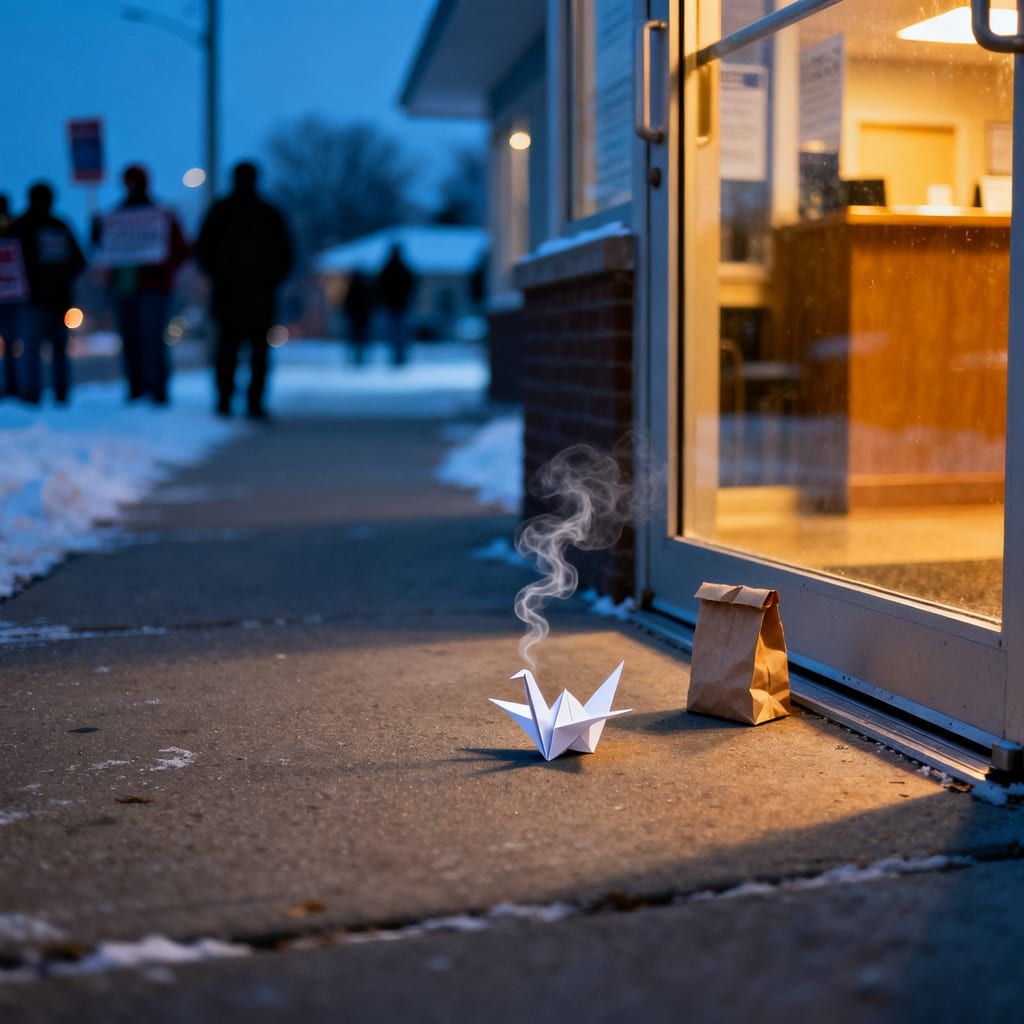
The next morning, when Noor unlocks the door, a small paper crane waits by the threshold. Its wings are too perfect to be a first attempt. She lifts it with two fingers, careful-as if it might startle-and tucks it beside the chipped mugs, a bright bird among ordinary cups.
Spring arrives like a rumor with receipts. Puddles hold daylight. The younger men outside find new decibels. A patient returns, months later, with a card the color of hospital sheets.
"I didn't think I'd-make it through," the young woman says in the lobby, words skipping like a record. "The nights were... But you-when you breathed with me? I borrowed that. I kept borrowing it."
She hands over the envelope and flees the vulnerability of gratitude as quickly as she can. Noor waits until a window of quiet opens-a tiny slot between one appointment and the next-then slips into the supply closet where it smells of lemon and damp cardboard. Mop buckets stand like patient blue animals. The light is grated and a little too yellow.
She opens the card.
I didn't expect to live through the anxiety, or the loneliness after. But the way you breathed gave me a rhythm to borrow. Thank you.
The handwriting tilts up at the end of each line-a person hoping the sentence might carry them further if it aimed for sky. Noor feels it in the boxed-in quiet spot between collarbones, the ache that isn't pain.
She thinks of the white flower and its quiet claim on the coffee mug. Of steam curling over rolls in the winter air. Of a photograph held to a chest and a man blinking in a streetlamp's small benediction. Of a paper crane, a geometry of carefulness.
She tucks the card back in its envelope, presses it against the shelf where extra gloves wait in sizes no one uses. She breathes in, breathes out, lending herself her own rhythm.
Outside, the corridor of shouting is already warming up-new voices strapped into old arguments, old faces softened by the work of mornings. Inside, the waiting room is filling with people who carry their stories like packed lunches, some with notes tucked in the napkins, some without.
Noor smooths the front of her scrub top and opens the door. The escort with the stitched eyebrow winks at her. The kid in the cat hat is back, this time without the hat, with steadier hands. The grandmother has switched to lemon bars.
A patient flinches when a chant ricochets off the glass.
"I'll be with you the whole time," Noor says. She hums, and the tune opens like a path just wide enough for two.
She walks the length of the corridor again, past voices that do not know her name and some that think they do. Her hands are quiet. At the threshold, she pauses, as she always does, feeling for the seam where outside becomes in-where the air changes temperature, where footsteps soften, where the world remembers its pulse. Then she steps through, and Tuesday begins again.
A drummer learns to listen for the rhythms you can't hear
Read more →
In Los Angeles, a daughter learns how to carry two lives forward
Read more →
In the soft hours before dawn, staying becomes its own kind of rescue
Read more →Story audiobooks for children of all ages — a new one every day on Smarter Way Stories.