Two Houses and One Quiet Heart
A daughter learns to read between the lines of a life split in two
Read more →
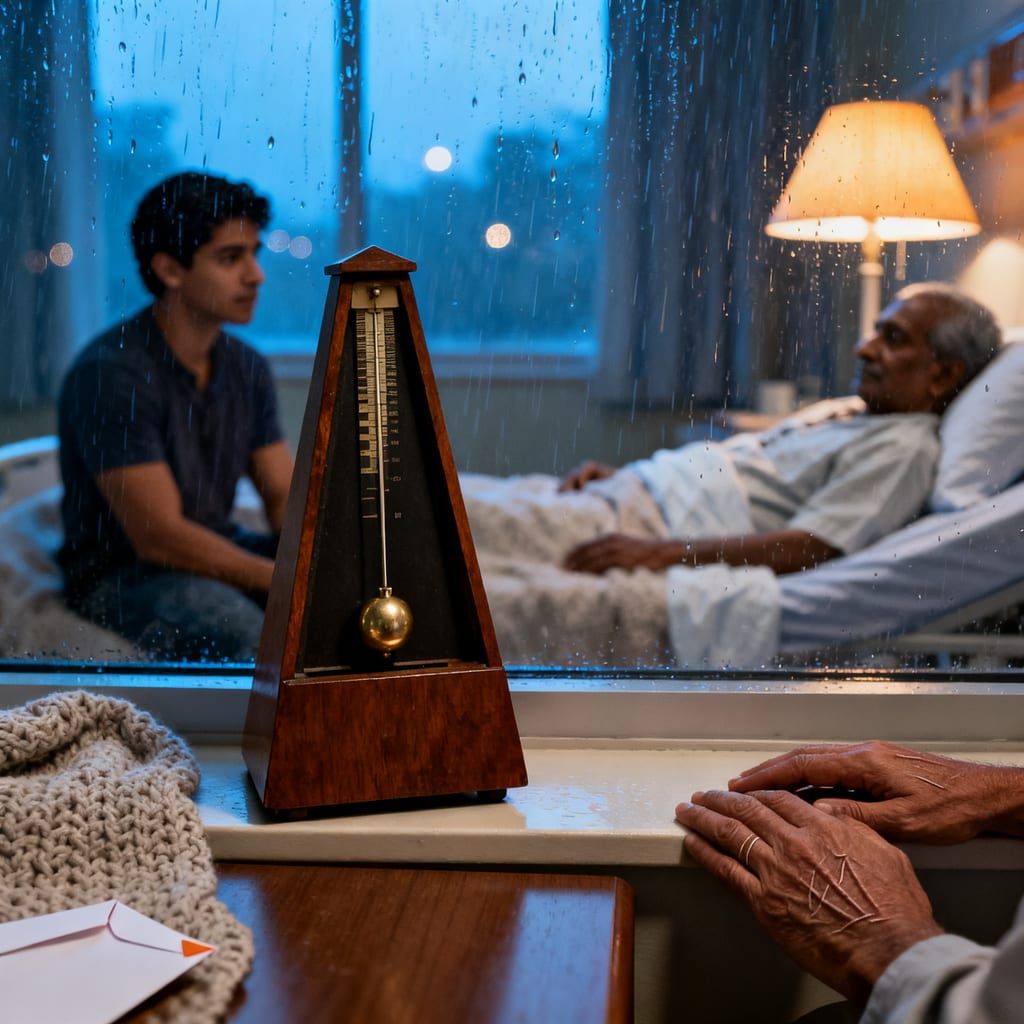
The first hour is eleven years long.
Rain arranges itself into silver ladders down the hospice window, and a wooden metronome ticks on the sill-neat triangular body, brass pendulum carving arcs through the wet light. Alex sits straight-backed in a mauve chair, hands anchored to his knees as if resisting the urge to stand.
His phone trembles in his pocket, a trapped bee begging to be freed. He can feel the stacked weight of everything he is not doing-emails unreturned, laundry unwashed, a restless city insisting on movement just beyond the glass.
Across from him, Halim Naveed studies the rain the way a calligrapher studies a line. His mouth moves, a soft count under his breath. He has a face built by careful work-cheekbones like folded paper, fingers lined with pale ridges as if riverbeds were etched into skin.
"Do you need anything?" Alex asks, for the third time in six minutes.
Halim barely shakes his head. "Just this." He taps the metronome lightly, as if waking a small animal. Tick. Tick.
Alex has come stocked with fixes-playlists arranged by decade, a lavender lotion he'd vetted in a forum, a deck of conversation cards with prompts like What's the best smell? and Tell me about a time you were surprised.
Halim wants time. Not to be filled, but to be heard.
In orientation they said: Meet people where they are. Alex took notes in bullet points, drew arrows and brackets like he could map grief into a workflow. After he burned out at thirty-two-calendar immaculate, life threadbare-he'd needed something that wasn't deliverables. Compassion, he thought, could be systematized.
He tries. He smooths Halim's blanket, aligns the water glass with the coaster's circle, arranges the lotion bottles in descending order. The room hums-monitor, vent, distant elevator. Rain whispers against the pane.
His phone throbs again. A phantom line of obligation tightens along his ribs. He clears his throat. "I, uh, brought music. Frank Sinatra, classic Afghan ghazals, lo-fi beats-"
"Not today," Halim says. His voice is a brush dipped in water. "Let's measure a quiet minute."
Alex inhales, holds. The metronome ticks into the space he leaves. It fills. It dares him to do nothing.
Thirty seconds later, he can't stand it. "Do you have family who-"
A look from Halim-gentle, not scolding. A fingertip tapping the pendulum back into rhythm.
Finally, in an act that feels like dropping a burden he didn't realize he'd been carrying, Alex slides his phone out and turns it off. A clean little animation, a black glass eye closing.
The room opens. Or maybe it stops resisting him.
He notices the knit of Halim's blanket-seed stitch, uneven in a way that suggests human hands and late nights. The monitor's hum doesn't annoy; it stacks under the rain like a bass note. The rain itself has tempo. And Halim's fingers-those etched lines like dried riverbeds, evidence of both flow and drought.
They count a quiet minute. Then two.
The next week, he brings the same bag and touches none of it. The metronome becomes part of the furniture, a small cathedral of rhythm on the sill. Chicago stutters between late autumn and early winter, leaves gluing themselves to sidewalks, then lifting in gusts that smell like steel and wet newsprint.
"Read to me," Halim says, pointing to a book on the nightstand. "Just a page. Slowly."
It's a slim memoir, sentences clean as winter light. Alex reads until he feels his voice settling into bone. He inhales at the paragraph break, ready to continue, when Halim says, "Pause. Tell me about the margins."
"The margins?"
"What do you see there?"
Alex turns the book toward the window. The margins are wide, generous. Someone-Halim, maybe-has made notes in pencil, ghost letters that coil around the print. There are pressed leaves as thin as memory. A doodle of a window. A date. 1998.
"They make room," Alex says finally. "For breath."
Halim's smile is the smallest triumph. "Yes."
They proceed this way for weeks. A paragraph, then a look out the window; a minute of counting; a story that is more air than plot. Sometimes, Halim shares a sliver of his craft-describing how letterforms aren't drawn but written, how the nib sings a different song on cotton rag than on vellum, how white space is not absence but invitation.
"People think the flourish is the point," he says, gesturing weakly. "But it's the pause."
Alex nods, thinking of his calendar once packed to the edges, the way he used to brag about ten-minute turnarounds, inbox zero, the staccato applause of notifications. He had mistaken velocity for virtue. Motion for care.
Here, he learns to let sentences swing and settle.
December arrives with a hard light that scrapes at five p.m. One evening, a storm shouldered in from the lake, wind threading itself into the buildings so they moaned. The hospice flickers. The metronome stutters-tick-ti-then the room dissolves into a mild, battery-lit dusk.
For a moment, the absence of hum startles Alex. No vent. No elevator. Just rain, pressing fingers against glass.
"Better," Halim says. His breath shivers on the word.
In the hush, something inside Alex loosens, the tight coil he has wound around a decade. He doesn't plan to speak. The confession arrives on its own, like a letter slipped under a door.
"My father," he says, and his throat works around the syllables. "Six years ago. I was there and then I wasn't. An email came in, and I stepped into the hall to answer. I thought-two minutes. A nurse walked toward me like she was wading. By the time I got back, there was only-" He rubs the place in the air where the metronome would be if the dark didn't swallow everything softer. "A voicemail, later. I have been sprinting ever since. If I move, if I fix-maybe I don't have to feel the part I missed."
Halim doesn't reach for answers. He doesn't say, You couldn't have known, or He understood, or Anything that begins with At least. He is a quiet lamp. He lets Alex's words settle into the room, into the battery-lit dusk, into the rain.
When he finally speaks, it's a question. "What did the voicemail say?"
Alex swallows. "Please come back."
They sit inside that sentence until it stops slicing. The metronome resumes when the power returns, reclaiming its gentle tick as if nothing happened. But something has.
As winter steepens, Halim's breaths shorten. The pause between tick and tock grows longer-as if the air is thickening, as if even time is tired. Nurses move softer around the room, their voices edged with wool.
Alex wonders, quietly, about the person on the other end of so many goodbyes. An estranged son, a love that frayed, a message that wants delivering. He asks once, clumsy with care, "Is there someone you'd like me to call?"
Halim's eyes close, then open, clear pools. "No one left who needs a phone," he says. "I have set down what could be set down."
"Then what are we-" Alex stops himself. The question shames him as soon as it lifts its head. He already knows.
Halim has been teaching him the thing neither of them can diagram on a whiteboard: staying.
He realizes it not in a thunderclap but in a series of minor weather changes-the way his own breath matches Halim's without effort; the way he arrives without a bag now, just hands; the way he no longer parses each silence for meaning but lets it be what it is: a room with two people and a window full of weather.
Sometimes they speak. Halim tells him about a market in Lahore where ink sellers made their own blacks from soot and gum arabic. About a student who wanted gold in every flourish and learned, after a year, that restraint is a kind of radiance. About a woman he loved whose laugh left commas in the air.
Mostly, they count. One quiet minute. Then two. Time reveals its own structure when it isn't cross-examined.
On a day when the snow comes slantwise and the sky can't make up its mind, Alex arrives to find the metronome still. The pendulum leans to one side, a dancer caught mid-bow. He picks it up, winds the key, sets it down gently.
No sound. The spring is done.
Halim watches him with a look so tender it frightens Alex. "It's all right," he whispers. "We know the beat."
They count anyway. Breath. Window. A distant cart's soft wheel-song in the hall. Halim's hands rest on the blanket, riverbeds catching what light remains. He reaches with effort for the nightstand and gives Alex an envelope addressed in careful letters: To The One Who Waited Without Asking.
"I should-" Alex starts, but he doesn't know the verb. Call? Fix? Fetch?
"Stay," Halim says, and it lands like a benediction, like an old instruction finally understood.
Snow edits the world outside into quiet facts. Halim's breaths become shallow, summer creeks in late August. Alex counts-not like a clock, but like a witness.
When the end comes, it is not a door closing. It is a question mark straightening. Rain starts again, soft applause against the glass. The metronome is still. The room holds what it can and lets go of the rest.
At home that night, the envelope waits on his table, the paper slightly toothy beneath his fingers. He thinks of not opening it, of keeping the mystery whole. Then he slides a finger under the flap.
Inside: a single blank sheet.
At first, he smiles at the audacity. Then the habit he had forgotten-curiosity without grasping-nudges him. He lifts the page toward the lamp. Faint as breath on mirrors, indentations surface. A message not meant to shout.
You were the first person who let time be time.
Alex sits back. The sentence arrives through his ribs rather than his ears. He holds the paper the way you hold a sleeping child's foot-carefully, with both hands, astonished at the smallness that contains a life's weight.
He doesn't cry right away. Instead, he sets the paper on the table and listens to his apartment: the fridge's ordinary hum, a neighbor's laugh leaking through the wall, the tiny tick of his own wristwatch. He has been sprinting around a missing minute for years. Here it is.
In the weeks that follow, Alex logs fewer tasks and more minutes. His calendar grows breathing room, white space like the margins of Halim's book. He still brings himself to rooms with windows and weather, but he no longer arrives armed.
Sometimes, he sets the wooden metronome-Halim's gift to the hospice-on a new sill. He tilts the pendulum and waits for the first tick to break the surface of the day.
"Shall we measure a quiet minute?" he asks, to a woman who used to run marathons and now watches snow as if it's writing her name. To a son who can't stop talking long enough to breathe. To himself, in the stairwell between floors, palm flat to the cool wall.
Not every silence is noble. Some are jagged, full of small panics. Old reflexes surge-stories, pillows, water. He learns to notice without lunging. He learns that staying is a practice built from tiny acts of unbecoming: turning off the phone, setting down the bag, letting the question remain a question.
When words do arrive, he lets them. When they don't, he lets that too. Presence turns out not to be a performance but a way of holding a room until it remembers itself.
On a late winter afternoon, rays lean through a hospital window like long fingers. The metronome ticks. Beyond the glass, Chicago hunches under salt and slush, impatient for thaw. Inside, a stranger's breath steadies, then floats.
Alex counts a quiet minute.
Then another.
And in the quiet hour that gathers between heartbeats, he stays.

A daughter learns to read between the lines of a life split in two
Read more →
A fog-draped night, two souls found, and the quiet shape of a life
Read more →
Story audiobooks for children of all ages — a new one every day on Smarter Way Stories.