Two Houses and One Quiet Heart
A daughter learns to read between the lines of a life split in two
Read more →
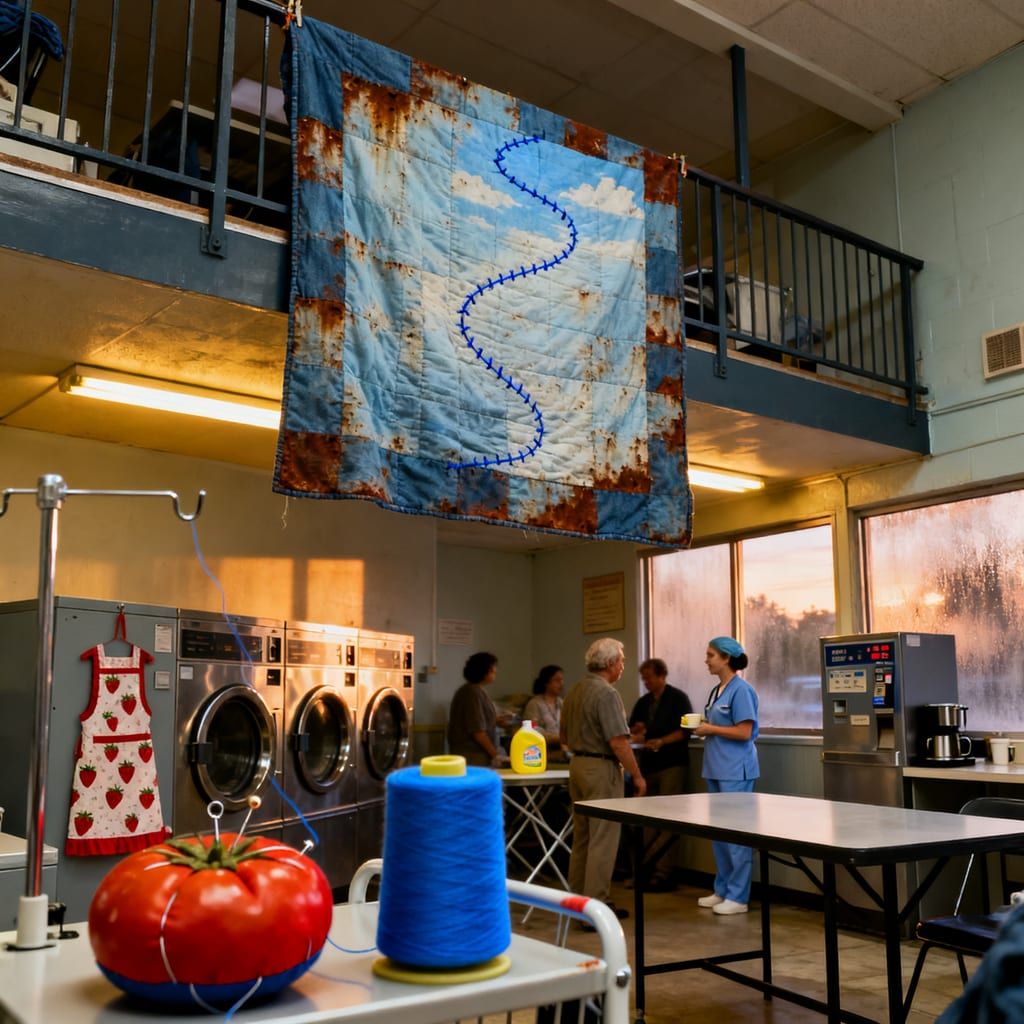
The laundromat smelled like hot metal and lemon soap, a thin sweetness riding the wet heat that fogged the front windows. On Tuesdays, when the fluorescent lights hummed like tired bees, Rhea dragged two folding tables together, taped a hand-lettered sign to a rolling cart, and opened Threadlight.
Repairs for the price of a story, the sign said. A spool of blue thread stood like a small lighthouse beside the tomato-shaped pincushion. She hadn't meant for it to be the exact blue of monsoon skies, or hospital curtains, or her father's last work shirt-she'd only saved that spool because, for years, she couldn't bear to snip the fabric it matched.
The first week, a man brought a floral dress folded in tissue. He was careful the way people are with things that harbor ghosts.
"It was her favorite," he said, smoothing the skirt. "She wore it whenever she didn't want to be sad."
Rhea ran the fabric under her fingers, felt where the seam had parted at the waist. She picked a thread and showed him how the needle entered and surfaced, neat as fish keels cutting water. As she stitched, he told her about the lilac bush his wife had planted in clay that refused to break, how every spring the bloom surprised their gritty block.
"She said all the things in this city grow toward the little light they can get," he said, laughing with his hands over his eyes.
Rhea saved a thumbnail of the dress when she trimmed the seam-just a sliver, small as a breath. She dropped it into a tin with other quiet pieces: a corner from a frayed hoodie a delivery driver shrugged out of while his phone pinged nonstop; a faint green from a nurse's scrub top that had been washed so often it felt like silk. She slid a single length of blue thread through the needle and fed it into the mending like a promise.
Customers began to linger. They brought broken zippers and busted hems and buttons that had leapt into dark corners months ago. They brought stories tucked under their arms the way you carry fresh bread-carefully, wanting it to arrive whole.
Rhea did not announce the swaps. She simply tucked a small tab of someone else's history into a repaired cuff, stitched down the whisper. The widower's newly mended dress got a fleck of gray knit from the delivery driver's hoodie. The hoodie came back with a petal of floral hidden inside the pocket seam, the print so tiny you had to want to see it. The ER nurse's scrub top carried a sliver of a barista's stained apron where a pocket met the side seam, invisible from the front but present all the same.
She tried not to be sentimental about it. She told herself it was whimsy, a way to keep the scraps from becoming mere trash. But when she reached for the spool of blue, always the blue, something lifted in her chest. This is what I have left of him, she thought, threading the needle. This is the part I can put back into the world.
She started a quilt on the slow mornings, spreading a thrifted sheet across the folding table and laying down squares like neighborhoods. Every piece asked to sit next to another. Rusted reds pressed against denim blues, faded florals against work-wear khaki. The tin of scraps grew lighter each week, a small hunger being fed.
Mr. Ortega watched from behind the counter as coins rolled in their separate metal rivers, meters spinning angry red messages about maintenance. He had owned Suds Deluxe for twenty-six years. His hands were freckled with bleach spots.
"You sure people will pay for a quilt?" he asked one Thursday, stepping around a slick from a misbehaving machine.
"They will," she said, and because the word hung too steady in the air, she added, "Maybe."
He laughed, but there was an ache under it. He flicked the light over Washer #9 twice, a habit he had when he wanted to fix something he couldn't.
The donation bags were an unruly tide by the back wall-castoffs, always arriving in black plastic like they were ashamed of their former lives. Rhea sorted them during lulls, folding kids' jeans into piles, setting aside what could be repurposed. One afternoon, under the hiss of a dryer with a sticky belt, she found a child's apron with a strawberry print, the seeds rendered in tiny black stitches. The fabric had softened with years, the ties frayed to wisp.
There was a note pinned inside: For the wall. I don't know if I belong here anymore.
Rhea held it up to the light. The strawberries glowed a little, like lanterns. She set the note on the counter and showed Mr. Ortega.
At first he said nothing. His mouth opened and then pressed into a line the way you press your finger along a seam to make it sharp.
"I bought that fabric at the church fair," he said finally, voice turned strange like it hadn't been used in days. "My girl-" He stopped. Opened a drawer. Closed it. "She was five and it was Fourth of July and I-" He rubbed at a spot on the laminate with his thumb as if the past could be polished into now. "We fought when she was older. About... everything we could find. She left with a bag and a face like a door slamming."
He touched the strawberry print like it might flinch. The hum of the dryers held a long note.
"Leave it," Rhea said softly. "For the wall."
That night, when she went home, she took her father's shirt from the closet. It was the blue one he'd worn on his last day at the factory, the one she had folded and refolded until the creases felt like bones. She laid it on her kitchen table. She ran her palm along the placket where his hands had worked the buttons, knuckles scarred from years of machines. She drew a breath that felt like old fabric releases.
She cut. A neat line. She cried less than she expected. The sound in her chest was not a break but a stitch.
They started finding each other in seams. The widower saw a thumbnail of his wife's dress peeking from the binding of a child's backpack and stopped the boy by the vending machine.
"Excuse me," he said, pointing, voice careful as if he were reaching for a small bird. "That print-she wore it to every block party. When they played 'September' she'd dance like she was twelve."
The boy looked down at his backpack, then up at the man like he had been offered a secret. "My mom says this is my lucky bag," he said. "Maybe 'cause it had other luck in it."
At the folding table, the ER nurse found a triangle of her former scrub top stitched into the corner of a barista's apron.
"Hey," she said as the young woman loaded towels, the coffee tattoo on her wrist flexing with each toss. "Long night?" The question was ordinary and kind, the way you ask when you have been there.
The barista smiled with half her face. "I'll have to brew myself today."
They laughed. Names were exchanged. Numbers were offered. The dryers thumped their soft applause.
In June, a tech contractor-smooth watch, crisp sneakers-argued with Mr. Ortega about the sticker that read Cash Only. "It's 2026," he said, the words a blade. "You're making it hard to pay."
"It's hard to pay," Mr. Ortega answered, "no matter how you do it." He gestured at the coin machine like a priest blessing the flawed faithful. The contractor looked around at the warping baseboards, at the taped signs that said Out of Order and Please Don't Slam the Doors, at Rhea's quilt-in-progress taking up a whole table, and he said nothing else.
By July, the quilt had a logic of its own. When Rhea stood on the step ladder and looked down, she realized the blue stitches-a single continuous line she had been careful to carry from square to square-traced a path from the door to the counter to the folding table. It was the way feet traveled the room, the path of coins and gossip and apology, sunlight, lint.
"You're making a map," Mr. Ortega said, squinting, hands on his hips.
"I think the map is making me," she replied.
The block party arrived hot and generous. Grills smoked. Kids ran between folding chairs with ice pops, their tongues stained cartoon colors. Rhea and two volunteers hung the quilt from the mezzanine railing with binder clips and prayer. The light caught the blues first, then the rusts, and then the little pockets of print that made your eyes wander and rest.
People clapped because that's what you do when something brave is shown.
From outside, through the plate glass, a woman hovered with a paper bag of quarters. She stood in the place where the delivery drivers usually double-parked, where a scuff on the concrete marked a thousand impatient stops. She didn't come in right away. Rhea saw her fingers worry the paper bag's edge into flowered rips.
The woman stepped inside as Rhea lifted her hand for the auction. The quarters chimed together. Her face had Mr. Ortega's cheekbones but years and a city had written their own notes on her.
"We have a starting bid of fifty," someone called from the back, too quick.
"One hundred," said the ER nurse, her hair up in a knot stabbed through with a pencil.
"Two," the tech contractor said, voice steady. "Three."
"Three-fifty," from the barista, blushing after she said it like she had broken a rule.
Rhea tried to keep her breath even, eyes flicking to Mr. Ortega. He was not bidding. He was not breathing, either, it seemed. His daughter-because that was who the woman was, absolutely, who else stands in a doorway at a time like this clutching coin and history-looked up at the quilt and then over at the strawberry apron pinned to the wall near the change machine. She made a sound you make when your bones recognize a room.
"Six hundred," the contractor said. A hush fell because money is a kind of volume.
The auction ended there. The contractor took a half step forward, his sleek watch catching the light.
"I argued for cashless," he said, voice pitched to the room. "I was wrong." He raised his hands like he could hold an apology there. "This stays here. A permanent loan. Everybody should see it."
The clapping started again, messier this time. Rhea felt the relief like a thread being pulled through a thick layer, snug and clean.
Mr. Ortega turned toward the doorway. His daughter was closer now, the paper bag still in her hands. He screwed his courage tight and walked to meet her in the corridor between Column A and Column B, where the breeze from the front battled the dryer heat in a stale truce.
"Mija," he said, and the word cracked down the middle.
"I didn't know if-" she began.
He reached for the bag, not to take it, but to touch the place where her fingers had wrinkled it thin. "We got machines that like quarters," he said, a smile coming on like weather. "And a wall that could use some strawberries."
They stood there, talking in starts. Not the old fight. Not yet the forgiveness either. Just the hum of the dryers behind them like a long, warm chord.
When the quilt was rehung, the room tilted toward it. Strangers leaned close, pointing out pieces they recognized: a child's sock toe reborn as a star point; a splatter of paint from the art teacher's jeans; a shaved curl from a velvet dress that had once danced under the streetlights.
Later, when the last lemon cups were thrown away and the teenagers had taken the speakers to someone's cousin's porch, Rhea stood with the quilt's shadow lying over her shoes. She pressed her fingers to one of the blue lines.
"My father had a shirt," she said to no one in particular, or maybe to the whole room. "Blue like this. I kept it for years. Couldn't cut it. Today I did."
The ER nurse, stacking chairs, paused. The widower, wiping the coin machine with a damp rag, stilled his hand. Even the contractor, awkward with the broom, lifted his head.
"I thought I was saving it for later," Rhea said, her voice even. "But sometimes later is a way of saying never."
Mr. Ortega's daughter, who had stepped to the strawberry apron and was considering where it belonged on the wall, turned. "I kept a drawer of things that were supposed to make me brave," she said. "Mostly they made me heavy."
They smiled at each other, the kind of exchange that doesn't undo years but slips a small folded paper into a pocket: Call me when you can. I'm here.
The night crew came in to mop. The fans clicked on, adding their cool breath. Rhea took the spool of blue thread and placed it back on the cart like an ordinary object. She knew now she could buy another spool when it ran out. The shirt was not gone. It had simply moved-into pockets and hems, into the hidden places where fabric remembers heat and hands.
Outside, the block party left a confetti of napkins and bottle caps. The lilac bush three doors down gave off a stunned sweetness in the heat. Through the glass, the quilt's path of blue shone dully in the industrial light, leading from the door to the counter to the folding table as if to say: here. This is the way in. This is where the stories go.
People would come tomorrow with sleeves and zippers and questions about the missing buttons of their lives. Some would leave with a different color hidden under their cuff. Some would find themselves, months later, in line at the bodega behind a stranger with a familiar print at their wrist and think, without panic or ache, We belong to each other more than we know.
Rhea locked the door. The metal gave a small complaint and then yielded-the sound of a hinge that has been used enough to be honest. The spool of blue slept on the cart. The strawberry apron waited for its second hanging. The street, not mended exactly but strengthened in its seams, breathed in the night and held.
A daughter learns to read between the lines of a life split in two
Read more →
A fog-draped night, two souls found, and the quiet shape of a life
Read more →
Story audiobooks for children of all ages — a new one every day on Smarter Way Stories.