Two Houses and One Quiet Heart
A daughter learns to read between the lines of a life split in two
Read more →
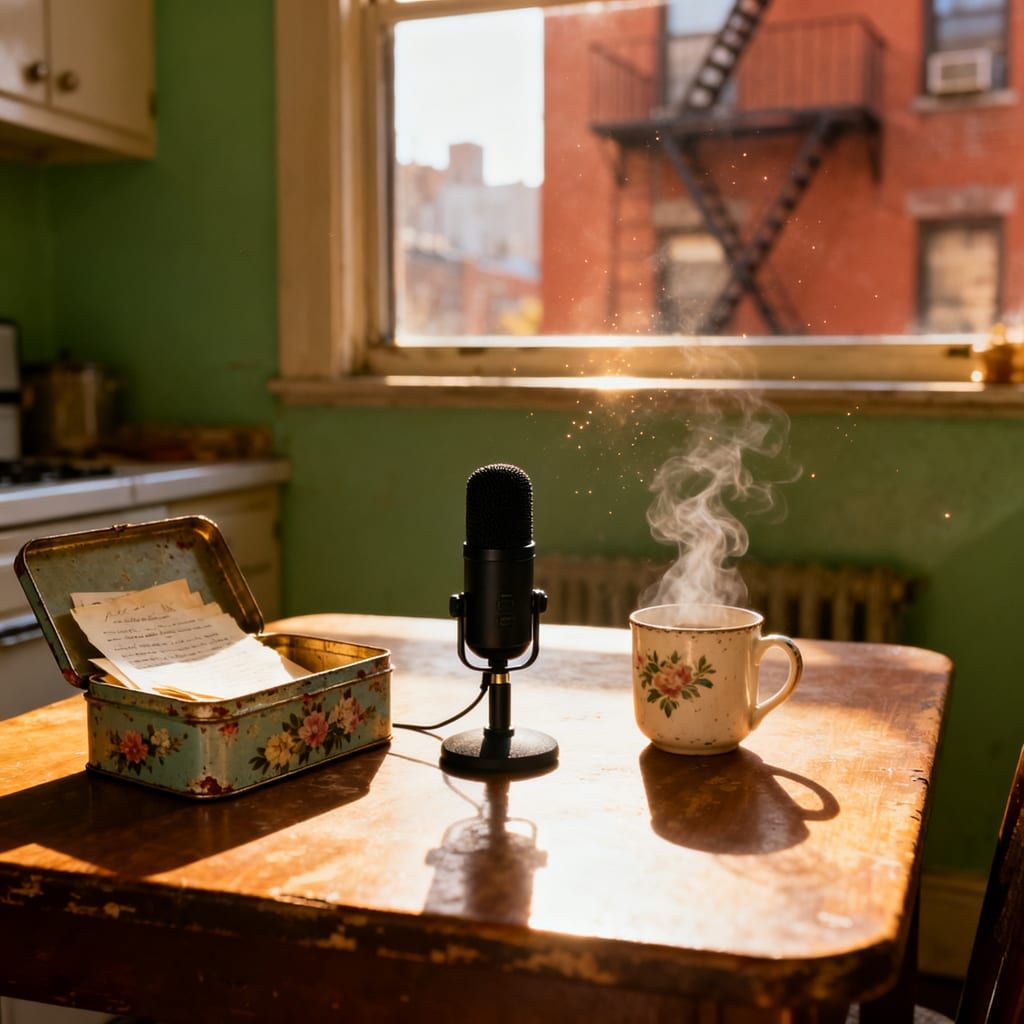
The microphone waited where the morning sun stopped-the line of light caught on its metal grill and turned it gentle. Steam ghosted from Rosa's chipped mug, the floral pattern thinning to nothing near the handle. Lina set her headphones aside and pressed record.
"Okay, Abuela," she said, though the word landed strange in her mouth today, like a note she could no longer quite sing. "Tell me about the soup with the cilantro stems."
Rosa's laughter came soft. "You always start with soup."
"Soup remembers," Lina said, and the little red light winked-two heartbeats and then the old kitchen gave itself over: the hum of the refrigerator, traffic a muted hush beyond the fifth-floor window, the tinny tick of the cooling stovetop.
Rosa pinched salt with fingers that had once shelled almonds by the crate. "Stems are flavor. People throw away flavor because they don't respect what is small." She spoke to the pot, but her words found Lina anyway.
They went like this for three Sundays-Rosa in her house dress, a folder of memories picked up and put down. The border crossing that stung like pepper in the lungs. The first winter in New Jersey when the radiator hissed like a snake at her ankles. A bus driver named Alvarez who wore a green cap and kept butterscotch in his pocket for children who cried on long routes.
Between memories, there were practicalities. "Turn that thing closer," Rosa would say, nudging the mic with a spoon. "If you want the truth, you must be brave enough to hear it."
Lina smiled behind her levels. She was thirty-three, a freelance audio producer with a voice used to pitching ideas that almost sold. Lately, the waveform of her days had flattened-too much editing for other people's stories, not enough of her own. She'd started this oral-history series as a way to feel useful, to braid strangers into a community. She did not expect the knot to slip in her own hands.
On the fourth Sunday, Rosa paused mid-instruction to hum. It was a tune Lina didn't know-plain at first, then widening, like a path remembered by the feet. The syllables were rounder than Spanish, softer at the edges.
"What's that?" Lina asked, watching the peaks lift on her recording software. "I don't recognize it."
Rosa's face eased into time. "Just a song." She tapped her temple. "From before."
"Before where?"
Rosa shook her head, that humming growing more certain. "Later," she said, and the word shut like a door Lina didn't know they shared.
A cough caught in Rosa's chest, then another, stringing together until the room narrowed. Lina set the mic on its little tripod and rubbed her back in circles, counting as if time could be convinced to behave.
"Water," Rosa said between breaths, hand on the table for balance. "And-under the sink. The tin."
It was the sort of request that sounded like a habit. Lina fetched the glass and opened the cabinet to a city of cleaners and folded bags. The tin sat behind them, simple and dented, a floral lid that once matched Rosa's cup.
"Here," Lina said, placing it where the mic had been.
Rosa drank, then nodded to the tin. "Open it." Her voice was steady now, but something in it made Lina think of a key turned and left inside the lock.
Inside, paper met paper met more paper. Birth certificates in thick, official stock and thin copies made at some point in a rushing office. One bore a name Lina knew. The other carried another-familiar in the eyes and cruel in its divergence.
A green card with the softness of years. The surname a line break she hadn't seen before.
A photograph-Rosa, maybe, but the look in the eyes was slightly not. Not sharper, not kinder; just... else. As if some small part of her had chosen a different corner of the room to live.
Beneath them, an envelope addressed in slow, careful letters to a man Lina had never met. The paper smelled faintly of dust and lemon oil.
"Abuela?" The word was question now, an ache.
Rosa rested her palm over the envelope without touching it. "We are circling the same fire, m'ija," she said, slipping into a tenderness Lina knew from fevers, from scraped knees. "Come sit."
Lina sat, the headphones cool around her neck, the recorder still running. She could hear her own breath through the tiny speakers. Outside, a siren passed with the bored certainty of Sundays.
"I am not," Rosa began, then stopped. She took the mic gently and turned it toward her like a face. "No, I am. I am your grandmother because that is what my hands have done. But-" She touched her chest. "I am your tía. Your great-aunt."
The word landed with its own weather. Tía, with its softer vowels and a history Lina had never put to Rosa's shoulders.
"My sister," Rosa continued, and the cough came back, gentler, as if even the body was trying to be delicate. "Your real abuela, the one whose eyes you have in every photo-she died on the road north. She was young and it was cold, and the man who said it would be fine did not count on the river. I took her daughter." A pause. "I took her name."
The recorder picked up the sound of a neighbor's radio bursting into merengue and then fading, apology implied. Lina's chest felt both hollowed and widened by something that did not fit.
"Why-" she began, then swallowed the question. "How long have you-" She faltered. "Does Mamá know?"
Rosa nodded. "She has always known, though knowing is a thing with sides. She knew she was my sister's child and mine. She knew our mother sang a certain song in a language that is not this one and that I cannot spell. She knew I married a man named Alvarez who carried coins for luck and called me Rosa like it was the only word he wanted to keep."
"Your green card," Lina said, touching the edge of the tin because to touch Rosa seemed too much. "It says-"
"A different surname," Rosa said, a smile pulling at her mouth in a private joke with a younger self. "For one year, I kept mine in a pocket. Then I put it away. His name was shelter. He died in a warehouse accident three years later, and the papers kept us from shaking apart."
Rosa reached for Lina's hand then, the skin warm as bread. "I told you the border and the winter and the soup," she said. "But some truths live under the sink. I kept them there because paper can be a kind of flood."
"You thought it would break us," Lina said, a marvel more than an accusation.
"I thought it might untie the knot," Rosa said. "The one I made to keep us a family." Her eyes shone, and in them, for the first time, Lina saw the photograph's almost-the not-quite look. A woman who had stepped to the side of herself and kept walking.
"What was the song?" Lina asked, her voice changed by something new, a carefulness that felt like a vow. "The lullaby."
Rosa's smile threaded back into the room. "Quechua," she said, the syllables clean as a river stone. "From our mother. From the highlands, before the road, before the names that made us passable." She hummed it again, and this time the sound went through Lina as if it had been waiting.
Back in her Brooklyn studio, the room made of foam squares and secondhand wood, Lina cued the recordings. The digital waves looked ordinary-sound mapped like a city skyline, peaks and alleys. But in the quiet spaces, she heard it now: the breath Rosa took before each story like a swimmer daring cold water; the catch when the word sister hovered just out of reach; the lullaby's shape nested under the scrape of a spoon.
She muted the track and closed her eyes. Her last name flickered across her inbox in subject lines-clients asking for edits, a festival rejection that used first names as if intimacy could soften the decline. Alvarez was a kindness, a shelter, a currency that bought a life and a language out of reach. Under it, something older waited with the patience of stone.
Lina opened a new project file. She titled it simply: "Kitchen_Tin.wav." She let the cursor blink. Outside the studio window, the city was in its afternoon deal-making-delivery bikes clattering, kids dragging sticks along fences, a couple arguing and apologizing between traffic lights. The world kept its rhythm.
She began to cut between Rosa's recipes and the cough, between the border story and the tin's rusted mouth, splicing in the lullaby where it surfaced like a fish too quick to name. The episode became a braid that refused to lay flat. It lifted at the places where the light changed.
Halfway through, she stopped. The patchwork felt like it was doing what she had trained it to do: ask a question, answer it, leave a line for donations. But the truth Rosa had placed on the table did not belong to the choreography of tidy reveals.
Lina sat back, headphones hanging like hands around her neck. Outside, a siren again, but softer this time, far away.
She opened her messages and typed to her mother: Can you come to the studio tomorrow? There's something I want to record with you.
The reply came after a pause that let her see her mother's hands-wiping them on a towel, finding glasses, squinting at the phone. Yes. Are you okay?
Lina typed: Better than okay.
Her mother-Rosa's daughter, her aunt by blood-arrived with a plant cutting wrapped in damp paper towel. "It's from Abuela's pot," she said, not flinching at the word. "She says it makes a place feel like home faster."
They sat across from each other in the little studio, the microphone between them like a candle. Lina pressed record. In the headphones, her mother's breath sounded like ocean and housework, like nights waiting on texts and afternoons blowing on soup to cool it for a small mouth.
"Tell me," Lina said, "what you think we inherit."
Her mother smiled, eyes on the mic as if it were a careful child. "Spices," she said first, and they both laughed, the sound layering like harmonies. "And songs that have no written words. And ways to hide and then to come out of hiding. We inherit the work of explaining ourselves and the right not to."
"And names?" Lina asked.
Her mother reached, and they shared the weight of the microphone stand for a moment, that small contact grounding. "Names are ladders," she said. "We climb them until we can see a farther mountain."
The lullaby slipped into the room then, uninvited and welcome. Lina's mother sang what she remembered, which was not all of it, and together their not-all felt like enough. Lina listened to the shape of the words and heard stones and wind, green woven into sky.
When she finished, Lina did not stop the recording. She let the air hold itself together. She thought of the tin under the sink and the photograph with eyes from the middle of another life. She thought of Rosa humming as the soup boiled, as the world hinged and unhinged around them.
After, she sat to write her credits.
"This episode," she said into the mic, voice steady, "was produced by me, Lina-" She paused, tasting both parts. "Alvarez-Qori."
The old mountain word Rosa had murmured between sips of tea rolled forward like a river that had been here longer than the city knew. It landed on her tongue and did not feel like a theft. It felt like the sound of her own feet on a path she had not realized was waiting.
Back in Queens, the microphone still on the kitchen table caught only the hum of an empty room. The afternoon had slid along the wall, leaving the metal grill dull, practical. The tin was back beneath the sink, the papers lined up not like lies but like stepping stones someone had been brave enough to lay across dark water.
Lina imagined the red light blinking in the quiet-two beats, a rest. She pictured Rosa closing her eyes and humming once more, the word for grandmother and aunt and the place between them curling into a song that needed no translation.
She did not finish the first episode. She left it as a braid with flyaway hairs, a story that refused to be forced into a single parting. Instead, she cued a new track and slid her mother's voice into the frame, the lullaby threading under questions like a river under bridges.
Outside, the siren passed again. Inside, the plant cutting waited in its glass for roots.
The microphone listened without hurry.
The kitchen kept its secrets and its steam.
And a name, said aloud, opened like a door that had only ever asked to be knocked on.

A daughter learns to read between the lines of a life split in two
Read more →
A fog-draped night, two souls found, and the quiet shape of a life
Read more →
Story audiobooks for children of all ages — a new one every day on Smarter Way Stories.