Two Houses and One Quiet Heart
A daughter learns to read between the lines of a life split in two
Read more →
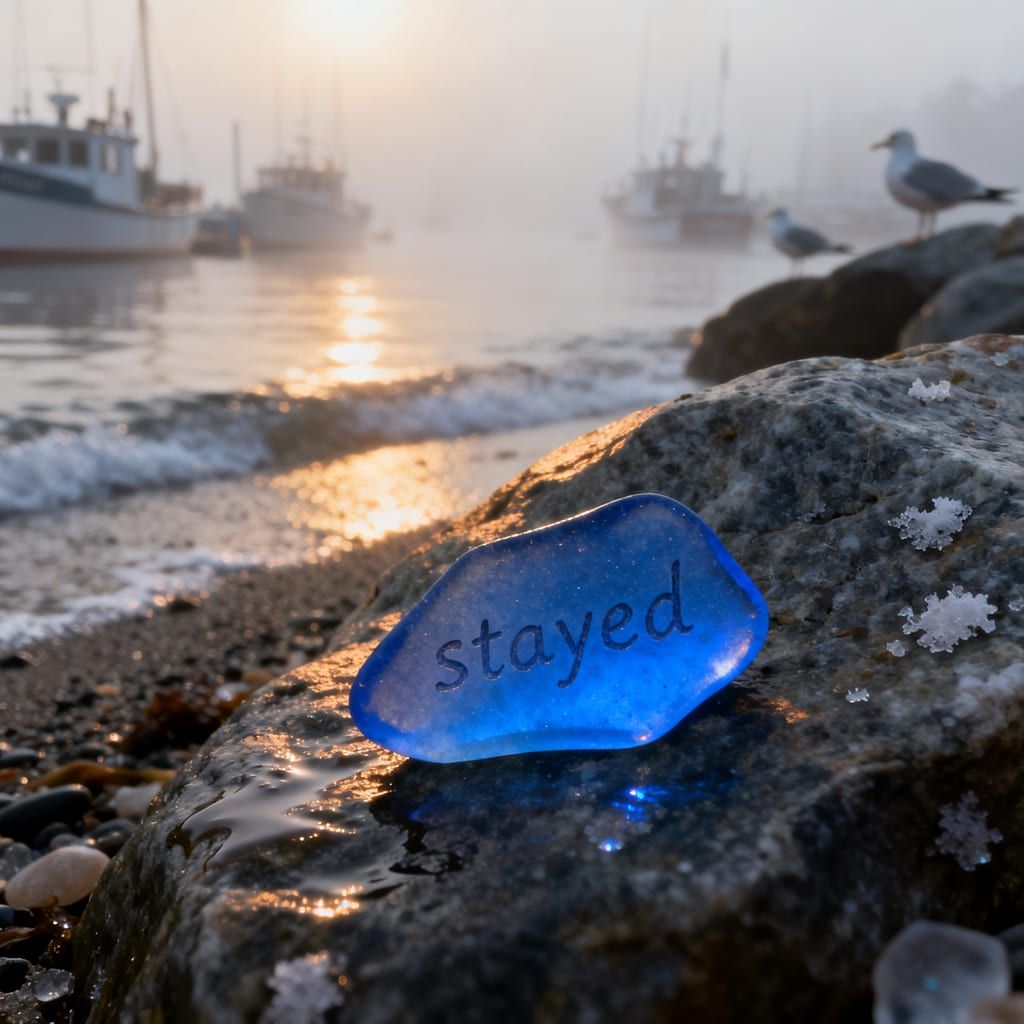
The harbor is a throat clearing itself-gulls rasping, rigging ticking, the faint cough of a diesel engine warming somewhere in the fog. Elena runs its edge until her lungs sting and her thoughts fall into cadence with the slap of her shoes.
She slows where the sand turns pebbled and the tide leaves its gloss. It's her private cooldown, this hunt among kelp knots and bottle caps-proof that broken can become beautiful if it's tumbled long enough. She palms browns and greens, the common tones, and tucks a pale lavender into the pocket of her windbreaker like a secret.
Her fingers graze something brighter. Cobalt, rare as a good apology.
She lifts the shard, still wet. Its edges are worn to silk. At a certain tilt the surface catches a filament of dawn and a word appears, thin as a breath on a mirror: stayed.
The word needles past her glove.
Elena presses the shard to her palm as if it might warm. Thirty-six, still sleeping on the coast when she's already said she'd be inland by now, already told a hiring manager she just needed a week to decide. As if time lives obediently on a calendar.
She angles the glass again. Stayed. What the dogged do. What cowards do. What people write into their bones like a vow, or a trap.
By the café, the regulars are arguing about clams through their scarves. Elena sips a paper cup of coffee outside and props the shard against the lid to take a photo. The cobalt blazes. She opens the beachcombers forum on her phone-username SeaglassPark-and uploads the picture with a caption:
Found at Harbor East. Looks like it's engraved? Anyone seen work like this.
Responses bloom while she's still stretching her calves: nice find!; cobalt, 1950s Bromo bottle maybe; that etching looks hand-done; check with Ruth at Second Wind.
Second Wind is the thrift shop with a sun-faded buoy out front and a bell on the door that rings like a small chapel. Elena finishes the coffee, tucks the shard deeper into her pocket, and takes the long way through streets of clapboard houses going gray at the edges.
She tells herself she's just curious. She tells herself she can run errands forever.
The bell chimes. The shop smells like lemon oil and wool. Afghans folded in happy stacks; bowls made in high school ceramics; a ceramic gull with a crack glued neat down the neck.
"Morning," a voice says from behind a cash register once used to count nickels. The woman has a crown of white hair and hands that look like they've been telling truths to wooden spoons for decades.
"Are you Ruth?" Elena asks, suddenly feeling the salt on her face, her ponytail, every marker of someone who thought she'd be a different kind of person by now.
"I am if you're returning a coat that 'shrunk in the closet.'" The woman smiles. "Or if you're looking for a red mixing bowl with a chip that makes it interesting."
Elena laughs, grateful for the ease. She sets the shard on the counter. It turns the scratched wood ocean-deep. "People on the forum said you might know something about this."
Ruth's eyes arrest. She doesn't reach right away. When she does, her fingertips are tender as if the glass could feel.
"Cobalt," Ruth says softly. "From the harbor. Where did you find it?"
"East side, near the old mooring posts."
Ruth holds it under the shop light, turning it until the word lifts like a bruise to the surface. Stayed. The smile does not return. "I thought the sea took all of that."
"Do you recognize it?" Elena asks.
Ruth sets the shard down and leans both palms on the counter as if bracing for a tide. "My fiancé, Jonah, had a boat with a motor that coughed like a smoker and hands that knew how to fix what coughed. In '76 there was a storm that came up mean. We'd been...we'd said things. I told him if he wanted to go-go. He said maybe he would. The way a man says a thing to see if the room will hold it."
The bell rings again as a couple of teens duck in, laughing. Ruth waits for them to drift to a rack of prom dresses. She lowers her voice, not for secrecy, but for courtesy to ghosts.
"He went down to the harbor in the first fingers of light after the worst of it. Sat on the seawall with that little pocket tool, the one he used to sharpen fishhooks. Pressed words into glass. I watched him from the house, too proud to go. Then I saw him smash the bottle on the rocks. He turned his skiff to help a man whose boat had come loose. He waved to me-like this, just a shape of a hand-and he never came back."
She cups the shard now, and Elena feels she should look away. "People brought casseroles. I kept the curtains open at night, like a lighthouse with no beam. I waited over that sentence I couldn't hold. I thought maybe he wrote something sweet-maybe he chose me. Maybe the sea could translate."
Elena's throat tightens. Stayed. It bears both blessing and ransom.
"I'm sorry," she says.
Ruth breathes in as if to steady a picture frame. "Don't be. We do what we do with what we think we know." Her eyes flick up. "You're shaking. Do you need a chair?"
"I'm fine," Elena lies. "I've been...putting things off. A move. Work. I keep running the same loop." She gestures toward the harbor. "I think I've been waiting for something to tell me yes."
Ruth nods at the glass. "Sometimes what comes back doesn't say yes or no. It says why."
Back home, Elena sets the shard on the windowsill above her sink. The afternoon fog presses soft against the glass. She turns the cobalt in her fingers, catches glimpses of the word, loses it again. She tries to imagine a man on a seawall pressing a pocket tool into a bottle while a storm breathes hot on his neck.
The forum pings. Someone suggests that oil can help reveal engravings. Another recommends backlighting. Elena pours a drop of olive oil into a napkin and rubs the shard in small circles until it wears a sheen like rain.
She holds it against the window where the weak sun pushes through. The letters sharpen. The tiny grooves glean a second line, faint as thread. The words arrange themselves not as what she'd assumed but as what was truly pressed into them.
Stayed-
For the wrong reasons.
The room takes one beat, then two, to exhale. Elena presses the cool glass to her lower lip.
Second Wind is quiet when she returns. Ruth is arranging a row of teacups so their roses all face forward.
"I found more," Elena says. "When it's wet. When you backlight it." She places the shard on a patch of sun that has found the floor. With her thumb, she smears a bit of oil and turns it until the second line rises.
Ruth's eyes flick. Her hand goes to her throat as an old rope might find its cleat. She reads without moving her mouth, then closes her eyes as if she has been given both answer and ache.
"Stayed," Ruth says. "For the wrong reasons." She laughs once, a short sound edged with something like mercy. "I thought the sea kept that for itself."
They sit on two mismatched chairs dragged to the shop window where the harbor is a blurred watercolor. Outside, a gull lands like a letter.
"What were his wrong reasons?" Elena asks, then wishes she could stuff the question back in her pocket. But Ruth doesn't flinch.
"Fear, probably," she says, considering. "Of failing somewhere else. Of making a choice he couldn't undo. Of me being braver than him. Maybe he stayed because leaving would have made him a story he didn't recognize. Maybe he stayed because staying was what the men before him did."
The bell rings. The teens return to buy a jacket. Money changes hands. The world continues in its gentle commerce.
Ruth turns the shard, then hands it back. "Sometimes we tell ourselves we're noble when we're just afraid. And sometimes we tell ourselves we're selfish when we're finally honest." Her eyes are kind but unsparing. "What are your reasons?"
Elena looks at the harbor. At the blur of gray that is home and habit and the particular consolation of gulls swearing at the sky. "I keep thinking if I stay, I'll get braver. But I might just be getting better at explaining why I haven't moved."
"You don't owe the town an answer," Ruth says. "You owe yourself a true one."
That night, Elena puts the shard on her kitchen table and writes a note to the man she used to call home. She doesn't write about blame. She writes that they tried. That comfort can masquerade as love and sometimes love masquerades as fear. She wishes him well without scrolling old messages for proof.
Then she opens her laptop and types the email she's been circling for weeks. She accepts the job inland. The cursor blinks, then the message leaves like a bird that was always meant to.
When she sleeps, her dreams are not of running in circles but of roads shown in long straight segments with trees that thin to fields.
In the morning, Ruth calls. "My granddaughter sent me a video of her school play. She's a squirrel who forgets where she buries things. I've decided to move closer."
Elena laughs, the sound surprised and clean. "That's wonderful."
"I think so." Ruth's voice lifts. "I've had the house above the harbor so long I started to believe it kept me. Turns out, I kept it."
They don't mention the shard. They don't need to hold everything forever.
On Elena's last dawn run, the harbor wears a shawl of mist. The world is tuned to that key between night and day where it is possible to believe in soft deliverances. She runs until her breath braids with the cold and then walks, palms open.
She brings the shard from her pocket and warms it between her hands. Its blue is the exact color of the pill bottles her mother used to line up on the kitchen counter, the ones that taught Elena to count out mornings like obligations. It is also the color of Jonas's skiff in the old newspaper clipping Ruth found in a box, and the ribbon Elena wore in third grade when she wanted to disappear into the summer sky.
She turns it until the words appear. Stayed-for the wrong reasons. The glass holds the confession without dramatics, a sentence made patient by years of waves teaching it how to be read.
A sun-warmed rock waits where tide meets sand. Elena sets the shard there, just above the reach of water, a bright punctuation at the seam of land and sea. She presses her palm flat a last time, not as claim, but as thanks.
She could keep it. But the lesson has settled in her the way the harbor fog settles in the low places-quietly, and everywhere. She leaves the cobalt to light someone else's morning, to tell its sentence again when the angle is right.
Elena runs back along the curve of the bay as the boats begin to chuff and back out of their slips. Her breath evens. The tide is coming in. Or going out. Both are true. She does not need the horizon to promise anything. She knows her reasons, and for now, that is the cleanest kind of weather.
At the bluff road she stops and looks once more at the slice of blue she's left behind. It flashes even from here-small, stubborn, perfectly placed. Then she turns inland, where the map opens like a palm.
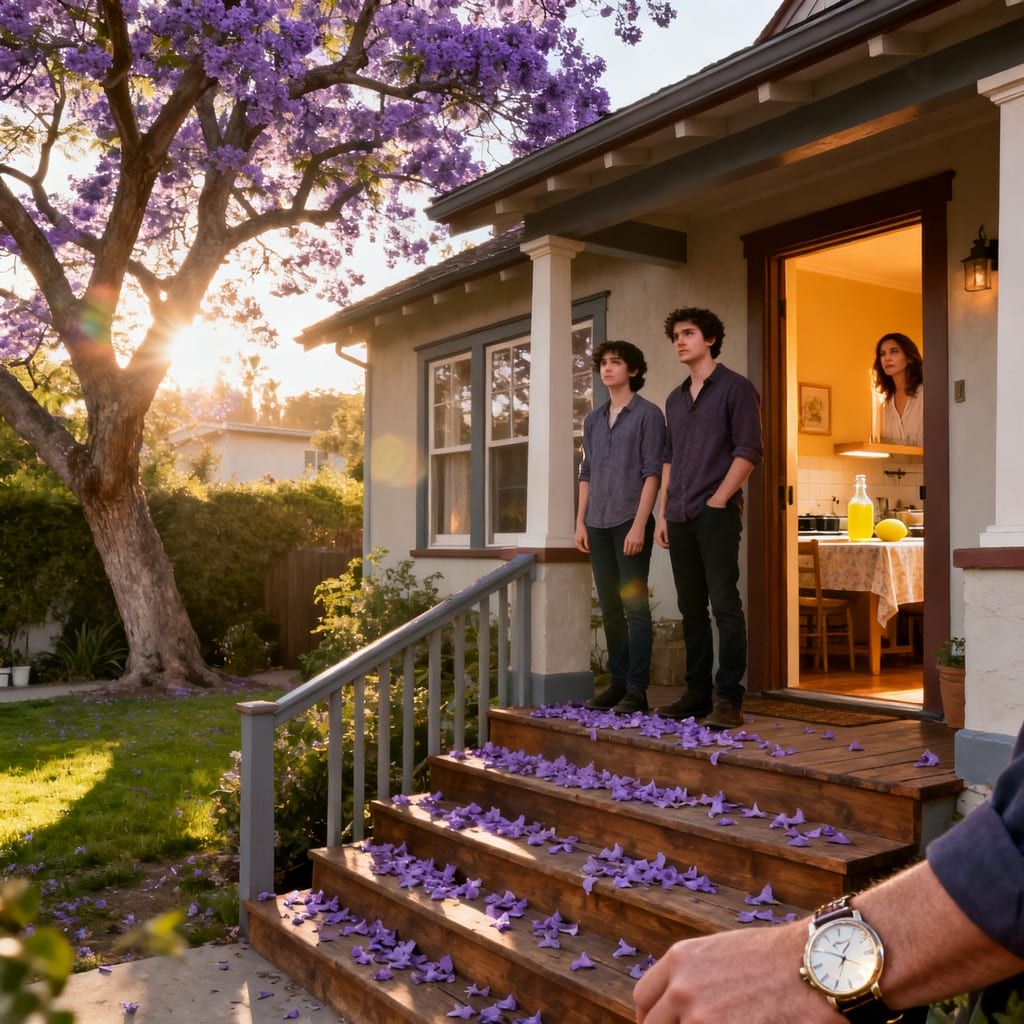
A daughter learns to read between the lines of a life split in two
Read more →
A fog-draped night, two souls found, and the quiet shape of a life
Read more →
Story audiobooks for children of all ages — a new one every day on Smarter Way Stories.