Two Houses and One Quiet Heart
A daughter learns to read between the lines of a life split in two
Read more →
Nora noticed the clatter first-the ice-maker kicking on in the break room like a tired heart-then the ache in the middle of her palm where the space bar had worn a slick dip. Midnight had turned the nonprofit office into an aquarium of blue light. Street noise rose through the old windows and then, like a tide, went out again.
The screen glowed with the bones of a proposal. Inputs, outputs, deliverables. She could make them dance, if she had to. She'd learned where to tuck the ache of a life into a box with a neat label.
She tried a line, deleted it, tried again. Coffee cooled in a paper cup. Her cursor winked its endless dare.
When she typed it, her fingers didn't shake or swell with certainty. It was plain, almost embarrassingly simple: Dignity is not a pilot program.
She should have rolled her eyes. Instead, she felt her breath settle like snow. The words sat there, not spun from cleverness but from the hum she'd been carrying-Yvette's voice on a scratchy Zoom years back, saying they couldn't keep testing compassion like a software update. A voicemail from a client: I'm tired of being a test.
Nora tucked the line into the narrative like a note under a plate. Submitted, exhaled. The funder called two weeks later, buoyant. Full award. Launch date set. Her director did a small victory dance in the hallway and texted balloon emojis.
Then the weeks became lists. The lists bred more lists. Nora fed them with commas and caveats, with budgets that pin-wheeled like carnival rides. Somewhere, a bus was being wrapped in silver.
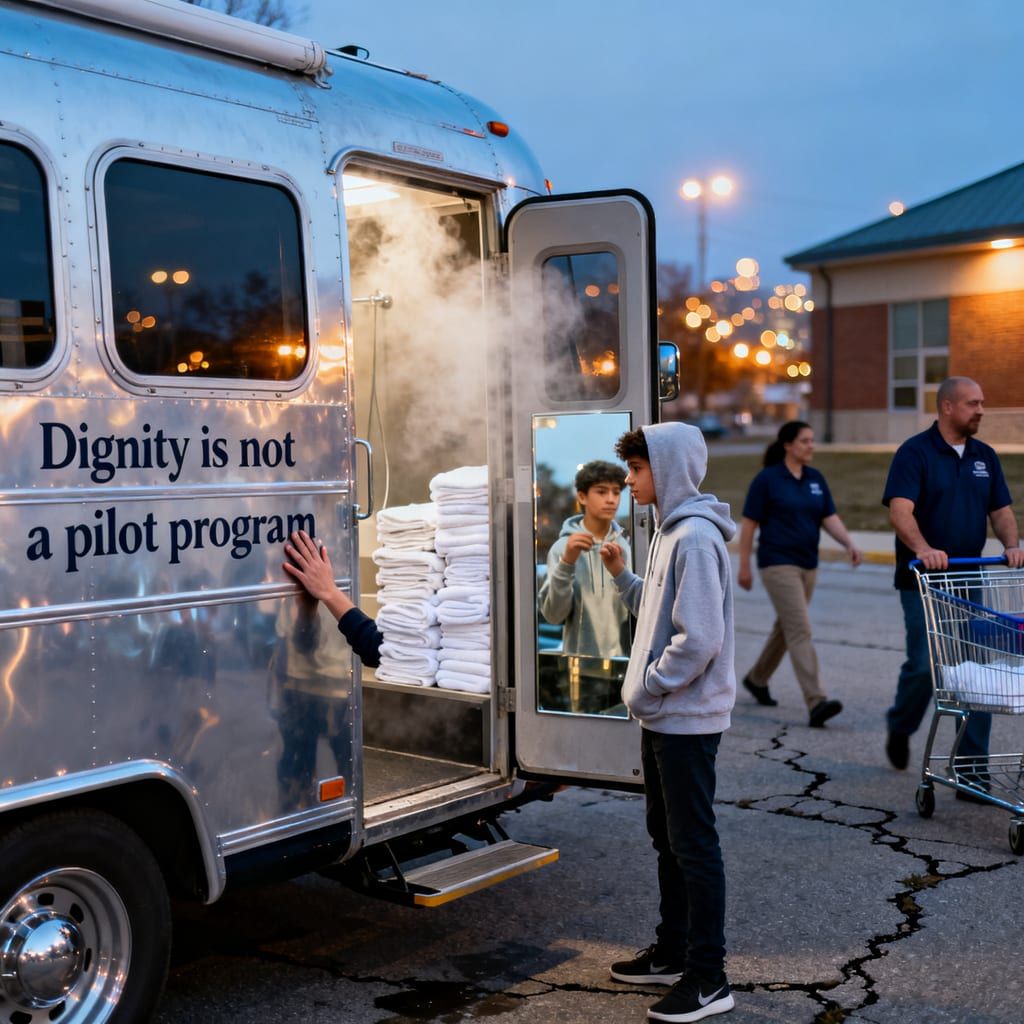
The cc wasn't meant for her. It arrived with the subject line "towels?" followed by a river of gray bubbles and typos and low-lit photos taken with sticky hands. A gleaming flank of metal. A row of white towels folded like gifts on a shelf. Steam coiling out of an open door. Someone had stenciled words along the bus's side. Her words.
She enlarged the photo until the pixels blurred. The sentence curved above a handle, catching daylight like a blade.
She told herself she would only stop by. A drive-by on her lunch hour, a walk around the block before the grant strategy meeting where she was supposed to say scalability without flinching.
But when she stepped onto the cracked asphalt where the bus idled, breath puffing in the Midwest cold, a woman in a navy polo waved her over.
"You're just in time," the woman called, already handing her a clipboard. "Sign-in sheet, then towels in the blue bins. I'm Dev."
"I'm-" Nora started. Not a volunteer. Not really. Her name hung in the air, lowercase.
Dev grinned. "First-timers get the easy fold. Corners to corners. Steam makes them tricky."
Inside, it was meadow-warm. The smell of unscented shampoo and lemon cleaner. Stainless-steel gleam. A radio low with 90s R&B. Water hissed in one stall, then steadied. A man laughed somewhere down the line with the relief of a problem solved.
Nora slipped into the rhythm. The towels were warm as bread. She pressed corners together, slid them into clean stacks. The staff moved like a choreographed blessing-checking names, fetching socks, cutting down a line when a razor dragged.
A man arrived with a shopping cart nested in another, the way grocery carts sometimes do. He parked it so carefully it looked like he was docking a ship. His eyes skipped the line and the intake table and went straight to the side of the bus. He read, lips moving. Reached out and laid his fingers on the sentence like a mezuzah.
He stood that way for a breath. Two. Then nodded, once, to no one. He stepped up and disappeared into the wash of steam.
Nora watched the place where his hand had been. Her face hovered in the metal for a second before steam erased it. The towels kept arriving, soft and faithful. She stayed until her lunch hour shattered against afternoon, until her phone buzzed itself blank with missed calls.
Two days later, a white envelope with her name in ink waited on her swivel chair. Inside, a torn piece of notebook paper, the lines slanted like a hillside.
To the person who wrote the sentence,
He didn't trust help after the factory closed. Didn't trust anything after that if we're being honest. But he came because the bus said what I'd been trying to say on a hundred conference calls nobody heard. He said, "Whoever wrote that, they were listening."
-Yvette
Nora read it twice without breathing. The Y. The long tail of the t. She could see Yvette at twenty-six in the cubicle sea, headset tilted, shoulders hunched against the word metrics like rain. Yvette who'd trained under Nora and burned out in a single, blinding year. Yvette who'd been told compassion didn't have measurable KPIs.
The sentence wasn't hers alone. It was a distillation, an echo. It had walked in the door wearing other people's shoes.
Nora set the note on her desk, then picked it up again. The paper had been folded hard. The crease looked like a scar.
She started bringing her laptop to the bus. Sat on a plastic chair near the hum of the washers, where the floor vibrated like a purr. She wrote between loads, between razor refills, between a man in an army jacket asking if anyone had extra lotion and another offering his seat to a woman with a cane.
On a day the city smelled like wet pennies, she wrote on a curb, listening to the rain tattoo the shelter roof. Kids thundered past in cleats, their shouts snagging in the chain-link. In a rec center hallway that smelled like oranges and sweat, she revised a needs statement while a staffer taped up a flier for a GED class.
Sentences arrived as annotations of the real. Not We will restore dignity to X clients per quarter, but the way a woman in a bathrobe folded her old shirt and set it on her lap, palms flat, like she was thanking it for service. Not Evidence-based engagement strategies, but Dev crouched to eye-level with a man whose socks had outlived three winters, saying, "We'll get you there."
The proposals read differently. Not softer-more legible. Money began to move toward the places where heat gathered. It was as if funders had been trying to read in a dark room and someone turned on a lamp.
The bus added evening hours. Teenagers came after practice, hairlines edged clean. A second route spun up along the river, where tents freckled the tree line. Nora built the budget by hand, line by line, as if it were a recipe her grandmother would have trusted.
At a community gathering under a mural of corn taller than people, Nora spotted a woman near the coffee urns whose laugh lifted the air. Yvette looked older the way everyone did now-more light in the eyes, more weather at the edges.
"You got my note," Yvette said, no question in it.
Nora nodded. "I...I think I borrowed your sentence without knowing."
Yvette shrugged. "We all do. We hand them to each other. We're just lucky when someone writes it down before it blows away."
They stood shoulder to shoulder and watched a kid in a fresh hoodie tug at his sleeves like a magician warming up. He squinted at a flier, mouthing the words, and then read aloud to the cluster around him. When he reached the line stenciled on the bus, his voice slowed. He looked at his reflection in the polished metal, running his palm over his head where the clippers had drawn a new border between boy and young man.
He smiled at himself first. Then at the sentence.
Yvette's father lingered near the intake table, chatting with Dev about the brick factory that used to smell like bread. His shopping cart was gone. He held a reusable tote someone had given him, the kind with a pineapple in sunglasses. He slapped the side of the tote with affection and said, to no one in particular, "They mean it."
Back at her desk, Nora rearranged her ritual. No more writing from the map. She would visit the terrain. She started pinning small things above her monitor-a dryer lint heart someone had laughed about, a wrapper from the lemon candies Dev kept under the intake desk for nervous hands, a note in a looping hand that just said Thank you for the hot water, never thought I'd cry about it.
When she opened a blank document now, she could hear the washers. Feel the radiant heat of the bus's side. Smell soap and rain. The boxes on the page didn't disappear-they housed something warm.
When the foundation asked for a case study, she sent a story that started with a kid tracing his reflection on chrome. When a corporate partner needed impact statements, she gave them lines you could hold: 1,476 showers, 1,476 times a person stepped back into the world rinsed and a little lighter. For sustainability, she wrote about the second route that now stopped by the library on Tuesdays and the laundromat at Seventh and Pine on Thursdays, where the owner started leaving the lights on late and the radio tuned to Motown.
Sometimes the words were ordinary and sometimes they were the only bridge between No and Yes. She was not, she knew now, in the business of miracles. She was in the business of arranging the furniture so a miracle might want to come in and sit awhile.
On a dusk that made the city purple at the seams, Nora walked the length of the silver bus with a roll of blue painter's tape pressed against her hip. A new stencil waited in its sleeve, cut from card stock and hope. She taped it straight with Dev squinting and Yvette making the kind of commentary that kept them honest.
The kid with the clean hoodie held the spray can like a chalice. Dev guided his hand. They painted the letters slow, letting the silver show through in the thin parts like veins. When they peeled off the stencil, the words looked less like an announcement and more like something that had grown there.
Later, when the first wind lifted the scent of damp metal and detergent, a man paused, read, and nodded to himself. Just once. As if agreeing with an old friend.
Nora stood far enough away to take it all in-the bus, the people in small constellations around it, the towels like clouds waiting to be folded, the sentence catching the last streaks of light. She didn't think about indicators or dashboards. She thought about the way words could lay a hand on a shoulder, could say I see you without bragging about it.
Tomorrow there would be a meeting and an ask and another spreadsheet that did its obedient math. Tonight, there was the echo of water on metal. The outline of a girl's grin in the bus's reflection. Yvette leaning against the bumper, arms crossed, looking pleased and private.
Nora slipped her hands into her coat pockets and let the warmth from the bus seep through wool. The sentence wasn't hers. It never had been. It belonged to the hands that touched it before stepping in. It belonged to the daughter who mailed a note that turned a clever line into a compass.
She walked back toward the office with steam still tucked under her collar, already composing-not from above, but beside. The city said goodnight in its small ways: a siren far off, a window closing, a bakery tossing tomorrow's dough to thaw. When she sat down to write, the words came carrying the weight of being used, the shine of being true, and the soft, practical heat of a towel folded just right.
A daughter learns to read between the lines of a life split in two
Read more →
A fog-draped night, two souls found, and the quiet shape of a life
Read more →
Story audiobooks for children of all ages — a new one every day on Smarter Way Stories.