Two Houses and One Quiet Heart
A daughter learns to read between the lines of a life split in two
Read more →
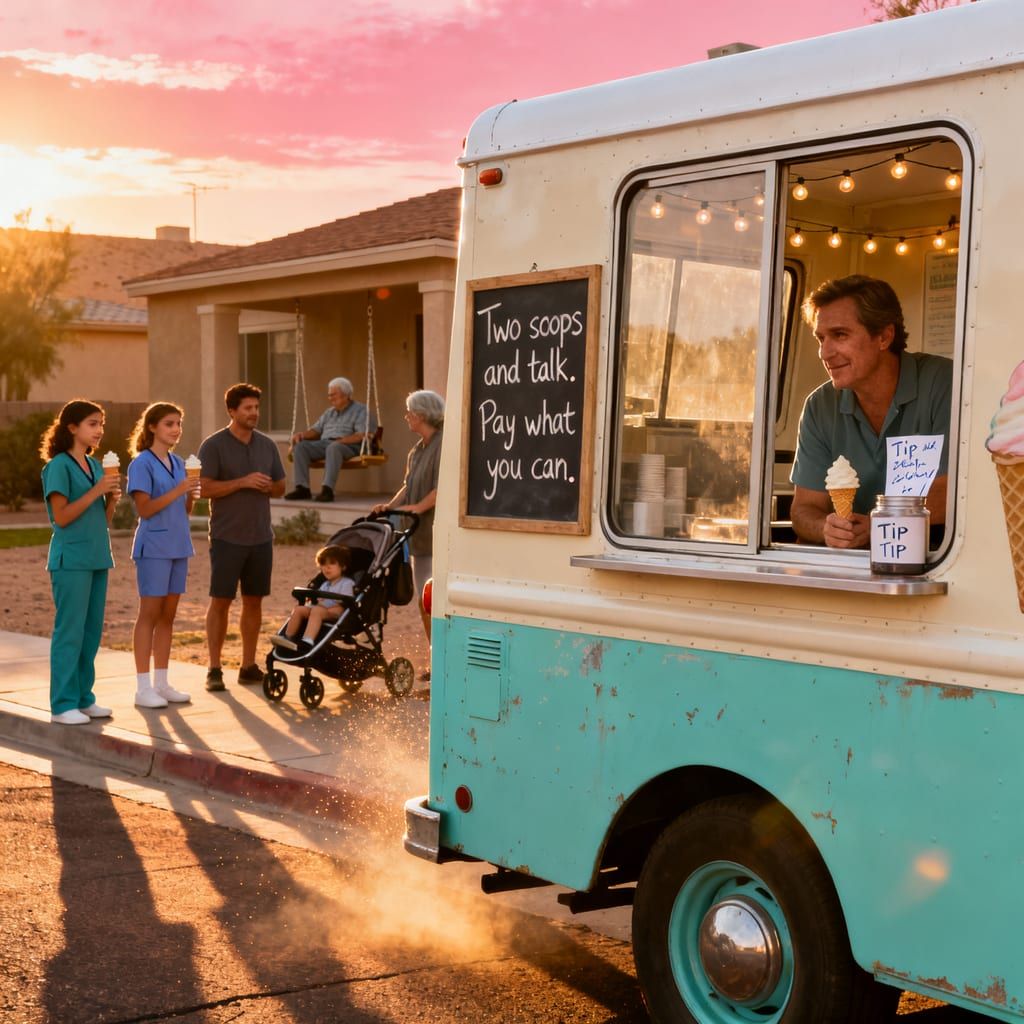
The first night I turn the key, the jingle comes out too bright, like laughter at a funeral. I flinch. It's barely six, the Phoenix heat still thumb-pressing the air, and yet the sky is already practicing amber.
The truck is the color of a swimming pool from the seventies-faded turquoise with a white roof and a bald spot where my uncle's old antenna used to be. His cologne has long since seeped into the metal. Lemon oil. Motor oil. Ghost oil. I wipe the serving window with my forearm and chalk on the menu beneath Bomb Pops and toasted coconut bars: Two scoops and talk. Pay what you can.
The first to test me are children sticky with sidewalk and bargaining. A boy with a Spiderman Band-Aid trades a holographic dinosaur sticker for extra sprinkles. A girl argues earnestly, spoon raised like a gavel, that rainbow sherbet is a fruit group because it's "orange." I nod like this is case law. I am out of napkins within an hour.
Teenagers come after, moving in a looser constellation, pretending not to have been children ten minutes ago. "What flavor matches your week?" I ask a girl with chipped black nail polish.
She rolls her eyes, then says, almost to herself, "Probably pistachio. It looks sweet but it's... not." She pays with lint-covered quarters and the dignity of someone who has named something out loud for the first time.
The adults hang back until the line thins, watching me from the shadow of carports, from the cradle of their porches. They don't put their elbows on the ledge until the sun has loosened its grip.
A rideshare driver rehearses the sentence he'll say at a custody hearing, breath fogging the glass even in this heat. An ICU nurse buys a bomb pop and asks if she can use the hand sanitizer I keep by the register, then dips into it again, again, until her skin flashes raw. A new mother-hair shoved into a defiant knot-leans into the bell's music and cries because her baby won't nap unless that jingle is near. She stands with the stroller's brake on and nods to the rhythm. "Vanilla," she says. "No-mango. Mango tastes like... naps you didn't think you'd get."
I don't fix. I scoop. I listen. Sometimes I ask, "What flavor matches your week?" and watch people sift through their own storms to find the taste.
A tip jar appears overnight, as if the truck birthed it while I slept-mason glass with a rubber band. A few nights later, a stack of folded notes joins it, bundled tight. When I open the first one, a scratch of blue ink reads: Thank you for being here when the apartment got too quiet.
In the freeze-thaw of evening, the asphalt still radiating yesterday, the truck becomes a moving porch. The bell doesn't announce so much as invite. You can hear it two streets away, a small muscle memory of joy tugging at the corner of your mouth.
The complaint lands in my inbox on a Monday in August, subject line crisp and correct: Noise Violations, Loitering, Unlicensed Counseling. I read it twice, then a third time with a bowl of melted Rocky Road sweating by the keyboard. The address is familiar-the block with the porch swing where a gray-haired man watches me all summer without waving. His eyes have a polished look, like river stones smoothed by time and other people's feet.
I consider quitting. My chest still startles at sirens, even when they're far. I still hear a student's last voicemail-his careful joke, the swallow after-when I turn any key, even this one. Burnout is the neat word I hand to anyone who asks why I left the school. Neat words are sometimes lies folded into clean shirts.
But the driver's seat, scrubbed lemon-clean, fits. It doesn't demand what I can't give. The engine ticks when it cools, like a dog settling at your feet. I find my uncle's old windbreaker in the glove box and drape it over my knees. It smells like the inside of a citrus.
I keep driving.
At the permit hearing, my hands are not hands, they're birds trapped under my skin. My folder of receipts feels like a prop in a play I didn't audition for. I take a seat in the second row to make a quick exit if I can't breathe.
People filter in slowly at first, then in a gentle rush-faces I know only in profile, the angles they make leaning into the truck window. A woman with a baby strapped to her chest rocks without noticing. The rideshare driver wears a tie with a hopeful battle going on inside it. The ICU nurse holds her hands like delicate animals she's afraid of scaring.
When public comment opens, they stand, one by one, and say their names the way you unfold a letter you've carried too long. They talk about a window where they weren't a problem to be solved, but a person with a flavor and a week. Someone says, "I thought I was coming for ice cream, but I came for the moment my own voice didn't sound crazy in the dark."
I'm halfway through squeezing the cap of my water bottle when the gray-haired neighbor rises. He's thinner than he looks from the porch, his collar a little too big for his neck. He introduces himself into the microphone with a certain care: "Dr. Benjamin Kline. Retired therapist." A small ripple moves through the benches like wind over a wheat field.
He admits he filed the complaint the week his wife died. "The jingle," he says, jaw tightening, "made grief ring our doorbell every night. I wanted quiet. Or-I wanted to choose when grief got to visit." He inhales, the kind that rearranges a person's rib cage, then adds, "I was wrong to aim an old pain at a new kindness." He looks at me, not for forgiveness-just to land the plane of his apology.
His voice steadies. "The city might consider a pilot program," he says. "An allowed route for pop-up, peer-led support on public streets. It's not therapy. It's a commons. We need commons."
By the time he sits, my birds have forgotten they are trapped.
That night, I find it while fishing a nickel that slipped under the tray-an old route map, edges softened by palms. My uncle's handwriting loops across neighborhoods like a river. Tiny inky hearts mark certain corners. I recognize them now-where people lingered longest, where conversations went soft around the edges.
At the bottom, a note: Keep the engine gentle; the rest will trust.
I stand in the aisle of the truck, hand on the freezer handle, and let the old and the new stack neatly inside me. My uncle had been listening, too, in his way-trading sugar for story, ding-ding for doorbell. A line connects me to him I hadn't noticed because I thought it was an exhaust line, not a lifeline.
There's a tap at the curb. Dr. Kline stands with two vanilla cones, humidity already slumping the curls. His porch-swing eyes are softer tonight.
"I've been the anonymous caller," he says, thumb worrying the edge of the napkin. "On your voicemail. Practicing apologies to my wife I never said out loud while she was alive. It felt less foolish if I aimed them at a truck."
The bell inside the truck is quiet. We hear crickets trying their best in the scruffy ornamental grass by the sidewalk.
"I'm sorry," I say, useless but true.
He shakes his head once. "Not yours to hold. Would you like to learn how to listen without drowning?" He says it like he's offering to teach me how to thread a needle or prune a rosebush. Ordinary holiness.
Something unclenches at my spine. I laugh, an ugly bark that splits into tears. He hands me a cone and we stand in the kind of silence that is not absence, but presence without demand.
The next evening, I arrive early and chalk a new line beneath the first: Soft Serve + Soft Seats: Fifteen minutes to breathe. I pull two folding stools from the back where the spare tire used to live. I adjust the jingle until it's less carnival, more lullaby a block away.
The heat has learned to be kind by seven-thirty. Moths read the menu like scholars. The first customer is a boy on a scooter who brakes so fast his heel squeals. "What flavor matches your week?" I ask.
"Grape," he says, immediate. "Because I fell off the monkey bars and it made my mouth taste like pennies." His father smiles at me over his head-the tired, grateful kind.
Two teenagers arrive with tongues stained blue from earlier experiments. "Mint matches my week," one admits. "Sharp. But sweet after."
Later, the ICU nurse comes and sits on a stool like it might refuse her. "Last night," she says, "I washed my hands at the sink and cried into the paper towel dispenser. It made the same sound as the bell." She tries to laugh; it comes out as fog. We talk about water-how it leaves and returns and leaves again, how it keeps no score.
A construction worker with dust in the seams of his knuckles buys a creamsicle and tells me about the foreman who calls him "Buddy" in a voice that makes it an insult. A woman in scrubs pulls off her badge and swears she can smell the OR on her skin; I hand her a lemon ice and it's as if she forgives herself a little.
And then, as the last strip of sun knifes between roofs, Dr. Kline slips by without fanfare, perches on a stool, and watches me work. When there's a lull, he leans in. "Notice the breath," he murmurs. "Not to analyze-to land somewhere other than the story. Yours and theirs."
We practice closing the window not as dismissal, but as a boundary with cushions. He shows me how to ask a second question that makes a first answer braver. How to hold my own ribs when a voice on the radio-sirens snapping through the night-tries to shake old ghosts awake.
Between customers, I read another note from the jar. You didn't ask me to be okay. I fold it back and slip it under the band, near the others, like stones circling a small fire.
By week's end, the city sends a notice: temporary pilot approved. Approved routes outlined in pastel on a map that mirrors, oddly, my uncle's hearts. I tack it above the fryer we don't use anymore, next to the photo of him in tube socks holding a rocket pop like a trophy.
On Friday, the rideshare driver returns in a suit that is learning how to be his. "Rocky road," he says, shaking, "but the marshmallows are starting to make sense." The new mother walks beside us, the stroller wheel a little wobbly, the bell rinsing the air just enough for the baby to sleep through a dog barking two houses over.
"What flavor matches your week?" I ask a woman with paint on her cuticles.
She tips her head back, tastes the air. "Toasted coconut," she decides. "Because it's familiar, but it's been somewhere."
The truck hums like a lung. Kids run crooked figure eights on the pavement that used to blister my knees when I fell, once, at eight years old. My uncle's note looks on, looping and sure: Keep the engine gentle; the rest will trust.
When I put the truck in drive, the bell whispers rather than sings. The evening leans in. I recognize this feeling from years ago, before the last voicemail and the brittle quiet that came after: the sense that something simple is making a hole in the wall large enough for air to find us.
I hand a cone to Dr. Kline without asking what flavor he wants-vanilla, the honest kind-and he pays in singles with a tip that is a half-smile. He doesn't need to mentor every inch now. He sits on the curb with the teenagers, knees out like a kid, and tells a story about a sundae he ate in 1969 that tasted like the moon landing.
I steer us along the pilot route, the gentle version of the jingle looping ahead like a string we follow home. On certain corners, people are already waiting, as if some whisper got there before us. They bring with them the week-the ache and the small victory, the grief with a new haircut, the gladness they don't quite trust yet. They let it drip down their wrists. They name it without shame.
And me-I take my seat in the driver's chair, knees under my uncle's jacket, palms on the wheel that has known all our hands. The engine's lull settles under my sternum like a cat. For the first time in a long year, when I turn the key, what I hear isn't a jingle, or a siren, or a voicemail knotted with the last words I couldn't answer.
What I hear is a commons breathing.
A daughter learns to read between the lines of a life split in two
Read more →
A fog-draped night, two souls found, and the quiet shape of a life
Read more →
Story audiobooks for children of all ages — a new one every day on Smarter Way Stories.