Two Houses and One Quiet Heart
A daughter learns to read between the lines of a life split in two
Read more →
Lena julienned carrots like she was trying to make them speak. The knife rasped the board in a soft rhythm, a steadying metronome above the shop downstairs where someone was buying lilies at six on a Friday. Steam nosed the kitchen window and drew a brief, fogged oval on the city-wet pavement like a new coin, a bus sighing, a couple arguing gently about whether to eat before or after the movie.
She stacked bowls along the counter. Bread rounded gold on a thrifted cooling rack. The lentils simmered; she stirred, tasted, salted with the patience of a person hoping courage tastes better with heat.
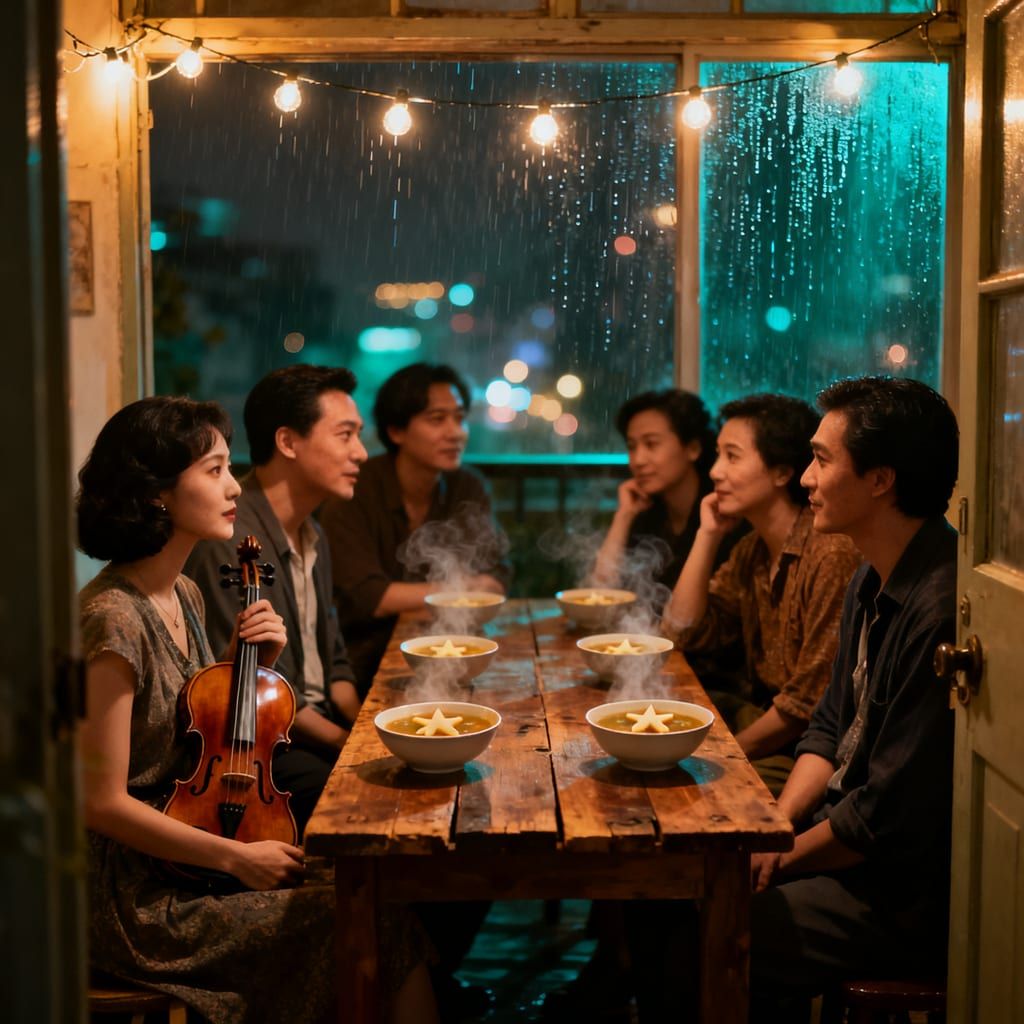
They came in ones and twos, trailing umbrellas and the street's perfume: damp wool, rain, the ghost of cut stems from the florist below. Lena, thirty-three, practical and soft around the eyes, ushered them to the long table she'd built from doors and borrowed legs. Thrifted lights fell in tired arcs overhead. The apartment held the warmth of things that had been repaired.
"I'm Lena. Welcome," she said, palms open as if to catch what might fall.
She didn't ask what anyone did. The rule was on a paper card at each plate, written in her tidy print: no small talk-one true story after the first course. It had sounded, to her, like a dare that wouldn't leave bruises.
A nurse in scrubs rolled to the ankle. A man with hands nicked the way wood teaches. A woman with a violin case she kept on her lap, as if it might wander off. A teacher with a ring ghost on his finger. A guy with startup hair and nervous shoes. A barista whose laugh would later make everyone smile with their shoulders.
"Bread first, then soup," Lena said. "Talk after." And then she tried to disappear into her role-the host, the hinge, the one who kept things open without stepping through.
They ate as if chewing remembered something their bodies had wanted to say. The table listened, wood and legs and light doing their old jobs. After the bowls were set down empty, they each slid one item into the center as if paying tribute to a small god: a child's sock with a hole perfectly thumb-sized; a chipped mug; a tape measure; a dog-eared menu; a metronome; a key with no door.
"One true story," Lena reminded, and then sat with her hands in her lap.
The nurse went first. "I hate hospitals," she started, then winced at her own audacity. "I work in one, but I hate them. The doors at night sound like apologies. I switched to day shifts for the noise. I miss the kids, but I sleep now." Her voice was dry as toast; then it softened. "I sleep now, and that feels like a betrayal."
They passed bread and silence like condiments. The widowed carpenter said, "My wife never let me eat in bed. After she died, I ate cereal under the duvet for a week out of spite, then felt ridiculous and loved. I make tables now that wobble a little on purpose." He tapped the table leg, and it hummed obediently.
The startup founder admitted he was very good at making people click Yes. Not as good at asking for a second date without checking his analytics. The teacher halved sentences like he was grading them. The violinist watched the steam from her soup rise with a look that made Lena think of winter windows.
When it came to Lena, she told a safe story about a wedding she'd planned where the cake collapsed like a sunken ship and how they served it anyway in bowls and called it trifle. Everyone laughed. Her own loneliness remained in the kitchen sink, where she'd left the light off.
They took back their objects only after they'd spoken. It felt like permission earned.
Word traveled in the way a handful of people talking can make a city feel like a porch. They came back the next month with food touched by ghosts. The nurse brought a casserole her grandmother made with potato chips crushed between her strong, ringed hands. The teacher baked biscuits that made him reach for someone who no longer reached back. The barista arrived with a tin of cookies one cookie short-"I got nervous on the train," she confessed, wind-chime laugh proving it.
The violinist set a small jar on the table, amber liquid holding peaches in suspension. "My mother's. I haven't played in months," she said, as if those were related.
A ritual formed without anyone designing it. The center of the table grew heavy with objects before the stories loosened: a receipt for dry cleaning from a month that ended badly; a subway token; a postcard never mailed. They touched the edges of grief and then their hands found each other in the passing of plates, the slow, ordinary benediction of feeding.
Lena watched from within and without. She kept the wine at the level that made people generous but not brave enough to shatter. She told herself she was building a room where everything stayed at arm's length and close enough to warm the skin.
In the third month, someone sent Lena a link to a local forum. A thread: The Supper Club of Quiet Hearts-loneliness circus? The words pricked like nettles. Anonymous, it said: curated pain, an art installation of ache. People baring themselves for... what? The high of confession, the low of Monday morning like a rung you miss in the dark.
A week later, two chairs sat empty like missing teeth. Another canceled with a text that tried too hard to smile. Lena arranged napkins in small, precise stacks, furious at a phrase she couldn't put in the dishwasher.
She considered shutting it down, rearranging her Friday nights into something with less pulse. But when she turned off the lights, the apartment looked like a mouth closing against a spoon. She turned them back on.
On a rain-polished night, Lena added a twist. She wrote it on the same paper cards: bring a recipe you've only eaten alone.
They came with Ziplocs and shame and the kind of giddy you feel when a rule gives you a reason to be tender with yourself. The nurse brought cinnamon on cereal and shrugged like it was ridiculous, then brightened when someone else said, "I do that with bananas." The teacher presented rice with butter and salt in a bowl with a chip that was a continent. The barista plated instant noodles dressed like a festival-scallions sliced on the bias, a soft egg slipping toward yes.
Arturo-the carpenter, his name rolled warm in the mouth-set down toast with tomato rubbed raw and olive oil like sunlight. He cleared his throat. Rain was ticking the window, the cheap string lights humming their bug-song. He pulled a crumpled printout from his back pocket and, with the stubborn courage of a person who builds things to last, read aloud the anonymous review.
The room bristled as if someone had opened the window without asking. The violinist's hands tightened on her jar. The startup founder sat straighter, a defense algorithm searching for targets.
"I wrote it," Arturo said, voice low and even. "Because I was afraid this was performance. That we'd cook our sadness in pretty pots and go home and starve. That I'd be the only one who came back in five years to find this door locked."
Someone exhaled a hey that was not quite a reprimand. Someone else reached for the salt as if to keep their hands busy while deciding what to think.
Lena felt heat climb her neck like embarrassment or a fever. Her instinct was to smile and smooth. Instead, she wiped her palms on her apron and didn't reach for a joke.
"I started this," she said, and her voice surprised her by being steady, "so I wouldn't have to call what happened to me being alone. I was with someone for years. We broke, and I kept setting one plate and calling it a phase. I thought if I fed other people, I could be the person with the spoons instead of the person without a chair."
She waited for the room to crumple. It didn't. The rain kept its small applause. Arturo stared at the grain of the table as if reading a map.
"I'm sorry," he said, the two words carrying the weight of sandbags. "I didn't know how to stay unless I pretended I didn't care if I left."
"Then stay," the barista said, laughter tucked back like a hairpin. "Eat your toast. Pass me your ridiculous olive oil."
Something in the room exhaled. Not forgiveness, exactly. A truce made of soup and rain.
After that, the club didn't dissolve. It thickened like a stew left to find itself.
The startup founder-Kiran-admitted he ran a dating app and hadn't turned his phone off during dinner in years. He laid the phone in the center among the keepsakes, screen down, the small rectangle suddenly a kind of sacrament.
The nurse-Marisol-said she switched departments because the pediatric ward doors at night had started to sound like promises she couldn't keep. "They hiss. They breathe," she said, and everyone at the table could hear it.
The teacher, Nate, confessed he'd stopped going to the farmers market because a woman there always offered him half an apple and he couldn't bear the luck of that. "I want it to be me," he said, "not the sample." He found himself laughing at his own metaphor, and then he didn't, and both seemed right.
The violinist, Irena, undid the case latches as if they were cuffs. She lifted the instrument, the varnish catching light like honey. She didn't tune. She put bow to string with the care of someone touching her own skin for the first time after being sick.
She played-not a song, exactly. Notes like lanterns. The room held its breath. The hum of the string lights braided with the rain; somewhere downstairs, someone rang a bell for lilies, and the note climbed the stairs and tucked itself under the melody.
Lena leaned against the counter, fingertips thawed by the soup she kept ladling. She thought, So this is what it is to host something that hosts you back.
Later, in a thrift store with bad lighting and better prices, Lena pulled a cracked-spined cookbook from a crate marked 2 dollars. A card fell out and skated across the linoleum. She knelt and picked it up.
The handwriting was the neat, leaning script her abuela used to label freezer bags and birthdays. Sopa de estrellas. Star pasta. Chicken stock, onion, a tomato charred on the stove and peeled with the patience of someone teaching a child to say please. Cumin, a pinch. Cilantro if you had it, which they often did not. At the bottom: Para cuando el corazón quiere algo suave-For when the heart wants something soft.
Lena stood very still between a box of mason jar lids and a stack of romance novels. The city kept going without her. She pressed the card to her chest and tasted, suddenly, the not-quite-salted-enough stars from summers when her knees were always scabbed.
The next club night, she cooked it. The pot steamed like a good secret. She set the bowls down and said nothing about the card until someone inevitably asked.
"Found it," she said, fingers splayed on the table. "Or it found me." She told them about her abuela's kitchen-plastic tablecloth, saints on the fridge, a fan that clicked every third swing. How sometimes the soup came when you did not deserve it; how sometimes that was the point.
They ate, the tiny stars sliding onto spoons like constellations you could swallow. The conversation narrowed to the quiet kind that wraps you without stitching you in. Kiran's phone remained in the center. Marisol's laugh-wind through glass beads-made Arturo look up and smile with his eyes.
People began to ask, midweek, if there would be leftovers. The table learned the arms of familiar elbows. Chairs scraped in the same music. Mementos returned again and again like tides: the metronome, the unmailed postcard, a new addition-ticket stubs from films someone watched alone and now wanted to talk about as if they had company in the dark retroactively.
Lena noticed how often plates came back scraped clean and thought of her first year eating above the florist, pretending a half-plate meant she wasn't hungry for anything particular. She looked at the people around the table, at their odd tendernesses and well-told hurts, and felt the shy bloom of recognition.
On a night when the rain stayed away and the city's windows looked like sequins, they lingered with tea and the last of the peaches. Arturo fixed the wobble in a chair and left it a whisper crooked anyway. Irena set her bow back in its sleep. Kiran's phone stayed where he'd left it until he forgot to pick it up and someone tucked it into a napkin like bread for tomorrow.
Lena stacked bowls in her sink. She did not turn off the light. The florist downstairs banged metal into place. Someone started playing music two buildings over, faint brass like a parade far from home.
She stood in the doorway to the room she'd made with these people and thought of hunger-the old kind with edges, the new kind with names. It made neighbors of them, not matches. The table held the imprint of their wrists.
Outside, the bus sighed. Upstairs, the lights trembled then steadied.
They would come back. The stars would soften in broth. The door would open, and the first thing you'd smell would be onions learning how to be sweet.
A daughter learns to read between the lines of a life split in two
Read more →
A fog-draped night, two souls found, and the quiet shape of a life
Read more →
Story audiobooks for children of all ages — a new one every day on Smarter Way Stories.