We Move Slow Enough to Stay
On a hospital rooftop, a class learns a new kind of balance
Read more →
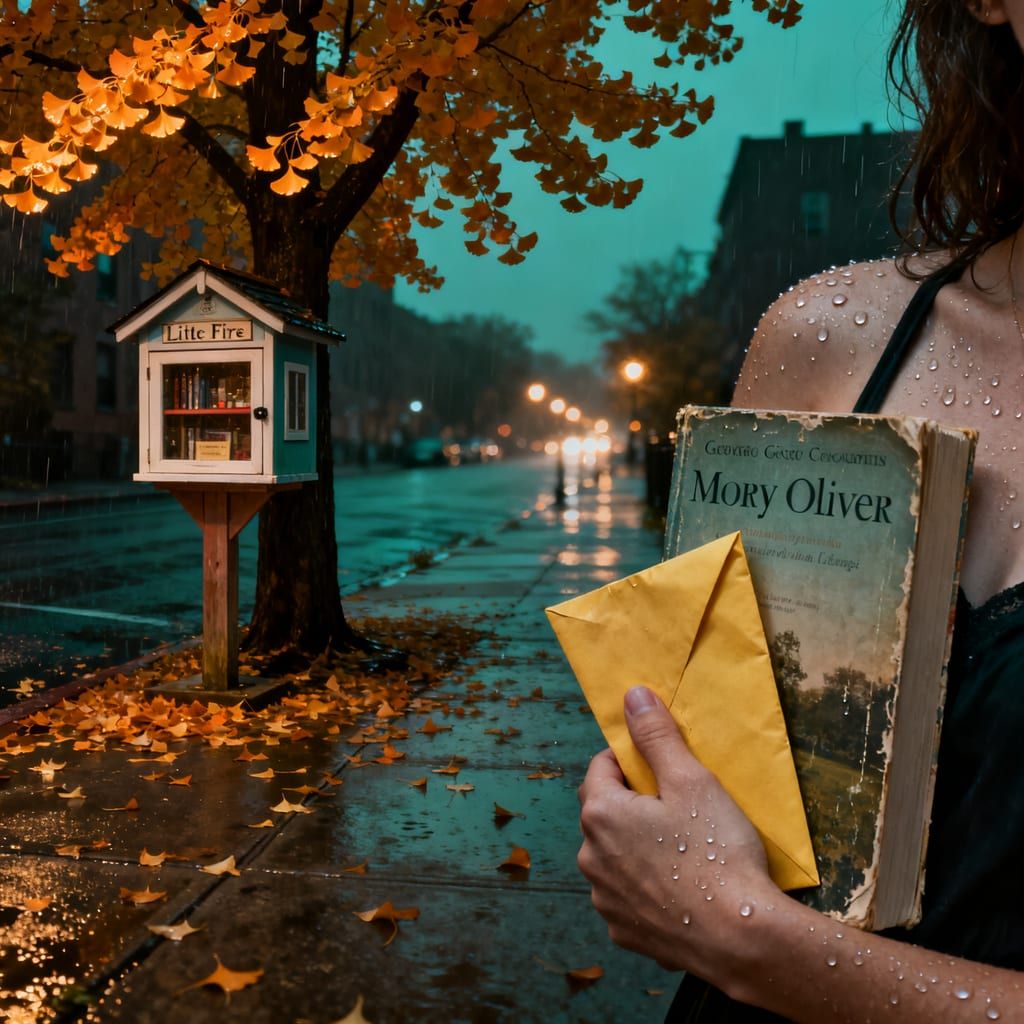
Rain glassed the window and hummed against the fire escape, a stubborn, silver drumming that made the whole room feel underwater. Neha knelt beside the last box, cutting through packing tape with the serrated key fob from a bank she no longer used.
In the muddle of cables and ticket stubs and dead pens, something thin slid loose and fell like a leaf. A yellowed envelope-rubbed soft at the corners, stamped with a college bookstore's return address she hadn't thought about in years.
She held it. It was lighter than she expected.
Her old backpack sagged open on the rug, canvas bleached at the seams, the ghost of Sharpie doodles still dimly there. The envelope had lodged in an inner pocket, the one where she used to stuff loose change and bus receipts and gum. Her name was on the front in looping script. A rush went through her like stepping into too-cold water.
She eased the flap up. The paper inside had browned in the creases. The handwriting was long and slanted, impatient, a version of herself she could feel in the wrist.
By the time she reached the third line-I am tired and I don't see my way out-the room pivoted. The old radiator pinged, a car down on the block honked bright and silly, and she stood in the center of it with a decade looking at her.
She lowered to the floor. Her knees ached-she'd started running again this past year, and her body objected-but the ache steadied her. Rain combed the city's hair.
She read. Every sentence cataloged a night she could not fully call back, invented again by language: the rent due; the joke she laughed at in the hallway though it wasn't funny; how heavy the subway turnstile felt; the isolating arithmetic of debt and disappointment. The letter traced a path to an exit, final and absolute. A signature at the bottom, a younger Neha's neat, terrified name.
Oddly, her chest did not cave. The steadiness came like sitting on a dock and feeling the planks hold when the boat rocks. She was here. Thirty-two. Divorced, yes; raw, yes; some nights full of a quiet that swallowed the air. But she was also a woman who knew which neighbor's radiator hissed all afternoon and who at work liked their coffee like tar and who on her block wore evening lipstick and smiled at dogs. That had not been true then. Or maybe it had and she could not yet see it.
She slid the paper back into its thin skin, then held it again to the light, as though the page might confess where, exactly, she had pivoted away from the edge.
Memory didn't pour in; it stitched in. A seam here, a seam there. She saw the cafe near Myrtle-chipped turquoise mugs, a chalkboard with lopsided ferns. The barista with blunt-cut bangs and a tattoo of a paper crane on her wrist. The barista had slid a cup toward her, steam curling.
"Chamomile," she'd said, like it explained something. "Rough day?" One eyebrow lifted, not fishing, just hanging a small lantern between them. Neha had wrapped her hands around the warmth because-what else did hands do in a storm?
She saw the entrance to the Myrtle-Willoughby station, a slick of rain making the steps look like piano keys. A busker tucked under the scaffolding, his guitar varnished to a weary shine. He played a melody so simple it almost wasn't. Her mother used to hum it when she was washing dal, wooden spoon tapping the rim of the pot like a metronome. Ba, ba, ba- three notes. In the memory, Neha's throat did the small, involuntary swallow that comes before a person weeps or sings.
Up in the hallway of her old building, she waited for the elevator that always carried the scent of someone's dinner-garlic, cumin, onions that snagged in her hair. The neighbor's door opened and a baby, chubby and damp-cheeked from a bath, laughed-a bright, gummy chuckle that made even the building's brittle fluorescent light feel generous. The mother nodded, tired and kind. Neha had smiled back with the strange panic of someone who doesn't know if smiling counts as a reason.
Ten minutes. Thirty. A kettle on, the letter begun, paused, the ink smudged where her hand had pressed too long. Somehow she had not mailed it. She had folded it, slid it into a pocket, and lived.
She sat back against the wall now and exhaled into her palms. The smell of cardboard and rain filled her mouth. The divorce had been a clean rip and then a messy one. Papers filed, assets split, the small grief of unpairing forks. He had wanted silence; she had given it to him. She had been good at withdrawal-she could track that curve back ten years and further.
But the page in her lap felt like a thread thrown backward through time, taut enough that she could test it with her thumb. Someone had held it at the other end. Or many someones-unwitting, unknowing, a net made of other people's clean cups and broken songs and babies' laughs.
She didn't throw the envelope away. She laid it on the kitchen table she hadn't had a chance to sell yet, beside a bowl of underripe pears and a roll of painter's tape. The steam from the radiator made a small shiver of the paper.
She brewed tea-the same chamomile, because apparently she was a person who believed in symmetry-and found a pen that still worked. On the back of the old letter, she wrote slowly, the black ink like a road stitching south.
To whoever finds this, if anyone does. To the next night like a closed door. To me.
She did not write triumph into it. She wrote about the busker's three-note song and the smell of rain-wet coats in a train car and the way the baby in 3B had laughed from somewhere that had never learned the word debt. She wrote that time had made a space where her chest used to be crowded. That she had become a person who understood the slope of morning light across her own pillow, the precise way her courage arrived-not as a shout but as a chair pulled out and held for her to sit.
She wrote, simply: I am here. You might be, too. If you can, let the night pass you like weather. Someone once put a warm cup in my hands without asking for the story. I will try to do the same.
She tucked the letter back into its brittle home and slid the envelope into a battered paperback of Mary Oliver poems that had survived three apartments and one failed houseplant. The spine creaked, agreeable. On the first page, in pencil she'd written, years ago: Keep what is beautiful. It felt, this minute, like instruction.
Two blocks over, under a gingko that littered the sidewalk with fan-shaped leaves, the Little Free Library stood like a dollhouse for the literate. Its glass door stuck; it always did. She shouldered it open and placed the book in the center, between a thriller with an untrustworthy wife and a paperback Bible swollen by some past rain.
A woman passing with a sodden dog glanced at her, then at the small box, then at the sky. "At least it's honest," the woman said, nodding at the rain.
Neha laughed, a sound that surprised her by being light. "Does its best."
She closed the library door, watched her faint reflection in the rippled glass-a woman with rain-beaded hair, mascara reliable against the weather, shoulders set. She turned toward home and, on purpose, slowed her steps. The block smelled like petrichor and burnt toast and the metallic tang of someone's bicycle chain.
Back in the emptying apartment, the walls echoed. She worked her way through the last box-vases wrapped in newsprint, a bowl shaped like a mango leaf her aunt had insisted she bring back from Delhi. When the hunger hit, she ordered chana masala and ate it from the container, standing by the window, watching people blur under umbrellas.
The evening sloped. She texted a coworker she mostly nodded to in the break room-a quiet engineer named Luis who wore novelty socks with planets on them. Thinking of you-hope the sprint isn't breaking you. Here if you want a second pair of eyes.
He responded with a surprised emoji and, a minute later: Ha. It might be. Thank you. Coffee on me next week?
She set a small plant outside her neighbor's door with a note: For your window. It likes morning light. She wrote to her mother, not about the divorce precisely, but about the soup she was making tomorrow and whether black cardamom or green would taste best with mushrooms. The replies came back like pinged sonar-little pips in the dark.
The days that followed arranged themselves into a new kind of scaffolding. She complimented the woman in the 99-cent store on her magenta headscarf and was rewarded with a grin that showed a molar capped in gold. She brought samosas to the woman on her floor who had just had surgery, listening while hospital stories unspooled in that patient, molasses way pain speaks.
At work, she looked up more. How many glances had she let fall straight to her shoes all these years? She caught the intern's hand fumble over the Figma tools and leaned in, not to rescue but to witness. "Margin helps," she said, and the intern's shoulders fell an inch.
She noticed where habit had told her to withdraw and, instead, left the door to conversation propped open with something trivial and true. Nice boots. I miss summer. That song always makes me want to buy a train ticket. Each was nothing. Together they made a ledge.
At night, she ran in the drizzle along the promenade, the bridge raffled with light. She thought of the younger version of herself who had written in looping terror, and she let herself feel protective without feeling ashamed. She felt how often she'd wanted someone to steady the buzzing of her thoughts, to map the exit on a napkin, to press a warm thing into her hands until her fingers remembered how to unclench.
She slept with the window cracked so the rain could come in honest.
Weeks later, on a Saturday that smelled like frying plantains from somewhere down the block, she passed the Little Free Library with a tote of paperbacks slung against her hip. The gingko had dropped its last leaves; the sidewalk was an amber fan carpet.
Inside the box, the Mary Oliver was gone. In its place, tucked like a bird's note under the lip of the shelf, a scrap of lined paper waited with its own ink road.
She eased it free. The handwriting was cramped, decisive. If you left this, thank you. I chose to stay another day. -A.
She stood on the sidewalk with the scrap balanced in her palm like it might bolt. Her throat tightened the way it had on that old night, before the barista slid the cup toward her. The city moved around her-horns, wheels hissing wet, someone somewhere on a second-floor fire escape coughing into the air. A little boy clattered past on a scooter, one shoelace serpentine behind him. Life did not slow down to applaud; it never did. But the seam of her own life shifted under her, a piece fitted into place with a soft click she could feel in her bones.
She didn't know A. She likely never would. It didn't matter. The net had caught again, between strangers, made of the flimsy, stubborn stuff of human errands and accidents. You threw a thread, and somewhere a hand, unknowing, held.
That evening she walked back to her shaky, generous apartment and boiled potatoes and peas with cumin, the air warm with steam. She texted Luis a meme about space socks. She emailed her cousin in Mumbai a photo of the gingko carpet and received a row of astonished heart emojis in return.
After dinner, she took out a clean sheet of paper. She wrote the date at the top and nothing else for a while. The room held still around the sound of rain. Across the page, the words took shape without rushing, like a city seen from a train: lines, pauses, light in windows.
Dear A, she began. Me too.
She didn't know yet where she would leave this one. Maybe it would live in her drawer for a while, patient as a seed. Maybe it would travel folded into the back of a book to a new pair of hands. She liked that either was possible.
Before bed, she stood by the window and pressed her palm to the cool glass, feeling the weather on the other side press back. She thought of the envelope's thin weight, the decade between, the laugh that had rung like a bell in the fluorescent hall. In the glass, her reflection layered the city over her own face-lamp, moon, a stranger shaking out a newspaper across the street.
She lifted her hand. Rain sounded like applause and like nothing at all.
And in the quiet after, she heard-faint and certain-the three-note line of a song.

A daughter learns to read between the lines of a life split in two
Read more →
A fog-draped night, two souls found, and the quiet shape of a life
Read more →Story audiobooks for children of all ages — a new one every day on Smarter Way Stories.