Two Houses and One Quiet Heart
A daughter learns to read between the lines of a life split in two
Read more →
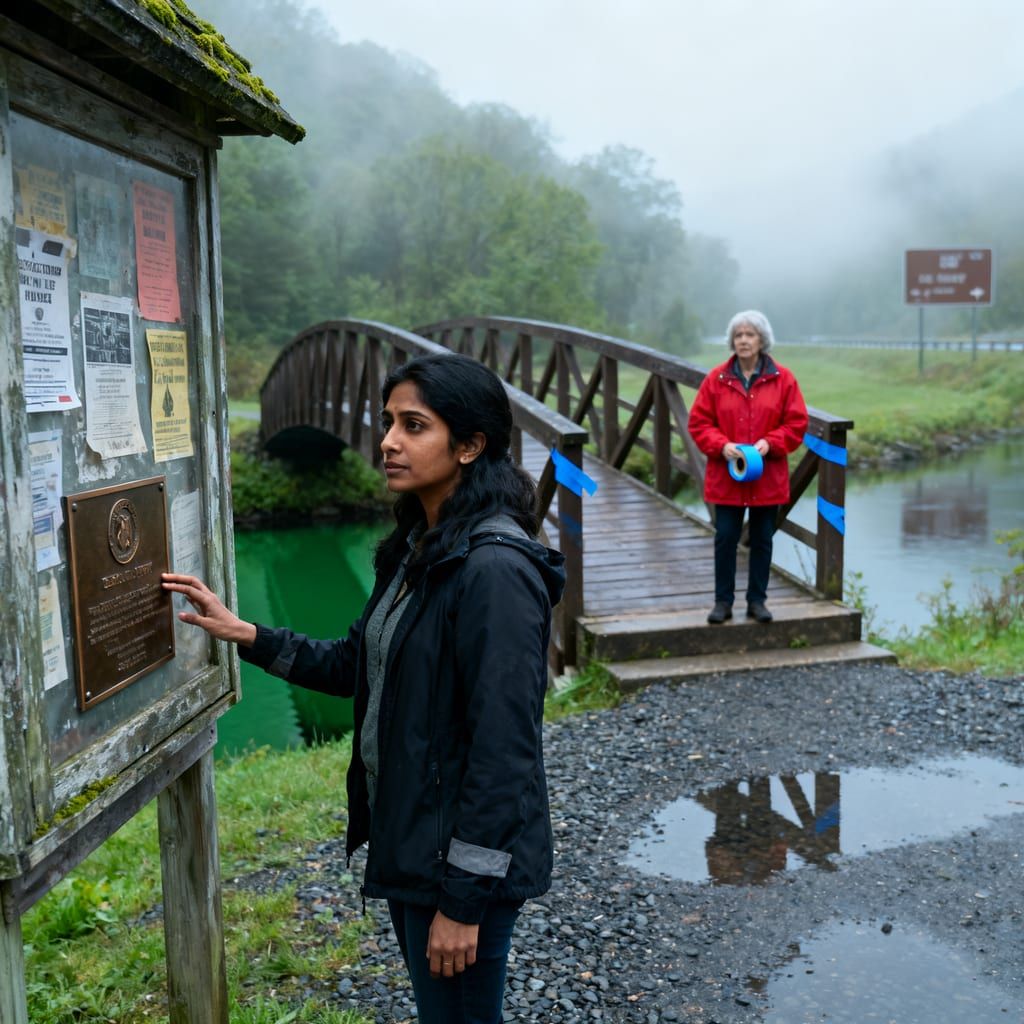
The brown sign has lived in the corner of Nora's eye for years-Eel Creek Overlook, a picnic table icon flicking past like a wink she's never returned. On good days, she hums past it and pretends it's the kind of place she'll stop at when there's time.
On this Tuesday, the sky is a dull bowl. Her phone chirps with a calendar square that says "Urgent alignment-7:30 a.m." The words make her jaw calcify. She presses the accelerator, drifts into the right lane for the usual exit-and slides by it, almost lazily, as if the car has chosen its own spine.
Gravel crunches beneath her tires. She's in the pull-off, engine ticking, breath snagged on the fence between panic and something else. A patch of trees stands there exactly the way it always has-lit gentler than the road.
I'll just look, she thinks. Two minutes.
The overlook is smaller than her mind made it. A wooden footbridge, a green-black ribbon of water sliding under it with the secretive confidence of something that's been moving a long time. A bulletin board crowded with sun-faded flyers-missing dogs, yoga in the park, a ghosted "river cleanup" in fonts the color of old basil. A bench, initials carved deep, four hearts and a curse word.
The air tastes like wet iron and pine needles. On the far bank, a boy in a yellow raincoat throws sticks, and his father times their drift beneath the bridge with the grave seriousness of men who've agreed to be silly for a while.
Nora's shoulders drop a fraction. The quiet here isn't empty; it's the hum of something working. Under the bulletin board plastic, a photograph catches her eye-thirty faces, hair big and jackets brighter than weather. The picture is curling at the corners, the gloss gone to a paper thirst. "Eel Creek Stewards, 1991," someone wrote in Sharpie, the ink spidering.
Second row, just left of center: a girl in a windbreaker, brow serious, teardrop earlobes shining like punctuation. Nora knows that face the way she knows the freckles on her own wrist. Her mother-Lata-stands there, maybe twenty-two, the river behind her, her smile not quite happening, as if she's holding in a laugh.
Nora's throat tightens. She reaches for the photo before remembering there's a sheet of plastic guarding it. Her fingers meet the cold barrier, the old image hovering safely out of reach.
Beneath the footbridge, a bronze plaque catches the gray light: Dedicated by the Eel Creek Stewards, 1991, in honor of those who tended this water so our children can wade in it unafraid.
"You have her ears," a voice says.
Nora turns. A woman in a red windbreaker, silver hair in an honest braid, stands with a roll of blue painter's tape tucked under her arm. Her eyes travel across Nora's face with a kind of careful warmth. "I'm Sophie. Your mother taught me the knot that holds this bridge."
The words land with the softest thud. Nora's fingers find her earlobe as if to confirm it's still there. "I... I'm Nora."
Sophie nods, like that solves a puzzle she's been working at for a while. "I thought so. You look just like that Polaroid she kept. You were always here, in a way."
They stand together for a moment, the river narrating something neither of them wants to interrupt. The boy's stick surfaces on the far side of the bridge, triumph bobbing. The father pumps a fist, mock-epic.
"We used to come with thermoses and garbage bags," Sophie says, unwinding her tape. "Your mom would wear these ridiculous socks. Neon. You could see her ankles from a county away." She laughs-quick, fond. "She could talk a hardware store into giving us rope by the yard and cookies to go with it."
"I didn't know she..." Nora trails off, as if the sentence is shy. "I knew she volunteered. But this-"
Sophie lifts her chin toward the plaque. "She helped get the grant. She stood right there arguing with a man who said the bridge wasn't worth it because kids would only scribble on it with Sharpies. She told him, 'They're going to scribble anyway. Let them scribble somewhere lovely.'"
Nora imagines her mother thigh-deep in March water, cheeks stung crimson, telling a man to build a bridge for the joy of defacing it. She almost smiles. The grief that usually sits in her stomach like a folded blade shifts, not duller-just less solitary.
Her phone buzzes against her palm. A preview: Where are you? The 7:30-
She types: Running late.
She waits. The river does not.
Then she types again, the words arriving like the truth of her own name: I need this morning.
"You have time for one small lesson?" Sophie asks, as if she heard the text. She gestures toward the far end of the bridge where a coil of rope sleeps by a post. "The knot that keeps us from learning the hard way what water can do."
Nora follows, feeling both tawdry and exalted, like a child who's faked a fever to stay home and found a universe under her own bed. Sophie's hands are quick. She shows the rope's path around the post, the loop, the tuck, how everything holds not by force but by remembering where to go.
"Bend, loop, bite," Sophie says. "It's a kind of conversation."
Nora tries it. Her first knot sags like an apology. The second slips. By the third, her fingers begin to believe. The rope hums under her grip, a quiet surety, as if the fibers are pleased to be asked to do what they know.
The boy in the yellow coat comes to watch. "She's getting it," he announces to no one in particular.
"Takes time," Sophie says. "Took me three Saturdays and a blister. Lata pretended not to laugh."
Nora looks back at the photograph on the board. The plastic shines a small rectangle of sky. She thinks of the road above them, traffic flowing like a different river, people in sealed cars believing morning is a race you can win.
She breathes. The air makes space for her.
The morning unspools-no agenda, just tide. Sophie tells stories between tasks. How Lata organized bake sales with brownies so dense they felt like apologies and were eaten anyway. How she waded in March and came away with purple knees and a grin. How she taped a Polaroid of baby Nora inside the volunteer cash box so the bills watched out for a face.
Nora sits on the bench and reads the initials, tries to guess the lives that pressed those letters in. The boy and his father experiment with bigger sticks. A heron steps from shadow and lifts, prehistoric and exact.
When Nora stands to go, the light has shifted to something forgiving. She touches the plaque the way people touch the shoulder of a friend. "I'll be back," she says, to Sophie, to the river, to the board with its curling edges. It surprises her that she means it.
She drives to work by side streets she usually skips, as if speed is an old language she's decided not to speak today. The blue of the creek seems to have climbed the air. At a red light, she looks at her hands-rope-burnished, soft in a new way.
She comes back. Not every morning. Enough.
Once on a lunch break, crisp apples in a bag and her laptop snoring updates on the passenger seat. Once at dusk, when the water goes to pewter and the bridge grows a spine of shadows. Once in the rain, thin as sewing thread, her mother's old scarf wrapped twice around her neck, damp with a smell that is not quite mothballs and not quite memory.
She pins flyers. She picks up candy wrappers with a grabber that clicks like a guilty metronome. She learns the names of people who do not send calendar links when they want to see you. People who have thermoses they're proud of. People who know the creek's moods the way others know market swings.
She learns the knot until her fingers do it while her mind goes other places. She notices the way the water changes after a storm-angry first, then apologetic. She thinks, sometimes, of Lata wading thigh-deep and laughs out loud at nothing anyone nearby can see.
At work, she says no where she would have said yes. She slides her calendar blocks like chess. She scales back a project and no one dies. She starts making eye contact with her coffee. Her boss says, "You seem... calmer?" He says it as if calm were a flavor he's pretty sure he ordered.
"I go by the river," she says, and lets him think this is small talk.
It's at the community potluck that the past walks in damp and cardboard. Someone finds a box in the park shed behind a rake that's been complaining for a decade. The box leaves a dark kiss on the picnic table and gives up a stack of Polaroids-white margins browned to tea, images like undone pollen.
Sophie flips through with reverence, narrating softly. There's the first cleanup-people with bandanas, sun like a promise. There's the day they burned their tongues on cider and laughed about it for a year. There-Lata, her head thrown back, the river doing its tired work, the bridge a sketch behind her.
Nora's hands shake when she lifts a curled image of her mother holding a swaddled infant the size of a loaf. Lata's eyes are the same in every period Nora can remember-amused and taking attendance. The infant's mouth is an O of complaint or awe.
On the back, in ink that has bled into the paper fibers: "Nora at Eel Creek, first spring. We'll teach her to stop."
Nora reads it twice. The words rearrange into something like a map. She feels the crowd change shape around her, the way rooms do when the light moves one inch too far to keep the truth from your eyes.
"She wrote that," Sophie says quietly, looking at the river as if it's old enough to keep secrets and young enough to remember. "I told her it was grandiose. She told me some things are allowed to be."
Nora presses the photo flat with her palm and feels grit-the memory of rain, or the shed's allegiance to dust. She does not cry the way the movies teach grief. Her chest loosens like a knot she forgot she knew how to untie.
A teenager with a nose ring asks if anyone wants more potato salad. A toddler sleeps belly-down in the grass. Someone's mutt steals a paper plate with the stealth of a jewel thief. The river keeps its appointment with the sea.
The next day, Nora opens her inbox and writes the email she's been rehearsing to the ceiling at 3 a.m. for months. Subject line: Adjusting my bandwidth. The note is simple, like a good knot-loop, bend, bite. She offers to scale back a team she doesn't love, says yes to a smaller, saner scope. Her finger hovers. She thinks of the sign on the highway, the brown wink finally returned. She presses send.
She doesn't become a different person. She becomes the one who hears water when she's stuck in traffic and counts slow to five. The one who says "Eel Creek" out loud as she passes, even on days she doesn't pull off, as if naming is a kind of staying.
Some Saturdays, she volunteers. She brings the thermos that satisfies her now and her mother's scarf when the wind's opinion matters. She teaches a kid with glitter on his face how to tie the knot and watches him learn to remember where things go. She holds up the old Polaroid at the end of one cleanup and tells a small, embarrassed story about neon socks.
On a morning fat with fog, she stops alone just to listen. The bridge groans its contentment. The boy in the raincoat is not there, but another child, another father, measure another stick as it slips under and out into light.
Nora sits on the bench. The initials under her palm feel like a secret handshake. Cars whisper past above, their urgency floating toward somewhere else. She lets the minutes do what they want.
When she stands to leave, she crosses the bridge slowly, her hand on the rope for no reason she can name beyond pleasure. The bronze plaque warms against her fingertips. So our children can wade in it unafraid.
Back on the road, the brown sign surfaces and is gone. The patch of trees holds its softer light. Nora exhale-laughs-one of those small private sounds that feel like the beginning of a longer sentence. She turns the radio down. Names the creek as she passes it. Promises nothing and everything.
And drives on, a little slower, as if the color of the water has found its way into the sky.
A daughter learns to read between the lines of a life split in two
Read more →
A fog-draped night, two souls found, and the quiet shape of a life
Read more →
Story audiobooks for children of all ages — a new one every day on Smarter Way Stories.