Two Houses and One Quiet Heart
A daughter learns to read between the lines of a life split in two
Read more →
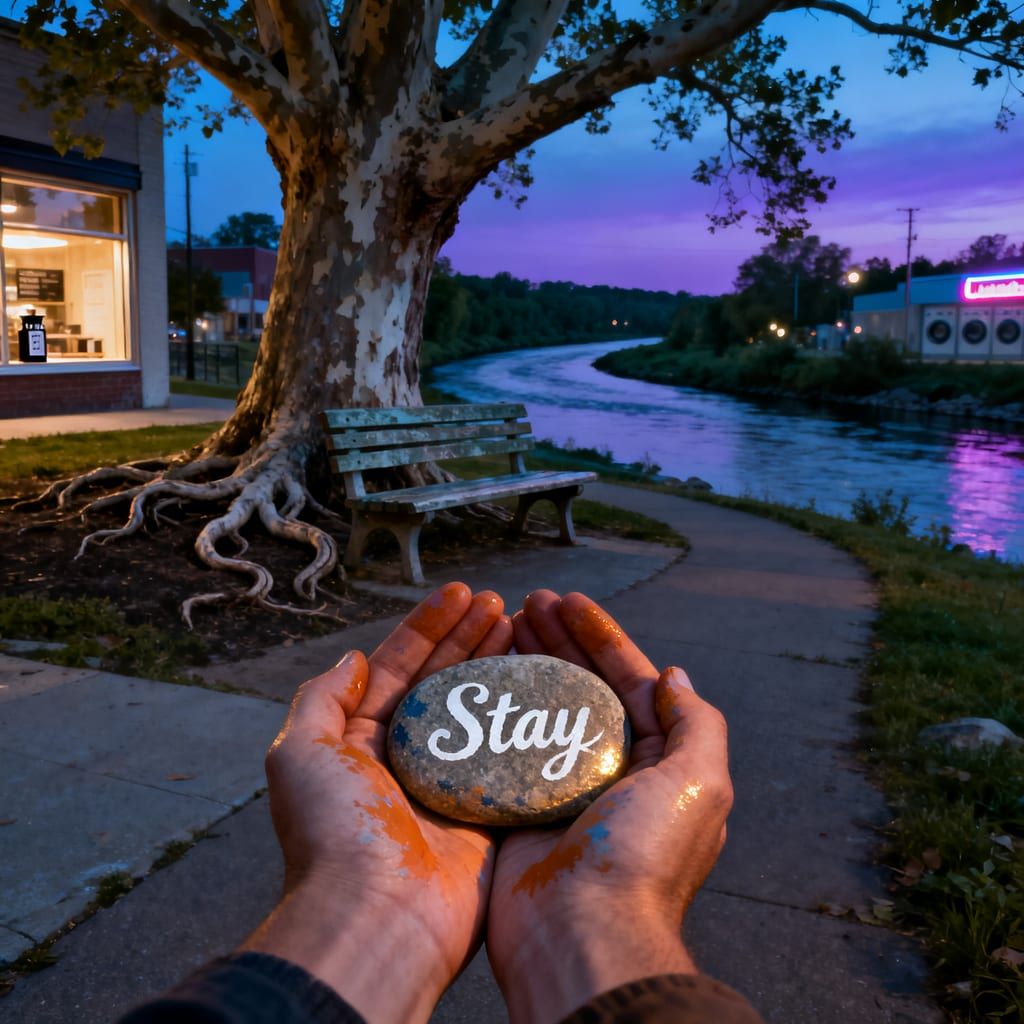
Nora spotted the first stone by the bend where the river slowed and the sycamore leaned out like a curious old aunt. Smooth as a bar of soap, cool against her palm, it carried nothing but a faint pink line where iron had kissed water. Her hands buzzed as if she'd walked through a low hum-restless, aimless, a hum shaped like doing.
She had been laid off two Tuesdays ago, a quiet video call and a colder email, and now the mornings were hers in the worst way. The town still woke: a delivery truck hissed outside the bakery, the laundromat flicked on its neon, the river took a breath no one heard. The day waited and she could not yet step into it.
Back home, she dug out a tin from under the bed-stubby paints left from a side project no one bought. She washed the stone. She painted one word, thin and careful.
Stay.
She set it under the bench by the laundromat, the one that chewed at the back of her knees when she waited for dryer F. She didn't sign it. She walked away fast, like she'd told a secret to the ground.
The neighborhood board, always a churn of lost cats and porch cameras, lit up at lunch. A photo of her stone, the bench's chipped blue peeking into the corner.
Found this when I needed it.
Comments stacked like plates. Heart emojis. Somebody wrote: Whoever you are, thank you. Someone else, in a thread that kept unspooling: My dad used to say that.
Her hands trembled. A good tremor.
The next morning, she walked to the pharmacy and set a pale oval on the bell's ledge. Breathe. A day later, the barista at Current Cup propped Begin Again in the window between a tip jar and a postcard of Lake Superior. "We've never had a Tuesday like this," the barista told a regular with a gray braid and a dog-eared thriller. "I swear it's the rock."
Nora kept walking the river at dawn, pockets chinking. She learned the stones by feel: the flattest ones took script like skin takes water. She never repeated a word. She left them where the town exhaled-the thrift store planter, the park under the giant sycamore's split roots, the library steps, the railing outside the rec center where cigarettes died.
She watched through glass and threads, anonymity like a blanket pulled up under her chin. Let it be enough to place and leave, she told herself, and sometimes believed it.
Summer flooded color. She lettered in white on slate and in navy on the pale ones. A rock tucked into the edge of a sandbox: Share. Someone posted a photo of two toddlers offering it to each other, solemn as officiants.
In August, heat lacquered everything. A construction worker with a sunburned neck found Okay in a patch of dust near a road closure sign. He rubbed it like a worry stone at the diner, glare bouncing off the chrome napkin holder. "Keeps my hand busy," he told the waitress when she smiled. "Keeps my head quiet."
Leaves turned. So did some part inside Nora that had been rusting in place. She woke with the words in her mouth. She took her time with the loops and the tails, let them swell or shrink depending on the stone. She learned to leave them in a way that felt like tucking someone in.
Patterns emerged. A woman with hair in a messy bun and a sleeping newborn tucked against her chest paused on the library steps, reading You Are Not Failing twice, lips moving silent. She picked it up the way you pick up a found photograph-with care for a history you didn't live. On the board that evening: Whoever left this-I thought I was the only one dropping all the plates.
In November, a teen in a thrifted denim jacket fished Stay Curious from a planter dusted with cigarette ash. He turned it over, thumb on the C as if he could push the word deeper. Later, a post from a new account with shy punctuation: Anyone know about night classes? Robotics? The rec center tagged a flier. The thread hummed.
The river hardened at the edges. Nora painted on the floor near the heater, radio low, coffee cooling faster than she could drink it. Some days the ache rose-a question without punctuation. She walked anyway. She scattered anyway.
December brought early dark and a new fear. Someone had commented on a photo: These are sweet, but isn't this technically litter? Another: And a tripping hazard? Kids run everywhere.
She swallowed. If I've done harm with good hands. She set down her brush. She went to bed tasting paint.
The room smelled like old carpet in a church basement-coffee too. Folding chairs did their metal gasp as people settled. A sign on the wall: TOWN HALL: CIVIC MATTERS, in a font that had attended every bake sale since 1987.
Nora slid into a seat near the back, small as she could make herself. Her palms rang with heat. She had rehearsed an apology all afternoon, steam curling from her tea into nothing.
A woman from the PTA spoke first, precise as a paper cut. "We appreciate the sentiment, but rules are rules." A man with a beard the color of rainwater said, "The trail's not a gallery," and a second later: "But-my kid found Brave last week. Slept with it under her pillow."
A retired teacher in a cherry sweater clasped her hands. "I found Gentle by the nursing home. I can't walk far anymore. That word was a hand on my back." Murmurs. The coffee machine knocked in the corner like someone trying to be let out.
The official who'd filed the complaint sat on the aisle, tie crooked, eyes filmed with exhaustion. He cleared his throat. The room made its small rustle and went still.
"I filed the paperwork," he said. "Litter. Trip hazards. It was my job." He placed a stone on the folding table, careful as if it might roll away. Slate gray. White letters.
Stay.
He touched it with one finger. "The night my business collapsed, I walked to the river with a stone in each pocket." His voice thinned. "Not these. Heavier."
The room drew in air.
"I sat on the bench by the laundromat because I couldn't decide about the water. And this-" He lifted the stone, just enough to catch the terrible fluorescent light. "-was under the bench. I held both kinds of stone and... I called my sister instead." He gave a small, embarrassed laugh that cracked at the end. "She talks too much. It saved me."
Someone near Nora sniffed. The PTA woman took off her glasses and pressed the bridge of her nose. The man with the rainwater beard looked at his hands like he'd never seen them.
The chair of the meeting cleared his throat, a gentler sound than the official's. "Well, then." He squinted at the agenda. "Perhaps the matter isn't removal but... placement."
Arguments melted. Suggestions took their place, clumsy at first, then cleaner: paint them on the flattest stones; tuck them where feet don't live; seal them so snow won't swallow the ink. A teenager in the back-Nora recognized the denim jacket-raised a hand and said, "We could make a map. Not to spoil the find. Just to avoid the joggers." Laughter, soft as tissue.
No one asked who made the stones. Nora's apology dissolved on her tongue. She left without speaking, still anonymous, the winter air washing her face like cold water after a fever.
Weeks turned, carrying salt-streaked cars and a January sun too pale to be trusted. On a Thursday, Nora opened her door to fetch the mail and found a stone on the stoop that wasn't hers. The letters were bolder, the paint thicker.
We See You.
No signature. Just the faint fingerprint of a smudge in one corner, like someone had lifted it with paint still wet and couldn't wait.
Two days later, a rock appeared on her windowsill, balanced under a loaf of banana bread wrapped in a paper towel. The rock said Thank you, in a looping hand that loved its own tail. A note, penned on the back of a Current Cup receipt: Recognized the curve of your 'k' from that Okay pebble. No pressure. Just carbs.
Nora laughed, the kind that turns into a cough when you're out of practice. She ate a warm slice with a cold fork. Her eyes stung and she let them.
The board filled now with not just finds, but makings. Someone posted a photo of a kitchen table covered in newspaper, a toddler dipping a brush too deep and emerging with a gloopy miracle: Sun. A nurse posted a palm-sized Heart, the EKG line running through it, and wrote: For my break room, because we forget.
When she walked the river, Nora found her words where they'd been moved-on shelves in the coffee shop, in the rec center display case, tucked along the inside lip of a flower bed like a festival of mouths. And underneath, here and there, new words in new hands.
Spring came raw and then decided to mean it. The sycamore leafed out, green like a fresh idea. One evening, on the edge of dusk, a knock.
Through the peephole: a semicircle of people. Faces from posts and comments and the blur of mornings. The barista with the gray braid. The construction worker, his palms stained permanently with the memory of rebar. The teen in the denim jacket, taller now, shoulders straighter. The official with the crooked tie, eyes clear.
When Nora opened the door, no one spoke. They didn't need to. In their hands, held at the center like a cake with too many candles, was a wide, smooth river stone painted by many hands. Edges banded in colors that almost matched and didn't, the way a choir doesn't.
In careful letters that leaned into each other, the front read:
You Mattered Here.
Around the rim, tiny signatures and story scraps: Aunt Vi, who found Calm outside dialysis; Mateo, who slept through the night with Brave under his pillow; "for S., the word was Eat," in green pencil; a doodled robot with a grin too big for its face.
The barista's voice made a soft home in the air. "We didn't want to out you. We just wanted to... loop it back." She held out the stone like passing a small sun.
Nora's throat closed. She reached for it anyway. It was heavier than she expected-in the way that means you will not lose it to a light wind. The paint was slightly sticky in a place that hadn't fully dried. She could see where a child's hand had wobbled and an adult hand had let it.
"Will you-" The official with the tie stopped, smiled at his own awkwardness. "Help us place more? Safely. There's talk of a bench with a little shelf."
Nora nodded, tears finally doing their clean work. "Yes," she said, and the word traveled somewhere in her she hadn't been able to reach for months. "Yes."
They met on Saturdays. Not too formal. Not a movement. Just a table at the rec center or a picnic blanket under the sycamore, newsprint and cups of coffee and stones rinsed of river. People came and people couldn't. There were rules, if you could call them that: no repeats; no commands in capitals; leave them where eyes go, not toes.
They told stories until the paint dried. Someone said, "I found Steady the day after my mom's diagnosis." Someone else: "I put Warm on my neighbor's porch when their heat went out." The teen-Ari, it turned out-brought a small robot that beeped and drew crude hearts. The construction worker's hands were surprisingly gentle, his S's beautiful. The PTA woman, red-scarf now instead of meetings-gavel, apologized to no one in particular and wrote Listen on a pebble with the gravity of a promise.
Nora didn't talk much at first. She painted. She placed. When someone slid a new brush in front of her-You like a fine tip, right?-she smiled without explaining how much that mattered.
It was not a fairy tale. A dog chewed a stone. A kid slipped on mud and cried until the mud made more sense. The river flooded and took three pebbles and a picnic fork. But the practice held. The town held the practice. On walks, strangers nodded in ways that felt like agreements. The tip jar stayed generous on Tuesdays and sometimes even Wednesdays. The official started wearing socks that didn't match on purpose.
On a late Sunday, Nora placed a small word at the base of the sycamore-Carry-tucked where ants trafficked and children searched. She sat for a moment with the river's patient voice in her ears. In her bag, the broad, communal stone warmed her hip through canvas, and she liked the weight of it pressing against her side, a second heart returned.
She stood and brushed grit from her palms. Tomorrow would come in the same blank way, the one that used to scare her brittle. Now the blank felt like a page. Like a flat, smooth surface asking for a word.
Behind her, a mother laughed at something small and ridiculous. A bike chain clicked and sang. Up in the sycamore, new leaves shook out their folds and faced the light.
Nora stepped into the day.
A daughter learns to read between the lines of a life split in two
Read more →
A fog-draped night, two souls found, and the quiet shape of a life
Read more →
Story audiobooks for children of all ages — a new one every day on Smarter Way Stories.