Two Houses and One Quiet Heart
A daughter learns to read between the lines of a life split in two
Read more →
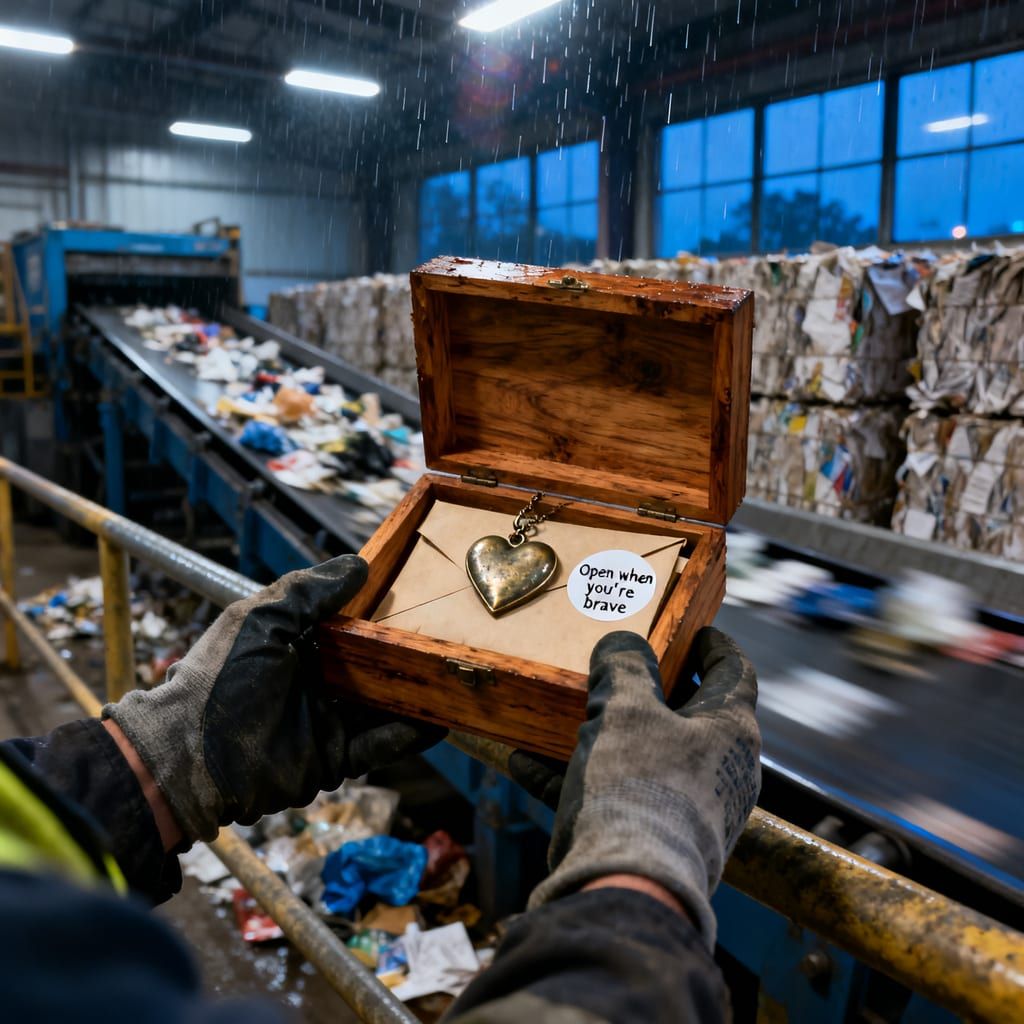
The belt never sleeps. It hums through the small hours like a river under ice, carrying what people meant to throw away and what they didn't-lipstick-streaked coffee lids, paper moons of orange peels, a crumpled photo, a shoe with its laces tied to air.
Mateo works to its rhythm. Gloves on. Eyes quick. The smell is wet paper and lemon cleaner, the ghost of last night's rain. His station light halos the dust as if it were weather.
He doesn't announce his ritual. The foreman knows and looks the other way. If something feels like it belongs to someone-class rings, dog tags, a recipe card stained with cinnamon-he lifts it out of the stream and sets it on a metal shelf by the time clock. Nothing fancy. Just a place that says, not trash, not yet.
By morning, the shelf empties. Drivers nod at him. Once in a while there are tears and the fast, surprised hug of a stranger who didn't know they were missing something until it was gone. Mateo says, It's nothing. He thinks about the ways people drop their lives-on purpose, by accident, in the slow erosion of a long day.
He does not think of himself as sentimental. He thinks of himself as careful.
On a rain-slick Tuesday, the belt brings him a dented cedar box-wedged between a cracked blender and a knot of Christmas lights. The cedar is scratched but still breathes its sweetness. He slides it free with a gloved hand.
He waits for a lull in the flow and pops the lid. Inside: a tarnished heart locket, a child's drawing of a blue house with crooked windows, a brass key wrapped in dental floss, and a creased, unsent letter sealed with a round sticker that reads, "Open when you're brave."
He doesn't open it.
He turns the box over. On the underside, in faint Sharpie: "D. Alvarez."
The locket's hinge gives just enough to flash a tiny photo-a woman smiling with a dimpled chin, a bit of someone's sky behind her. On the back of the drawing, in a child's careful print, a phone number.
Mateo wipes his gloves on his shirt. The phone is warm in his palm, the number smudged but clear. He calls.
"Hello?" The voice is thin, like the line is long.
"Hi. I'm calling from the City Transfer and Recycling. Is this D. Alvarez?"
A pause. "Daniel. Yes. Did I-did something happen?"
"We found a cedar box," Mateo says. "With some personal things. There's a name. A number. Thought you might want to take a look."
On the other end, air. Then a sound like someone covering the receiver with their hand. "I'll be there in twenty minutes," Daniel says, and hangs up as if afraid the chance will change its mind.
They meet under the scuffed fluorescents of the break room, the vending machine chattering in the corner. Daniel is older than his voice-gray in his beard, jacket zipped despite the heat. He carries himself like he's done waiting rooms.
The box sits between them like a fragile animal.
Daniel lifts the lid with both hands. He touches the locket. "Her," he says, and the word is a door. "My wife. Alma." A thumb brushes the dimple he knows by heart. He holds the drawing up to the light. "Lila drew this when she was seven," he says, and his smile limps into place. "She hated straight lines."
When he sees the sealed letter, something in his face folds and keeps folding. The sticker catches the light. "That's my handwriting," he says, almost to himself. "I wrote that early on. When I was..." He doesn't finish the sentence. He doesn't have to.
"You can open it," Mateo offers, softly. "If you want."
Daniel shakes his head. "It wasn't for me to open alone. I wrote it for when I was brave enough to show Lila what the mess really was. Haven't been." He taps the sticker with one knuckle. "Haven't been."
They sit with the hum of the soda machine filling the space between what people want to say and what they can. Finally Daniel closes the lid, careful, like putting a sleeping child back in a crib.
"Thank you," he says. "I don't know how you-this is-" He stops. Starts again. "We haven't spoken since she moved out. Months now."
Mateo nods. He hears an echo he doesn't name.
Days pass. The box waits on the shelf by the clock, the letter still sealed. Mateo posts a small, text-only note on the corkboard by the outbound scale:
FOUND: a promise in a cedar box.
His coworker Yaz-who wears glitter liner on the night shift and calls everyone "cousin"-leans on the rail and gestures with her chin. "You should put this stuff online. People love a good cry at two a.m."
"I'm not making a spectacle," Mateo says.
"Not a spectacle. A map." Yaz scrolls through her phone. "Start an account. Hands only. No faces. Keep it kind."
He resists until she makes one for him on her lunch break. FoundAtTheTransfer. It's only photos of hands touching what's been returned-wrinkled fingers around a bundt pan, grease-stained knuckles holding a wedding band wet from the sink trap, a teenager's chipped polish cupping a cassette tape with someone's voice on it.
The captions are plain as bread. Found under the baler. Came back for it. We are all losing and finding.
The algorithm does what it does. So does word of mouth. People arrive in utility vests and cardigans, in scrubs and suits, looking unsure until they aren't.
Sometime past midnight, a woman in a clean hoodie thumbs through her phone in a studio apartment that smells like hair product and mint tea. She stops. There on the screen-a blue house with crooked windows. The caption: Found tucked in cedar. Waiting.
Her heart does the small, panicked jump of a deer at the edge of a road.
She messages, then deletes the message. She messages again with only a time: Tomorrow.
The facility looks different in daylight-louder somehow, everyone sharp-edged. The bale-stacks of compressed paper tower like a new kind of geology. Sun slices in, a high glitter off the conveyor's guardrails.
Lila arrives with the hood up and the tight set of someone braced for weather. Her eyes are anxious and fierce at once. Mateo recognizes the walk of a person talking herself into a thing.
Daniel is already there, jacket zipped though it's not cold. He stands small in the bigness of it all. When Lila sees him, the old fight rises between them like a third person-fully present, sure of its seat at the table.
"Hi," Daniel says.
"Hi," Lila says, the word clipped. Her gaze drifts to the shelf by the clock, to the cedar box waiting as if it's been doing so all along.
Mateo brings it over and steps back. "I'll give you some space," he says, and means it. He retreats to the line, pretends to watch for plastic in the paper stream. His ears, traitors, stay open.
Lila lifts the lid. Alma's locket casts a dull heart-shaped moon in the fluorescent light. She touches the photo with a fingertip, the way you might test the heat of something you want but aren't sure you can hold.
She takes the letter in both hands. The sticker is worn at the edge where Daniel's thumb has worried it for years. She peels it back, slow. The paper sighs.
"Read it," she says, not looking at him. Then, softer, "Please."
Daniel clears his throat. The first words shake on their legs but stand. "Lila," he reads. "I wanted to be better for you, long before I knew how."
The conveyor hums on. A yard truck beeps in reverse, far and small. A gull lands on the roof and cries like someone lost its keys.
Daniel reads. He reads about nights on the bathroom floor and mornings that came like judgment and mornings that came like mercy. He reads about Alma and the day he put a bottle in the trash and then took it back out, twice. He reads about the first meeting in a church basement with bad coffee and the strange relief of people you don't owe anything to, except the truth. He reads about the apology that kept changing shape-too big, too small-and how he learned that apologies are like shoes; they don't work if you only carry them around.
He does not make excuses. He says, "I'm sorry," in present tense, body leaning toward her like the words are heavy and he is willing to hold them.
There is a sound a body makes when an old grief unknots. It is not dramatic. It is like a knuckled hand opening.
Lila's shoulders lower, barely. She blinks hard, then laughs-a cracked thing, bright through the break. "You always write like this?" she says, swiping at her face.
"Only when I'm scared," Daniel says.
She folds the letter back along its creases. "Me too."
They don't hug. Not yet. They stand close in the bright cage of the facility and figure out where to place their hands.
Mateo steps out to the loading bay. The air tastes like rain and hot metal. Someone's cologne lifts from a passing driver-citrus, sweet, gone.
He sits on the concrete ledge where weeds grow stubborn from a crack. He takes the stub of a pencil from behind his ear and a folded receipt from his pocket. He writes his son's name at the top.
"Nico," he writes. "You like to line up your toy cars by color. You hate the crusts and then decide you love them when I'm not looking. Today I almost told you I was too tired to come get you from your mom's because of the shift, and then I remembered-I'm not too tired. I am afraid you won't want to come."
He stops. The yard truck beeps again. A gull watches him like a critic from the roofline.
He keeps writing. "I want to be better for you long before you know the ways I need to be. I'm learning. I'm here. If I mess up, you can tell me without losing me."
He doesn't plan to mail it. Not now. He folds the slip of newsprint and tucks it in his back pocket. A private promise. A small mended thing.
Inside, Lila and Daniel are laughing at something their hands have remembered together. The box sits open. The locket warms under a palm. The sticker curls on the table, its work done.
"Thank you," Lila says to Mateo as she passes him on the way out, the letter folded safe under her arm. Her eyes are red and alive. "For not opening it."
"Wasn't mine to read," he says.
She nods, like this explains everything.
Yaz appears at his elbow. "You posting that?" she asks, already aiming her phone.
"Hands only," Mateo says.
The photo-two sets of fingers brushing the edge of a wooden box-goes up before the lunch whistle. The caption is six words long: Came back for it. Left braver.
Comments bloom, then settle. Somewhere a stranger opens a drawer and pulls out a thing she meant to fix. Somewhere a boy puts a ring back in a dish before bed.
The belt hums. Things arrive. Things depart. Mateo moves in the rhythm he knows. A snow globe pours its winter over his gloves. A postcard from Miami flashes teal and flamingo pink and is gone.
At the end of shift, he adds a new index card to the corkboard:
FOUND: a promise, cedar-scented, unsealed.
He clocks out. He stands for a moment by the shelf he keeps, watching the door. The morning crew clatters in with coffee and sleep in their eyes. Someone has left a small paper bag there with his name. Inside: a cinnamon roll, still warm.
He smiles. He takes what was offered and leaves the shelf clean.
Outside, the day is thin and beginning. He texts his ex: Can I get Nico after school today? I'll bring the cars.
Three dots. Then: Yes. He'd like that.
Mateo pockets the phone. The gull lifts from the roofline into a sky the color of primer-unfinished, ready.
He walks toward the parking lot with the river humming at his back, his hands empty and open, the small folded letter warm against his hip like a locket he wears on the inside.
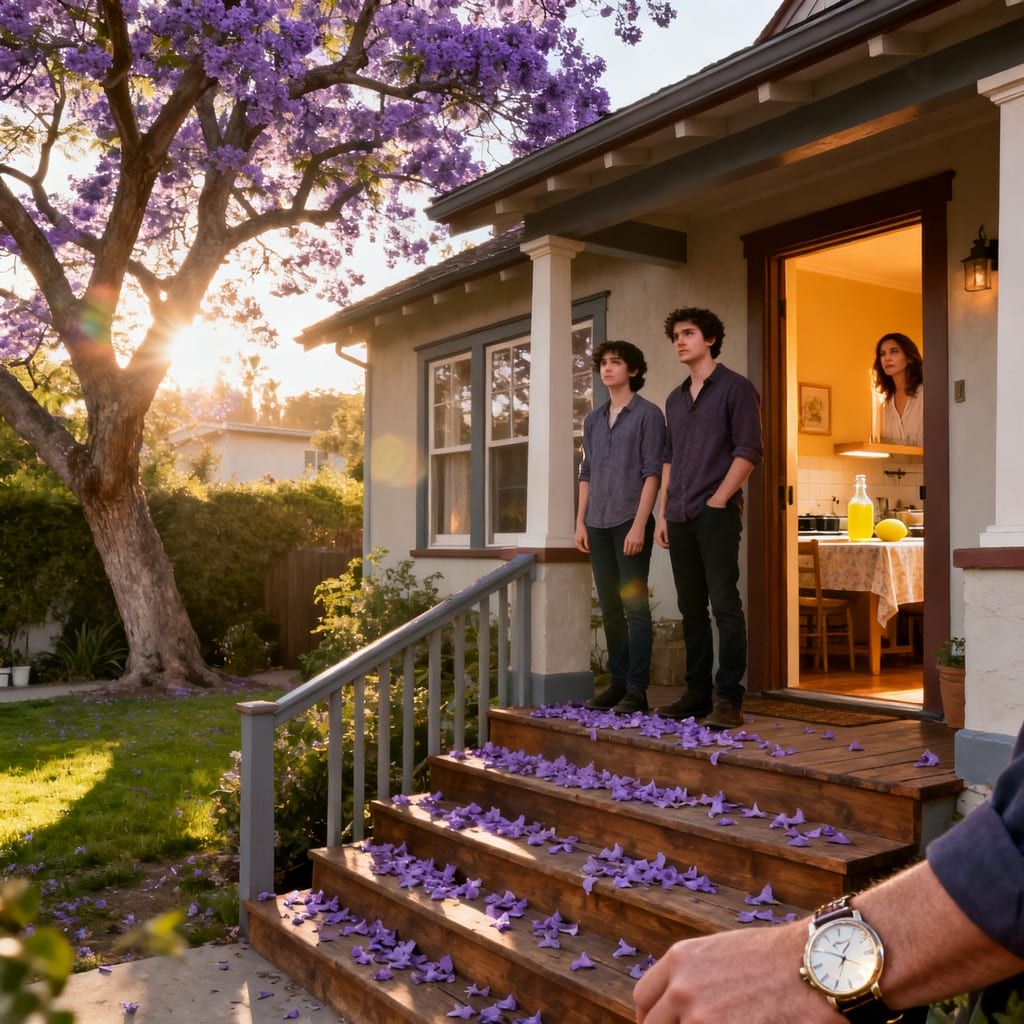
A daughter learns to read between the lines of a life split in two
Read more →
A fog-draped night, two souls found, and the quiet shape of a life
Read more →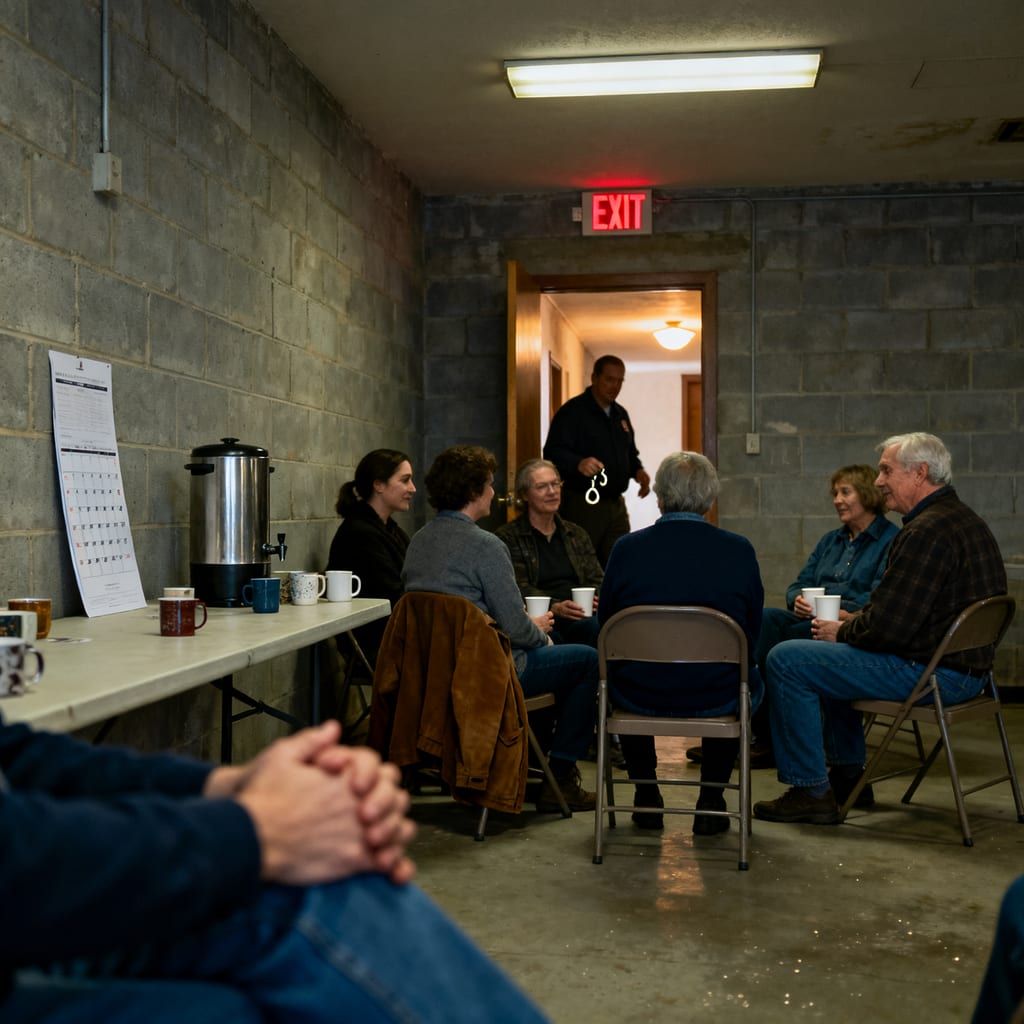
Story audiobooks for children of all ages — a new one every day on Smarter Way Stories.