Two Houses and One Quiet Heart
A daughter learns to read between the lines of a life split in two
Read more →
The bread was still warm when Sami slit it open along the seam where the crust had been stitched with syrup. Steam breathed into his face-yeast and sugar, the faint sting of cinnamon-and in the hollow where bakers tucked luck on festival days, he found a book as thin as a rib.
He slid it into the shadowed mouth of his tool bag, nestled beside insulated pliers and a coil of wire. Outside, the coastal wind pushed fog against street cameras until their halos bloomed. Somewhere, a drone's lens whined and corrected. The city, nervous as a cat, watched itself.
He had promised himself he wouldn't be reckless. Thirty-two, municipal electrician, badge scanned at every turn, mother gone the year the bans arrived-he had kept his head down, listening to the algorithms decide what words were dangerous. But the old map unfolded in his hands before he could stop it: his mother's voice over the clatter of spoons, stories poured like tea.
He didn't want to read alone.
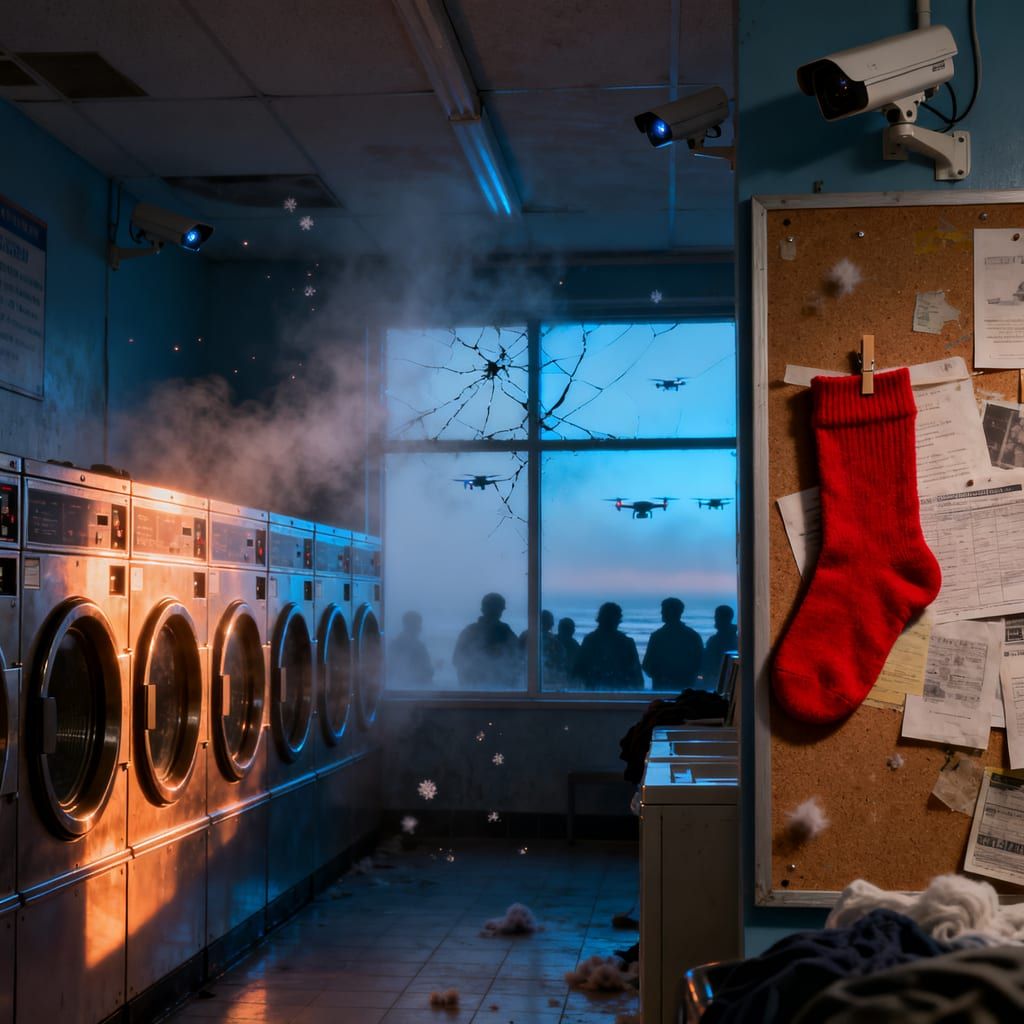
They gathered where nobody lingered for pleasure: beneath the hum of coin-operated dryers in the corner laundromat, where lint drifted like soft snow and machines confessed in steady thrum.
Zara the baker came with flour on her elbow, a red sock pinned to the bulletin board-their signal, small and brazen. Ms. Anahita shuffled in with a cane she didn't need when she was excited. Kenji, night-shift nurse, set his phone face down and closed his eyes as if preparing for a patient's breath. Leena, courier with ink-stained fingers, arrived late, always, smelling of rain and wet envelopes.
They named themselves The Spin Cycle and agreed on rules. When the washers clicked open, the pages closed. They traded lines on receipt paper and tucked them into the mouths of detergent boxes. They memorized metaphors the way others saved seeds-pressed them between the ribs of their days. They left the covers to be found and burned, burying only the words.
Sami read one chapter each week. His voice learned to move like thread through cloth, steady, trying not to snag. The book-the first-was a fugitive about a man who turned his house into a boat, and when they laughed, it was soft and high, like a shared secret escaping.
Sometimes, a drone idled outside the cracked window with the bored persistence of a gnat. Sometimes, the laundromat's owner switched to bright-lit channels of legal news. They learned to speak with their faces when they couldn't risk their mouths.
Word, even now, has a scent-it thickened the air when the rumor arrived. An informant, someone said. A lingerer by the window. It came tucked in with coins, in nods that lasted a beat too long.
Then a newcomer started coming on Thursdays with a canvas bag full of clothes he never washed. He was soft-spoken, fine-boned, with a Bureau of Cultural Purity badge that flashed when he forgot to tuck it away. Rahim, he said, and he smiled like a man apologizing for entering a room late.
He told stories he said he remembered from his grandmother, lines that landed with the weight of truth but rolled oddly in his mouth, like river stones newly turned. He listened more than he spoke. He laughed only with his eyes.
Sami felt the group tilt toward or away from Rahim in small, uncoordinated motions. Zara stopped meeting his gaze. Kenji wrapped his forearms across his chest. Ms. Anahita asked too-bright questions in a teacher's test tone. Leena, practical and impatient, pressed her tongue into her cheek.
Outside, drones hiccuped and paused over their block, bored, persistent. Algorithms trolled the river of their lives, skimming for the glint of contraband syntax. The city announced a sweep for the district: a night of doors opening like held breaths released.
Sami had always trusted the quiet threading of wires over the noisier currents of people. He followed a hunch the way a line follows voltage-down, along, hidden. At dawn, as delivery trucks exhaled crates into the waking market, he watched Rahim slip through the bakery's side entrance.
He waited-counted to ninety the way his mother had taught him to cool anger-and then eased into the bakery's back. The cellar was cool, smelling of stone and old oranges. He found Rahim at a workbench, hands moving as if he were making a gift: parchment, twine, a rectangle wrapped like a kept secret.
Rahim didn't flinch when Sami stepped into the weak light.
"Did you ever think," Rahim said, voice low, "that a man could do his job and also do it wrong on purpose?"
On the bench lay a ledger with careful columns-dates, titles, addresses burned in a code only a librarian might love. Behind Rahim, shelves not for bread but for spines, their covers turned inward, their names stripped to protect their bones.
"I take one from each seizure," Rahim said, hands warm on the parcel, as if it were a child. "Zara bakes them into loaves. She mends the crusts with syrup. You read them. Someone remembers. That's the chain."
Sami's mouth was dry. Above them, footsteps. The scent of sweet dough. The world sharpening at the edges with morning.
"You're the informant," Sami said, and surprised himself by not making it a question.
Rahim's smile was a wince. "I am the beehive. The honey and the stings."
The city arrived early, as bullies and storms do. Trucks like dark punctuation marks. Officers in hard blue-fists, radios, boots. The laundromat's bell jangled without joy. On the cracked window, a new notice blinked in municipal orange.
Rahim moved first. He flipped the breaker with a fingertip as gentle as blessing, and the laundromat fell into a sudden, delighted night. The hum of the dryers softened to after-sound. In darkness, the red sock on the board became a memory of red.
"Follow," he said, and the word felt like a rope tossed out.
They went the way only two men in the city knew: down through the service hatch behind the vending machine, into the tunnels that held the city's nerves. Sami's muscles remembered angles and ladders and the exact forgiveness of each rung. Pipes sweated in the heat and sang in small, constant pain.
Kenji counted under his breath to calm himself-probably someone else's heart rate leaking into his own. Ms. Anahita muttered multiplication tables as if proving the world still made sense. Zara's hands smelled of crust and fear. Leena, whose ink stained her fingers permanent blue, kept looking back for the light.
Above them, the officers pounded. A voice through a bullhorn tried to flatten the city into compliance. Down here, breath became language. Steps made paragraphs.
At the first junction, they scattered the way they'd practiced, each toward a station that could eat them without chewing: the empty tram during the scheduled blackout, the morgue lobby at midnight where grief made all speech legal, the ferry deck when fog erased land.
Rahim stayed. He pressed something flat into Sami's palm-a book wrapped in parchment, warm from his hands-and then steered him toward a narrower tunnel, a vein behind a vein.
"If I don't come," Rahim said, "remember this: when ink is outlawed, become paper."
He gripped Sami's wrist three times-tap, tap, tap-and was gone up a rusted ladder into the mouth of danger.
Days became a long exhale. The sweep bruised the district the way wind bruises a shoreline-some pieces lost, others found elsewhere. The laundromat reopened under new management and brighter lights that watched but did not see.
The Spin Cycle loosened itself from one room and threaded through the city. They became motion, camouflage. They met moving.
An elevator stalled between floors on purpose, and a woman in a nurse's uniform recited a paragraph into the stale light while a delivery boy hummed to cover her cadence. A man dropped his keys in the produce aisle, knelt, and whispered a single sentence to a small girl who would carry it, stone-like, in her pocket for weeks.
Wet cement on a construction site held a stanza before the trowel erased it-no evidence, only fingers that remembered. A tram's announcement system hiccuped, and over the cough of static came a metaphor that compared fog to forgiveness. In the morgue lobby, beneath the hum of vending machines and the gravity of breath, an old woman mouthed the shape of a hero's name like prayer.
Sami learned to hear new currents. He touched fuse boxes and felt what he had not felt before: the city's forgotten spaces holding sound as if it were charge. He guided the others to places the patrols did not yet understand-maintenance corridors that joined buildings like secret handshakes, stairwells that spiraled thought back to itself, storm drains that made a chorus when the tide rose.
He carried nothing but lines committed to bone. He ate carefully, slept in bursts, watched for drones with half an eye and listened for red socks with the other half of his heart.
No one saw Rahim again. There were rumors: a transfer; a reprimand; a clean, terrible van. In the ledger of harm, his name sat between two smudges. In the ledger of hope, it had a page to itself.
Weeks later, the laundromat shone. New owners, new cameras, new prices that pretended to be old. The bulletin board was bare except for rules printed in five languages-no loitering, no soliciting, no music. The dryers hummed anyway, stubbornly full of song.
Sami stood by the soap dispenser as if considering powders. He paced his breath to the spin cycle's steady loop. He had forgotten the weight of a book in his hands; he had grown used to the thousand small weights of words in his mouth.
On the board, it appeared-not so much posted as manifested-one red sock, pinned with a bright silver safety pin.
A stranger stepped to his side. She was small, her hair a black sail, her ears crowded with brass hoops. She raised her hand to her ear and tapped-three soft knocks on her own threshold. Sami felt the answering knock inside his chest.
She leaned as if to tell a joke. "The first line," she breathed, and her voice was almost his mother's and almost Rahim's and mostly her own. "Do you remember the first line?"
He didn't answer. There, in a room pretending to be brighter than it was, with cameras blinking like tired eyes, she began to speak the story they had burned into themselves.
Her words moved through the machines and into the bones of the place. Somewhere, under the street, a tunnel held the echo the way a hand holds heat. Somewhere, on a ledger's page, ink dried in the shape of a promise.
When the washers clicked open, he closed his eyes.
Outside, the fog pressed its cheek to the city and listened.

A daughter learns to read between the lines of a life split in two
Read more →
A fog-draped night, two souls found, and the quiet shape of a life
Read more →
Story audiobooks for children of all ages — a new one every day on Smarter Way Stories.