Two Houses and One Quiet Heart
A daughter learns to read between the lines of a life split in two
Read more →
The first package disappeared on a Tuesday so hot the air felt like a hand on the back of Jon's neck.
He replayed the doorbell cam until the pixels blurred-just a shoulder, a cap brim, a flash of forearm, and the quick, tidy lift of a brown box marked with the toothpaste company's cheerful logo. The cicadas screamed; a pickup rolled by; the thief's shadow never even touched the azaleas.
Jon stood on the porch of his rental duplex, the boards baked to a blond glare under the Austin sun, and swallowed hard. He pictured his ex-wife saying, You can't fix everything by organizing it, and pressed the pad of his thumb against the doorbell camera as if to soothe it.
That night he didn't sleep. The house was too quiet, the kind of quiet that made him hear the AC kick on like a cough and every neighbor's car lock chirp. He lay on his back, finger scrolling through Nextdoor posts and police blotters until the words smudged. By sunrise he had a plan.
The cul-de-sac was a fat comma of asphalt tucked behind a line of live oaks, nine houses facing inward like a circle of listening faces. Jon made a map of them in a spreadsheet first, then in a neat Google Doc: house numbers, names, notes. He printed a version in color and taped it to his fridge, little squares coded with markers-yellow for single, blue for family, green for elderly. His pen hovered over his own-thirty-seven, newly divorced, remote product manager-then settled on yellow and a small star he couldn't explain.
He slid flyers under doormats and into mail slots: Neighborhood Watch Meeting-Porches, Cameras, and Peace of Mind. He brought a pitcher of grocery store lemonade and a stack of plastic cups to his driveway on Saturday. His voice found an ease he hadn't felt in months.
"Just some light coordination," he said to the small ring of neighbors who appeared in sensible shorts and sunglasses. "A group chat. Camera sharing. Schedules for anyone up at odd hours."
A white-haired man in a UT cap introduced himself as Mr. Patel and squeezed Jon's hand with papery strength. "I like a man with a list," he said, smiling. Mrs. Kline from the ranch house-stooped, a scarf the pattern of blue china tied at her throat-nodded slowly, as if reading an invisible caption under each of their faces. A nurse named Elena lifted a hand in greeting and yawned around her travel mug.
They traded numbers. The group chat bloomed: CulDeSacWatch-no spaces, a silver shield emoji.
By Monday the chat was a pulse on Jon's nightstand. Blurry, gray-toned clips rolled through-cat shadows warping like spilled ink across porches, a raccoon rearing on hind legs in a recycling bin like a tiny bear, a bike left leaning against a fence and noticed then forgotten. Someone posted a screenshot of chalk marks near the curb in loopy handwriting. Another sent a photo of a dented mailbox like a wounded lip. Fonts and timestamps stacked; vigilance sprouted like volunteer weeds.
Jon appointed himself hub. Tips with thumbnail images-How to angle your cam to avoid road glare; Porch Light Settings 101. He drafted a rotating schedule: night walkers; dawn check-ins. He set his phone to Buzz on All Mentions, heart leaping at pings like a dog at the door. The workday drifted out like a tide; he answered Slack with the same voice he used to answer neighbor questions and forgot to eat lunch.
At night he stood under the eaves and listened to the cul-de-sac exhale. Somewhere, someone's TV murmured a laugh track. A sprinkler's soft whisk-whisk went off like a secret. He imagined the watch as a net-fine, strong, catching trouble before it wriggled through.
The stories pressed close. Someone thought the chalk marks were a burglar's code. Someone was sure the dented mailbox meant someone had run it down to test if anyone was awake. Elena saw a figure by the park fence at 3 a.m.-hood up, hands deep in pockets, head tipped as if listening. The chat shivered with theories.
It was the kind of evening that glued shirts to spines. The air hung heavy with the smell of damp earth and lawn clippings, and the sky was a pearly lid about to blink.
8:49 p.m.-a ping. Then three more, climbing the cascade of Jon's notification tone.
-Figure by Patel's hedge. Hunched. Not moving. Anyone home?
He was out the door before the last bubble blinked delivered. The asphalt held the day's heat and pressed it through the soles of his sneakers. He jogged toward Mr. Patel's yard, past the boxy elm where teenagers sometimes leaned and whispered, past Mrs. Kline's white lilies, their heads drooping like tired apostles.
Behind the hedge, a shape folded in on itself-linen pants, a damp shirt stuck to a narrow chest. A soft sound, barely a moan. Jon dropped to a knee, the hedge scratching his forearms.
"Mr. Patel?"
The old man looked up, his rimless glasses fogged, eyes swimming. "Shouldn't have tried to water so late," he breathed. "It all spins."
Jon's fingers moved without thought: one on his phone for 911, the other on that papery wrist, feeling for the jitter of a pulse. The dispatcher's voice was grainy but calm. "Shade and water," she said, "stay with him."
Neighbors materialized like they had been standing just offstage. Elena in her scrubs dropped with a clinician's economy of motion, her thumb on Mr. Patel's jaw. "Dehydration," she said quietly, "and heat. We're okay." Mrs. Kline clutched a paper bag and fanned her own chest. A kid hovered-sixteen, maybe-hair a glossy black tangle and shorts dusted with chalk like she'd leaned against a rainbow.
"I'm Mira," the kid blurted, eyes flicking to Mr. Patel, then to Jon's camera-aware phone. "I wrote on the street. The marks? I wasn't trying to-" She swallowed, chin down. "It was for my mom. I was-she doesn't text back unless it's... I wrote like, 'Are you awake?' and arrows. Dumb."
Jon's mind splintered-bits of fear and how quickly they'd posted that chalk photo and how he'd replied with a magnifying-glass emoji like a half-joke. He looked at the chalk dust on her shin and saw not code but a question.
From the pocket park, a figure approached-the hoodie from the 3 a.m. clip, the one whose head had tipped like listening. The hood was down now, sweat lacing hair to temples. "I'm Nora," she said, tugging her badge lanyard out of her sweatshirt like a white flag. "ICU, Seton. My breaks are weird and the fence... I walk there and just breathe. Sorry for the creeps." Her voice caught on the last word and then steadied. "What do you need?"
Elena nodded without surprise, as if she had already stitched the night by touch. She pressed a sweating bottle to Mr. Patel's lips. "Sip," she murmured. "Good."
Neighbors filled in gaps of air and grass. Someone brought a flashlight; someone brought ice. The siren's distant whine threaded toward them and swelled until a wash of red lights painted their faces. The EMTs slid Mr. Patel onto a stretcher with the practiced grace of people who lift strangers for a living. He raised his hand as they wheeled him away-a small salute, wobbly but intent.
The cul-de-sac let out the breath it had held.
In the dispersal, Mrs. Kline's scarf had come loose. It trailed like a thought. "I walk late," she said while Jon retied the knot, fingers working like he was mending a sail. "The house is... It's quieter at two. The floors creak and say his name if I stay too long in bed." Her smile was a museum piece-fragile, fiercely tended. "Your cameras probably got my ankles a dozen times."
Jon pictured her silhouette on the sidewalk, the one the chat had labeled Elderly Walker 2 a.m., and felt his stomach drop as if a step had been missing from the stairs.
The map on his fridge flashed in his mind: yellow, blue, green. He had drawn a net and caught faces.
The next morning the chat tone woke him at seven, tinny and insistent, but it wasn't an alarm. Nora had dropped her split-shift schedule and circled the days she was on nights. "Buddy check-in?" she'd typed, a small ask, shy in its way. Mira had posted a photo of the chalk, now scribbled over with hearts and big flowers, and the caption: "I'll put my questions in the chat like a normal person? Also, Mr. P okay?" Elena pasted the doctor's update. "Home by evening," she wrote. "Bananas and Gatorade. 10/10 would recommend shade."
Jon stared at his own thumbs over the keyboard. The restlessness from the weeks since the divorce had been a wind that turned everything inside his house upside down. He'd tried to weigh it down with cameras, schedules, square-edged lists. But last night's scramble had knocked the heavy vase over and found a simpler truth underneath.
He walked to the fridge and pulled down the color-coded map. The tape came away with a soft protest. He set it on the counter and drew over it-new marks in softer lines: a little coffee mug next to Nora's place with the hours she'd want a check-in; a question mark by Mira's with a cartoon speech bubble; a heart on Mrs. Kline's, next to a note-"Walks, 2 a.m., company = yes." Next to Mr. Patel's, a cautious sun: "Water before dusk." Next to his own, he drew a small, square table on a porch.
He typed into the chat:
-New idea. Instead of midnight patrols: Porch Potlucks. Thursday evenings through October, bring whatever. Also, a 'lights-on hour' Sundays 7-8 p.m.-porch lights on if you're open to drop-ins. Buddy system for night-shift folks and elders. Camera chat stays, but... let's use it to invite, not just alert. Thoughts?
Dots bloomed then disappeared as people thought. Then-he counted because he couldn't help it-thirty-two little hearts and thumbs-up and a few of the dancing lady, and then the messages came in a warm tumble. "I can grill." "I have folding chairs." "I bake too many cookies when I'm nervous, consider yourselves warned." "Mira, teach me chalk art," from Mrs. Kline, whose icon was a watercolor of a blue bowl.
Jon leaned his forehead against the cool of the fridge and let the relief roll through him like shade.
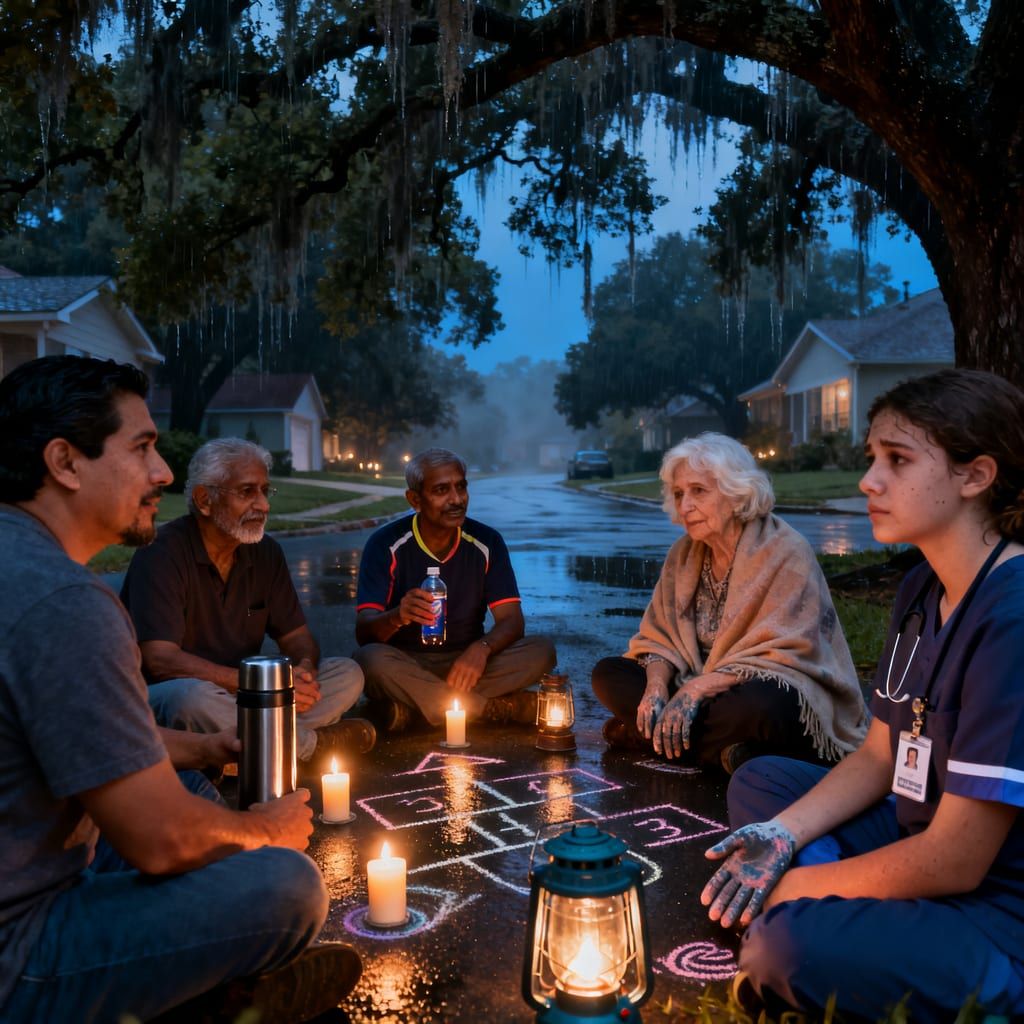
The storm snapped through two weeks later, a tantrum of Texas weather that arrived like a slammed door and left as suddenly. The cul-de-sac went dark. The first quiet after the wind and rain felt unnatural, wires that hummed in the background suddenly still. Then the murmurs started-doors opening, footsteps on wet concrete, the scrape of metal chair legs.
Jon lit three candles, their flames coiling. He filled his thermos with coffee and another with the mint tea his ex used to brew. He hesitated-then he carried both outside.
Porches bloomed with light: candle jars, battery lanterns, one heroic neighbor with a headlamp. The air smelled of wet leaves and hot wax. Frogs made a noise like someone rubbing a balloon across a violin string. Laughter lifted in puffs as if powered by the same mysterious grid.
"Coffee?" Jon called, awkward and hopeful. Hands reached. Someone set a pie on a cooler. Nora leaned against the fence, hair damp, eyes bright. "Buddy check minute?" she said, and he touched his phone like a reflex before remembering they had no bars. He grinned. "Right here."
Mira scribbled with a stump of chalk on the slick asphalt, drawing a hopscotch that looked like planets. Mrs. Kline watched her, shawl around her shoulders, the candlelight turning the white in her hair the color of peaches. Mr. Patel, a bottle of neon-orange sports drink tucked like a talisman in the crook of his arm, told a story about monsoon storms in Ahmedabad and how they'd sit inside and listen as if the sky was cooking.
Jon watched the light move across faces. It made everything more itself-the shine of a tooth when someone laughed, the crinkle in Elena's eyes when she teased Mr. Patel about staying hydrated, the curl of Nora's hand around her thermos. The edges of the street grew blurry, but the circle of neighbors was bright.
He remembered the first clip he'd replayed and how small it had made his world feel, shrunk to pixels and a small theft and the idea of danger breathing at the edges. Here, now, the hum he'd wanted as a kid-screen doors, his mother's voice calling him in, the live oak dropping acorns like applause-rose around him, not from a device but from mouths and the warm drift of bodies.
Someone started a story; someone else finished it. A toddler tangled her fingers in Nora's lanyard and then refused to let go, giggling. Mira showed Mrs. Kline how to step into the chalk galaxies. Mr. Patel held court on hose nozzles, triumphant when a neighbor admitted she'd never found the "mist" setting on purpose. The street, for an hour, felt like a village.
Jon held his thermos in both hands and felt its heat. His house light had been a single window in a dark field for so long it had begun to feel noble. Now, he understood what it had really been.
He glanced back at his porch, where the doorbell camera's little eye sat dark and unblinking in the outage. He reached up, just for a second, and touched the plastic ring with his fingertip.
"Hey, Jon," Mira said, drawing a star that touched three chalk planets at once. "Do you think the power'll be back soon?"
"Maybe," he said. "But we've got enough for now."
The wind ruffled the live oak leaves like pages. Candles guttered and steadied. A dog barked once, then twice, then settled as if recognizing the shape of the night.
The storm had knocked the hum out. The neighborhood built it back, one voice at a time, until the dark felt full.
When the lights sprang on, eventually, there was a breath of surprise and a small cheer. The camera woke with a blue blink. Jon turned, listening past the thin digital chime to the thicker sound of neighbors mid-sentence, continuing.
He didn't need to replay it. He was here.
A daughter learns to read between the lines of a life split in two
Read more →
A fog-draped night, two souls found, and the quiet shape of a life
Read more →
Story audiobooks for children of all ages — a new one every day on Smarter Way Stories.