Two Houses and One Quiet Heart
A daughter learns to read between the lines of a life split in two
Read more →
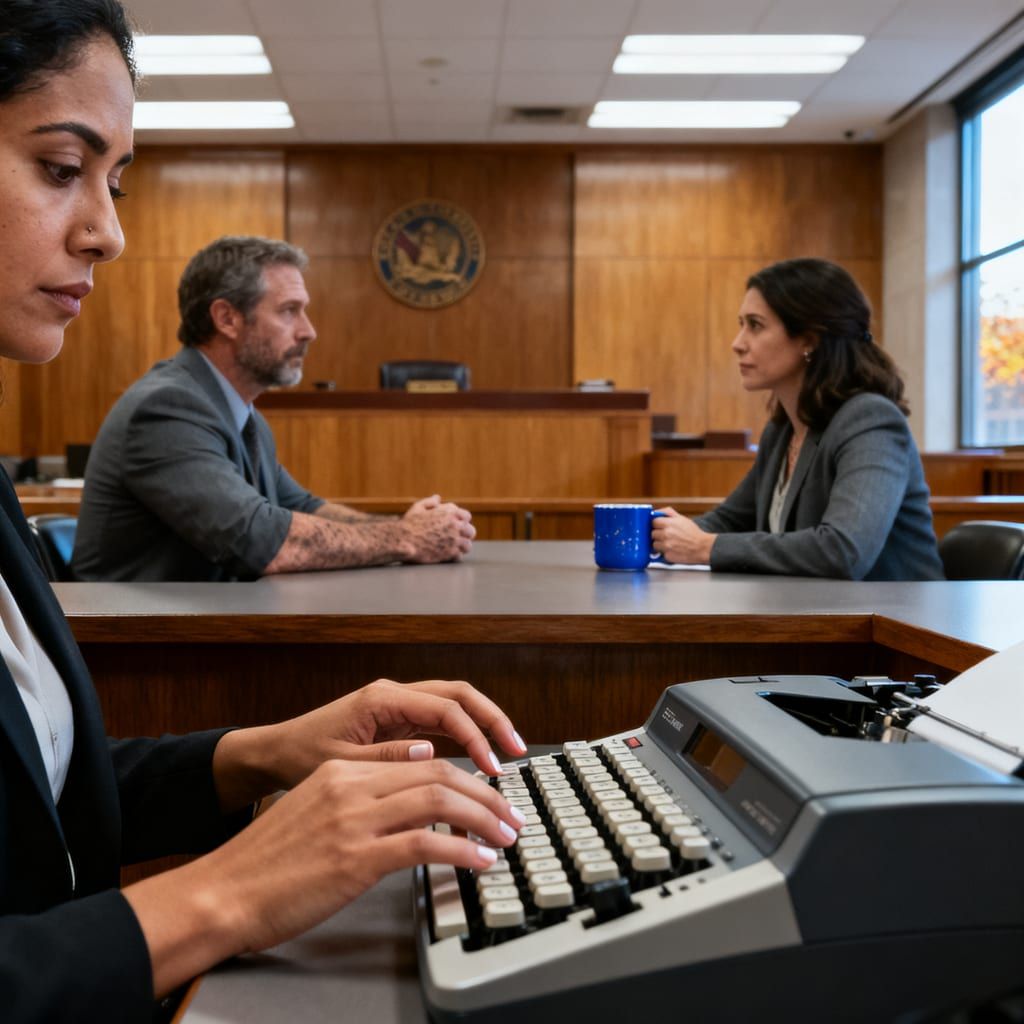
The keys make their own weather-soft clacks like rain against a window. In the Daley Center, seventh floor, I sit where the carpet gives way to tile and the fluorescent lights wash the world the same shade of beige. A seasonless place, even in early autumn, even when I can taste the wind from the river between revolving doors at lunch.
I am a metronome. When people speak, I strike. When they pause, my hands float above the keys, hovering like birds.
They teach you to disappear-spine straight, eyes on mouths, not on faces. The human mess unfurls: divorces, evictions, a lifetime cracked open in calendar hearings. I take it all down in chords of stenotype, translate later into a language the law will live by. No adjectives. No embellishments. These are my vows.
A year of this, and I have perfected neutrality. Or so I tell myself. Since the winter my mother's bungalow lost its porch light and my brother and I-Marcus with his firefighter shoulders, me with my immaculate notebook-stopped speaking. Over paint colors and estate papers, then over old stories sharpened into weapons. We stopped before I could play her last voicemail. I keep it starred, untouched. As if unplayed means unending.
On the calendar today: Probate dispute. Modest estate, two siblings. I write the caption at the top of my transcript and feel nothing. Or the cleanest approximation I have to nothing.
They enter like walking history: a woman my age in a thrift-store blazer, a man older by a head with lawnmower forearms. Their lawyer leads. They do not look at each other.
The judge-Russo, with a handkerchief perpetually half out of his pocket-asks them to be seated. The lawyers clear their throats like orchestras tuning. My machine steadies under my fingers. I swallow the coffee later, colder by degrees.
Plaintiff's counsel begins with the inventory: A silver watch with a cracked crystal. A house with a sagging porch. A handful of accounts that barely break the five-figure mark. The sister, Marissa, clutches a chipped blue mug like it is a passport, knuckles whitening each time the word "sell" lands on the record.
"When my father's mind started to go," she says, voice thin, "he left the porch light on. Every night. Even noon on some days, he'd flip the switch." She squeezes the mug. "It was the only thing he could remember without help."
The brother-Daniel-clears his throat. "I did the lawn. Every Sunday, like church. Resented every line I mowed around the hostas." He tries to smile and fails. "Felt like the house would swallow me if I didn't keep cutting it back."
I write their pauses. I write their laughter where it falters. The words find me where I don't want to be found.
My mother used to stand in our kitchen in Pilsen, apron apron-smudged with flour, and say to us over the sizzle of onions, Don't forget, the porch light's on. Come home when you can. Voicemails in December echoed it, softened by static. I never hit play on the last one. Neutrality is easier when the tape is sealed.
Defense moves to admit Exhibit D: a note found in a junk drawer, discovered after the funeral under rubber bands and batteries that leaked white powder. It's torn from a lined pad, blue ink smudged where a left hand would rest.
"May it please the Court," the attorney says, and Russo lifts a hand like a conductor stalling an exuberant violin. I take it down. My thumbs anchor me to the machine.
The lawyer reads: "Dan, I put the spare key under the mailbox. Marissa, if you need the ladder, it's in the shed. Porch light's on. Come home when you can."
The words arrive like a stone tossed into the still pool I've made of myself. Ripples move out-kitchen light, winter voicemail, a refrigerator covered in magnetized years. I keep writing. I do not stop.
"Objection as to relevance," someone says. "Goes to intent," comes back. The dance of it, the good shoes on carpet. But the brother and sister have stopped blinking like people surfacing.
Daniel leans forward. "He used to say that. When he forgot my birthday, when he forgot there was milk in the car." His voice breaks its own rule. "He'd say it like a promise he could still make."
Marissa's hand cups the mug as if checking a child's forehead. "I didn't want to sell," she tells the judge, not looking at her own counsel. "It felt like leaving him on the porch with the light still on. Felt like I was the only one who saw it."
The attorney's mouth opens. The judge lifts an eyebrow. I keep time.
It does not come with fanfare. No violins, no collective gasp. There's just the moment where their eyes touch-a bridge dropped across a cold river-and the hearing takes a small step sideways.
Daniel clears his throat again, gentler this time. "I took the watch," he says. "Not because it's worth anything. Because I was afraid-" He pinches the bridge of his nose. "Afraid I was already a ghost. That when you left food in the fridge with my name on it, you were feeding a memory. I didn't want to be one."
Marissa nods, mug trembling on saucer. "And I camped in the house like it was a flag I'd planted. I was more proud than sad. I didn't want you moving in and repainting the kitchen sage-green and erasing her."
Her. We all know who the her is. The room shifts, like someone has cracked a window and invited October in.
Their lawyers try, half-heartedly, to herd them back into arguments, but Russo is shrewd in the way of old men with good handkerchiefs. He lets them tie their own knots into bows.
They do not speak in legal terms. They speak about a toaster that burned one side only. Black cherries in a paper bag. How the old screen door never latched unless you kicked it, light-footed and sure. It all goes into the record because their mouths make it so. I do not decide; I receive. But receiving has its own weather.
"Return the watch," Daniel says finally, to no one and everyone.
"I'll sell," Marissa answers, eyes steady. "We split. But one dinner first-Sunday, in the empty kitchen. We'll use paper plates." She lifts the mug as if toasting a ghost. "For him. For us."
My fingers travel the arc between grief and grammar. Their words land as they are: uncluttered, unadorned. I type the settlement on a machine that has never known anyone's mother but learns the shape of mine in the patterns of other people's speech.
At noon, my badge swings against my chest in the security line. Outside, the air finally tastes like leaves. I take my sandwich to a bench across from the fountain, where pigeons conduct small negotiations over crusts.
In my inbox, my mother's name is four letters and a number. "Ma, 1 new." The last voicemail sits there with its little triangle waiting, patient as a porch light.
I put in one earbud. Then the other. I hover over the play icon. My thumb stutters.
The exhibit's words follow me out into the sun-blue ink, slanted letters. Porch light's on. Come home when you can. The same cadence my mother used when she'd call after my shifts and leave the radio on too loud in the background.
I press play.
Static first. The click of her breath. Then her voice, smaller than I'd kept it in memory and somehow more hers.
"Mija, I got the gas bill. Don't forget to take the good blanket, it's in the closet with the wrapping paper. Porch light's on. Come home when you can."
A car horn smudges the end. Someone laughs in the distance. My chest opens like a door on a stiff hinge. I do not cry. Or I do, but it's not the parade I feared-more like a faucet turned low, rinsing the coffee out of a mug.
Neutrality had been a costume with the seams giving way. Sitting there, I let the sound stitch me.
Marcus is still a green dot in my messages. Last we spoke, he sent me a photo of the bungalow's porch roped off for new steps. Caption: "Permits came through. You're welcome." I scrolled past, righteous and right. The ledger I keep is neat, columns crisp, my pride a perfectly drawn line.
I open our thread. My thumbs, little birds again, hover over glass.
I type: I can meet you at the house.
I watch the sentence for a beat, as if it might misbehave. Then I press send. The screen bubbles, then settles into stillness. The fountain keeps spilling over itself. On the bench beside me, a woman in scrubs pinches pickles off her sandwich and lines them up like commas.
My phone pings before I expect it to. His reply is a photograph-front steps finished, the porch light glowing although it's barely noon. Under it: Sunday?
Yes, I write. Paper plates.
The next day, back in the seventh-floor weather, I prepare the minutes. Case number, parties, disposition. I type it as the cleanest fact: Case settled. The words look smaller than what they hold. They always do.
In my own book-the one without a caption where I keep grocery lists and the number of earthquakes that happen in a day because my mind likes useless order-I add a line beneath the week's items: Call Marcus re: Sunday. Bring napkins. No italics. Ink.
The day slides forward. Landlords. A rearranged custody schedule. A woman who says the word "forever" into a microphone like it has teeth. I make the record faithful. More and more, the record makes me so in return.
When I leave that evening, the building has discovered fall. The plaza is scattered with blown leaves, the kind that stick to your shoes and show their undersides, silver and soft. I walk to the bus with my badge tucked into my coat, fingers warm from the memory of voicemail static and the shallow dunk of Mendoza-line coffee.
On my way home, I pass a row of houses with their porch lights on though the sun is still up, as if a neighborhood can practice remembering. I think of a chipped blue mug waiting on a paper plate, of a watch returned to a drawer next to batteries that don't fit anything anymore.
No one monologues the moral. No one asks forgiveness into a microphone. The key, I think, is in how we listen-how we let other people's sentences lay down tracks our own feet can follow.
At my stop, I step down into the street's shallow gold. Behind me, the bus pulls away with a hiss, and the day makes a soft, decisive click-like a buttoned coat, like a light switched on and left burning just long enough for you to find your way.
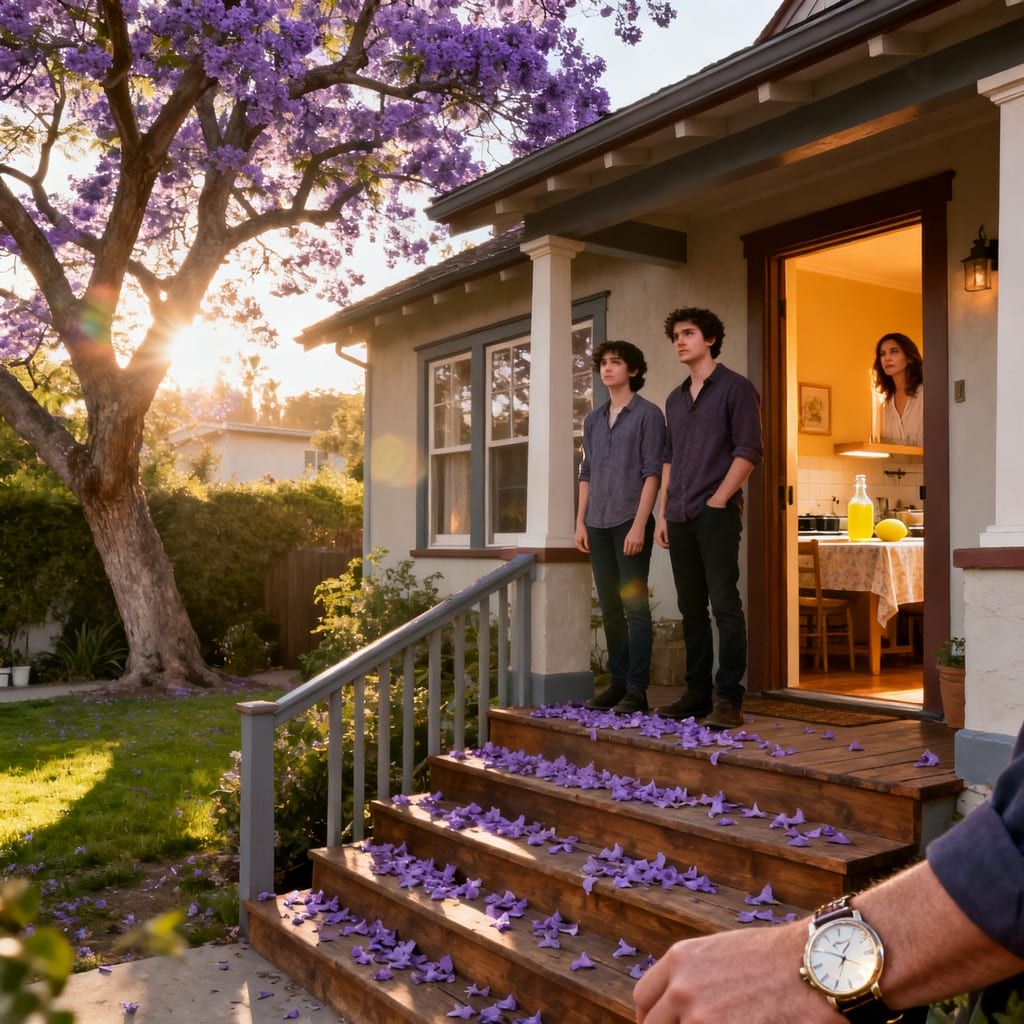
A daughter learns to read between the lines of a life split in two
Read more →
A fog-draped night, two souls found, and the quiet shape of a life
Read more →
Story audiobooks for children of all ages — a new one every day on Smarter Way Stories.