Two Houses and One Quiet Heart
A daughter learns to read between the lines of a life split in two
Read more →
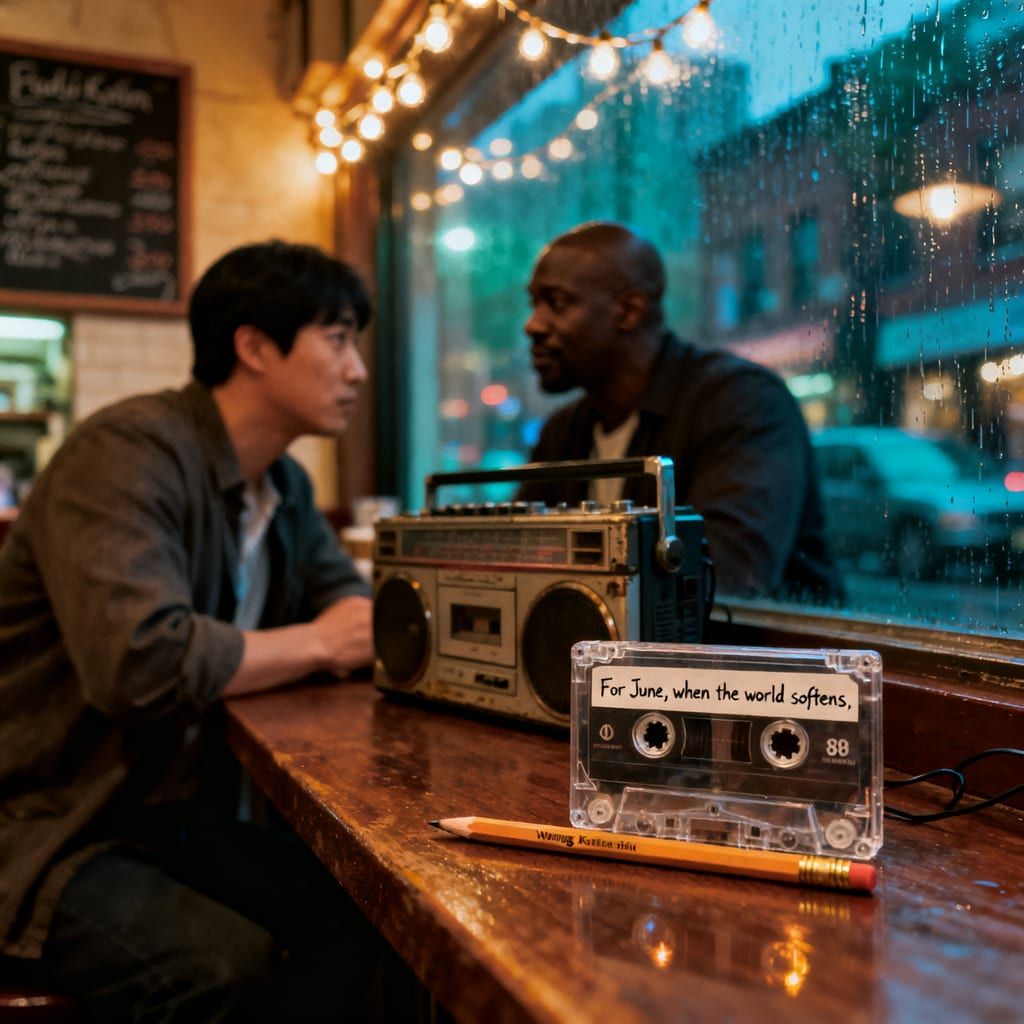
The Walkman was the size of his palm and the color of an old bruise. Evan found it in a bin near the back of the thrift store, glass bottles chiming somewhere behind him, the overhead speaker caught in a loop of a chorus that never landed. He bought it for six dollars to test a client's lo-fi fever dream-tape hiss as aesthetic, warble as virtue.
On his kitchen counter that night, he thumbed the latch. The door gave with a tacky sigh. Inside, a cassette: clear shell, reels the yellow of tea. A handwritten label in soft pencil: For June, when the world softens.
He pressed Play. The first thing was air-hiss, crackle, then the tender drop of Mazzy Star floating up like something lost at sea. He turned the volume a hair. Between tracks: a doorway slam, a bicycle bell, someone laughing too close to the mic as if they'd been startled into joy.
Then a voice, bright and certain: "Good midnight, Owls. This is June Bug on 89.7. Keep the night kind."
He stilled with his hand on the kitchen table. June Bug. His mother, June Park, had said once-twice?-that she'd done a college radio shift the year before she graduated. She didn't leave much behind when she left the world, just a shoebox of index cards with recipes clipped from magazines, and two playlists hand-lettered on scrap paper with stars in the margins. She had never played him a single tape.
He rewound. He played it again. This is June Bug. The way the j softened into the u. The little comma of a sigh she always put after a joke, like an apology. He would have known that voice in a tunnel.
He digitized the tape the next morning because that was his work and because it felt like prayer. He fed the line-out into his interface. He named the project file "World Softens." Waveforms crawled across the screen like a coastline-peaks for the high hats, valleys of quiet so tender he wanted to put his hand in them.
Between A Tribe Called Quest and Jeff Buckley, the young woman returned to give the weather. "Fog rolling in. Love line open 'til two-say hello, say sorry." Her consonants snapped like clean lettuce. Then a corridor of footfalls, someone whistling under breath, a door that didn't know it was heavy.
He posted a clip on his little-followed feed. He knocked on the doors of forums with names like Tapeheads and Dead Air, wrote to people who had written about people who had once haunted midnight studios. He called the defunct station number on the liner note, half expecting the endless ring to swallow his afternoon.
Three calls later, an engineer named Laurel answered at her kitchen table in Ohio. Her wife laughed, off, about the box marked "Cables, 1993-1998." Laurel took a breath when he played her the DJ sign-off over the phone. "I wasn't nights," she said. "But June Bug-June Park-that was spring of '96. You said the cassette said 'For June'? Might not be for her. Lots of boys named their girlfriends June in the spring. Try the reunion group. They announced one for this year."
The group led him to a photo of a coffee shop with gingham curtains and a bell that hung like punctuation. The caption said: "Marcus is still keeping time. You remember his afternoon show?" Someone tagged Marcus Reed. Someone else wrote, "He used to make the best mixes."
The café's door chimed an E-flat when Evan pushed through. It smelled like burnt sugar and damp wool. A man in his forties with a careful beard wiped down the counter in slow ellipses, the rag squeaking.
"Coffee?" he asked.
"Maybe in a minute." Evan set the cassette in its cracked case on the counter as if it might spook. "I think this is yours."
The man's hand stopped. He stared at the tape with the incredulity of someone who recognizes his own handwriting on a note he never sent. "Where'd you-" He swallowed. "Hold up."
They went to the back room, past sacks of beans and a dented stock pot, to a battered boombox on a metal shelf above a crate of paper cups. Dust motes wavered in a shaft of window light like something underwater. Marcus clicked the tape into its little mouth and pressed Play with his thumb as if he were throwing a switch that controlled the weather.
Mazzy Star bloomed thinly, familiar even through the boombox's uneven speakers. Then: street noise, the jangle of keys. The DJ's laugh.
"June Bug," Marcus said, not looking at Evan. "I clipped her between songs. Courage in pieces." He rubbed his thumbnail against a nick in the boombox's grille. "I made this in '96 for a girl who was leaving for a semester in Prague. Her name wasn't June. I was too shy to say half of what I thought. So I made... sounds. I thought if I put the world in a row-songs, voices, the train by the river-you could hear what I meant. I never gave it to her. Then I lost it in a move. It felt like proof I'd meant something, and I let it vanish."
"My mother's name was June," Evan said. It felt ridiculous as soon as he said it, like an overreach, a ghost hunt. "She used to say 'keep the night kind.' That was her-on the tape."
Marcus's mouth opened, then gentled into an O of awe or apology. He paused the boombox. Hiss held the air a moment longer and then let go. "You sure?"
"I hear her." The old heat rose beneath Evan's sternum-the same heat that had ripped through him on the day they unplugged the machines and all that humming dropped away. He blinked hard and looked at the slit of light under the stockroom door.
Marcus nodded once. "We can find her. The station kept rosters. I know a guy who archived flyers. She was a student then, yeah?"
"Yeah." Evan's voice came out thready. "She... she became a guidance counselor. She died in March." Saying it was easier among stacked cups and the persistent smell of coffee oils, like pressing a bruise in private.
They worked in fragments, in the cracks between shifts and sessions. Marcus sent messages to classmates with last names like bridges and colors. Evan combed forum threads, found scanned playlists with block letters and hearts. Someone posted a photo of a young woman at a soundboard, hair pulled into a high ponytail, headphones crooked around her neck like a question.
He zoomed in until the image dialect broke into squares. The caption read: "June P., Midnight. 'Keep the night kind.'"
At Evan's apartment, they propped the photo against a jar of pens, an audience of one. They listened through the tape together, the hiss like surf between islands-A Tribe Called Quest's bass like warm breath, Jeff Buckley's falsetto lifting until the ceiling seemed to arc. Between songs, June's voice let herself into the room as if she had a key. "Rain tomorrow," she said. "If you're awake for bad reasons, call me."
"She always said that?" Marcus asked softly.
"Different words." Evan's mouth tugged into a smile he didn't quite feel yet. "Same weather."
When the tape's first side thudded to a stop, Evan didn't flip it right away. He traced the label with his fingertip. The pencil had pressed just hard enough to dent the paper-For June, when the world softens. He knew the phrase from a card his mother once propped against a vase of peonies. He'd thought she'd clipped it from a magazine like the lemon bars. Maybe she'd borrowed it from the air of that spring, from a station that sang to small rooms.
Marcus cleared his throat. "That winter, I almost dropped out. I was working overnight at the copy shop, sleeping between classes. My dad thought radio was a waste. I was... lost. June Bug made the night feel like it wasn't a punishment. I cut her voice into the tape to, I don't know, sew myself together. I never gave it. It still saved me." He let out a breath that left his shoulders smaller. "I'm sorry for your loss."
"Me too," Evan said. He surprised himself by laughing once, shy and real. "She'd hate that we're sitting in my kitchen crying to Jeff Buckley. She'd say we needed to eat first." He opened a drawer and pulled out two spoons and a tub of supermarket tiramisu. They ate standing at the counter, sugary coffee and cocoa dust choking into their laughter.
He slid the cassette case across the counter to Marcus as they packed up. "It's yours," Evan said.
Marcus held it like a thing newly fragile. "I can't-"
"You can." Evan met his eyes. "You made it. It did what it needed to do. It brought you here. It brought me here." He tapped the scuffed plastic. "Unfinished gestures count. They're how we leave the door ajar."
Marcus's throat worked. He nodded, then took a pen from behind his ear. On the cassette's paper insert, in tidy block letters, he wrote: For June-who kept the night kind. Thank you for teaching me to be brave, even when I wasn't. He dated it, twenty years stall between numbers and ink.
A week later, he told Evan he'd mailed the tape. Not to the girl in Prague. Not to himself. He addressed it to the high school where June had been a guidance counselor, in care of the counseling office. In the envelope: the tape, his note, a copy of the scanned photo, and a letter that began, "You don't know me, but your colleague once told a campus full of insomniacs to be tender."
"They called," Marcus said, eyes a little red from the morning rush. "They're going to keep it in a little display for the seniors. 'Voices of Care,' they said. I told them about you." He blinked as if the world were new when he looked up. "You okay?"
Evan nodded. The ache under his ribs had shifted shape-not gone, but with edges he could touch without bleeding. "I think I want to make a night. A small one. Here, maybe." He looked around the café-the way a family of light pooled on the chalkboard, the tree outside tossing its leaves like a stubborn cheer. "We'll play tapes people forgot they loved. Bring your cassette, your voicemail, your grandma's recipe on the answering machine. I'll run the board. You pour coffee. We'll keep the night-"
"Kind," Marcus finished, smiling.
Flyers bloomed on telephone poles and under magnets on fridges. People brought shoeboxes and Ziplocs and a basket with a ribbon. A man stepped to the mic and played his mother's message from '98 reminding him to bring his saxophone home. A woman unfolded a letter her wife had written on hotel stationery and read with the crackle barely contained. A kid set a phone on the counter and streamed a voicemail from a grandmother who'd taught her to count in two languages. Somewhere between a protest chant recorded on a MiniDisc and a lullaby on dictaphone, the room learned to breathe together.
When it was time, Evan slid the mix into the deck. The room hushed in the way that quiet can be a crowd. Hiss. Street noise. June Bug's weather. He closed his eyes. The sound was both smaller and larger than he remembered-smaller, because speakers keep secrets; larger, because more hearts were holding it up.
He looked at Marcus. Marcus looked at him. Neither of them needed to narrate the way music presses its thumb into time and makes an impression that stays when the thumb lifts.
Outside, the streetlamp blinked and settled. A bus sighed, patient as an animal. On the chalkboard, someone had scrawled in neat block caps, All Ages Welcome.
When the tape clicked at its end, the room didn't rush to fill the space. They let the hiss live five seconds, ten, like touching the edge of a warmed bowl. Then the bell above the door chimed for someone late, and someone else laughed too close to the mic, and Evan leaned toward the small whirling wheels and felt-for the first time in months, for the first time in years-how a world can soften and still hold.
He thought of the label in pencil. He thought of a woman with a ponytail and a voice like a nightlight, bright and certain. He thought of all the ways we say hello and sorry, the ways we leave rooms ajar.
He pressed Stop. He let the silence be kind.

A daughter learns to read between the lines of a life split in two
Read more →
A fog-draped night, two souls found, and the quiet shape of a life
Read more →
Story audiobooks for children of all ages — a new one every day on Smarter Way Stories.