Two Houses and One Quiet Heart
A daughter learns to read between the lines of a life split in two
Read more →
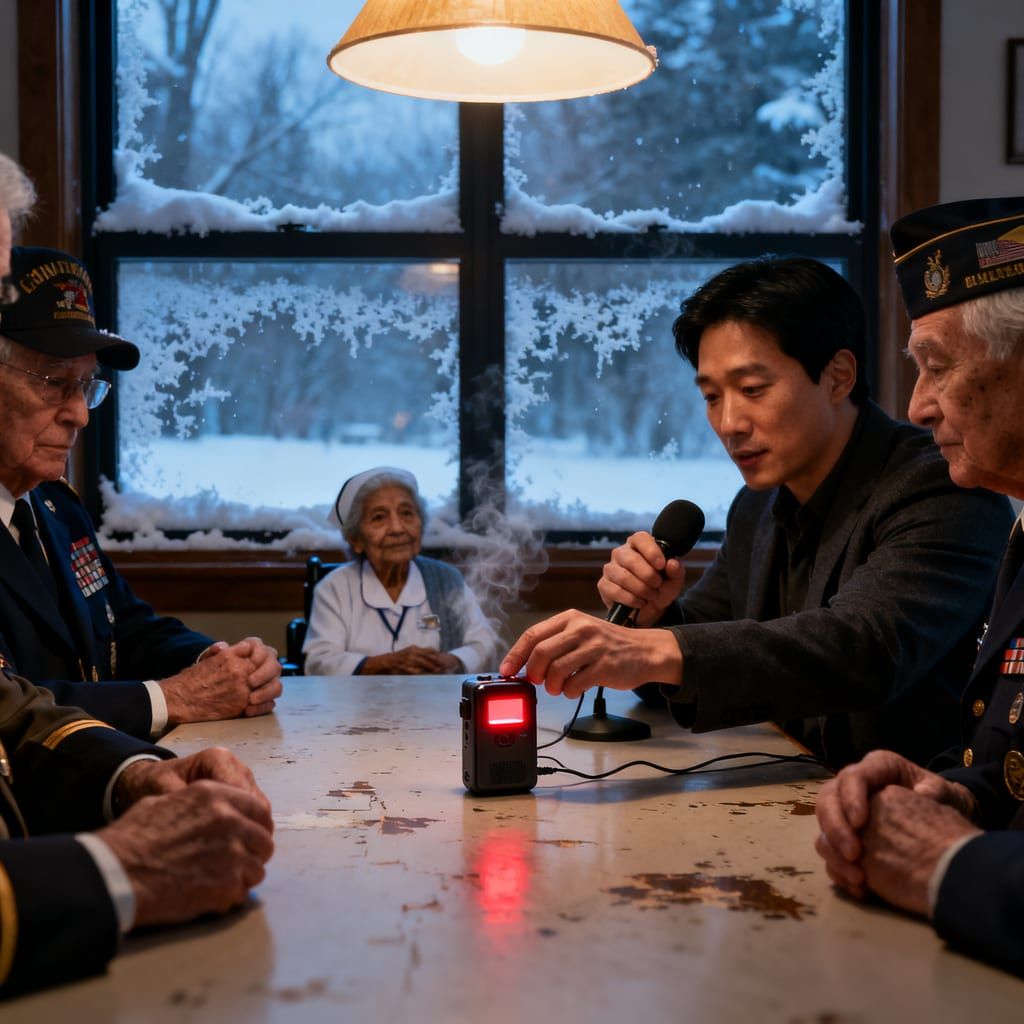
The first thing you heard in the community room was the humming-fluorescents scalpel-sharp above the scratched linoleum, radiators clanking like stubborn memory. Liam set the recorder down and watched the red light steady itself, the size of a pinprick heart.
"Take your time," he said, voice low, as if the story were a skittish thing you had to coax with quiet bread.
He'd learned the posture of listening-elbows tucked in, shoulders unthreatening, eyes soft. A question, kind and specific. Then he held still while the room rearranged itself around the memory.
Outside, Boston practiced winter: snow threading the windows, cars whispering on slush.
On his third week, she was waiting-small and sharp, ninety-two and unapologetically upright. Ruth Navarro had the gravity of someone who had stitched the edges of too many nights back together. She declined the chair he offered and took another with better light.
"You don't need to interview me," she said, hands folded, the faint blue map of veins luminous beneath paper-thin skin.
"I want to-"
"You need to interview your father."
The room paused, as if the radiator had heard something it liked. Liam's mouth worked around air. He hadn't mentioned his father, not to anyone here. The man a few tables over coughed the way old smokers do after too many winters.
"Ma'am," he said finally, because respect steadied the tongue, "I'm here to record your histories."
"Record this," Ruth said, not unkindly. "Promise me you'll talk to him. You've got a quiver, Mr. Park, a hitch when someone says 'home.' You don't fix that by taping strangers."
She held his gaze until something inside him decided it would be easier to submit than to be seen.
"Okay," he said. "I promise. But only if-"
"I'll give you ten minutes," she said, and then, after a beat that felt like mercy, "and a muffin. Blueberry, if you can manage it."
Evenings lined up like tapes on a shelf. Liam learned the weight of small trades: a warm banana nut for dawn patrol over desert scrub; a blueberry for the way a midnight radio sounded when the generator hiccuped; a cranberry orange for laughter that loosened a room the way a key loosens a stuck lock. He held his questions close and let their answers spill however they wanted.
He met men and women who had sat silent through bingo and news and bingo again. With the mic, they lifted their faces, the tremor of old hands becoming conductors' gestures. They spoke of canteens tasting like tin and prayers like dust; they spoke of letters carried in plastic bags to keep them safe from rain and fear.
Ruth's ten minutes became twenty, then an hour. She was surgical with her sentences: the way adrenaline smelled on the skin; how morphine turned the world to honey; the heat of a forehead under her palm and the word she whispered into more ears than she could count-stay.
Each night as he packed up, she'd tap the recorder with a fingernail, a small flint sound. "Don't forget your promise."
He didn't. He also didn't call.
Walt showed up like weather-quiet, unassuming, inevitable. He took the far chair and stared at his hands as if they belonged to a stranger. They trembled until they touched the microphone. Then, as if the electricity went both ways, they calmed.
"You don't have to say anything you don't want to," Liam said.
Walt lifted his eyes. They were river-colored, washed but carrying silt. "That's the problem," he said. "Nobody made me say it when I should've."
The snow had been folding itself against the window all evening, a lace curtain that made the room feel smaller, softer. Liam clicked the recorder. The red dot steadied. Ruth nodded from her post under the better light, the corner of her mouth approving in a way that made him feel twelve and eager.
"I was twenty-one," Walt began. "We were outside a village with a name I still can't say right. There was a boy-no, a man, I suppose-but he looked like a boy if you didn't know the way boys can look with a ring on."
He talked about the firefight as if speaking a recipe with missing steps. The rush, the confusion, how training turns your body into a stranger you trust. He spoke of a rescue that failed-not a grand failure, but the kind that tears a quiet hole you spend decades skirting. He'd carried a ring from that night, he said, pocket to pocket, drawer to drawer. Inside, initials. He'd tried over the years to trace names and families, always coming up against the way time erases like tide.
"I thought I'd bring it here," he said, thumb turning an invisible thing. "Give it to somebody who could finish what I started. Or didn't start. I don't know."
The red light flickered, a blink. Liam leaned forward, a hand hovering over the machine as if he could warm it back to loyalty.
"Tell me the initials," he said. "Tell me everything."
Walt's mouth formed the first letter and that's when the recorder died-the small gasp of a battery going dark. The red light went out; the room, for a second, felt as if it had, too.
"I'm so-" Liam started, panic finding the empty places. He grabbed his bag, fumbled for the spare pack he knew wasn't there because he'd used it this afternoon on a story about a midnight radio and the way a particular song can make you eighteen and invincible again.
"It's alright," Ruth said, from her corner, not moving.
But Walt kept talking. He stared not at Liam, not at the machine, but at the carpet-tan, stained with the ghost of coffee. His voice didn't falter. He said the name of the village. He said what he did and what he didn't, what he wished he'd done, who he carried.
Liam listened without the crutch of tape. He tried to memorize the shape of the syllables, the tilt of Walt's jaw at the difficult bits. He felt, for the first time, how a story can exist without plastic reels to catch it, how it can hover in the shared air and still be real.
Walt didn't come back. News passed like it always does in places where time is a collective project. A quiet, a whisper: he went in his sleep.
Liam stood in the doorway of the community room with the dead recorder shockingly light in his hand. "I'm sorry," he said to the gathered faces, to Ruth. "I'm sorry about the tape."
Ruth looked at him the way nurses look at men apologizing for their pain. "Sit," she said.
They did something he'd never seen-never dared to ask for. Ruth began with the village's name, pronouncing the consonants as if they were sutures. A man by the window supplied a detail about the heat that night, how it moved sideways along the ground. The woman who ran bingo whispered the way the air tasted-gunpowder and rain.
Together, they conjured Walt's confession. Line by line, each held a piece and then laid it down. They overlapped and corrected with a tenderness that made Liam swallow twice. He wrote frantic notes he knew he would not need-the notes were a courtesy to his own training.
When the question of the ring's initials arrived, the room hushed as if a bird had just landed on the sill and nobody wanted to scare it.
"J.N.," Ruth said, so quietly it took a beat for the letters to take form. "We tried to get him back. He asked me-" She stopped, adjusted her sweater the way people do when calling their body back into the room. "He asked me to hold something until I found someone to finish what he could not. I gave it to Walt because he was the one with hands open."
The letters ran along the inside of Liam's skull like an old train route. J.N. He thought of the laminated sheet his aunt kept above the family calendar, the tree drawn in tidy boxes. Maternal great-uncle: Joseph Navarro. Killed in action, 1951. Sister: Ruth.
He looked up. Ruth was watching him with the infinite patience of a night shift.
"I couldn't find his people," she said. "They were my people. I was so new then. I thought if I gave it to someone better, he would know to go home for me."
Liam exhaled, and it felt like clearing a room after surgery-lifting blinds, pulling the bedclothes back, letting light consider the scar.
He put off his father like you put off a dental appointment-necessary, dreaded, easy to justify delaying with snow and work and the small dignities of being busy. Then Ruth, on her way out, placed her hand on his sleeve and squeezed, the way you do when your words have run out and you risk leaving too much unsaid.
"Don't come back without his voice," she said.
The hallway outside his father's apartment smelled like boiled cabbage and Pine-Sol. He stood there with the recorder heavy as a proposition. He knocked. The chain slid, the door opened the cautious width of a man who expects salesmen or debt.
"Dad," he said.
His father had the look of retired weather-broad shoulders, a clouded calm. The scar on his knuckle was the same one Liam had traced as a child while pretending sleep in the back of the car.
"What's all this?" his father asked, eyes on the bag.
"I'm asking you for an hour," Liam said. "And a chance to hear you in your own words."
They struggled at the threshold-shifting from old habits to new ground is a choreography. Then they sat. Liam set the recorder between them like a neutral country. He asked the kind question he had been practicing on strangers, and then he held still.
The tape caught a man learning the shape of forgiveness in real time. His father spoke around the silences he had enforced for decades, the places where a door had been closed and the sound of it had made a boy flinch. He said the names of men he'd carried, the smell of the ocean in his hair when he came home and couldn't wash it out. He talked about the way laughter sometimes burst into rooms built for grief-not as offense, but as oxygen.
At some point, the afternoon slid into evening. The radiator in his father's apartment hissed the same melody as the one at the VA. Liam imagined the red light glowing honest between them.
When he told his father about Walt, about Ruth, about J.N., something unclenched in the older man's jaw. "Navarro," he said, trying the name on. "I remember that name. We lost a Navarro. I didn't know he had a sister."
"He does," Liam said. "She's been waiting without expecting."
They found her in a house with a plastic snowman staked in the yard and a mailbox with paint worn away where hands had insisted on being hands for half a century. She answered the door with an afghan draped over her shoulders and the cautious brightness of someone who has learned to meet strangers with tea.
The ring sat in Liam's palm like a small moon, the initials catching the light-J.N.-and throwing it back unbroken. He offered it not like a victory, but like a relay baton you're relieved to pass without dropping.
She held it and let out the sound people make when something impossible becomes touchable. Not a sob, exactly. A release. Liam saw, in her face, planes rearranged by time finding again their original coordinates.
"Where has this been?" she asked, eventually.
"In a lot of pockets," Liam said. "And in a room where people remembered together."
His father stood a little behind him, the way he had at school plays-present, trying to be invisible so the stage could be the stage. Later, in the car, he sat with both hands on the wheel, engine off, as if they'd reached somewhere that required stillness.
"I don't know how to say the right thing," he said, finally.
"You already did," Liam said. "You said it back at the table."
Back at the VA, the red light blinked on. Liam let it be an instrument, not a crutch. He told them where the ring had gone. Ruth closed her eyes, and her inhale shook once, like a wave arriving from a very long way away.
They went on telling. The stories held each other like patches in a quilt-different weights, different colors, one warmth. They laughed in the places where laughter sneaks in, even now. They sat with the places where it doesn't. A broken machine no longer felt like an ending; it felt like an invitation for the room to lean in and become more itself.
When he packed up, Ruth slipped a folded napkin into his hand. Inside, a blueberry muffin, still warm enough to smudge the paper with butter.
"Payment," she said.
"For what?"
"For finishing what I started. And for starting what you needed." She looked at the recorder. "You keep running that thing, but don't forget how we did without it."
Outside, snow worked the city softer. Liam stood under the streetlight and listened-not to tape, but to the sound of his own breath clouding the air and disappearing without being lost.
He had cabinets now full of voices-desert heat, midnight radios, mercy's sly arrival. But the archive that mattered hummed elsewhere, a chorus that didn't need spools or screens, only a room with a table and chairs and the decision to hold one another's sentences until they found where to land.
On his way home, he called his father just to leave the line open while they said nothing together. The silence didn't harden. It breathed.
And when he closed his apartment door, the red light of the kettle flicked on. He smiled at it-at how small a heart can be and still keep time.
A daughter learns to read between the lines of a life split in two
Read more →
A fog-draped night, two souls found, and the quiet shape of a life
Read more →
Story audiobooks for children of all ages — a new one every day on Smarter Way Stories.