Paper Cranes at Shift Change
A winter of small mercies, folded and kept
Read more →
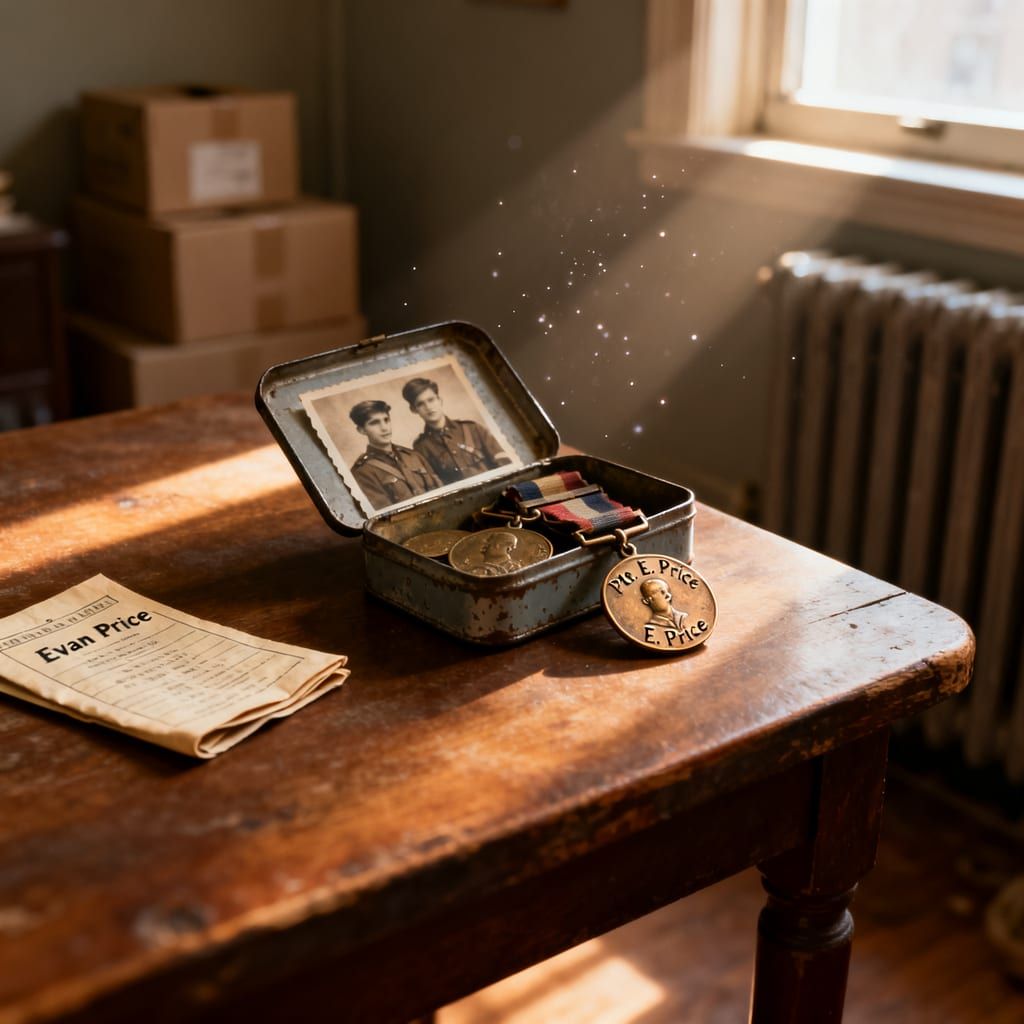
The shoebox was the kind that remembered feet. Tin dented in two corners, lid that stuck like a secret. Aaron found it at the back of his late grandmother's closet, where dust gathered in soft drifts and a lone pair of heels lay on their side as if mid-conversation.
He sat cross-legged on the carpet, the apartment quiet except for the thin rasp of traffic sliding down 46th Street. When he pried the lid, the air changed-metal, old paper, the sweetness of lavender sachets crushed into time.
Inside: four tarnished medals, faces dulled by thumbprints long gone. A sepia photograph: two young soldiers with open, astonished smiles, shoulders touching under a sky bleached to blank. A folded ration card, fragile as onion skin, stamped in a British hand-Evan Price.
His great-grandfather, Suresh, had marched in parades, the ribbons bright against a suit that smelled of starch and winter. Beyond that, a shorthand of history: duty, honor, Italy. Nothing that could be held this way, that had the gall to introduce a stranger by name.
Aaron slid the card between his fingers. It made a dry whisper, like a leaf about to let go.
He called his father that night from the kitchen, the shoebox between the cumin and the soy sauce. The apartment smelled like boxes, like tape ripping, like the ends of sentences.
"Evan Price?" Aaron asked. "Does that name mean anything to you?"
His father's pause softened around the edges the way fatigue does. "Your great-grandfather didn't say much. He kept... practical company. He didn't save the medals to show off. He saved them because his mother hid them in the flour tin and then couldn't find them without him."
"Dad."
"There was a story," his father added quietly. "Something about Italy. Snow that wasn't snow. But I was a kid, and I thought he was being dramatic about dandruff."
Aaron laughed despite himself, then stared at the photo again-the two boys there, the curve of a smile that looked like someone he'd know.
The job had been bruising him from the inside out for months. Design sprints that sprinted nowhere. A manager who used "war room" for meeting invites without irony. Courage reduced to persuasion decks and demo-day adrenaline. In the morning, he was supposed to present a feature addressing a problem that did not exist.
He ran a finger along the ration card's edge and felt something like the beginning of a tug.
The neighborhood veterans' center in Elmhurst had frosted glass and a doorbell that squealed its age. Bulletin boards layered with paper: grief and gratitude in pushpins. He explained himself to a woman with silver hair and steady eyes who led him to a back room where a retired historian kept a desk like a harbor.
"British Indian Army," the historian said, lifting the medals with the gentleness of a man handling a sleeping bird. "Italy. Likely the 8th Indian Division. See here? This ribbon-Italian Star. That makes sense. But this one..."
He turned a bronze disc under the fluorescent light. "1939-1945 Star, India Service Medal... and-this isn't Indian issue. British War Medal, yes, but the naming-see the edge? Evan Price."
Aaron read it-there, faint as a bruise: Pte. E. Price.
The historian watched Aaron's face do the math. He slid the sepia photograph closer. "Men didn't fight alone," he said. "They held onto each other. Sometimes, quite literally."
Outside, a siren wailed through Queens traffic as if answering an accusation. Inside, Aaron stared at the names. Suresh Patel had kept a stranger's medal in a tin where flour used to live.
"Why would he-"
The historian shrugged, eyes turned kind by years of reading endings. "Promises made in places designed to break them tend to have weight."
In the shoebox, under the photo, a pawn ticket: Issued: December 1946. And a penciled address on the ration card, the handwriting careful, like someone not used to English wanting to get it right.
The Astoria rowhouse sat narrow and stubborn, its stoop paint chipping in neat confetti. A wind chime shivered in the late light. When the woman opened the door, Aaron recognized her only by the look of someone who has kept a room in her heart ready for a visitor she cannot name.
"Carys Price?" he said.
She was in her sixties, gray hair piled in a clip, shirt sleeves rolled to elbows made for work. Her accent was Queens with a question mark tucked into the edges. "If you're selling energy plans, absolutely not. If you're here about the stoop repair, come in."
He held out the ration card like a passport between old countries. "I found this in my grandmother's apartment. I'm Aaron. My great-grandfather was Suresh Patel."
Her face changed the way a sky does just before rain. "Well," she said softly, then again, as if to herself. "Well. Come in."
She made tea. The kettle took its time, rolling to a boil with an old-fashioned pride. On the table, she set her own shoebox-cardboard taped, edges softened by years of sliding things back when the world felt too big.
"Evan was my grandfather," she said, fingers resting on the lid. "He never came home. My mother kept this box because it was the only room he did."
Inside were letters, tight cursive that leaned forward, as if in a hurry to be heard. A photograph of a boy fishing with a makeshift rod, trousers rolled to knobby knees. A list written in a different hand: names with addresses. At the top: Return. Please.
"The story we had," Carys said, "was of a man named Suresh who my grandfather pulled from something that wanted to keep him. He was hit himself. Field hospital-the kind with mud for walls and saints with dirty hands. He made Suresh promise to return a medal to his mother if he didn't make it."
She looked at Aaron. "We thought it was one of Evan's. We never had it. We never had him."
Aaron opened his tin. She lifted the odd medal like it might tell them what to do. The edge said what it could: Pte. E. Price.
Carys pressed her lips together. "He did it," she whispered. "He kept it safe until someone could carry it the rest of the way."
They sat with their tea and history between them. Outside, a bus sighed at the corner, and a child laughed at something invisible and perfect.
"There's a pawn ticket," Aaron said. He slid it over. "1946. My father thinks Suresh didn't keep much. Money was-well-Queens in '46, immigrant in '46."
Carys nodded. "My grandmother worked a line in a cannery, sent coins folded in paper to my mother for shoes. The list-" She touched the sheet with names. "Evan wanted things returned when they could be. The war, it spread people like dandelion seeds. He didn't want names lost."
Aaron read the first: Mrs. S. Patel. Then, an address that matched his great-grandmother's building. Down the page, strangers whose names felt dear for how simple they were-a Habib, a Flynn, a Chatterjee. Debts written like prayers.
"Do you know why the pawn ticket?" Carys asked.
"A retired historian said men didn't fight alone. He didn't say what they did after. But-" Aaron hesitated. "My father said Suresh once mentioned helping someone get somewhere. Passage, he called it. He was the kind of man who'd pawn himself for a stranger if that's what the day asked."
Carys smiled in a way that made the room warmer. "My grandmother always said, 'He sent us a man who believed promises were currency.'"
They placed the medal on the table between their mugs, the bronze catching afternoon like a secret finally on the right shelf. In the soft clink of ceramic and metal, something settled.
Returning the medal did not cleanse anything. It did not make the world smaller or the past less cruel. It only created a line that felt right to stand on.
Carys cradled the medal the way you carry a sleeping child's head. "I wish I had the words," she said, "but they all sound like the kind you print on benches. Thank you will have to do."
He shook his head. His palms felt empty in a new way-emptiness like a promise kept.
"He pawned his," Aaron said quietly, to the room, to the woman whose eyes were full and steady. "To get someone started. He kept Evan's to get this done."
Carys wiped her cheek with the back of her hand, efficient and tender both. "Then we do both. We return what's not ours, and we push someone else's cart a little further. That seems fair, doesn't it?"
Aaron thought of his grandmother's apartment, the tape on her chairs, the list of food she could have on a good month. He thought of stand-ups that asked for courage and meant compliance. He thought of the way his great-grandfather wore his suit, careful and clean, and the way he never corrected anyone who assumed the medals were all his.
After he left, he walked the Astoria streets the way you walk when you're carrying a glass filled to the lip. The light slanted; a deli cat draped itself in a window like a small sun god. A man on the stoop practiced a trumpet line that kept almost becoming a song.
He called his father from the corner of 30th Avenue and Steinway, where the air smelled like grease and oregano.
"He kept a promise," Aaron said when his father picked up. "Evan Price died dragging him out of a mortar blast. Suresh promised to return the medal. He did. He pawned his own to get someone passage-maybe to here, maybe to anywhere. It wasn't a trophy box. It was a ledger."
His father was silent long enough for Aaron to hear him sit down. "You always did like the stories that hurt a little," his father said finally, voice gone gentle. "What do we do with this one?"
"We finish it," Aaron said. He surprised himself with how solid the words felt. "On the day he was pulled out-the day he got another chance-we pay for someone's first step forward. Something small but real. A bus pass. A textbook. A month's rent if we can manage it. We make it a Patel thing. A Suresh thing." He paused. "A Price thing."
There was a chuckle, thickened by tears. "Your grandmother would love that. She'd insist on paper receipts and homemade food after."
"Deal."
That night, the apartment hummed with the sound of radiators and the kind of quiet that holds space for new ideas. Aaron opened his laptop and wrote-with hands that did not shake-his resignation letter. He didn't write about burnout. He didn't write about broken sprints or postfixes or the way the slide decks snapped shut over his voice. He wrote: It's time for me to build different things.
He saved it to drafts. He set a reminder on his phone for a date in late January, circled in his grandmother's old calendar with a piece of red thread.
On the table, the empty tin shoebox shone in the lamplight like a palm turned upward. It looked lighter and more honest, its dents new geography.
He poured two glasses of water, out of habit, and only realized after he set them down that he had no one to hand the second to. He left it there, a small libation. He imagined Suresh at nineteen, the field hospital's air thick and wet, a boy whispering a name into his muddy shoulder. Evan Price. He imagined promise spoken in two tongues at once-one to the living, one to the dead.
Courage, he thought, isn't a bright ribbon. It's arithmetic. Add what you can carry. Subtract what's not yours. Balance the page before you close it.
In the morning, he'd go back to the veterans' center with a list of names and a plan. He'd call Carys about that textbook fund. He'd take the long way to the train, past the park where the swings moved on their own after dark, past the laundromat with its constellation of mismatched socks.
He'd carry the lightness that comes from putting a story in the right hands, from knowing that some weights are meant to be shared, some debts are meant to be forwarded.
On the windowsill, the glass caught the first thin light, and the day's work-small, specific, generous-waited to begin.
A drummer learns to listen for the rhythms you can't hear
Read more →
In Los Angeles, a daughter learns how to carry two lives forward
Read more →Story audiobooks for children of all ages — a new one every day on Smarter Way Stories.