Clean Water, Quiet Street Revolutions
What begins with a sink becomes a city learning to breathe
Read more →
The bus sighs open at Western, breathes out a ribbon of steam, and Noor steps into the kind of cold that makes the inside of your nose ache. It is the hour when the city rubs its eyes-trash trucks coughing, a man in a neon vest salting the corner, a bakery warming the air two doors down. Noor tucks her chin into her scarf and keeps moving, tote thumping her hip in a rhythm she knows too well.
She has learned to measure a day not by clocks but by the quiet hours between feeds. Elevators that never come. Stairs that always do.
Olivia and Mateo's building is a honeycomb of small lives: someone's radio murmuring Spanish pop, a dog lifting its head then deciding against barking, a hallway plant that gave up in November. The stairwell coils up and up, plaster chipped to old layers of paint the color of manila folders. Noor climbs, denies herself the pause on four, reaches five with the throb behind her knees she calls Chicago tax.
Olivia opens the door with one hand and a wince that asks forgiveness before words can. Behind her, the apartment is a soft disaster-unwashed mugs ringed like lunar phases, a baby cap in the path of feet, a lamp on at noon tossing a small island of light from a side table. The phone on the counter exhaled a steady hush, white noise conjuring an ocean out of pixels.
Ava is a comma of a person inside Mateo's elbow. He is trying confidence on like a shirt that doesn't quite fit, a wrinkle of worry between his eyebrows. He looks at Noor as if her badge could issue pardons.
"Hi," Noor says softly, already easing her tote onto the table, clearing a corner with the side of her arm. "I'm Noor. You did the hard part already. I'm here for the weird part."
Olivia's mouth flickers toward a smile and doesn't quite land. "She won't-" A gesture toward her chest. The syllable kept small by the ache in her voice.
"Let's look with her," Noor says. "Together."
There's a way the new ones open their mouths like birds and a way they clamp, frantic. Noor reads Ava the way she reads buses and weather and silence. She warms her hands on the flannel blanket, encourages Olivia out of the nursing bra, into skin that doesn't apologize.
"Wait for her to be the one who asks," Noor says. "See how her tongue is here? We want it down, like she's licking the air. When her mouth is wide-really wide-that's our yes."
Ava roots the way roots do-blind faith that there's something if you press. She scrabbles. Noor cups the back of that tiny skull, angles Olivia's nipple toward the roof of Ava's mouth, supports the jaw with two fingers, patient as weather.
"There," Noor whispers. "Hear the difference? That's a swallow, not a suck."
They listen together. The white noise app surrenders to a softer hush, their shared breath ambient in the small room. Ava releases with a squeak of rubber loose from a lid. Olivia's face knots-hope, pain, a flicker of fury aimed at her own body.
"It's not you," Noor says, anticipating the apology that so often rises. "It's both of you. New people learning each other is loud work."
She offers lanolin, shows hand expression over a warm towel-milk like dew at first, then a thin thread bright as silver in the lamplight. She brings Mateo into the circle of doing, demonstrates paced bottle feeding so the baby won't rocket through the milk like a mouth on a hill. She normalizes and names and leaves space between the names where shame can take a seat and breathe until it remembers how to stand.
Between instructions, Noor scribbles on the chart balanced on her knee. On a mug, a hospital bracelet loops, idle jewelry. The ink catches her eye-the maiden name, a little pop of recognition that rearranges the air.
Olivia Choi. The same tight scrawl from Mrs. Kline's attendance sheet. A high school classroom with the smell of Expo markers, Noor at the front watching her own voice crack open over a slide about maternal health in developing countries, tears too early and too much. Laughter like coins scattered on a tile floor. Olivia's voice: You're too serious to be maternal, Patel. Are you going to cry at everything?
Years telescope into a single heartbeat. Noor feels it in her fingertips first, the way a memory can find your smallest bones.
She looks up. Olivia's hair is unwashed in a way that touches something tender; there's a line on her lower lip she keeps worrying with her teeth. Ava grunts, seeking. Mateo's hand hovers, not sure where on this new terrain to land.
The room is full of the present tense: a wincing woman, a squeaking newborn, a partner trying not to crack.
Noor closes the chart, tucks the sting back into its envelope without a stamp. The job is here. The job has always been here.
"Let's try laid-back," she says, rearranging pillows into topography. "Gravity's your friend if you let it be."
Chicago winter blooms like a bruise outside their windows. Noor's phone collects the hours in blinks-11:48 p.m.: Is it normal for her to fall asleep on my boob? 2:07 a.m.: a photo of Ava's mouth like a perfect O, captioned: Latch?? 4:21 a.m.: I can't tell if she's eating or just... there. Noor replies from buses and bathrooms, her words a hand on a shoulder in the dark.
She teaches Olivia to listen under the noise-swallow, pause, breath. She reminds her nipples are skin, not glass. On a Tuesday, she drops a square of index card on the table in blue pen: You're not failing; you're learning. It stays wedged under the salt shaker like a tiny flag none of them needs to salute to believe in.
Ava gains ounces. The scale in Noor's tote clicks and the numbers hold. Olivia's shoulders loosen half an inch. Mateo learns to burp with a bounce that makes Ava look affronted before she sighs like a small old man. Noor allows herself, on a bus with the heat turned up too high, a smile that doesn't need a witness.
Thursday again, but this one less bitter, or maybe she's grown a layer in the last seven days. The hallway plant has rallied with three brave leaves. There are flowers on the table inside the apartment, a Medusa of carnations flopping earnestly, and dirty plates in the sink because someone loved them enough to bring lasagna and leave without staying to be thanked.
Ava latches without theatrics, mouth a fact, not a question. She nurses with the contented efficiency of someone who has figured out how to align want with getting. When she lets go, it's with a sigh like a door closing softly.
"Did you hear that?" Noor whispers, and Olivia laughs, eyes wet but not with panic. Mateo's relief expands the room a size up.
Noor weighs the baby, notes the progress, packs the tote with its old procession-scale, flannel, lanolin, pens pilfered from nurses' stations over the years. She writes down a few nexts that are really forevers-keep offering, keep watching the diaper counts, keep forgiving yourself in advance.
At the door, Olivia squeezes her hand. "Thank you," she says, the words coming out steady. "For making this feel... possible."
"Text me if the evenings get loud again," Noor answers. "They like to make liars of us after six."
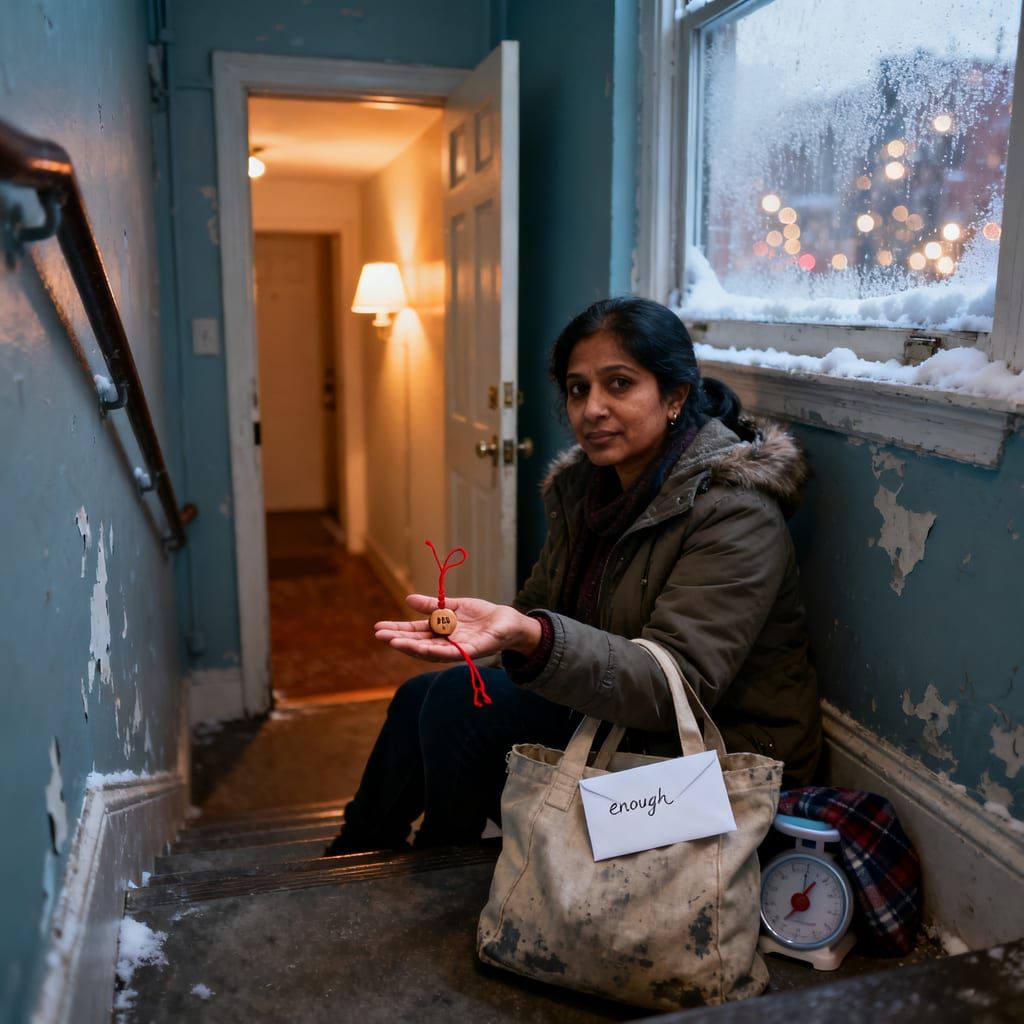
The stairwell holds its weather: the cool smell of wet coats, the metallic tang of the railing, a draft that threads a needle through the gap in the windowpane. Noor pulls the door closed behind her and sees it, wedged into the frame, her name written in a looping hand that doesn't match any form she knows of Olivia's but is hers all the same.
Inside is a torn yearbook photo-the grid of faces, young and convinced of their own outlines. Noor's own senior picture: hair too neat, eyes already busy. A handwritten note that leans forward as if it had to be written standing up at the counter with a baby's breath punctuating the margins.
I knew it was you the first visit, it says. I have been afraid to say it. In high school I was cruel because I was scared of everything I wanted and didn't know how to touch. You cried in class and I decided that meant something about you when really it was about me. I'm sorry-for then, for waiting. Thank you for treating me like a mother and not a memory.
A small wooden bead slides into her palm, strung on red thread, stamped with one word: enough.
Noor sits on the stair between four and five. She rests her spine against the cold wall and lets the city hum halo her-the bus brakes outside, a neighbor's key stuttering in a stubborn lock, a radio climbing a scale and failing and trying again. She rolls the bead between thumb and forefinger the way she has rolled so many baby jaws toward openness.
Something quiet and foundational inside her rearranges. Not a dramatic cracking-more like a shelf leveled at last so what it holds can stay.
She thinks of the ledger she's kept without meaning to: the unpaid humiliations of adolescence, the interest they've earned just by being left alone in a drawer. She thinks of how often the work asks her to walk in without asking for proof of goodness, to meet people where they're bloody and undone, to say this is not a test you can fail. She thinks how Olivia looked at her not as a past to be reconciled but as a present tense, a verb.
Noor tucks the note back into its envelope, slips the bead around her wrist where it sits as modestly as a mole. When she stands, the stair creaks in a new register, or maybe she has learned to hear it.
Outside, the wind has a kindness to it, or perhaps she carries one now that the morning didn't have. She passes the bakery breathing cinnamon, a man coaxing his car into starting with words that sound less like curses and more like encouragement. Her phone buzzes once-another address, another lamp left on at noon. She answers with the time she'll arrive and a small note: Do you have pillows? If not, I'm bringing towels.
On the bus, she takes the seat that faces backward and watches the city come toward her. The glass fogs where her breath meets it; she draws a circle with her glove and, without thinking, an O inside it that could be a mouth opening, a bead, a beginning.
She does not take a picture of the envelope or the bead. She does not post a gratitude caption or an anonymous vignette for the internet to nod along to. She folds the morning into the place where she keeps the smell of hospital soap, the weight of her tote, the names of babies who learned to swallow the world and of mothers who learned they already knew how.
The bus leans into a turn. Noor leans with it, wrists warm under her coat, the word against her skin a pulse she can steady to. The day is full of corners and stairs and doors-some that stick, some that slide open as if on cue. She can feel, in her palm long after she pockets it, the light pressure of the bead.
She thinks of the note one more time, then lets it move to wherever things go inside us when they are no longer asking for a decision. Not forgiven, not forgotten-just integrated, like a breath you didn't notice until it was already out in the winter air, turning to steam and vanishing, proof having never been the point.
By the time she reaches the next stop, the city is awake. Noor stands, her tote settling against her side with that familiar weight, and steps out into the cold that bites and blesses in the same motion.
Between feeds, there is always a quiet hour. She walks toward it.
What begins with a sink becomes a city learning to breathe
Read more →
In the minutes that matter, a life you never meet is waiting.
Read more →Story audiobooks for children of all ages — a new one every day on Smarter Way Stories.