The Quiet Hours Between Feeds
In the hush where shame dissolves, something rewires
Read more →
The day after we tucked my mother into earth, Chicago surprised itself with sun. The sky turned that clean, scrubbed blue you only get after a storm, a blue that makes brick look warmer. I sat cross-legged on my parents' living room rug, my skirt belling around me like a puddle, and pulled a dented cookie tin from the back of the credenza-ginger snaps stamped on the lid, dust clinging in the grooves.
The hinge groaned open. Inside, paper careful as pressed leaves: receipts, a recipe card stained with oil, a yellowed Polaroid of my mother laughing with her head thrown back. And an envelope, sealed and soft at the corners. Across it: my mother's hand, always slightly right-leaning, like it was hurrying to catch a bus. "For when the truth won't break us."
The air thinned. I slid my thumb under the flap.
A hospital bracelet slipped into my palm-plastic dulled with years, the kind of thing babies kick off without knowing. A birth certificate followed, its type uneven and severe: "Baby Girl Morales," dated two years before I was born.
The room tilted, framed prayers on the wall suddenly off-kilter. My mother's handwriting ghosted me from the envelope. The truth.
My father was at the kitchen table lining up his pills like a tiny parade. He'd stopped talking at the funeral, and the silence had clung to him like an extra layer of clothing. I set the bracelet and birth certificate on the table between us. He closed his eyes the way a person does at the dentist-bracing for the drill.
"Papá," I said, softer than I meant to. "Who is she?"
He pressed the heel of his hand to his breastbone. "A season," he said. "A bad one."
"Tell me." The bracelet pushed a ghost-cold against my skin.
"We were so young." He looked past me, toward the wiry basil plant on the sill that my mother used to pinch and scatter on eggs. "Your mother was eighteen when we came north. We didn't have papers. We had one grocery bag between us. When the baby came, I thought we would drown. A couple at church-good people-said they could give her what we couldn't. We didn't tell anyone. We folded it up and put it away." He tapped the envelope with a brittle finger. "Your mother... she wrote that in case. In case you ever found it and we were strong enough."
"We?" I swallowed the word like a sharp seed. I could feel a bruise forming along my throat, something that would surprise me in the mirror later. "Why didn't you tell me?"
His eyes pooled and then steadied. "Because I wanted your childhood to be what we promised her-simple, held. I didn't want you living in someone else's season." His voice frayed. "I am asking you, m'ija. Let the past stay folded. We are fragile now."
My jaw worked. I thought about the way my mother had smoothed my hair at night and told me I had a good heart, that good hearts knew when to go soft. Betrayal and compassion wrestled until I couldn't pick a winner. I slid the bracelet back into the tin and closed the lid. The sound of it was too loud in our small kitchen.
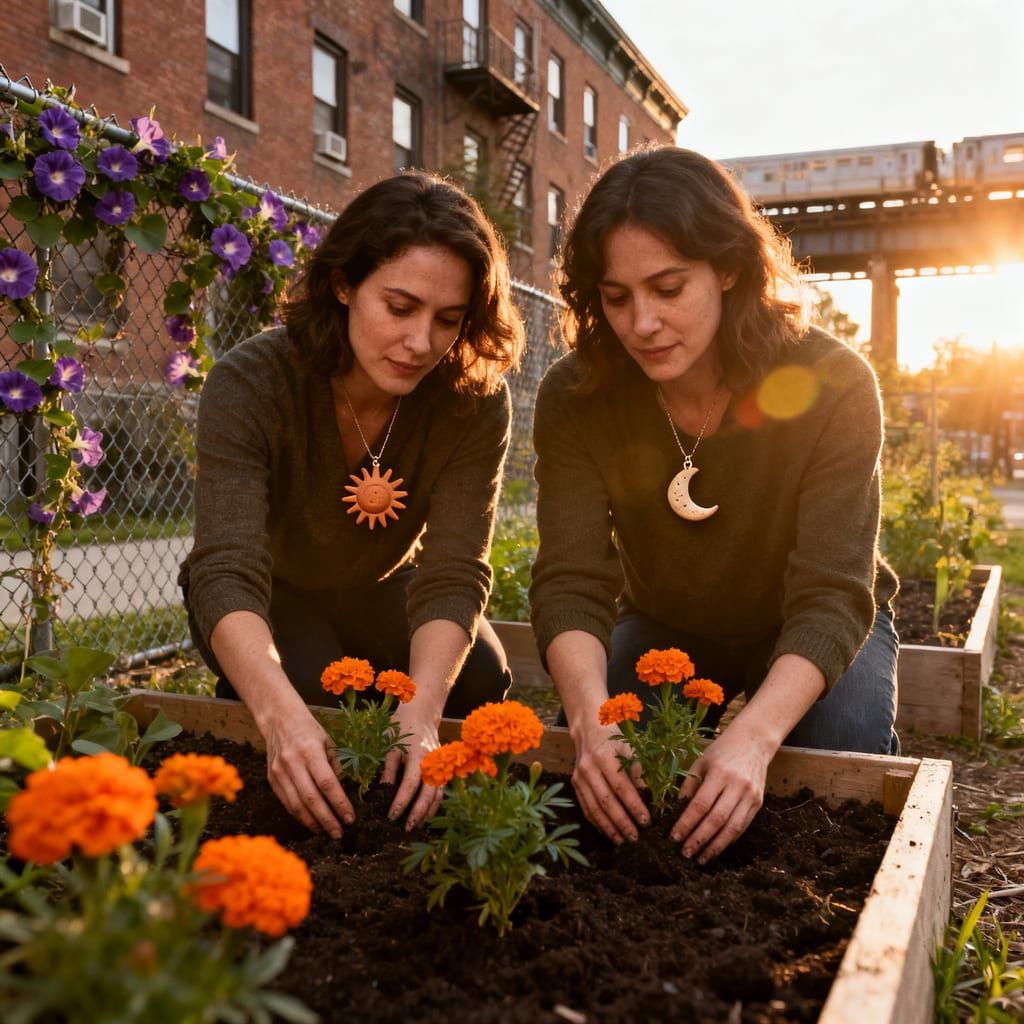
When grief got buzzy inside my ribs, I went to the community garden on Kedzie. It was a patchwork of raised beds and chain-link borders draped in morning glory like cheap jewelry. You could hear the El ghosting past if you stood still. Dirt didn't care if you were gentle with it; it wanted your hands.
Nora ran the place with the kind of calm that made people stand taller. She had a laugh she didn't hoard and a habit of tucking a pencil behind her ear like it belonged there. We'd been orbiting each other for months: she'd slipped me cuttings of mint and I'd left lemon cookies on the potting bench; we traded recipes for sofrito and debated the ethics of taming volunteer squash. Late afternoons, when heat went slack, we watered in a quiet rhythm that made the day make sense.
"You're pulling the tomato suckers like a surgeon," she said one evening, squinting down the row. "Teach me your ways, Morales."
I wiped my wrist across my forehead and left a comet streak of dirt. "Pretend you're choosing the long game," I said. "Say no to the eager ones."
"Harsh." She grinned. "But fair." The hose hissed like an old secret.
She told me about her Saturdays at the shelter and the body shop her adoptive dad ran in Avondale; I told her about client deadlines that arrived like weather and the old jokes my mother wrote in the margins of cookbooks. We didn't touch our lonely centers directly. We watered around them.
At home, I ordered a DNA kit in the same way I sometimes bought shoes I didn't need-half curiosity, half dare. Spit into a tube, click a few boxes. I told myself I was throwing a question into a ravine and walking away before the echo.
Weeks swam by. Deadlines, grocery runs, stopping by my dad's to change lightbulbs he pretended had just burned out. In the garden, tomatoes swelled and fattened, shouldering aside the wire cages politely.
Then an email blinked awake while I waited for the bus. I opened it and felt my stomach ladder down into my shoes.
"Close Family Match: Nora S."
Near certainty. Half-sister.
The city blurred. A woman with a stroller clipped my shin and said, "Sorry," and I said, "It's okay," and meant nothing by it. My mouth filled with the taste of pennies. On the bus, a kid in a Spiderman shirt sang to himself, soft and off-key.
In my head, I practiced conversations that never made it past my teeth. I didn't want to rip the tarp off anyone else's old weather. I didn't want to be the person who exploded someone's afternoon.
That night, I stood at my father's sink washing a pot that didn't need washing. "Papá," I started. The word was a hallway. He looked small in his chair, the TV muttering at a low volume like a neighbor on the landing.
"Not yet," I said to myself instead, letting the water run until it went from hot to hotter.
I invited Nora over the next Sunday under the polite pretense of herbal tea and a rescued pie from a bakery that overestimated the neighborhood's appetite for rhubarb.
She arrived with rain on her shoulders and a bag of lemons. My apartment sits above a laundromat and buzzes like a hive. I like it; it keeps me from mistaking my thoughts for pronouncements.
We talked about ridiculous composting advice. We talked about whether cilantro truly tastes like soap or grass, and why people don't know the difference between marigolds and calendula. Our tea got cold.
"Nora," I said, and the word snagged on a barb I hadn't noticed. "Can I ask you something a little sideways?"
She nodded, braced like a dancer.
"What was it like, being adopted?" I kept my eyes on the lemon I was slicing, as if it might misbehave if I didn't supervise.
She exhaled. "You know how people talk about countries they've never visited? How they romanticize them or hate them based on a dish they tried once at a street fair?" She smiled without letting her eyes join in. "It's not that. It's everyday. It's love that sometimes doesn't look like you. I have a mom who keeps all the fortunes from cookies in a jar. A dad who won't let me drive with my gas light on. I have this blank wall behind that, and a few thumbtacks in it."
"Thumbtacks?"
"Artifacts." She set her mug down with a soft ceramic click. "A snapshot of a young woman holding a clay sun. I keep it on my dresser like it's a saint. A little note that just says 'Forgive the season. Grow anyway.' That one guts me. There's a charm too. Sun. I like to wear it when I'm feeling dramatic." She laughed then, embarrassed at herself. "My parents told me what they knew, which wasn't much. They never made me choose between gratitude and curiosity. But I... I keep my searching small. Like a window I open a crack."
The room shifted. A throb started under my ribs. I reached for the cookie tin I'd tucked into my bookshelf between design magazines. It chimed when I set it down, a nervous bell.
"I found something," I said. "After my mom." The box felt heavier than the sum of its contents each time I touched it.
I tipped it open and took out the things that had reconfigured my map: the bracelet, the paper. Then, from the corner, the small ceramic moon I'd assumed was a souvenir from a festival, or something my mother had haggled for at Maxwell Street.
Nora went very still. She reached instinctively for her throat. Her fingers found a chain and drew up a small clay sun, worn soft at the edges, crescent missing from the circle.
Silence became a creature in the room-a kind thing, waiting for us to notice it. I lifted the moon. She lifted the sun. When we brought them together, they clicked-the faintest sound. Not magic. Something truer than that. Like the sound of a key behaving exactly as designed.
She closed her eyes. When she opened them, there was salt on her lashes. I wanted to wipe it the way my mother had done for me as a girl. I didn't move.
"So." Her voice had dropped down an octave. "You and me."
"Looks like." My tongue was sand. "Half and half."
For a long minute, all I could hear was the laundromat downstairs tumbling someone's sheets into softness. We stared at the charms our mother had split into two like a benediction she didn't know how to give whole.
"Your note," I said finally. "I've been carrying mine in my head since I read it. 'For when the truth won't break us.'"
Nora wiped her cheeks with the heel of her hand and gave a short, surprised laugh. "That's a hell of a weather report."
We went to the garden without planning to. Our feet decided and our bodies followed. The sky had gone gray at the edges, the way it does before a summer rain that doesn't quite commit. The beds wore their row tags like name badges: chard, okra, zinnias squandering their color.
We knelt by the empty rectangle where last month's lettuce had given up. Nora handed me a flat of marigold starts-the cheap kind from the corner hardware, orange so loud it felt like a dare.
"Guardians," she said. "My dad swears they keep the bad off the tomatoes."
"Your dad sounds like a man with evidence." I pressed my thumb into the soil, made a hole, tucked a root ball into it like putting a child to bed. "Mine thinks the basil listens when you talk to it."
She smiled. "Maybe it does."
We planted in a stuttering rhythm. The hose lay in a lazy line behind us, a silver dragon shedding light. Dirt crept under our nails. It felt like honesty-a little uncomfortable, undeniably real.
"What do we do?" she asked finally, voice small. "About-" She gestured in the air between us, a shape no one else would see.
I tamped earth and sat back, my knees complaining. The truth was rooting itself whether we invited it or not.
"My father is..." I searched for a word that wasn't cruel. "He's made of quieter stuff. He asked me to let the past stay folded. To give him time."
Nora nodded, a steadying bob. "I can do time."
I looked at her-her hands, quick and sure; the smudge of dirt on her cheek she hadn't noticed; the necklace with the sun settling against her collarbone like it had always belonged there even when it didn't. I thought about my mother writing on the envelope and tucking it away, hope small and stubborn as a seed.
"Let's not make a headline out of it," I said. "Not yet. Let's make a habit."
"A habit?"
"Sunday tea. Tuesday watering. Talking when we can. Not... not performing a reunion for anyone, including ourselves." I laughed, a small, cracked thing. "Grow anyway."
She breathed out, relief passing over her face like shade. "Okay." She nudged a marigold into our line. "We'll be boring about it."
I leaned forward and pressed the moon charm into the dark soil between the first two plants, just for a second-let it feel where it might have landed if the season had been kinder. I lifted it again, mud clinging to its edge.
"Keep it," Nora said when I hesitated. "I don't think we need to force halves into wholes."
We rose together, brushing dirt from our knees. The first clouds began their undecided sprinkle, a coin-colored mist. We didn't run for cover. The city hummed-buses sighing, a dog staking a claim, a far siren apologizing for itself.
When the water finally came, it wasn't much, but it was enough to darken the top two inches of the bed. We stood and watched drops dissolve on our skin, watched the marigolds settle their shoulders into the idea of staying.
"I'm glad it's you," Nora said, so soft the sentence almost got lost to the rain.
I didn't answer. I didn't have to. We were already practicing it-the slow, unflashy tending. The kind that asks for seasons and keeps showing up with a trowel.
On the way out, I paused by the gate and touched the chain-link, the metal warm from the day. Behind us, the bed glowed absurdly bright, little suns declaring themselves under a pewter sky. Somewhere, a train wailed its long, unembarrassed note.
I thought of my father at his kitchen table, the parade of pills, the basil leaning toward the window as if trying to hear. I would go to him tomorrow. I would tell him that the thing he feared hadn't broken us. Not yet. Not if we gave it water and light.
We locked up and walked home slowly, shoulder to shoulder, not naming what we were. The charms knocked softly when we stepped off the curb-sun and moon keeping time.
What begins with a sink becomes a city learning to breathe
Read more →Story audiobooks for children of all ages — a new one every day on Smarter Way Stories.