The Garden Between Our Names
What we plant when the past breaks open
Read more →
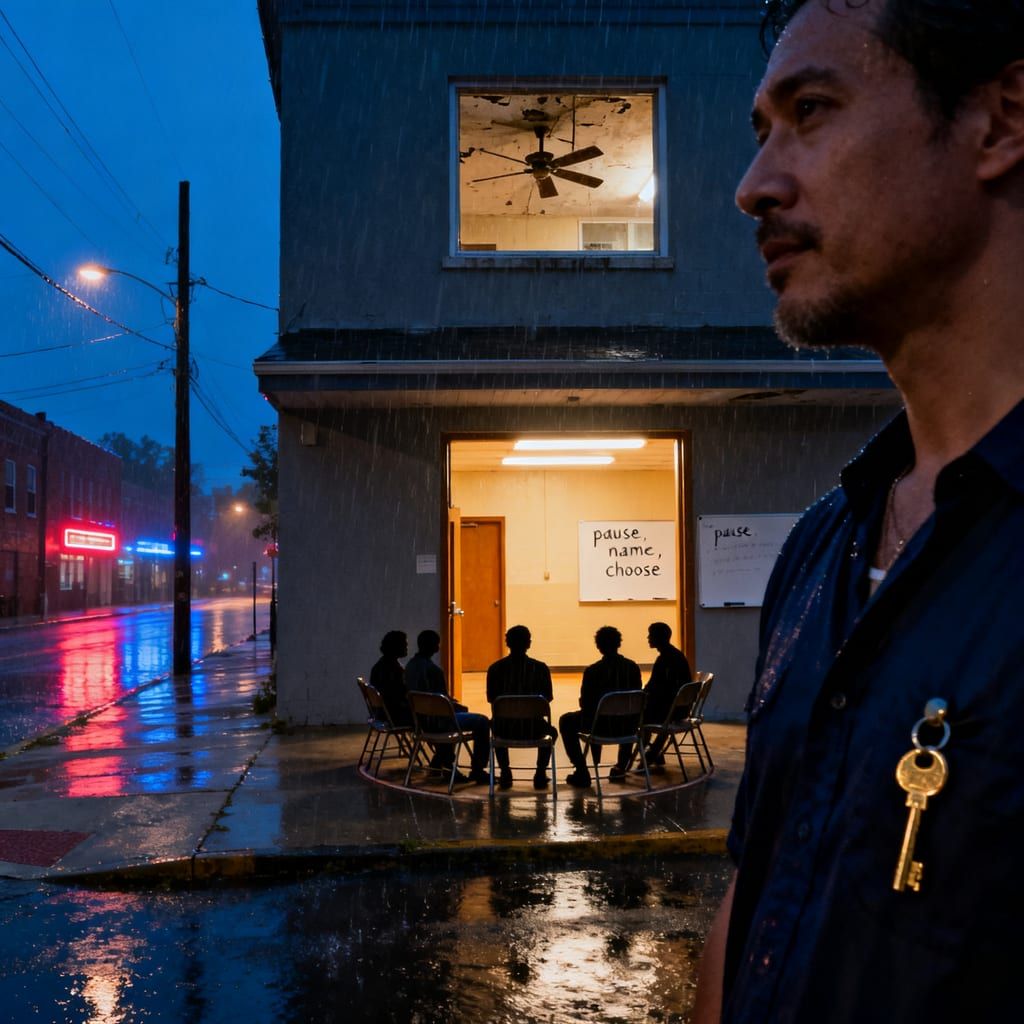
On Tuesday nights the community center breathes like a tired lung. The ceiling fan wobbles above a ring of plastic chairs, moving warm air and the ghost of bleach. On the whiteboard: pause, name, choose, penned in a hand that leans right like it's eager to leave.
Jonah Reyes stands with a dry-erase marker and the brass key at his throat-a small moon against his T-shirt. He looks at the faces of the court-mandated, the reluctant, the curious. Rain needles the windows. Somewhere downstairs, the church kitchen simmers onions and cumin.
"Let's start with the minute," he says. "A moment you took with anger. Find it. Bring it back."
A groan ripples. Someone shuffles a court slip. The fan clicks like it's about to give up.
A new guy-wide shoulders under a hoodie, driver's cap folded in his back pocket-leans back until his chair complains. "This is breathing for doormats," he says, not unkindly. "People cut me off, I cut back. That's math."
"Malik, right?" Jonah meets his eyes. "We're not erasing you. We're adding options."
"Options," Malik says, chewing the word. "Like counting to ten while someone talks to me like I'm a child?"
"You can count. Or you can leave. You can breathe. You can burn," Jonah says, voice even. "But you can also ask what the minute is worth. To you. To them."
A few in the circle exhale. There's a man in the back who never speaks, a silver beard tucked into a flannel collar. Arthur, according to the roster. He watches the scuffed floor instead of anyone's face.
Jonah caps the marker. He keeps his own storms named and leashed, or tries to. The unopened voicemail sits in his phone like a lit match. The key on his chain warms to his skin when he thinks of her.
Lila. Don't say it now, he tells himself. Not yet.
They go around. A woman returns a minute to a neighbor she slammed a door on, promising to bring down the music by ten. A teen promises to stop subtweeting his ex. They flail. They try. Jonah praises the attempt, not the elegance.
Malik rolls his eyes and then, grudgingly, speaks. "All right," he says. "I yelled at a cashier who asked to see my ID for cough syrup. Took twenty minutes, maybe more. Made her cry. I left before the manager came."
"How would you give it back?" Jonah asks.
"A text?" Malik shrugs. "A door?"
"A minute you stole deserves a minute you offer," Jonah says. "Sometimes more."
"And sometimes it's too late," someone mutters.
Jonah hears it like a thread pulled tight. He takes a breath-you teach the craft you still need. "Sometimes," he says. "And sometimes we get lucky."
After class, he erases the board but leaves the words faint, ghosts in dry ink. He tucks the marker in a cup, pockets the key. Outside, the rain has stitched the streetlights to the pavement. He walks to the bus and feels the old muscle in his jaw begin to ache.
The DMV is a ship of fluorescent light, line ropes and sluggish faces, a timer that never moves. Jonah steps in to renew the center's van registration and senses it before he sees it-the static crackle of a storm forming. A voice rising. A voice he knows.
Malik is at the counter, jaw set, fist on the laminate. "I uploaded the documents three times," he says. "Your system eats them."
The clerk, a woman with chipped blue nail polish, keeps her face neutral. "Sir, if you'll just-"
"I drove across town in the rain," he says, volume climbing. "You think I got time to-"
People look. The security guard shifts his weight. Jonah moves without deciding, sliding through the mutter and the sighs, the old heat licking up his spine like a remembered fever.
He puts a palm on the counter beside Malik's, not touching him. "Hey," he says softly. "It's me."
"Not a good time for breathing exercises," Malik spits, and there's a tremor under the spit that Jonah recognizes: fear dressed as fury.
"I want to win," Jonah says, like he's reading a recipe. "I want to prove. I want to breathe." He keeps his eyes on the counter, not the crowd. "Pause," he murmurs, almost to himself. "Name. Choose."
"Don't do your little-"
"I want to keep you out of handcuffs," Jonah says, quick as a match struck. "Name. Choose."
It's not magic. It takes a minute of circling, of Malik's jaw clenching and loosening, of the clerk's eyes darting to the exit. It takes Jonah narrating the micro-choices-the swallow, the step back, the deliberate release of a fist like opening a stuck jar. The room feels it-the shift from heat to weather.
Malik's shoulders drop. He scrubs his face. "I'm sitting down," he says to the clerk, voice hoarse. "Can you call my number when you find my file?"
She nods, relief plain as the sweat at her hairline. "I'll do my best," she says.
On the plastic chairs, Malik shakes, the adrenaline leaving in shudders. Jonah sits beside him and counts their breaths in pairs-four in, six out-until the timer above the desk flips a small red digit and the room claps once, quietly, like the end of a trick.
Back in the circle, Jonah writes Give Back the Minute on the board in smaller letters. He does not plan a sermon. He plans to be precise.
"When I say 'collect your storms,' I don't mean deny them," he says. "I mean hold them long enough to see their names."
Malik looks at his hands. Arthur stares at the fan.
Jonah flips the cap off the marker and sets it down like a small, deliberate offering. He reaches for the chain at his throat and steadies it. "I learned this late," he says. "I learned it too late for my sister."
The room tilts forward.
"Her name was Lila." His voice isn't steady, but it isn't breaking. "She called me once. Last call. I didn't pick up. I was busy being right in an argument that didn't matter. I told myself I'd call back in the morning." He stops. He lets the sentence sit and gather weight.
"I keep her last voicemail on my phone. I've never played it." He glances at the room. "That heat-the kind that folds you in half-it burned everything that wasn't nailed down. Friendships. Quiet rooms. The mirror." He smiles without humor. "So I started to collect, instead of explode. I named my storms and put them in jars. I practiced pause, name, choose until the jar lids loosened. Now the weather is still bad sometimes. But I can stand in it."
Silence, and then chairs creak. A man in the back raises his hand, slowly, like a student from another century.
"Arthur," Jonah says.
"Could I-" Arthur's voice is rough stone. "Could I speak to you after?"
The hallway smells like pencil shavings and spice, the church kitchen working late downstairs. The light hums. Jonah folds his arms. The key cools against his sternum.
"I'm not a talker," Arthur says, eyes fixed on the scuffed linoleum. "Been coming because the judge said. And because I thought-maybe I could sit in a place where people say the thing out loud." He swallows. His hands are big, veined maps. "Years ago, I chased a car. Thought the driver disrespected me. I clipped her back tire. She spun. I kept going." He closes his eyes like stepping into rain. "I did time. I've been trying to say her name since I got out."
He places his palm on his chest, over the thud of his heart. "Lila," he says.
The hallway pitches. It's not a fall, not this time-more a sudden drop in pressure that makes everything ring. The old script stands up inside Jonah, hot as it ever was, all the words with sharp edges. His vision narrows to the size of the brass key.
He inhales. The air tastes like cumin and the metal tang of the radiator. He narrates to himself, a man at a hurricane map. I want to destroy. I want to rewind. I want to breathe.
Pause. Name. Choose.
"Come back into the room," he hears himself say. "If you're willing."
Arthur nods once, bewildered, as if he'd expected a fist or a door.
Jonah pulls two chairs into the center and asks the others to stay if they choose to bear witness. No one leaves. Malik's cap is back on his head, brim forward like a shield.
"This is voluntary," Jonah says. "No one owes anyone forgiveness. We can try to make something we can stand in."
Arthur's hands shake as he speaks. He tells the story piece by ragged piece, not sparing himself. He says he sees Lila's car at the edge of sleep, headlights skidding across a barrier. He says there is no morning he has not woken up into the wreckage.
Jonah listens like it's the last decent work he can do. Each sentence lands and raises a small storm, and he names it. Rage. Grief. The wish to trade bodies, hours, anything. He holds them, a man with too many jars.
When it's time, he takes out his phone. The screen glows. He thumbs to the saved voicemail thread he has never opened. He looks at Arthur. At Malik. At the others who are here, on a random Tuesday with the rain hammering the gutters.
He presses play.
"Hey, J," Lila says, her voice startlingly ordinary. "You home? I'm thinking Thai or tacos for tomorrow. Text me if-" The message cuts at the ten-second mark, truncated by a pocket or a signal loss or the way time makes everything brief.
The room breathes with him. He doesn't cry, though he could. He sits with the voice as if it has heat, and it does-the kind that warms, not burns.
"Thank you," Arthur says, not lifting his face.
"This won't make it right," Jonah says. "But we can try to make it less wrong." He looks at the group. "I'm inviting a restorative circle next week. Voluntary. We set ground rules together. We talk about what repair looks like when there's no such thing."
Heads nod. The fan clicks. Somewhere downstairs, a pot lid clatters like a bell.
They come, and they come back. Arthur brings coffee and a notepad with his grandson's school logo; he takes notes on how to sit with someone else's pain without narrating your own. Malik drafts an apology to the DMV clerk on a sheet from the community printer and walks it over between shifts, timing it for a lull. He holds the door open for a woman struggling with a stroller and feels ridiculous and then relieved.
Arthur finds a program for new drivers and asks if they'll have him. He stands in front of kids with learner's permits and talks about space-not just between bumpers, but between thoughts. "Leave room for the bad day in the other car," he says, and his hands don't shake as much.
Jonah learns how to say Lila's name in a voice that doesn't break. He carries her key and her last question-Thai or tacos-like a tiny lantern. He learns, again and again, that peace isn't a verdict a judge bangs down; it's an agreement you make in the hallway, in the DMV, in the places where fluorescent light makes everybody look a little lost.
On a night when the rain returns, the class sits under the sagging fan and the soft ghost of the words on the board. Jonah erases and rewrites them, dark and fresh: pause, name, choose. He doesn't say the moral, because there isn't one, not really. There's only practice.
At the end, Malik lingers. "I gave back my minute," he says, almost shy. "Wrote the clerk. She wrote back." He shows Jonah the reply-a three-line thank you with a smiley face typed like a punctuation the woman forgot she knew.
"That's one," Jonah says.
"Just one," Malik echoes.
Arthur waits by the door. "I can say it now," he says, meeting Jonah's eyes. "Lila."
Jonah nods. They stand in the weather together. It isn't fair. It isn't fixed. It's breathable.
He locks the center with the brass key at his throat, though it's not the right key at all, just the right weight. On the sidewalk, the rain beads on his lashes. He names this storm too and lets it pass over him, cool and astonishing, leaving the city rinsed and ready for whatever minute comes next.
What begins with a sink becomes a city learning to breathe
Read more →Story audiobooks for children of all ages — a new one every day on Smarter Way Stories.