Paper Cranes on the Mountain
A fog-draped night, two souls found, and the quiet shape of a life
Read more →
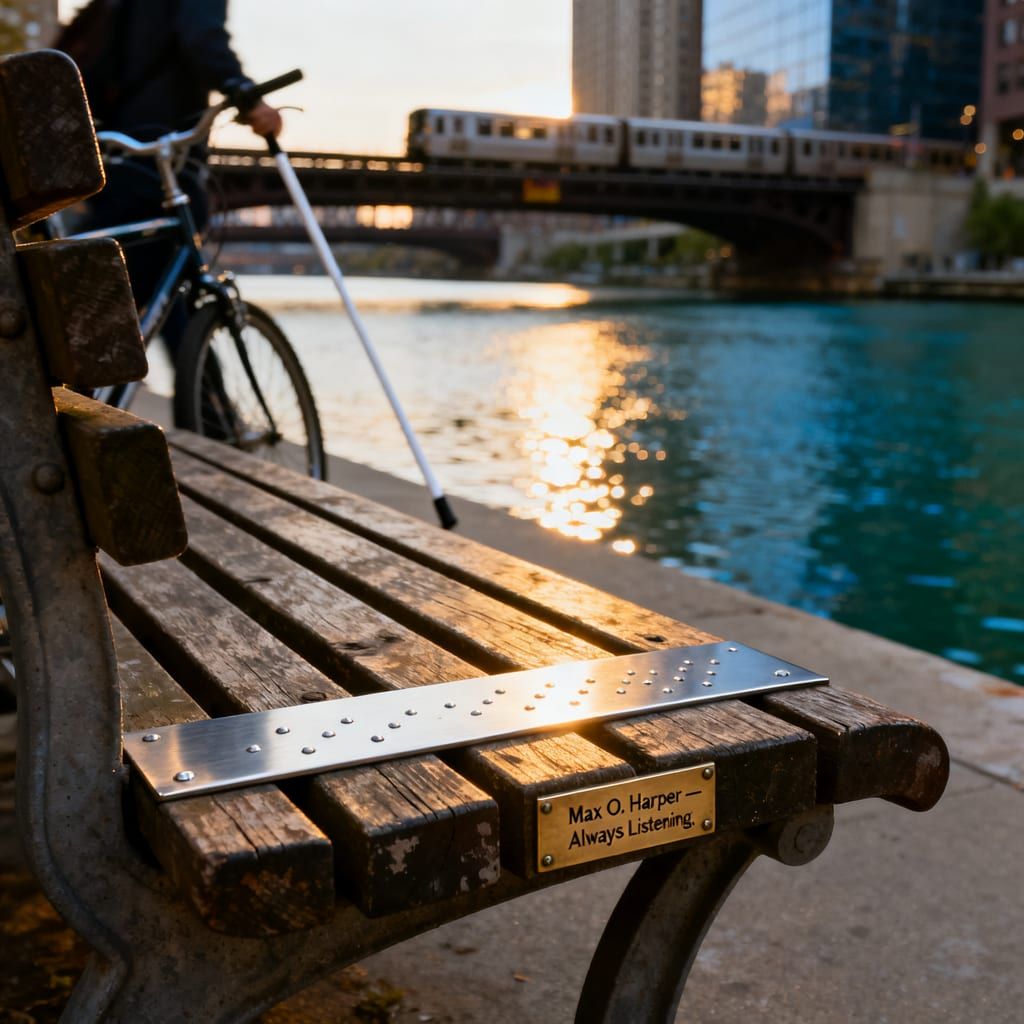
The van's mirror shaved past Eli's knuckles like a blade of cold wind, and the bike path shuddered in his vision. He jerked, threaded between a pair of joggers, and didn't stop pedaling until the river opened to the left-dark water rippling like a secret kept too long.
He collapsed onto the bench as if the wood could catch him. His wrist pulsed with that deep ache that promises to turn dramatic by morning. He pressed the heel of his hand into it, eyes on the scuffed toes of his sneakers, and only when his breathing slowed did he realize his palm had dragged over something unexpected.
Raised dots. A ripple of bumps scored into the slat beneath the peeling varnish.
He flattened his fingers and traced them again. Not splinters. Not vandal's grooves. A pattern. He pulled out his phone, opened a translation app he'd used once for a label in a customer's lobby, snapped a photo, and watched as the screen coughed up nonsense: "IT WZNT YR FALZT."
"Close enough to taunt me," he muttered.
The river licked at its shore. Somewhere north, the El sang a line of metal prayer. Beneath his palm, the dots waited-quiet and sure in their meaning, even if he wasn't.
He rode home with his wrist bandaged in a dish towel and tape. The night slid warm against his arms. Every red light felt like a confession he didn't want to make.
At twenty, after the crash with Jonah, he'd blown through a sign on a dare, misread the world as a stage. Jonah's front wheel kissed Eli's back tire and then metal tangled and skin met asphalt. Jonah's eyebrow split open like a pomegranate seed. Two stitches, a scar he called a lightning strike to make Eli laugh. But after, the laughter thinned. Messages took longer to answer. Then an argument that had nothing to do with bikes and everything to do with shame. Then silence.
He told himself for years that owning it meant staying away. That he'd done enough damage with motion; stillness would be his penance. The logic calcified. The friendship didn't.
In bed, the river's smell followed him-algae and sun-warmed stone. He stared at the ceiling fan and saw bumps in wood. He counted them like sheep you can't keep.
The next night he pedaled back with the smallest cargo he'd carried all week: a printed braille alphabet folded along the creases of his wallet, a penlight, and a clumsy determination that felt twelve again and reckless.
He sat cross-legged on the concrete by the bench. The river wore a silkier mood. Cyclists whisked past, lights blinking. He held the alphabet up to the streetlight and matched patterns aloud, a whisper he kept losing.
"Dots one and two and... four? That's a-no. That's a B if one and two, but with four... Jesus."
"You're close," a voice said, warm and amused.
He looked up. An older woman stood within the wash of the light, hair gray and fierce, white cane angled like an extension of her listening. She smiled, the kind that takes its time to land.
"May I?" she asked, hand hovering over the bench back.
He shifted aside. "Please. I'm murdering it."
She brushed her fingertips over the line with practiced grace. It was almost choreography. "I'm Ruth," she added, as if the bench required introductions.
"Eli."
Ruth's expression changed in the small, quiet way some faces do when they know a sentence is not just a sentence. "It says," she read, "It wasn't your fault."
The words opened a floodgate he'd dammed with years of righteous self-punishment. Heat rushed his neck. His mouth filled with air he didn't know where to put. He found it easier to look at the river than at Ruth.
He nodded, too many times. "Okay." He swallowed. "Okay."
"Bench wisdom," Ruth said lightly, but she angled her face toward him. "Whatever it brings up, that's honest."
He laughed, a sound that didn't trust itself. "Feels like the universe sent a push notification."
"Or someone did," she said. "Someone with a pocket knife and a point."
In the morning he noticed, for the first time, the small plaque screwed into the bench's arm. Brass gone dull with weather, letters holding fast: MAX O. HARPER-ALWAYS LISTENING.
He took a photo.
The downtown permit office was the beige kind of bureaucratic that makes you want to set your own bones. A clerk with a thoughtful mole above her lip helped him scroll through records until Max Harper appeared in a grid of approvals: the bench applied for by Leena Harper, mother, paid in full three summers ago. A separate note in a crankier font collected complaints: Unauthorized raised dots added. Potential hazard. Request inspection.
On his lunch break he biked to a community center that smelled of coffee and chalk, a hand-lettered sign announcing Knit & Natter 2-4 PM. He lingered at the doorway, helmet in his hands, while a laugh rolled across the tables like a loose ball of yarn.
"Looking for the Zumba class?" a woman called, needles a blur.
"I'm looking for Leena Harper."
Silence linked the tables. A woman with mahogany skin and a floral scarf lifted her chin. Her eyes were lake-clear and ten degrees wiser.
"I'm Leena," she said. "And you are?"
"Someone who sat on your son's bench," he said. "And found a sentence."
Her smile appeared and disappeared so fast it was less a smile than a reflex against something tender. She patted the chair beside her. He sat, elbows learning a new posture around yarn and tea.
"I added the braille," she said, before he could ask. "Not with a permit. With a grandchild's woodburner and the need to say things out loud."
He glanced at her hands-strong, a little nicked. "Why braille?"
"My son, Max, was a sign-language interpreter. Hearing kid in a Deaf family, later hired to stand in courtrooms and classrooms and concerts, being the bridge. He once introduced me to listening with your eyes." Leena snorted softly. "After he died, that phrase rubbed at me like a stone in my shoe. I wanted my hands to be useful again. Braille is patient. You can leave it in the world and it will wait."
He waited with her.
"He was stopped on Ashland," she said. "The driver rolled a right on red without looking. He'd spent months before that gnawing himself over a misinterpretation that wasn't his. He apologized to everyone but himself. The thing I hate is not that I couldn't save him. It's that I knew what to say and didn't say it enough."
"So you carved it into a bench."
"And bus shelters," she said, the mischief back. "And near the bakery. Little messages. Not for anyone specific-" she looked at him, not unkind "-but for anyone who needs it."
He breathed out through his teeth. The room hummed with small industry: cups set down, stitches made and unmade.
"I've been carrying..." He studied the pattern of the table's plastic wood. "When I was twenty, I blew a sign. My friend Jonah went down because of me. He's fine. He was fine. He has this scar that made him cool for a while. But I let the guilt turn me into a martyr. We stopped talking. I thought that was responsible."
Leena's needles stopped. "Maybe responsible would be telling him what you just told me."
He smiled, crooked. "I haven't earned it."
"Earned is overrated," she said. "Loved is better."
He picked up a spare needle and put it down. "It felt like that bench was... aimed."
"Sometimes the universe isn't hunting you," she said. "It's laying out tools. You still have to pick them up."
At dawn, the bench was silvered with dew. The city held its breath between garbage trucks and espresso machines. Eli sat, palms against the cool wood, and let his fingers find the dots again. The sentence thrummed under his skin.
He called Jonah.
The phone rang long enough for regret to lace his lungs. Then: "Eli?" Jonah's voice was deeper, or maybe just older. Somewhere, traffic pressed its palm to the line.
"Yeah." Eli swallowed. "I'm at the river. At a bench. I-this is going to sound like a bit-but there's a message carved into it. It says, 'It wasn't your fault.' I've been acting like-like it was. For a long time."
"Which thing?" Jonah said softly. "Your whole early twenties?"
Eli laughed without permission. "The crash. And what I did after."
There was the tiniest click of a smile. "I was waiting for you to stop punishing yourself so I could stop punishing you."
He blinked at the river, which had started keeping time with geese. "You were-"
"I wanted to be mad," Jonah said. "It was easier than being scared. But... it wasn't all your fault. I took that corner hot. We were both stupid. And I didn't know how to hang onto pride and you at the same time." A breath. "I miss you."
Eli's throat tightened until his ribs felt like a too-small coat. "Do you want to meet me at the bench?"
Twenty minutes later they sat with a slat between them like a third friend. Jonah's scar caught the light and made a small silver door above his eye.
They spoke plainly, words stripped of the old costumes. What Eli had believed. What Jonah had believed. Where the stories didn't line up. When Jonah said, "I kept waiting for you to forgive yourself," Eli's body answered with a quiet, unfamiliar ease-like coming home to a room that has been repainted while you were gone.
A breeze lifted the hair on their forearms. Footsteps approached, light and certain.
"Back at it," Ruth said, tapping the edge of the bench with her cane. She glided her fingertips along a stretch further down. "There's another one here." She smiled, face turned toward them but somewhere beyond. "It says, 'You are still loved.'"
Jonah made a sound like a stubborn laugh surrendering. Eli felt something gentle land in his chest and stay.
Ruth angled her cane toward the path. "I meet friends here," she said, "and we practice reading the city instead of just walking through it." She nodded toward the plaque. "Max's bench teaches well."
They thanked her. Ruth tipped an invisible hat and drifted on, following a map Eli couldn't see.
That afternoon, Eli called the parks department and braced for the tone of No. He got a woman named Inez who listened like Leena knit-steadily, with room for mistakes.
"Unauthorized modifications are tricky," Inez said. "But if this serves accessibility, we don't want to scrub it away. It needs to be legible and safe. Permitted. Maintained."
"What if I fund proper braille strips?" Eli asked, surprising himself. "Through a courier donation drive. In Max's name."
"Send me a proposal," Inez said. "And tell Leena Harper I said hi. We worked together back when benches cost half what they do now."
By the end of the week, riders who usually only slowed for red lights were chipping in crumpled bills and Venmo notes full of bike emojis. A machinist at a shop in Pilsen offered to etch braille onto thin steel. Leena sent over phrases in a list that read like a liturgy of relief: You did your best. Rest is allowed. I am with you. Eli printed them, held them like flashcards against the sun.
On a Saturday orange with late summer, a crew of unsanctioned volunteers met an entirely sanctioned Inez with a drill. They worked under the spell of permission granted and earned. Ruth arrived with cookies and a half-dozen friends who read each strip with reverent fingertips. Jonah leaned a bike against a lamppost and tightened bolts. Leena stood with her palm on Max's name and didn't cry so much as breathe deeper.
Under the wood slat, a new panel of metal sat flush and sure. Its dots were patient and exact, sentences that won't weather away.
"Try this one," Ruth said, finding the fresh braille with a kind of delighted hunger. She read aloud, voice steady as the river. "You are still loved."
Eli pressed his thumb to the edge of the strip and felt the cool promise of it. Not magic. Not fate. Just a message left where hands could find it.
He mounted his bike. The city opened its grid like a palm, lines and crossings and the possibility of not bracing at every one. He took the path along the river, the bench folding into distance, the new metal catching light and leaving it where others would come.
He rode away lighter-not because the world had bent itself to his private story, but because a stranger's quiet kindness had made a little more room to choose differently, and he had stepped into it.
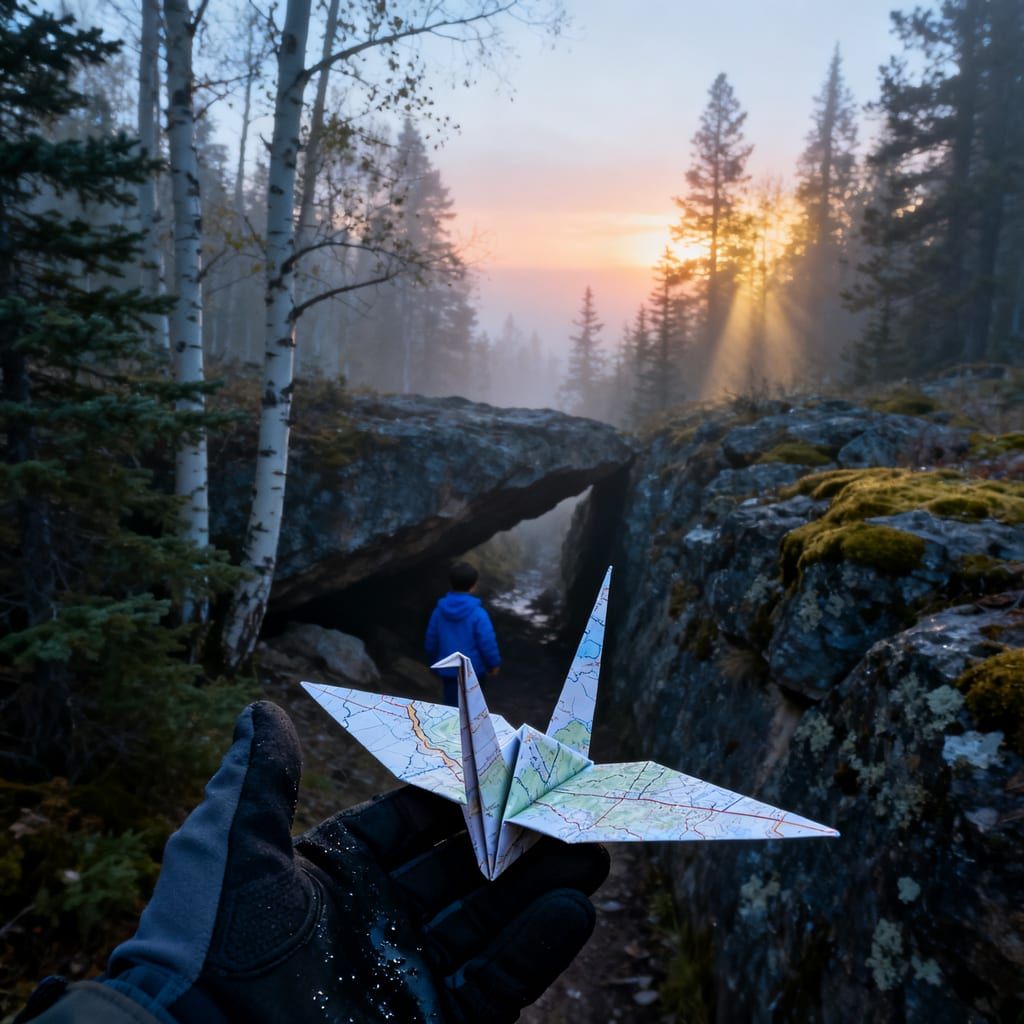
A fog-draped night, two souls found, and the quiet shape of a life
Read more →
Story audiobooks for children of all ages — a new one every day on Smarter Way Stories.