Castling Behind Barbed Wire
A quiet move beneath fluorescent lights
Read more →

The first time I hold the door button and wait for the clang, I think I know what I'm bringing in.
A Bluetooth speaker wrapped in a scarf. Laminated sequences with tidy arrows. A playlist that opens with Jon Batiste and ends with wind chimes-engineered exhale to soften any room.
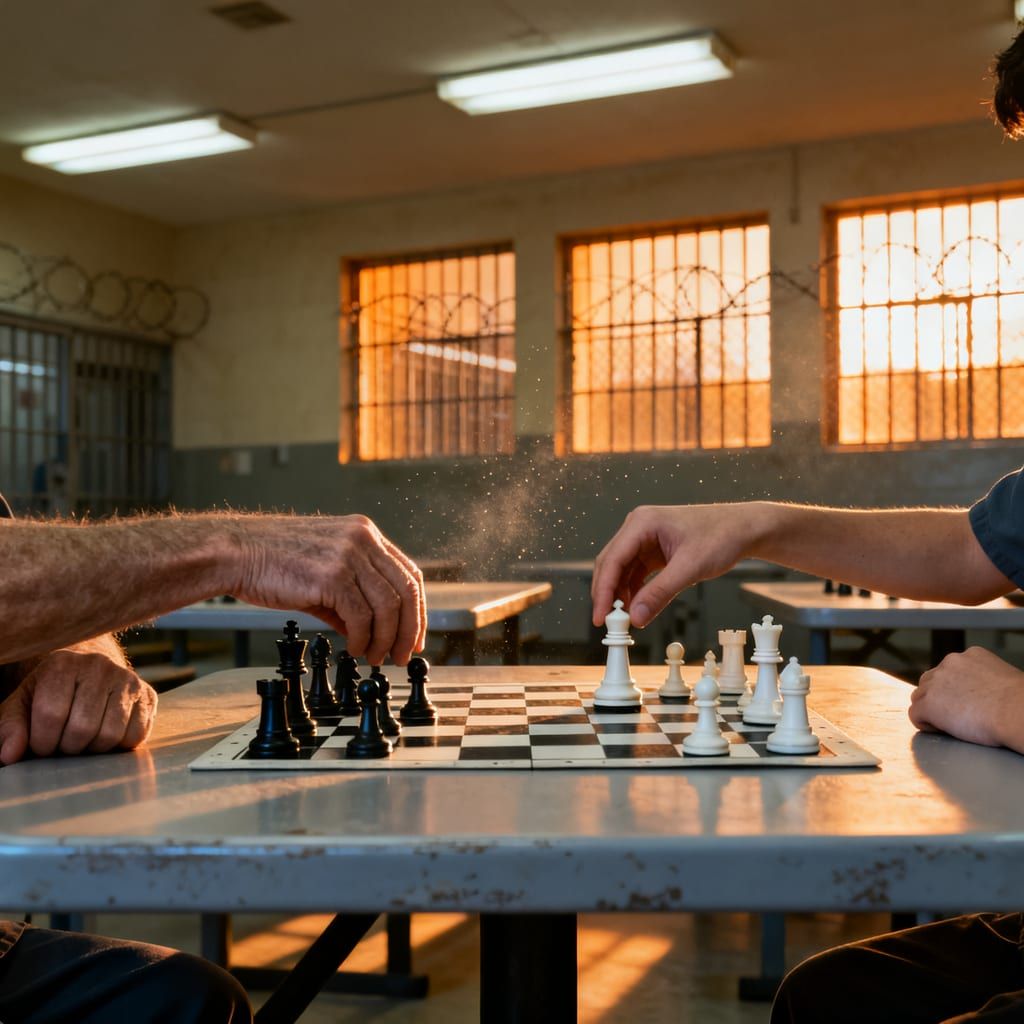
The multipurpose room hums with fluorescents. The high, narrow window is a mouth thin with restraint. The mats are the color of chewed gum.
I lay out blocks like offerings. I smile too much. My voice slides into the careful calm I learned in teacher training, vowel-heavy and floaty: "We'll start in Child's Pose-"
"Child's Pose," Tasha says, and grins. She's maybe fifty, a halo of gray curls compressed beneath elastic, eyes like still water. "We got no room for children in here. Show us how to sleep through the vents."
Nadiya, all bones and quick glances, is counting days on her fingers under the table-thirty-six, thirty-seven. A small tattoo lifts and drops at her throat when she swallows. "And for when your hand won't stop," she adds, without looking up. "Like the movie keeps running."
My laminated Sun Salutation feels silly in my hands. The arrows gleam. I tuck the page under a block like a secret I should've known better than to bring.
"Okay," I say. "Let's start with lying down. Palms to your belly. Feel the breath push back."
The vents hiss like snakes behind the drywall. Someone coughs a dry, hollow cough-bored air in a bored room. We practice noticing the wave in our sides, the tilt of breath in ribs. Not yoga as I've styled it, not the cathedral of pose, but the bare hinge of staying.
Week two, Tasha asks for a stretch you can do with your hands cuffed. She demonstrates-wrists together, a bit of theater, a bit of truth. Her calm unnerves me. It is not performative peace; it is a muscle she has braided from repetition and lack.
"You want to get behind the heart," she says, eyes on mine. "It gets stuck back there."
We lace our fingers, pretend rope, and roll our shoulders. I hear the tiny chorus of tendons. I see a woman at the back-Veronica?-close her eyes and tilt her chin toward a memory I will not name.
Nadiya wants something for wait time. "Like when you line up and the guard forgets you exist," she says. "And suddenly the floor tilts."
"Three-count inhale through the nose," I say, holding my own fingers at my sides, "four-count exhale out the mouth. Think of widening."
"That's nice," she says, and makes herself smile. It cracks her face open like dawn.
I learn what to swap: eloquent poses for small exits. A breath you can fit inside a five-inch window of time. A stretch you can sneak under a desk or while a name is called. We practice standing in line, in our minds. We practice hearing a buzz and not spinning.
After class, I wipe mats with lavender spray. The women leave in pairs, wrists a choreography of paper bracelets. A guard nods at me like I'm a vending machine that delivered.
On the drive home, my playlist no longer matches the dark. Traffic lights pool on the windshield. I see my father's face in the green-how it used to glow through the plexiglass at County South when I was twelve. His smile tilted, always apologizing. The smell of disinfectant and Froot Loops in the vending machine aisle.
I never wrote him after they moved him upstate. When he died, the letter I didn't write got lodged somewhere between my heart and my throat, a bird of paper and wire.
Week six, the speaker is playing Nina Simone when the siren lances the room. A shout, metal on metal, a command like a hand at the back of the neck.
"Down. Face down. Hands visible."
My body obeys faster than thought. Cheek on mat, the rubber tastes like pennies. My throat closes as if taught by a mother I don't remember teaching me fear. The playlist evaporates like steam. All I can hear is the vents hissing and the blood drum of my panic.
My old training flickers and dies. The room is reduced to concrete, fluorescent hum, breath like fish on a dock.
"Window breath," Tasha says, as if she's telling a story to a child at bedtime. Her cheek is to the floor. Her voice doesn't tremble. "Find the rectangle."
There's a small patch of light on the concrete, pale as milk. The high window is out of sight, but its permission falls square and clear.
"Trace the edges with your eyes," she says. "Inhale, make it bigger. Exhale, let it hold you."
Beside me, Nadiya's palm brushes mine, the lightest static of contact. "Match the drips," she whispers, and I hear it then-the tin sink in the corner dripping clean, stubborn time. Drip, two, three. Drip.
From the hall, a door buzzes, two long tones. Veronica counts them out like rosary, voice almost inaudible. "One. Two. Exhale on two."
Someone behind me hums something like a bee at a window. In the space where fear makes its nest, a different animal curls-small, sure.
I stare at the rectangle. I trace slow lines with my eyes as if drawing with a pencil kept only in the mind. On the inhale, I see it swell-not in the room, but in my seeing of it. On the exhale, my ribs soften, my cheek settles. The floor is less enemy, more earth.
The lockdown stretches and thins. The guards' radio chatter like metal birds. We stay pressed to the ground, leaders reversed.
After a while, the siren quiets. A gate claps shut somewhere like a book closing. We wait for the unspool. A voice announces the all-clear as if from the bottom of a well.
We roll up like punctuation-semicolons becoming sentences again. I turn my face to the ceiling and find my breath where it always was, patient as rain.
"You good?" Tasha asks without looking directly at me, giving me privacy to answer what can't be answered with a nod.
"I-" My voice is raw. "Thank you."
She shrugs. "We teach each other."
That night, the studio is a quieter kind of fluorescent. The mirrors are blank-faced. My mat lies like a tongue waiting for words.
I sit with a notebook in my lap and a cup of tea that goes cold in a way tea is always determined to go. The letter I didn't write has stretched out over years, long and thin as a shadow at five pm.
"Dear Papi," I begin. The word nation-states an ache behind my ribs.
I write what I should have written when the bus rolled me upstate on Sundays-the way the roadside cornfields slid by like a mute film. The way the guard's glance skimmed over us like a stone on water. The way I pretended to be taller than I was because I knew disappointment made you look smaller.
I tell him about the women. About Tasha's window breath. About Nadiya counting days on her fingers, then flipping them to count breaths. About the hissing vents and the way a room can hold eight different kinds of grief at once and still have space for laughter over a bad joke about Downward Dog.
I tell him I was angry-at him for leaving, at myself for staying, at a system with a mouth that swallows and doesn't spit back what it took. I tell him I'm still angry, and that the anger is less a fire now than a coal I keep in my pocket, warm and ready.
I read the letter aloud to the empty room. My voice shakes but doesn't break. The walls absorb and don't argue.
When I'm done, I fold the paper twice. I slip it under the top edge of my mat, like an offering slid under a door to a room I can't enter but can kneel at. The mat hums quiet beneath my hands. I close my eyes and do Tasha's practice-the rectangle is now the light that falls across the studio floor, fat and generous, swelling with my breath.
Two weeks later, Nadiya is going home. She wears the same tan uniform but carries herself like a suitcase with a hidden zipper-more space than it appears.
After class, she lingers. "I made this," she says, and holds out a long, narrow strip-crocheted from commissary bags sliced into plastic yarn, gray and off-white, soft with use. It smells faintly of soap. The edges are not straight, which makes me love it more.
"A mat?" I say, though it is not a mat in any way a catalog would agree to.
"A strip," she says. "For your knees. Or your forehead when you gotta press it to something. I don't need it where I'm going."
"Are you sure?" My throat tries to cinch again.
"You taught me the three-four breath," she says, and her smile is not cracked now-it is a doorway. "And Tasha taught me the window. But you brought the block jokes." She laughs. "Keep it. For the others."
I roll the strip, careful as if it could bruise. I don't say be safe or be good. I say, "May you be held."
She nods like she recognizes the wish as a place she's been.
On my way out, the tired guard stamps my hand and holds for the buzz. The door releases like a jaw unclenching. I step into the narrow vestibule, then the last latch thunks open-air tastes different on the far side of a threshold. Warmer, drier, with the faint oil of parking lot.
I pause with my tote on my shoulder, the crocheted strip coiled inside, the letter still sleeping under my studio mat, a square of practiced light folded in my chest.
Freedom does not swing wide. It breathes.
It breathes in the drop-drip of a stubborn sink. In the rectangle of window light that swells when you look at it kindly. In the four-count exhale you can take while a name is called that is not yours.
I walk toward my car. The sun is low enough to throw long yellow ladders across the asphalt. Somewhere behind me, doors buzz and close, the mechanical chorus of an evening settling in.
Something loosens-not out there, not in the rusted geometry of gates and keys-but inward, a muscle unclenched, a sentence commuted by attention.
I came with playlists and arrows. I leave knowing what breath can do in a five-inch window of time.
Under the hum of the world, I can hear it-the quiet unfolding.
Story audiobooks for children of all ages — a new one every day on Smarter Way Stories.