The Quiet Hours Between Heartbeats
In the NICU, the smallest hours carry the longest echoes
Read more →
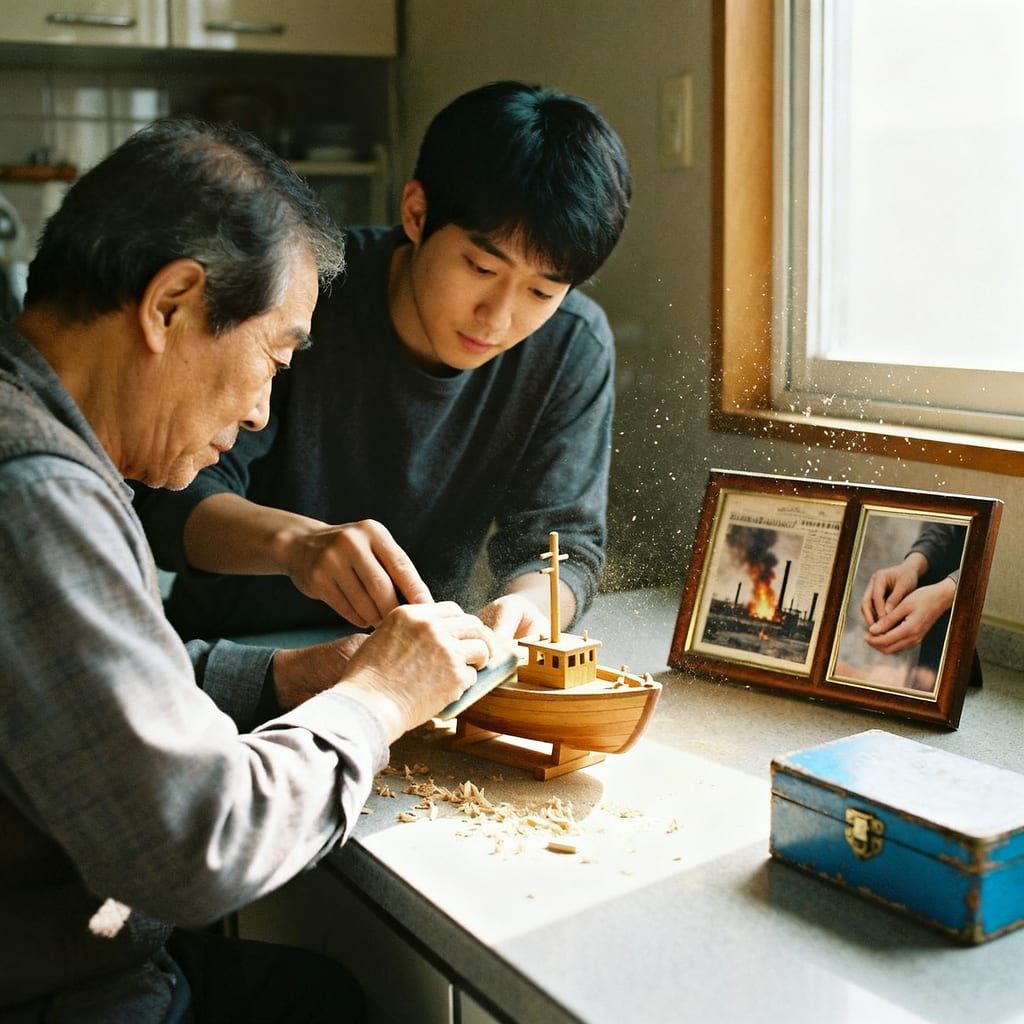
On a lazy Sunday that smelled like reheated coffee and rain on hot asphalt, Daniel Kim pointed his phone at his father's face.
The facial-recognition app blinked, drew its boxes, hummed with cheerful certainty. One match. A grainy newspaper photo from the late '90s: a young man with the same almond eyes and careful mouth, standing before a licking orange wall of factory fire. Same cheekbones, same serious tilt of the head-different name.
His thumb hovered. The biography blurbed nothing useful, just a caption: Local Worker Speaks After Blaze. The rest hid behind a paywall he could optimize around, but the name on the caption was the thing he couldn't. He scrolled to the name again until it blurred.
Outside, a siren thinned into distance. The house settled with the particular sigh of Cape cods in the Boston suburbs-sash windows, old vents, memories tucked into eaves.
In the attic the air had last summer trapped inside it: insulation dust, warm wood, the faint acid of old adhesive. Daniel pulled the cord-click-and the bulb swung a soft yellow circle over boxes labeled in his father's block letters. Winter Clothes. Tax. Tools.
He wasn't sure what he was looking for until he saw the shoebox, blue with white chevrons, tucked behind the suit he'd only ever seen his father wear to weddings and funerals.
On the lid, scotch tape had yellowed in two stripes. His name from childhood-Danny-was written small in one corner. He sat on the attic floor, cross-legged among brittle insulation pellets, and lifted it into his lap.
Inside, IDs lay like fallen leaves. A Korean birth certificate with characters he could sound out but not understand, a Massachusetts driver's license for a Min-seo Kim that was only good for a year, and the name he knew-Min Kim-with a picture where the eyes were his eyes and the smile was something he'd never noticed: a held breath.
His breath, now, did not want to go in. He turned the cards, felt their lamination edge against his fingers. The weight of them was wrong and right at the same time, like he'd found a secret map to a house he'd grown up in.
Downstairs, rain began again-soft at first, then the kind of rain that changes plans. Daniel's phone, face up on the boards, lit with a calendar alert about sprint planning and budget approvals. He silenced it and kept his hand there, palm pressed to its cool glass, as if steadying something that wanted to slide away.
The rehab facility had a lobby ficus that had outlived administrations. In the hallway, lemon cleaner and overcooked carrots tried to cancel each other and failed.
His father sat in a vinyl armchair by the window, pale green socks showing above rubber-soled slippers, a cuff on his arm counting quietly. The stroke had been small; the doctors had said "minor" like a hand wave. But something in his father's face had shifted a degree-stillness turning a notch inward, as if listening to a radio under the floorboards.
"Appa," Daniel said, and heard the child sound, like a word pocketed for emergencies.
Min looked up and smiled in that same held-breath way. "You come early."
Daniel sat. On his lap, the shoebox. He had wiped the dust off and now, under the fluorescent lights, it looked like a simple container again. He opened it anyway.
Min watched his hands, then the contents. His fingers tightened on the chair arm just enough to make the vinyl squeak. He might have said a prayer in his mind. Or maybe he just made room for the past to sit down.
"I found them," Daniel said. "And-" He pulled up the photo on his phone, the factory blaze like a cut in the screen. "And this."
Min took the phone in both hands, careful as if the image might spill. He nodded once. Set it face down on his thigh. "Ah," he said, a whole sentence in a breath. "That one."
Silence worked between them like a slow seam ripper. The monitor cuff exhaled and deflated.
"I changed my name twice," Min said finally, his voice steady but softer than usual, as if they were in a library. "Once to come here under a company's... program. Another time after I made trouble." A ghost of a smile. "Good trouble. Bad timing."
Daniel leaned in. "The fire."
"I warned them," Min said. "Before. Many times. We sent letters with our names. Then we sent letters without. The fans broke; the gauges lied. The solvents-" He rubbed his forefinger and thumb together, as if feeling invisible residue. "One morning a man I respected-your 'uncle'-stood with me outside with a reporter. We told everything."
"And then?"
"Then came calls at night. 'Accidents happen,' they said. Men waiting in the parking lot. No shifts. Your mother-though she was still your mother in the future then-" He stopped and tried again. "I wanted a life. Not stories about how brave I was. So a lawyer at the Korean community center filed papers. We picked a name that would not make anyone think of flames."
His father's eyes were not heroic. They were brown and tired and very alive.
"What did your first name mean?" Daniel asked.
"It means 'bright dawn.' Too loud, maybe." Min's mouth turned wry. "The middle name I had for that one year-Min-seo-is 'writing of people.' Like a ledger. Your aunt said it sounded proper. But the last one..." He touched his hospital bracelet, where Min was printed in blocky font. "This one, in my mother's dialect, not proper Korean-Min is like the cove behind our village-the place where boats hide in storm. Gentle harbor."
The cuff inflated again. He kept talking through it, muffled by air. "I wanted you to sleep. I thought, let the ocean make noise somewhere else. I clean schools at night so you can wake up and not think of me."
Daniel startled at this, as if something had tugged his shirt. He thought of all the optimized calendars, the perfect budgets, the sleek roadmaps he had lined up like soldiers. How he had believed the smallest variable was control.
"Uncle Jae," he said suddenly. "The man who taught me to sand my toy boats. That was him-in the photo."
Min's laugh came out like a cough. "Different first name. Same eyes. He liked to be near the water, even without it." Min closed his eyes for a second, tipping his head back as if leaning into a wave that would pass if he waited. "He stayed close, in case someone came to ask where I had gone."
Jae-who now introduced himself as Peter when ordering pie-met Daniel at a diner beneath a neon sign that hummed like a trapped fly. The vinyl stools carried decades of elbows and coffee rings. The waitress called everyone hon and poured until the cups shone black.
"You look like your father when he doesn't want to scare a squirrel," Peter said, sliding a sugar caddy toward him. "What did he tell you?"
"Enough," Daniel said. And then, because the night was the kind that coaxed returns, "Not enough."
Peter stirred his coffee without adding anything. The spoon clicked like a small metronome. "We thought the fire would be smaller because of what we did. We were wrong. But we saved some people in the months after, and that math has to count." He glanced up, smiled with a kind of apology. "We were very young. Your father had a way of making a room quiet. Not with speeches. With listening. Men said things to fill it."
Daniel pictured his father cleaning a classroom at midnight, erasing the day's chalk ghosts while kids slept, while Daniel himself slept, dreaming of deadlines like oncoming trains. He imagined boats-thin balsa, bright enamel-lined on the kitchen counter to dry on school nights when the dishwasher held their place.
"My mother," Daniel said. "Did she know?"
Peter tapped the spoon clean against his cup. "She knew enough to tape your windows in winter and leave the porch light on for me. She liked you to think my name was an accident. It made you giggle." He laughed, softly. "The first toy boat you sanded? Your father named it Arrival."
The word lodged in Daniel's throat, not like a fishbone but like a small coin, warm from a palm.
Back home, he set the shoebox on the kitchen table beside a cutting board and a mug with a chipped rim. The table wore a halo of wood dust from a long-ago project, caught in seams and knots. He could almost see his smaller hands pushing a strip of sandpaper across the boat's curved edge-his father's hand steadying, never stopping him when he pressed too hard, only turning the boat so his mistake might become the shape it wanted to be.
He texted his father, then the community lawyer listed on a yellowing business card in the shoebox. The man called back with a voice that sounded like the tail end of a saxophone solo. "It isn't complicated," he said. "We can restore part of the birth name as a middle. Names are doors. We can open one more."
Weeks folded into each other. Forms signed, notarized, filed. In the rehab room, then at home, Daniel read aloud the characters he could now both sound and feel. His father corrected his tone with the gentlest of taps, as if tuning a violin.
On a Saturday that smelled like sawdust and lemon oil instead of cleaner, they stood at the kitchen counter again. Min's grip had come back-a little slower, more careful. Daniel held the boat while his father guided the sandpaper with the grain, the same way he had when Daniel was five.
"What will you call it?" Min asked, eyes on the curl of wood lifting from the edge.
Daniel thought of the three names in the shoebox, of the cove behind a village he had never seen, of a neon diner where a man he loved as an uncle chose pie over sleep. He thought, too, of his own inbox, the red circles like fires he kept feeding.
"Harbor," he said. "But in your mother's way."
Min nodded, satisfied. "Then we make the bow strong."
Later, Daniel drove to a pharmacy that still developed photos and printed two images on glossy stock: the news photo, captured from a scanned page, its edges blurred with time, and a new one of himself and his father, sleeves dusted pale, their heads bent over the same small thing. He placed them in a frame with two panes, glass facing glass.
At night, under his desk lamp, he wrote a letter to his company's leadership. It was not a manifesto. It was a measured, careful thing-links to reports, names of suppliers in small towns he'd pinned on maps, a plan for audits that would listen as much as they would measure. His finger hovered over send. He could feel the ledger of his career on one side, the hum of something more on the other.
He clicked.
A minute later his phone buzzed with the kind of response that is not a response-the automatic glide of an inbox. He closed the app, then another, and another, until his home screen felt like a dock at low tide-everything pulled back to wet sand and quiet.
He scrolled to the facial-recognition app. His thumb hesitated. Then he pressed and held. The icons began to quiver. He tapped the X. The phone asked if he was sure.
He looked at the shoebox on the chair beside his desk, at the frame propped against it, glass catching the lamplight in a tiny flare. He was sure.
On the day the court filing came through, they went to the river not far from the old mill that had become lofts with dog-wash stations and eucalyptus-scented hallways. The river didn't care about rebrandings. It slid under a low bridge, shrugging off names, carrying grocery bags and sycamore leaves downstream with the same indifferent grace.
They set the small boat in at the calmer edge. Min's hand, spotted and capable, let go first. Daniel steadied, then released. The boat took water differently than plastic toys. It accepted it-a conversation rather than a battle-and it moved with that knowledge.
"You see?" Min said. "It is not about fast."
Daniel stood very still. He wanted to memorize this angle of his father's face, the shelter of it, how it could face a current and not make a speech.
At home, he slid the two photos into the double frame and placed it on the kitchen shelf where the afternoon light caught it just before dinner. He touched the edge of the glass with his fingertip. The old fire and the new boat met at the wooden divider, eye to eye.
That night, he slept without his phone under the pillow for the first time in years. He woke before his alarm in a room that was just a room-no red circles, no faces wanting to sort themselves. He padded to the kitchen in his socks and set water to boil. Wood dust still lingered in the light like a soft, persistent weather.
His father shuffled in, one slipper making a faint flip sound. He poured tea, then held out the mug with both hands.
"For the harbor," Min said.
Daniel took it. They stood there in the small, good silence, the boats and names between them like a tide that had come in without fanfare, leaving a clean line on the shore.
Outside, the city began, sirens somewhere, buses sighing, a million small efficiencies waking up. Inside, a frame on a shelf held two truths in balance, and a shoebox on a chair held three names that had all been, in one way or another, the right one.
He reached for his phone to take a picture and stopped. Some things, he realized, were meant to be held in hand, not fed to a feed. He let his palm fall to the table, where a ring of sawdust made a soft halo around nothing at all. The kettle clicked off. Somewhere, arrival kept happening-quiet, steady, true.
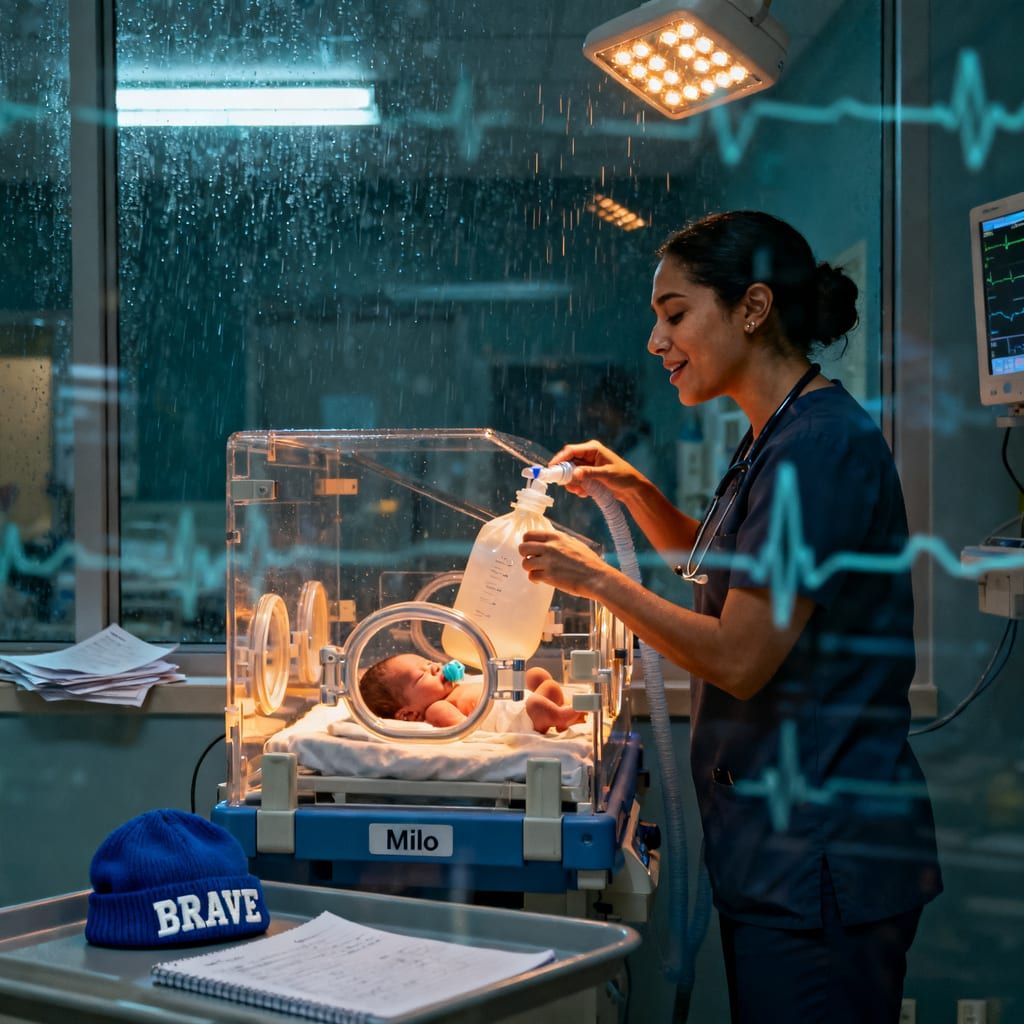
In the NICU, the smallest hours carry the longest echoes
Read more →
Story audiobooks for children of all ages — a new one every day on Smarter Way Stories.