Where the Fire Meets Home
A backburn, a shoebox, and the promises we keep
Read more →
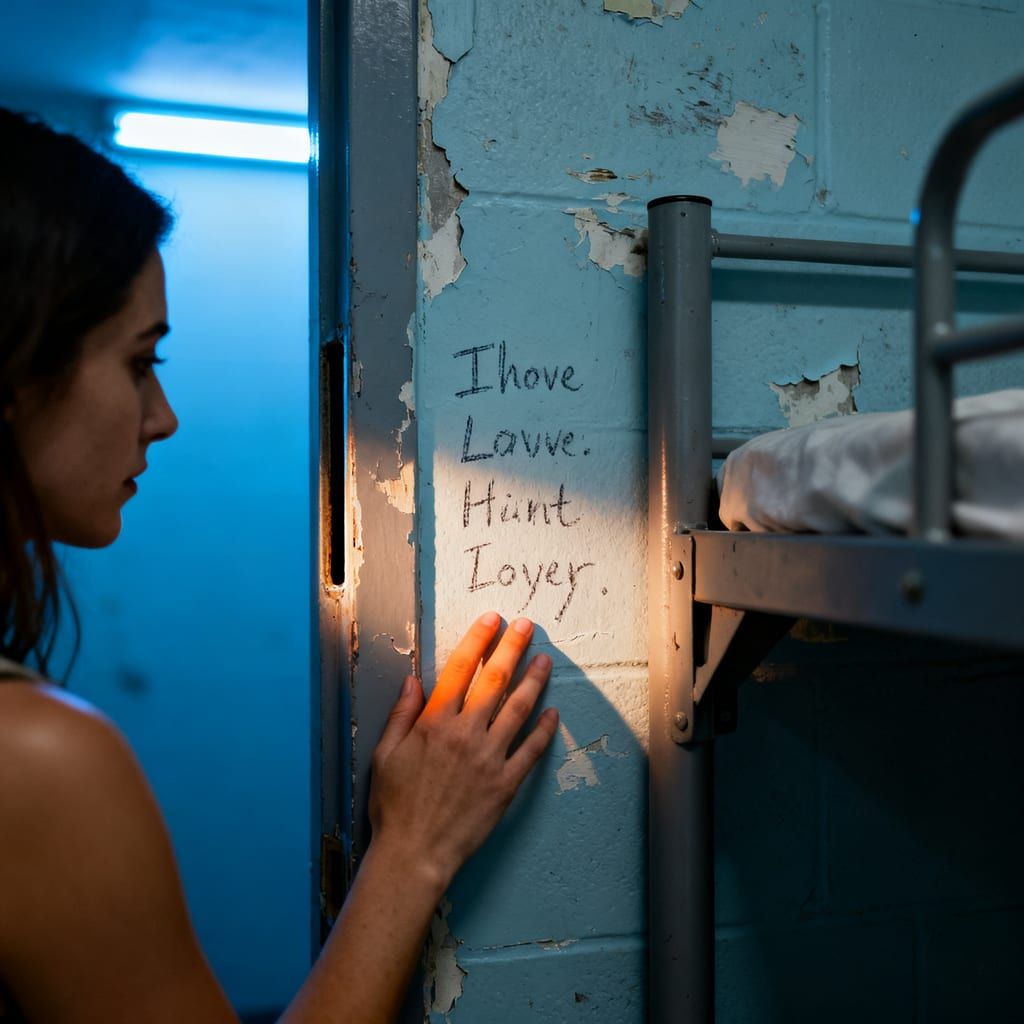
The first night, Lina counts the holes in the ceiling tile until they stop being numbers and start being stars. Fluorescent light spills through the slot in the door, flat and thin, and her thoughts pace as if they, too, have nowhere else to go.
Her bunk tastes of metal and old soap. The mattress squeaks when she turns. She presses her cheek to the cool paint beside the pillow-chipped, layered, history built up like sediment-and that's when she sees it. A shallow carving, letters gouged clean, careful as stitch work.
"Someone you will never meet is rooting for you. -M."
She touches it with the pad of her index finger the way you might touch a fresh bruise: gently, to learn the shape of the pain. Her breath snagged for days now loosens a notch. The words aren't warm, exactly. They're a hand on her shoulder through a sleeve.
Day makes a performance of being day, but the light here never changes. There is count, there is chow, there are cinderblock walls painted institutional blue so often they shine like ice. Keys clatter. Doors blink awake, then slam closed with a sound that lives in the teeth.
Her bunkie, Yara, has a voice like the soft undernote of a cello. "You're new," she says on morning three, braiding her hair with deft, factory-trained hands.
"Lina," Lina says. Her mouth tastes like the coffee they pour from gray pitchers. She hasn't found a place to set her shame down yet; she carries it in both arms.
They line up single file. They wait. They move as if the floor is an airport conveyor belt and each step is assigned. Between steps, Lina's fingers float to the letters behind the paint flake by her pillow. It becomes a motion like prayer-two breaths in, three out, trace the groove, the thought forming: Someone you will never meet is rooting for you.
Yara laughs the first time she catches her. "Girl, you got a ghost under there?"
"It's a sentence," Lina says. "On the wall." She tilts her chin toward the carving.
Yara leans in. "Huh." She runs a pinky over the words like tasting soup. "Corny." She smirks, then softens. "Read it to me tonight. Maybe I'll sleep."
That night, after lights dim enough to make faces gentle, Lina whispers the words. Yara repeats them back, uncertain, then steady. They say it again. They don't look at each other.
A week maps itself with tick marks on the cardboard of a cereal box lid tucked under Lina's pillow. On day eight, the C.O. calls out for volunteers, four women to work in the library. Lina's hand goes up before she can imagine it coming down again. Yara thumps her heel against the bunk in approval.
The library looks like a closet in a church basement. There is a smell of dust and something hopeful-paper daredeviling through hands. Paperbacks lean in wonky stacks, their spines a riot of fonts, romance blush next to true crime's menace. Above the check-out desk, a clock insists on counting time in the same way it does anywhere else.
"You stamp here," says Ms. Reyes, the volunteer librarian, pointing to a date with a rubber stamp made years from the new. "You shelve by the letters on the spine. You keep the carts moving."
Ms. Reyes is small and neat, gray streaks in her hair braided tight, an oval locket nestled where her throat begins. Her voice wears a hush like a sweater. She shows Lina how to turn the ink pad just so, how to coax bent spines back into the shape of themselves. Her hands speak economy, mercy in their precision.
"Why the hush?" Lina asks, smiling, as the other women speak in loud clouds across the room.
"It's a library," Ms. Reyes says, amused, and then, softer: "Also, people read different kinds of quiet here."
By the second day, Lina feels the heft of routine lifting something inside her. Stamp. Shelve. Check back. She can make a piece of time behave, divide an unmanageable hour into a series of small, obedient tasks. Her chest remembers how to expand. She tells Ms. Reyes about the sentence carved in her cell.
"It's saving me," she admits, pulse drumming in her throat. "It sounds ridiculous, but-"
"It doesn't," Ms. Reyes says. She arranges returns into a neat parade. "Words can be a hinge."
"I keep thinking I should write to whoever wrote it." Lina laughs, embarrassed by the idea of addressing someone who does not exist for her. "Like in that community newsletter they leave by the phones."
"You can," Ms. Reyes says, a small hitch to her smile. "But sometimes the letter you write changes you more than the person you meant it for." She closes a book and taps it twice with the flat of her palm. "Pick one thing you can do here that you keep doing after the door opens. The body loves a ritual."
"I was a graphic designer," Lina says, the verb tense a flinch. "I like making order."
"Then keep making it," Ms. Reyes says. "Shelves are everywhere."
On day thirteen, Lina's mother's voice arrives through the receiver spiked with static and old grievances. There are the expected questions and one unexpected silence. The silence swells and tilts the world.
"I thought you were better than this," her mother says finally. It is not said to wound. It does.
Lina bites the inside of her cheek hard enough to taste iron. She says nothing because anything she says will fall on its back and kick. When the call ends, the handset feels too heavy to return to the hook.
Back in the cell, the light has a cruel edge. Her hands shake. She wants to scratch a new message into the paint, to hammer a second opening into the wall, to argue on behalf of the person in her who looks so much like a mistake.
Yara watches from the lower bunk, her posture a comma, inviting the rest of the sentence to arrive. "Read it," she says. "Please."
"I can't. Not tonight."
"Then touch it," Yara says. "Do your weirdo yoga breaths."
Lina snorts-almost a laugh-and presses her fingers to the groove, in and out, until her breath returns to her like a stray dog: cautious, then all at once. She does not add her own words to the wall. She does not break the spell. She lies awake and learns how to bear herself in the dark.
The note to "M" appears in the next newsletter, a quarter-page confession with no return address: If you are out there, thank you. I am learning to stack hours like books. I am learning to breathe.
There is no answer the week after, nor the week after that. There are, instead, more carts to push, more returns to log, more stamped dates ticking forward like the legs of a centipede. There is the satisfaction of pulling bent bookmarks from between pages and marshalling them into a plastic cup with the others. There is the transom window's stripe of daylight at midafternoon that suggests the sun has not abandoned them.
At night, Lina and Yara read the sentence aloud like teeth-brushing. Sometimes they add a strange grace note-Keep going-as if the wall itself needed encouragement.
Two days before release, Ms. Reyes asks Lina to help with a box of donations. At the bottom, a children's book about a bear in a red scarf endures its tenth life. Ms. Reyes laughs and tells a story about her daughter, now grown, who made her read it until the corners gave up. Her locket slips open on its chain, a hinge bright as a thumbnail moon.
"I know your cell," Ms. Reyes says when they've packed the books away and the quiet settles. "By the chip in the paint under the back corner of the pillow." Her eyes flicker, not quite at Lina, more toward a point in the room only she can see.
Lina stills. The sawtooth hum of the fluorescent light fills the space between them.
"I was there," Ms. Reyes says. "A long time ago. Thirty years." She rocks the stamp in place, up and down, a tender hammer. "I carved those words the night they moved my bunkie out after a panic attack. No warning. One minute she's smoothing lotion over her elbows, next minute the door opens and it's just-" Ms. Reyes opens her hands. "Gone."
"M." Lina's voice is small, a child with a new fact in her mouth.
"My last name then." Ms. Reyes's smile is a thin, brave thing. "Morales?" she asks, glancing up. "Common enough. We might share more letters than we know."
Lina feels the room shift like an elevator settling on a floor. The magic is not magic. It's a promise someone made to themselves and kept, plank by plank, across a span of years.
"I thought-" Lina starts, and then stops, because what she thought does not matter as much as the living fact of the woman in front of her, whose hands have learned how to place books as if they are stones in a river, shaping the current.
Ms. Reyes tucks a stray hair behind her ear, shy. "I didn't have anything to give that night. Those words felt like a way to tie a string from me to whoever came next. I imagined it might tug at the right time."
"It did," Lina says. Her throat burns and cools, like the first breath after a deep dive. "Thank you."
Ms. Reyes nods once. "You'll pass it on," she says. Not a question.
Release looks nothing like it does in movies. There is no swelling music, only a stack of property returned in a plastic bag and a sky too exposed, a blue that makes the eyes water. The air smells like warm tar and cut grass. Yara's last words in the doorway were, "Brush your teeth. Call me if you need me to talk at your mom." They both laughed like they'd earned it.
A week later, Lina comes back with a civic cleanup crew, a paper visitor's badge pasted crooked on her jacket. The hallways are the same and not the same-new signs, the old hum. She rolls paint white over scuffs and tic-tac-toe games. The brush makes a sound like someone whispering secrets to the wall. Ms. Reyes appears in the doorway of the library, an apron tied over her dress, approval warm in her eyes.
When Lina reaches her old cell, her feet pause of their own accord. The world narrows to the square of paint above the bunk, the groove where her fingertip once learned a path. The sentence is there, faint with age but legible still, knife marks like tiny white rivers.
She can leave it. She can paint over it. Either is a kind of fidelity.
She lifts the brush. She hesitates the length of a breath.
Then she draws the bristles down, slow and steady, laying the wall smooth. Her chest tightens, then eases, and the white covers the words the way snow makes a yard new in the morning. She can almost hear the whisper change. Not erase-transform.
In the quiet after, she walks to the intake library shelf, the one Ms. Reyes keeps closest to the door. From her pocket, she pulls a card she has lettered by hand, the ink dark and unshaky. She slides it between thin volumes of poetry and a tattered yoga manual.
"Someone you will never meet is rooting for you. Keep going."
She signs nothing.
Ms. Reyes is leaning in the doorway. Their eyes meet, a nod passing between them like a baton.
Lina steps back, paint spattered on her forearm, a clean streak on the wall drying behind her, a card sleeping among the spines. She wonders who will find it first. She doesn't try to guess their face. She doesn't need to.
In a cell two doors down, later that night, a new inmate curls onto a thin mattress, the light hard as always, the ceiling tile counting back at her. She reaches under the pillow for nothing in particular and finds the edge of a card.
Her thumb follows the paper's corner. She breathes in once, raw; breathes out, slower. The sentence waits, inked and patient, a hand through a sleeve.
She reads.
She presses it to her chest. She listens to her panic lower its voice.
And somewhere down the hall, paint dries smooth as a promise.
Story audiobooks for children of all ages — a new one every day on Smarter Way Stories.