The Reason the Records Stayed Silent
How a sealed birth became a quiet covenant
Read more →
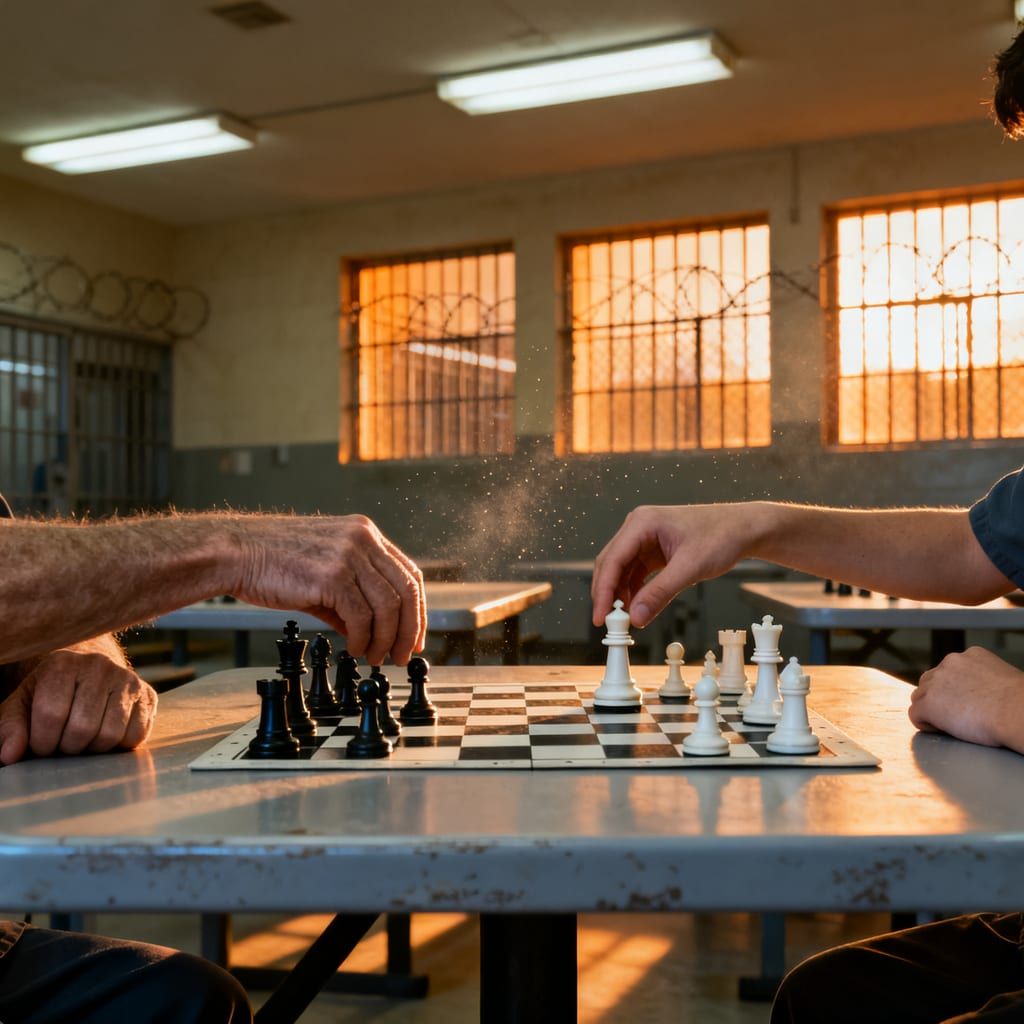
The first time Daniel Ortiz set the folding board on the scuffed table, the pieces looked too clean for the room. Plastic kings and rooks gleamed under fluorescent hum, set against a floor tattooed by dragged chairs. Barred windows held a late-afternoon amber that made the dust look like slow snow.
He looked up and found Deon watching with a narrow, restless stare, the kind that measured exits and offenses in the same glance. Sixteen, fast hands, faster anger. He set his knight hard enough that the base clicked. "So we play or we talk?" he said, chin high as if the question were a dare.
They played. Deon treated the opening like a sprint-knights slung forward, queen out early, pawns thrown like punches across the center. He grinned at every capture, leaning over the table with a half-laugh that was almost a growl. Trash talk bubbled at his lips, a way to fill the space where patience might have lived.
Daniel mirrored with small, quiet moves, exhaling through his nose, nodding instead of correcting. He moved his king two squares and dropped a rook beside it.
Deon blinked. "You hiding?"
"I'm castling," Daniel said. "Sometimes the bravest move is keeping what matters safe."
"Brave is taking his head," Deon muttered, but his eyes stayed on the rook's neat slide, a little muscle in his jaw ticking.
He reminded Daniel of himself at that age-the way he used to lunge until life grabbed his wrist and twisted. He felt the old heat lift at the back of his neck, then pushed it down like a rook moving behind cover. He placed a fingertip on the pawns. "You see them?"
"Yeah." Deon rolled his eyes.
"They're dangerous when they advance together," Daniel said. "Alone, they get plucked. Together, they change the whole board."
Deon snorted. "You writing bumper stickers now?"
"Maybe." Daniel smiled without teeth. "Or maps."
They fell into a rhythm on Tuesday afternoons: board unfolded, chairs scraping, the room briefly a country with borders and rules. Daniel replaced Deon's trash talk with quiet questions that didn't ask for confessions. What made you choose that move? What would it look like to wait? If you trade now, what's hanging after?
Some weeks, Deon arrived rope-taut, a fresh bruise softening under his eye. He'd play like the clock was draining somewhere he couldn't see. Other times, he slouched into the chair, yawning, eyelids heavy with a sleep he couldn't trust to last.
One afternoon, Daniel set two pawns shoulder-to-shoulder and walked them up the board like a long, slow march. "It's ugly," he said when Deon scoffed, "but ugliness wins sometimes. It exhausts the people who keep going for the flashy move."
"Where's the fun?"
"Depends on what you're trying to enjoy," Daniel said. "The cheer right now, or the win you still have tomorrow."
Deon leaned back. The fluorescent tubes buzzed like a tired wasp nest. "You talk like you swallowed a book."
"Nah." Daniel slid a pawn one square. "Someone taught me to read the small print."
He didn't say when. He didn't say where. He kept his past folded up, a note you carry in your wallet and don't unfold until the corners give.
By October, word threaded the unit like fishing line: someone's cousin had been slapped, someone's pride dented, a payback scheduled in the laundry room. It didn't matter that there were cameras. It didn't matter that there were consequences. The rumor moved with the right to go anywhere, picking up pieces without asking.
Deon kept glancing at the door as they played, jaw set. His knight skittered to the rim of the board, then in again, impatient. "People think I'm soft," he said too loud. "They think I'm gonna come out and just-do what they say."
"I don't," Daniel said.
"I ain't getting cornered." He drummed his fingers, a small, sharp rhythm. "You know how that feels?"
Daniel placed a hand on the edge of the table, flattening his palm against the pitted surface. He knew. He knew the itch in the spine, the dare you hear in your own blood. He swallowed the story. "Let's map it," he said instead. He reached into his bag and pulled out a cheap spiral notebook, the blue cover creased like a tired smile.
"Map what?"
"The board you can't see yet," Daniel said. "Tomorrow. Next week. The first month out."
Deon laughed once, brittle. "You drawing me a fairy tale?"
"Openings. Middlegame. Endgame." Daniel clicked his pen and drew a square, then a grid. He wrote in block letters: OPENING-DAY ONE. "Who you call first." He wrote: MOM. He glanced up. Deon shrugged, not meeting his eye.
"Where you go after curfew. What you do when someone texts you at midnight." He wrote QUESTION MARKS beside those. "Two choices each time. What trades you're willing to make."
"Trades?"
"You take the pawn now, lose the rook later. Or you pass on the pawn and keep a piece that guards everything." Daniel tapped the word GUARD. "You don't have to win pretty. You have to still be here to win at all."
Deon's gaze snagged on the page. He said nothing. He didn't need to. He just reached for the pen.
The rumors burst open before the notebook filled. In the fluorescent classroom, an insult flew, then a chair. Someone laughed, brittle and bright as broken glass. Two bodies collided hard enough that the table jumped, the pawns skittering, white's king tipping on its base.
Daniel felt the old heat again, a phantom current rising from somewhere hollowed years ago. He heard the scrape of shoes, the officers' boots down the hall. He saw Deon's shoulders go high, fists tightening around a piece of air.
"Yo!" someone shouted. "You ain't walking from this!"
Daniel stood but didn't raise his hands. He didn't say calm down. He didn't tell boys not to be boys. He let the silence gather until he could hear the tubes whine and his own pulse slow. And then, because the room was teetering, because he had taught them to castle and he had not yet shown them how a human being does it, he broke open the note in his wallet.
"I was locked up," he said.
The words landed like a rook on an open file, a clean drop. Heads turned. Even the room seemed to lean in.
"I was your age," Daniel said. "A quiet man with a wooden board sat with me under lights like these and taught me how not to swing at every shadow. He said the board is the same shape as the day you wake up to. He said you can learn to keep your king."
He looked at Deon. He didn't layer it with pity. He didn't perform righteousness. He held the boy's stare and let the past sit between them like another piece on the table.
Deon's shoulders lowered a half inch. The air in the room thinned, not all the way, but enough for breath. A chair leg touched the floor. The tipped king stopped trembling.
"Now," Daniel said softly, "we can keep this game. Or we can throw the board and let someone else pick our moves. Choose."
Slowly, like the idea hurt, Deon opened his fists. Around him, the hiss diffused. The room stepped back from its own edge.
The week before the hearing, they filled the notebook. They diagrammed the first morning out: breakfast with his mother, the bus route to the GED program, three numbers he could text when the night got loud. Deon wrote their names like he was carving them in wet cement.
"What about when old friends show up?" Daniel asked.
Deon drew an arrow with two branches. One said, "Meet at park." The other said, "Send them schedule-say later."
"You're allowed to castle," Daniel said.
Deon smirked. "To hide?"
"To protect time you'll need for the middlegame."
He didn't beg the boy to be good. He showed him squares he could stand on and still breathe. He resisted the itch to narrate success as a miracle or failure as fate. He showed him that pawns change the whole story when they advance side by side.
On the morning of the hearing, the courtroom's fluorescent lights offered a cleaner hum but no warmer mercy. Deon sat straight, knuckles pale, face set out of old habit. The judge scanned papers that turned Deon into lines and codes.
"Anything to say?" she asked.
Deon stood. He set the spiral notebook on the desk with more care than he'd ever given a thing before. "I made a plan," he said, voice rough at the edges. "Openings, middlegame, endgame." He flipped pages, not for show but because he needed to see the words to believe them. "I wrote down who I'm calling first, where I'm going after curfew, what I'm gonna do when my phone lights up with names I still like."
He didn't plead. He diagrammed. He didn't promise to change the whole city. He promised the small, defensible moves that make a life exist long enough to study.
The judge watched. Something in her shoulders softened like a rook easing off the back rank. She cleared her throat. "Thank you, Mr. Turner," she said, using his last name like it was a clean shirt. "We'll take this into account."
Daniel waited in the hall, pretending to scroll his phone while the air conditioning wrung sweat from his shirt. When the door finally opened and Deon emerged with a cautious half-smile, Daniel let out a breath he'd been holding for years.
That night, the bus rocked along its route like a long, tired cradle. City dusk blurred the faces in the window to streaks. Daniel held the empty board across his knees, the pieces zipped tight in their pouch. The seat beside him smelled faintly of orange cleaner and somebody's cigarettes.
He stared at his phone. His brother's number sat there, a stone he'd been circling with small steps for a decade. He felt the old heat again-the one that used to push him into doors. He closed his eyes and pictured a rook sliding to cover, a king tucked behind its wall.
He dialed. The first ring, then the second. On the third, a voice he loved and resented in the same breath. Daniel swallowed, throat roughened by air that tasted like metal.
"Hey," he said. "It's me."
He didn't apologize for years. He didn't narrate the bus or the chessboard or the boy with quick hands. He just offered his voice and let it stand, a small pawn moved one square, starting something that wouldn't impress anyone on Instagram and would matter anyway.
On the day of release, the unit's door yawned with a click that felt like sunlight. Deon walked slower than Daniel expected, his eyes flicking like wings to the corners of the room he wouldn't see again soon. They set up the board one last time.
"Speed chess?" Deon asked out of habit.
"No clock," Daniel said. "Let's see what we're actually choosing."
They opened tame. Deon sent a pawn two squares, then another one beside it, their shoulders touching. He smirked without heat. "Dangerous together, huh?"
"Ugly and strong," Daniel said.
Midgame arrived with a tangle. Deon's queen had a shot-a flashy tactic sacrificing a bishop to open a file. Daniel saw the glint in his eyes. The old Deon would have lunged, crowed when the first capture hit, swallowed the hook on the second, bled on the third.
Deon's fingers hovered. The room held its breath. Somewhere far off, a door clanged, a sound that used to lift his shoulders. He looked at the board as if it were the face of a person he meant to keep.
He touched his king. One square over. Castled by hand, late and patient, protecting what mattered.
Daniel felt something in his chest loosen and settle. The board changed. Not dramatically-the crowd would not have cheered. But lines closed, weak squares guarded, the shape of danger made smaller.
"You're soft," Deon said, out of habit, but he was smiling shy.
"Nah," Daniel said. "You're brave."
They played to an end that was not cinematic. No crushing checkmate. No flung pieces. Just a position that arrived at stalemate, then a shrug, then laughter quiet as shirts rubbing on plastic chairs.
At the door, Deon tucked the notebook into his waistband. He looked at Daniel, chin still a little high. "I'ma text when the board gets messy," he said.
Daniel nodded, the motion tiny and full. "Send the position. We'll find a move."
Deon lifted two fingers in a salute and stepped toward the amber hallway. He paused, turned back, reached, and with exaggerated care reset the toppled white king to the middle of its square.
Daniel watched him go, the bars throwing thin shadows like pinned threads across the floor. The hum of the lights receded in his ears. He folded the board, the click neat, final, and not.
On the bus home, he dialed again.
This time, when his brother answered, Daniel didn't clear his throat. He placed his words where they could be defended, a small fortress built one honest line at a time. Outside, the city moved in squares and streets, lights blinking in patient sequences. Inside, two voices found a file they could both travel down.
And somewhere inside the unit they'd both survived, a wooden king stood quiet and alive, waiting for the next careful hand to keep it that way.

Story audiobooks for children of all ages — a new one every day on Smarter Way Stories.