Two Houses and One Quiet Heart
A daughter learns to read between the lines of a life split in two
Read more →
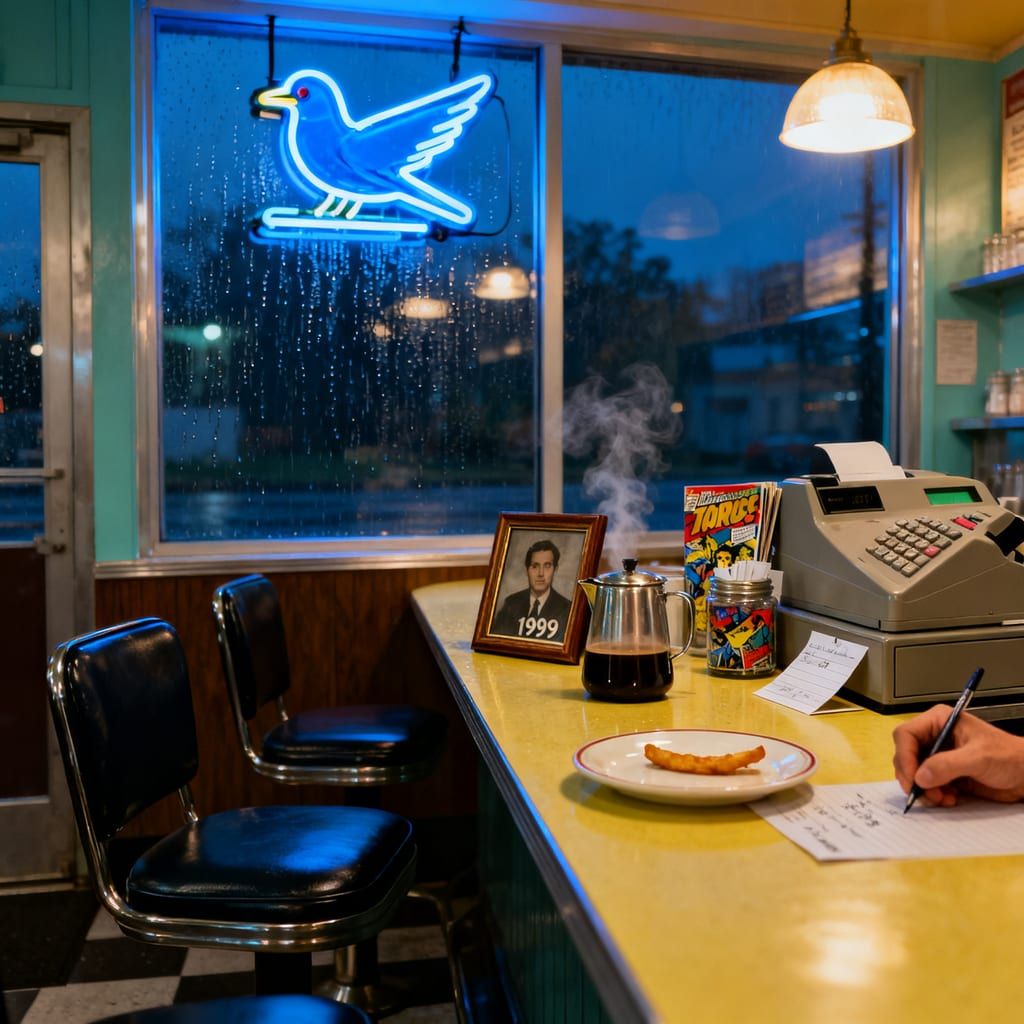
The neon bird over the window flickers twice before settling, a soft blue heartbeat against the dark. Elena keys open the register and sets her divorce papers beneath the till, face down, where the twenties should be. The metal drawer sighs like something relieved.
The diner breathes differently at night. The AC coughs against the high windows. A mop leans like a tired man. The clock's second hand ticks, unembarrassed. She ties on her apron and moves through the booths, aligning salt shakers like small lighthouses.
Mimi, the cook, slaps a palm to the pass window. "You look like you're going to a funeral."
"Wrong shoes for that," Elena says, flexing her toes. "Too much rubber."
Mimi snorts and slides a plate beneath the heat lamp. "Nurse special on standby. Something tells me we'll need it."
Something in Elena untenses. It's not silence she wants-she's had that, the flat, echoing kind-but a sound that keeps time. The neon, the clock, the sizzle. A metronome for the hours she refuses to name.
The first one in wears scrubs patterned with daisies. Her hands are not steady. She asks for coffee like an apology.
Elena brings it without comment, sets down a cup with a saucer to catch spills and a small plate of toast she didn't order. "Kitchen gets offended if I don't give everyone carbs at night," she says.
The nurse laughs once-odd, like a hiccup-and presses her fingers to the mug. "I don't want to go home yet." Her eyes stay on the coffee, a tide just about to crest.
Elena lets the silence hold. A van passes outside and the neon bird shudders across the tabletop. Mimi pretends not to watch, turning bacon with the care of a jeweler.
"I did everything right," the nurse says, each word placed carefully, as if she might tip them over. "Sometimes right isn't enough."
Elena nods. She thinks of papers with clean lines and wrong answers. She thinks of the way a door sounds when it closes the last time.
"Do you want the nurse special?" Elena asks. "It's not on the menu."
"What is it?"
"Grilled cheese and tomato, extra pickle. Pickles make people believe in second chances."
The nurse smiles, a muscle remembering. "Okay."
When Elena sets the plate down, Mimi has added an extra fry, crisp and ridiculous, a golden comma to the sentence. The nurse eats half the sandwich, then folds the other half into a napkin like a saved thought. She keeps her hands around the empty mug as if warming them over coals.
"You can sit as long as you want," Elena says, refilling the cup. "We don't close."
"Bless you," the nurse whispers, not meaning church.
A rideshare driver slides into a booth with a tired grin and a jacket that smells like rain. He orders pancakes, stares at the menu like it might tell his future.
"How's the night?" Elena asks, pen hovering.
"Longer than my playlists," he says. "But I'm saving for a custody lawyer. So. Extra syrup."
Mimi's laugh cracks like oil. "Heard that, sugar."
When the pancakes arrive, he inhales two, then sits back, crumbs threading his beard. He fishes something from his pocket and sets it on the table-bright paper, worn folds.
"You got kids?" he asks.
Elena shakes her head. The answer hangs heavier than she intends. "No."
He holds up the comic book anyway, its cover dog-eared, a girl with a cape mid-leap. "My daughter loves this one. Rocket Girl. She says I look like her sidekick." He chuckles, then sobers. "I like that she thinks I can keep up."
When he pays, he tucks the comic into the tip jar, something tender disguised as a joke.
"For luck," he says. "Or for some kid who needs to know the ground doesn't always win."
Elena wants to say she will keep it safe. Instead, she says, "Rocket Girl can borrow our ketchup bottle as a jet pack." He laughs, lighter now, and leaves with to-go coffee, steam unwinding into the cold.
A girl about sixteen edges in, eyeliner smudged in brave black crescents. She's a shadow trying to decide if it can be a person again.
"You got soup?" she asks, voice swallowing the room.
"Chicken noodle. Or tomato. We have a strong tomato game," Elena says. She keeps her hands visible on the counter, palms up like a peace offering.
"Chicken." The girl dips onto a stool; her knees bounce. A bruise blooms at the edge of her sleeve.
Elena ladles the soup herself though it's Mimi's domain, lets the steam kiss her face. She sets it down with a spoon that isn't chipped and a stack of napkins thick as a prayer.
"You got a phone charger?" the girl asks after a beat.
"Drawer by the pie case," Elena says. "And the phone's by the register if you need to make a call." She doesn't watch. She learns, in these hours, the holiness of looking away.
The girl eats like she hasn't in days, then takes the phone with both hands as if it might bite. Elena turns to restock creamers, grateful for noise. Behind her, the girl's voice shakes on the third ring. "Hi, Mom," she says, and the words undo the knot in the night.
When Elena looks back, the girl's eyeliner is two more smudges and her spoon is a tiny oar navigating a small, hot ocean. She nods once at Elena as if someone mastered a complicated handshake. "Thank you," she says, and slides a dollar across the counter, a too-light coin.
"Come back if you need more soup," Elena says. "We over-ordered noodles for the apocalypse."
The girl laughs through a hiccup and goes into the dark with her phone to her ear. The neon bird throws her a blue wing as the door shuts.
There's a lull then, the hour when even the city rests an elbow on the table. The bread delivery guy comes in humming off-key, leaves flour-dusted bags like offerings, and pats the photo on the bulletin board-a crooked print of the diner in 1989, the neon bird smaller, shy. He never takes coffee. He always hums the same song Elena can't place, something like an old commercial or a childhood morning.
Mimi pretends to scold a plate of hash browns. "Behave," she says, "or I'll make you famous." She catches Elena's raised eyebrow. "Don't look at me like I'm tender. I am a stone. A stone that occasionally sprinkles paprika where paprika is emotionally required."
Elena laughs, and the laugh stays when she finds her old pad in her apron pocket-the one she abandoned when conversations at home thinned to weather and rents. Without deciding to, she writes: Nurse holds her coffee like a candle. Rideshare man calls himself sidekick. Girl asks the phone for a bridge. Mimi, paprika as punctuation.
The pen moves. A map of the human night unspools in small lines. It surprises her, how easy it is to hear again.
He comes in folded into a good suit. His tie is neat, his hands not. The gold band on his finger is spun inward to hide the shine. He orders black coffee and a slice of lemon pie and looks at the pie as if it were a photograph.
"Big night?" Elena asks, because grief sometimes needs the smallest door.
He taps the cup. "Across the street," he says, nodding at the hospice through the window, where one light burns in a hallway like a lone lily. "I'm... I'm going to say goodbye." The word peels itself from him in strips.
Elena sets an extra napkin by his hand without comment. Mimi, expert at eavesdropping from a respectful altitude, quietly sets a spare fork by the pie.
He nudges the ring. "I turned it in," he says, a strange confession. "Feels like I'm cheating at something, like flipping a coin to always land on the dark side." His smile is quick and vanished. "Isn't that ridiculous?"
"No," Elena says. "It's... it's to keep the world from asking a question you don't want to answer."
He looks at her then, a surprised kindness in his gaze, as if she pulled a thorn neatly. "Yes."
They're quiet while the pie cools. Lemon and sugar settle the air. He eats one bite, then another like they're obligations. When he stands, he takes the ring between finger and thumb, considers, then turns it outward again-so small a pivot Elena feels it like a door creaking open in a distant room.
"I'll be back," he says, and leaves the cup half full, the saucer ringed with coffee like an eclipse.
The sky begins to think about light. The windows milk up with the breath of morning. Elena closes the till to count, thinking of the comic book in the glass tip jar, the nurse's folded sandwich, the girl walking toward a phone that answered, the man walking toward a goodbye.
The register sticks. She wrenches it, and the whole drawer lifts an inch, clattering like bad timing. She curses softly and peers under the rim, fingers searching for the snag. Her knuckle grazes paper.
Taped there, lip curled yellow, an index card clings. On the front, in blue pen, neat curves lean into one another: To whoever takes the last shift.
Her stomach drops in a pleasant way, like the first swing of a child's playground. She peels it slow, careful not to tear the corner where the tape has grown brittle. The script is unmistakable the second she turns it over-the looping, stubborn handwriting that signed permission slips and grocery lists with the authority of love.
Leave one light for the lost.
Her mother's words. Her mother's hand. Her mother-who'd never said she worked nights. Who'd woken early to pack lunches, who'd smelled like coffee that somehow, Elena realizes now, always had the sweetness of lemon peel.
Mimi looks up at the sound Elena makes, too small to be called a cry. "You okay?"
Elena holds up the card. Mimi squints. "Ah," she says softly, as if someone she knew long ago just walked in. "So you found it."
"You knew?" Elena's voice is all edges.
Mimi wipes her hands on a towel. "Your mama did a year here. Last shift. Held this place together with tape and care. Taught me the nurse special. Taught me that, too." She nods at the card. "Said some nights, people need a porch light to see the steps."
Elena's eyes smart. The neon bird hums in sympathetic vibration. Outside, the streetlamp goes out one bead at a time.
"Why didn't she tell me?"
"Maybe she did," Mimi says, and taps the card lightly. "In her way."
Elena slides the index card into her apron with the smooth muscle memory of a daughter pocketing a pebble from a river. Beneath it, the corner of the divorce papers pricks her knuckle. She presses the stack deeper into her apron and forgets their edges.
The door swings once more. The man in the suit returns, morning unkind on his face. He looks emptied and very clean, like someone who washed his hands too hard.
"I made it," he says. The words wobble, then hold. "She knew. She waited." He exhales, a long, finished thing.
Elena pours coffee like blessing. He doesn't drink it. He reaches into his pocket and places the index card on the counter, not surprised to find it there as if it had been for him, too, the whole time.
"Found this under the register," he says. "Seemed to be addressed to me," and he smiles, cracked but mending. He retapes the curling corner with the precision of a man who's been entrusted with fragile packages. The tape snicks, sure. The card settles back, patient.
"Leave one light for the lost," he reads aloud, soft, then touches his ring with his thumb. "I'll try."
Elena nods. A bus sighs at the curb, a bird insists somewhere in a tree the city forgot. The diner fills with the early workers, bright vests the color of warnings. The bread delivery guy hums out the door. Mimi clatters plates like cymbals. Someone orders pancakes. Someone orders courage.
Elena writes one last line on her pad: Morning is a room with the light already on.
She unties her apron and ties it again, a small ceremony. The papers in her pocket are a weight she can bear. Outside, the diner's sign throws blue onto wet concrete, the color of a bruise healing.
She flips the switch that keeps the neon bird lit despite the sun. The humming holds-a metronome, a heartbeat, a nightlight left on by someone who thought ahead.
Elena breathes in coffee and rain and lemon. She looks at the crooked photo from 1989 and sees, for the first time, a young woman in the corner, hair pulled back, hand on the register. The woman's smile is a private thing, as if she'd just hidden a note where someone she loved would find it much later.
Elena steps to the door as the first wave of morning enters, their boots wet, their shoulders wide. She catches her reflection in the glass-soft-eyed, apron crooked, light behind her. She does not think of escape. She thinks of porch lights.
The bell above the door jangles-a small, joyful sound. She puts a fresh pen in her apron and goes to take an order.
A daughter learns to read between the lines of a life split in two
Read more →
A fog-draped night, two souls found, and the quiet shape of a life
Read more →
Story audiobooks for children of all ages — a new one every day on Smarter Way Stories.