Two Houses and One Quiet Heart
A daughter learns to read between the lines of a life split in two
Read more →
The lock gave under his key with a sigh he didn't trust. Alex pushed the door, and the apartment greeted him with a soft echo. Air moved like it had more space to consider.
A thin wedge of sunset crept across the living room floor, lighting a white outline where the record player used to sit. The shelves-once a grid of rare sneakers like bright museum pieces-stood naked, dust ovals like ghosts of soles. The cameras were gone. The oak watch box, the one that clicked shut like a whisper, lifted without a fight. Even the brass bowl he'd bought in Lisbon, emptied of keys, sat on its side, its ring scratched into the console.
For a while he cataloged aloud. "Jordan 1 Retro, 2015. Leica Q. Submariner-no, the Tudor. The... Jesus." His voice thinned, the naming exhausting itself.
On the counter, a jar of pasta sauce waited, unaware. He opened it, boiled water, ate standing up. After, he sat on the floor and leaned against the bare shelf where the Off-Whites used to perch, laces like tongues. He could see his reflection in the black TV screen: a thirty-six-year-old product manager with a soft beard line, eyes that kept skittering to the gaps.
"Mr. Rivera, do you have receipts?" the officer had asked, his pen slow.
"Yeah," Alex had said, ashamed at how proud he sounded. "Yeah, I have all of it."
He did, of course. He lived in receipts-versions, iterations, roadmaps. His life arrayed in stacks he could defend.
The apartment hummed at night-refrigerator, neighbor's faucet, the Q train somewhere like a distant door. Alex opened his laptop for comfort, then flinched at the glow of a resale site ad following him like a dog.
He opened a blank spreadsheet instead. Cell A1 blinked, an empty room.
"What is this for?" he muttered, then typed: Moments.
In B1, after the cursor's little performance, he wrote: Time Spent.
In C1: More or less alive?
He set a quiet target in D1-small font, as if not to spook it. Collect 100 by summer.
The first entry came easy only because it happened outside of him: First snow from the fire escape. He stood pressed to the cold railing at 1 a.m., flakes crossing the yellow streetlight like moths, and he remembered being eight, head tilted to sky, mouth open. Twenty minutes. More alive.
The second was a phone call. "M'ijo," his mother said in New Jersey, her voice through the little speaker somehow filling the room. "You never ask for my secrets. Now you come for the sofrito?"
"I'm evolving," he said, grinning into the dark.
"You never had my sofrito in your fancy jars. Mira. Onion, green pepper, cilantro-no, not that cilantro you kill in a week-garlic. Chop and think of me."
He wrote: Called Mom for recipe. Forty minutes. More alive.
At three a.m., in a drawer the thieves hadn't bothered with, he found a notebook from fifteen-stiff cardboard cover, bad gel pen lyrics. The poem inside was not as terrible as he wanted it to be. He said yes to a co-worker's open mic. His hands shook at the mic, the paper trembled, and when he read the last line-about wanting to be seen by someone not yet real-the room clapped like rain.
He logged it. Ninety minutes including nerves. More alive, more alive.
Days accrued. He left for work ten minutes early to watch a muralist on Myrtle lift a sunrise onto a brick wall with a roller, orange bleeding into pink. "You're the guy who comes by and says nothing," the muralist laughed.
"I don't want to mess you up," Alex said.
"You can't mess up a sun," the man said, dipping the roller. "It'll happen anyway."
He bought two coffees once and handed one to a woman waiting with a grocery cart. "Careful," she said, a smile catching him off-guard. "I don't drink anything a man hands me on the street." Then she took it anyway. They stood in the wind together, steam thin as a veil.
On a Sunday, the neighbor's father knocked. "Your shoes," he said, pointing at the scuffed oxfords Alex had worn to a pitch once, now demoted. "They got history in 'em. You polish them, you respect that."
The man-Arturo, ninety if he was a day-set up a towel on Alex's bare coffee table. His hands were mottled and certain. "You know, I wore a pair like this to ask my Rosa to marry me," he said, rubbing in small circles. "They had a stain from a salsa night. I wanted to buy new. My cousin said, 'You want her to know you dance, no?'"
Alex laughed. "Did she say yes?"
"Three kids later, m'ijo," Arturo said, winking. The shoes shone like a new language.
He wrote: Learned to polish. Listened to a proposal. Sixty-five minutes. More alive.
He started walking the long way to work to catch the muralist at dawn, paint under the nails, a line of pigeons on the curb like an audience. He noticed how the bakery air changed with the hour, how the dogwalker called each animal by a different nickname, how his own lungs felt less like United States of Stress and more like weather.
On a cracked Wednesday, he rode the Q to Coney Island, just because he could. The car swayed. A boy pressed his palms to the window glass and left prints like little maps. At the boardwalk, the horizon opened like a hand. Wind flattened his hair. He bought a hot dog and texted his father a photo of the empty winter beach.
"I haven't seen that in years," his father texted back. Then: "Pick me up Saturday?"
He made a row for it. Two hours. More alive.
At work, the intern-Shayna, a whisper of a person with bangs like a decision-waited after a meeting, twisting her lanyard.
"I'm drowning," she said low. "My landlord- he raised the rent. I don't know."
Alex thought of the safe, the silent watches, the police pen. He heard himself ask, "What can you let go of, without your life falling apart?"
They spent Saturday on her floor, listing a bar cart shaped like a globe, a superhero print, a pile of sweaters she never wore. The room lightened as the boxes did. When they were done, she breathed easier. He opened the spreadsheet later and paused.
He wrote: Helped Shayna take back her room. Four hours. More alive.
He didn't write, because it felt too much like announcing himself: Paid for her first piano lesson. He thought of her hands, always fidgeting, finally sure over keys.
When the envelope came, it was thick enough to thump. The insurance company's logo in blue, his name in black. He placed it on the bare shelf where his cameras used to sit and made eggs. It looked like a new kind of object-a promise and a dare.
He opened it on the fire escape. The check's numbers marched across, respectable and heavy. His inbox vibrated. Subject lines: We Can Help You Rebuild. Exclusive Drop. Start Fresh.
He wrote nothing in the spreadsheet that day. He carried the envelope like a teacup across the week.
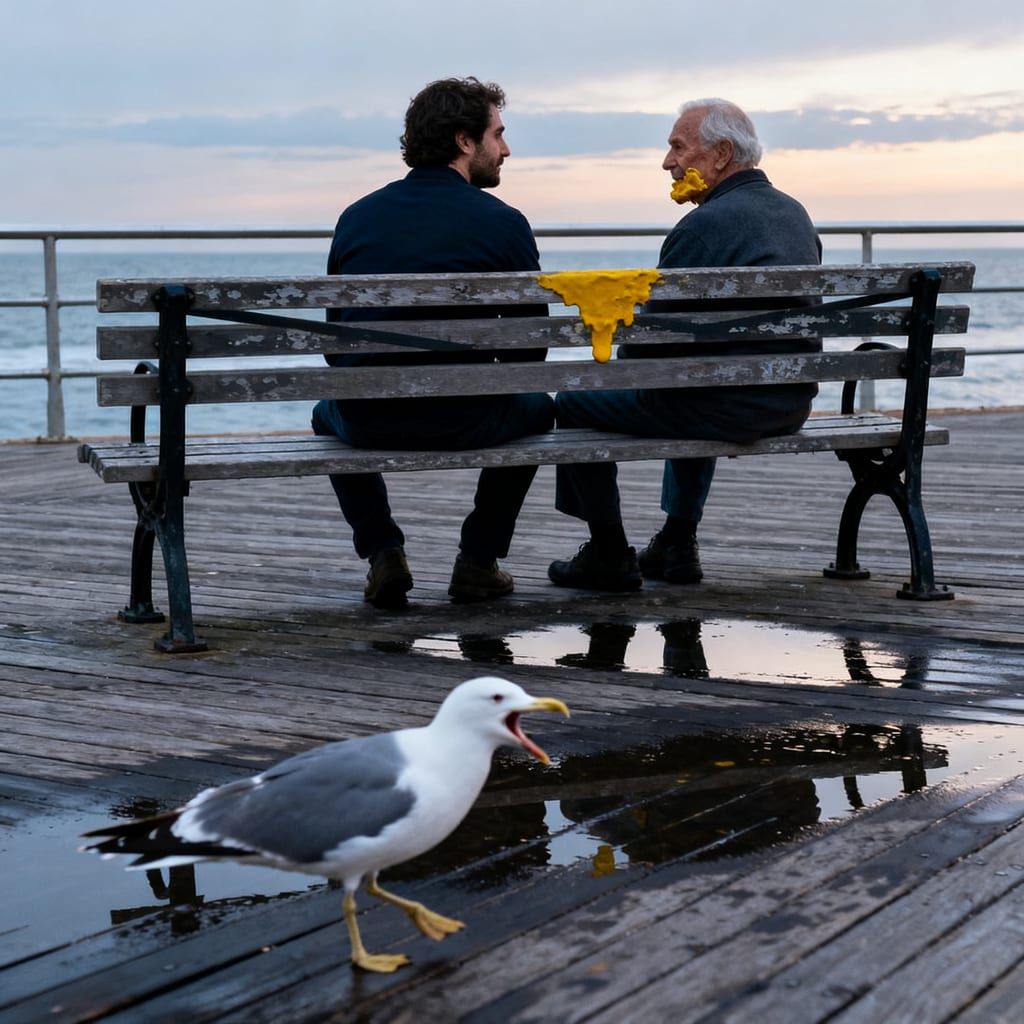
On Saturday, he took his father to the boardwalk. They rode in silence, the Q rattling past rooftops like a flipbook. His father wore a hat that had seen things. At Nathan's, mustard found its way to his father's chin, where it sat, bright as a celebration.
"Don't wipe it," Alex said, laughing. "It's-perfect."
A seagull screamed at the wind like a heckler. The ocean did its old slow work. The envelope stayed in Alex's backpack like a good child.
"You gonna buy it all back?" his father asked, not unkindly.
Alex watched a kid drop a quarter and chase it. He felt the answer arrive like weather. "I don't think I want to," he said. The words made room in his chest.
He used the money on time. He negotiated three unpaid Fridays through summer. He bought two Amtrak tickets to take his mother to the church of her girlhood in Washington Heights, the one with the cracked blue glass. He stood beside her as she lit a candle, watched the flame take, watched her face soften into a shape he remembered from photographs.
He handed the muralist an envelope one morning, not the envelope, but a small one. "For paint," he said.
"For paint," the muralist echoed, not looking inside. Weeks later, Alex walked by and found himself in the corner of the rising sun-his silhouette, coffee in hand, permanent as paint allowed. He laughed, then felt a prick at his eyes he didn't fight.
He added rows he could not have predicted. Teaching Arturo to add a photo of Rosa to his phone's home screen. Watching a feral cat finally accept a scrap of tuna in the alley. Riding the F one stop past his own to walk someone else's street.
His pulse loosened around price tags the way a tie loosens after the toast. The ads still found him, but they slid off.
Months later, a call. "Mr. Rivera? NYPD. We recovered a box we believe belongs to you."
The station smelled like coffee and pencil shavings. The detective slid a battered sneaker box across the table as if it might remember being precious. The lid had a crack through the logo. Inside: a pair of shoes from five summers ago, scuffed at the heel. Tucked to the side, a Polaroid he didn't know he'd been missing.
He lifted it, and the room shifted.
There he was-ten, hair sticking up like grass after rain-beside his father on this same boardwalk. Both barefoot, both grinning, arms empty, the day behind them as big as it could be. His father's hand half-caught between fixing his hat and touching his son's shoulder. The ocean a stripe they could stand on.
Something in him rearranged itself, quietly, like a traffic light turning and nobody honking.
He carried the box home and sat with the photo before the bare shelf. Then he wrote to a charity that auctioned shoes for scholarships. Come pick them up, he typed. He kept the Polaroid propped against a plant in a thrifted frame.
He logged: Returned what was never mine to keep. Thirty minutes. More alive.
Rain stitched the block in silver lines. The kid from 2B-Zoe with the gap-toothed grin and a bike too big for her-stood in the hallway with her helmet askew.
"Mom says you know how to not fall," she announced.
"I know how to fall better," Alex said. "But we can work on not."
They went to the parking lot behind the bodega, puddles reflecting the red letters of ATM like some kind of art. He jogged beside her, a hand light on the seat, sneakers-ordinary ones-soaking through.
"Look at that lamppost, not your feet," he said. "Breathe. You're part bird."
"I'm part bird," she repeated, serious as law.
She wobbled, corrected, rolled forward. His hand let go. She didn't notice for five seconds-six, seven-before she did, and then she shrieked, which made him laugh, which made her laugh, the sound making a bubble around them that the rain refused to pop.
They circled until they were both wet through and shining. Zoe's mother waved from the stoop, a dish towel in her hand like a small flag.
Back upstairs, Alex toed off his shoes by the door. The spreadsheet waited open on the table, cursor steady. He typed: Taught Zoe to ride, in the rain. Ninety minutes. More alive.
He glanced at D1, the goal he'd been polite about. Entry #100 blinked back at him, no confetti, just a line like any other. But he felt larger in his own skin. The apartment was still spare, but somehow warmer-the plant thriving, the thrifted lamp tilting its light toward the table, the photo of two bare feet at the edge of the world.
He closed the laptop. The hush that followed wasn't emptiness. It was room. He stood at the window and watched the rain knot the street together: cab lights, umbrella arcs, a man running with a box under his coat, laughing into weather he couldn't name a price for.
His wealth rose and fell with his attention. Tonight it swelled-quiet, certain-as if counted by a softer light he now knew how to see.
A daughter learns to read between the lines of a life split in two
Read more →
A fog-draped night, two souls found, and the quiet shape of a life
Read more →
Story audiobooks for children of all ages — a new one every day on Smarter Way Stories.