Two Houses and One Quiet Heart
A daughter learns to read between the lines of a life split in two
Read more →
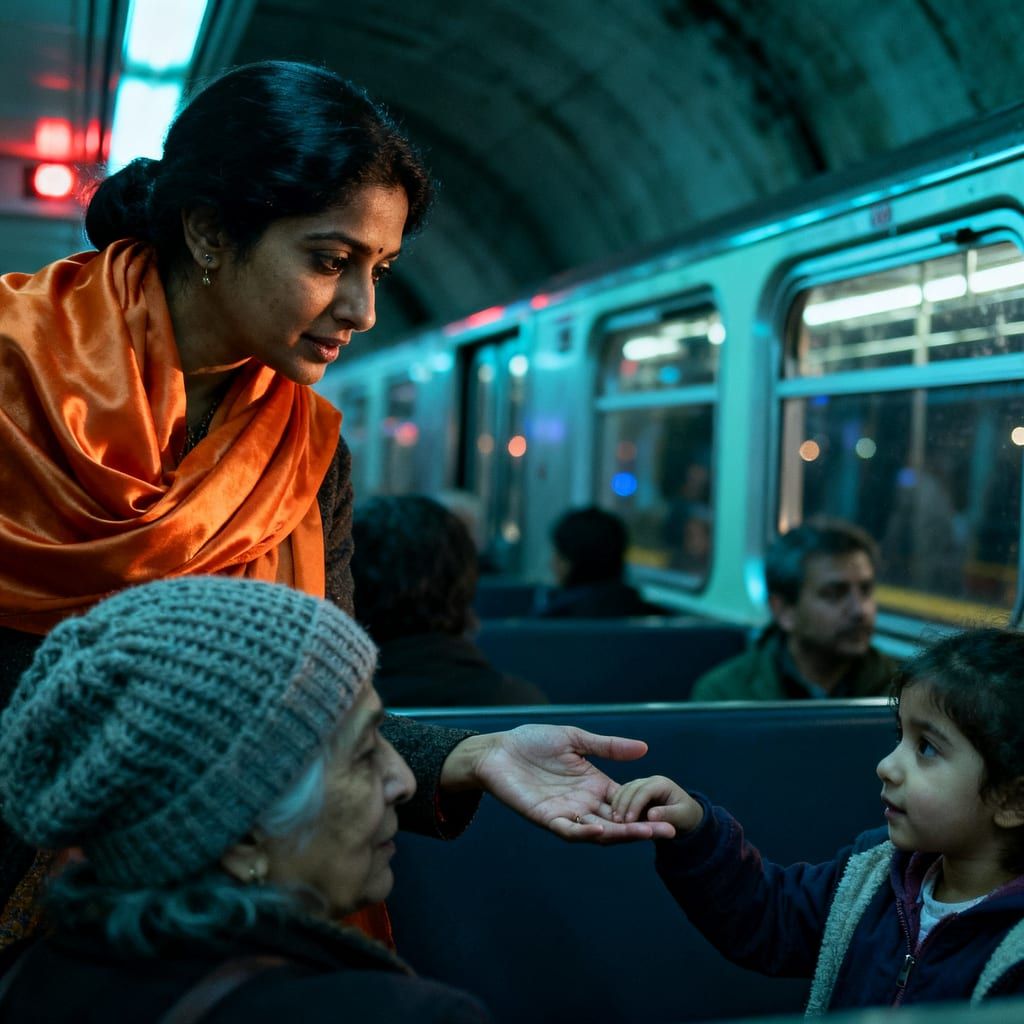
The train took its breath and held it.
Somewhere between two stations, the car shuddered, lights hiccuped, and darkness settled like a curtain pulled in mid-rehearsal. Metallic silence, a single cough, the hum of the tracks dying into a hush that let everyone hear their own pulse.
Across from Nisha, a boy's face tipped toward a fretful cry. He clutched a dinosaur backpack to his chest. His mother rubbed small circles on his shoulder, murmuring something that wasn't landing yet.
Nisha had worn her orange scarf-presentation day superstition, though there was no presentation. The silk warmed the hollow at her throat, a bright flag in the shadowed car. Habit wanted her to fold inward, to become spreadsheet-silent, to wait for someone official.
Instead, she cleared her throat. "Do you know," she said into the dark, "that even when we can't see them, the constellations are still there?"
A few heads turned. The boy's hiccups stuttered.
"My dad used to point them out," she went on. "Orion's belt. Cassiopeia-she looks like a W if you squint and tilt your head." She tilted hers; someone chuckled softly. "If the lights stayed off, we might even see them from here."
The boy's breath steadied. "What's your favorite?" he asked, sniffling, voice floating in the space between strangers.
"Scorpius," she said. "It's fussy to find. Like a secret."
A ringtone broke the spell and died. The car held a smattering of smiles. Nisha felt the tremor beneath her sternum ease. She surprised herself again. "While we're waiting," she said, "what's your favorite smell?"
"Cinnamon rolls," someone blurted. Laughter, small and grateful.
"New tennis balls," offered a man in a wool coat.
"My grandmother's hair oil," said the mother, and the boy repeated it proudly, then added, "Wet sidewalk after the first rain."
Nisha closed her eyes and saw her father in their kitchen, steam fogging the tiny pane above the sink. The smell of mustard seeds popping in hot oil. The way he'd tap the counter and say, Beta, stars don't vanish when you shut your eyes. You carry them.
The train lurched. Lights returned with a buzzing apology. The boy blinked like a small owl. The car exhaled as one.
As they rolled into the next station, an elderly woman in a knitted cap reached across the aisle, found Nisha's hand, and squeezed-a quick, potent voltage of thanks-before letting go.
At her desk, Nisha's first act was to adjust the angle of her monitor by a degree only she would notice. She toggled her keyboard to its precise, remembered tilt. Outside the window, the city heaved up its day in sirens and coffee steam. She opened her spreadsheet.
For two weeks, a noisome line in her analysis had kept pulsing in the corner of her vision-subscriptions for micro-clients tabulating twice in a way that wasn't a rounding error. Not a weird decimal. A wrong.
"Don't overthink edge cases," her manager had said in a previous one-on-one, genial voice like a door that doesn't fully close.
Nisha had left it. Pinned it to the corkboard of her brain with a straight pin of dread. But the train car had rearranged something she hadn't realized was movable.
At eleven, she got a text from her father: Found your scarf in an old photo. You wore it to your science fair. You were so serious, beta. Proud of you. She thumbed back a heart and a joke about the scarf's luck rubbing off through the screen. She didn't say: I needed that memory today.
She ate her meal-prepped chana salad at her desk, the cumin waking up the sterile air. Her calendar chimed the way it always did, blocks of color like stained glass. At twelve-twenty, she zipped her coat, wrapped the orange scarf again, and slipped into the street.
The sound of the crash was both sharp and soft-a slap, a breath knocked out of metal. A taxi door opened into a bike lane. A bicyclist-the kind of woman who could have been any of them, brown braid like a rope down her back-hit it and crumpled across the asphalt, half on, half off the white striping.
Phones lifted like a flock startled into flight. Reflex, not malice. The taxi driver shouted at nobody, at the sky.
Nisha's feet had already stepped past the curb. The light threatened green. She moved into the crosswalk and held up a palm like a crossing guard for adults. Cars idled, impatient, then subsided under the authority of a human body planted there.
"I'm here," Nisha said to the cyclist, her own voice frighteningly calm. She crouched, the world narrowing until she could see the small tremor in the woman's lip.
"Phone," the woman muttered. Nisha found it under the glitter of a water bottle, the screen spidered but responsive. A contact starred: Emergency-Maya. She pressed it. When a voice answered, Nisha said, "My name is Nisha. I'm with your person. She's conscious. We're at-" She craned for an intersection sign. "Clark and Monroe."
Someone leaned in, recording every twitch. "Please," Nisha said without looking up, her hand gentle but firm on the phone, lowering it. "Give her some dignity." The person hesitated, blinked, and dropped their camera to their side as if released from a spell.
Blood slid bright down the cyclist's knee. Nisha unwound the orange scarf and tied a band neat as a bow just above the gash. Fabric stained. Color deepening.
Sirens began downstream and grew closer. The tide of bystanders eddied and parted as paramedics arrived, lifted, evaluated. The woman squeezed Nisha's wrist. "Thank you," she said, voice fraying. "Nisha. Thank you."
Hearing her own name in a stranger's mouth startled her. She nodded. "Heal quick," she said, because she couldn't quite find the eloquence she wished she had.
The light turned green. Car horns hiccuped and then thought better of it as the paramedics waved traffic along. Nisha found herself clutching her scarf-less throat, air cool against her skin. She walked back to the sidewalk, palms buzzing. People were dispersing, stories already forming in their heads to tell later: I saw-, There was this woman-, The city is-
She washed her hands in the office bathroom as if the day might rinse off. A pale tide line on her wrist where silk had been.
Back at her desk, the spreadsheet waited like a standing puddle in a hallway-unavoidable, easy to step around, impossible to ignore once you'd looked into it and seen the sky reflected.
She drafted the email and deleted it. Drafted again and built it the way she built everything-the care you take when you're the only child of a man who insists the smoke detector be tested on the first of every month. Clear subject line. Short paragraphs. Screenshots embedded. Columns labeled like neat drawers.
To: Manager. CC: CFO. She hesitated there, fingers hovering as if the keys might bite. Then she added her name, the weight of it making the line feel upright.
She typed: Here is the discrepancy I've found. Here is how we can fix it. Here is why we must.
When she hit send, she felt it not in her finger but in her stomach, a pinball finding the chute. The whoosh of the outbox sounded louder than any siren.
Two hours later, her manager appeared with a face like a closed window. "You went over my head," he said, no greeting. "Retract the email. Apologize."
Her heart thudded hard enough she could see the rhythm in the hollow of her throat. She looked at him and found the sentence ready, simple. "I can't apologize for telling the truth."
Color climbed his neck. He said words about team cohesion and optics. She sat very still, like a person hiding in plain sight. After he left, the walls did a subtle rock. The spreadsheet blurred and sharpened. She did not cry. She answered a vendor's question about dates in ISO format. She booked her father's dentist appointment between meetings, the orange scarf folded damp in a bag under her desk.
By five, the day felt like a balancing act she'd held a hair too long. She walked to the corner stall that smelled like frying and cumin and years. The vendor peered at his phone, brow creased. A small line pulsed and threatened to break as people checked their watches.
"It keeps rejecting," he said to the world. "Update, update, always update."
Nisha stepped forward. "May I?" She crouched, one knee popping. His hands were warm when they passed her the device. She toggled permissions, force-closed, reopened, chased a permissions bug down a side street in the menu. She found the refund screen like a hidden drawer and showed him the button. "Try now."
It chirped an approval like a bird. He tilted his head back and laughed. "You saved me," he said, hyperbole sincere. He slid an extra samosa into a paper napkin as if he were giving her a medal.
She ate it walking-pastry shattering, potato and peas sighing warmth. Dusk folded itself over the rooftops. The air was forgiving on her bare neck.
At home, she called her father. He wanted to know if she'd eaten. He wanted to know if she'd seen the moon. They both looked out their separate windows at the same white coin above two neighborhoods. "Scorpius," he said dreamily. "Remember?"
"I remember," she said. She thought of a train in the dark. A small boy. A stranger's hand.
She showered, stood under the water until the city slid down the drain. She laid the scarf flat on a towel. Rusted orange, deepened where it had held pressure on another person's pain. She ran her fingers along the stain and didn't try to scrub it out yet.
Near midnight, her phone chimed.
The email header was a clean font carrying heavy news. From: CFO. Subject: Re: Subscription discrepancy.
Her hands trembled for a different reason as she opened it. He wrote: Thank you for catching this. We will begin processing refunds first thing. Then a link. A neighborhood forum thread, its title in a kind of civic handwriting: To the woman with the orange scarf who helped my sister after her bike crash: thank you for your kindness and for keeping your phone in your pocket. We need more people like you in this city.
She clicked. The post unfurled-his words about his sister, about the steady voice that had said, I'm here. A blurry video by a bystander from the sidewalk's edge caught a slice of scene: a person in an orange scarf tying a careful knot, palm up in the traffic like a small, certain lighthouse. Comments bloomed with the city's chorus: Bless her. I saw that too. Faith restored for five minutes today.
Nisha sat on the edge of her bed, phone lighting the room blue. She laughed, a small, disbelieving sound that made no dent in the quiet and yet changed it.
She wrote back: Thank you for your note. I'm glad your sister is okay.
When she put the phone on the nightstand, she let her eyes close. The day replayed not like a headline but like beads sliding on a string-train, street, email, stall, moon. Each small sphere warm with touch.
In the morning, the office felt different in the way a room does after someone moves a chair an inch to the left and balance returns. Refunds ticked out like steady rain. The micro-clients replied, polite and stunned: We thought we were losing our minds. We thought we'd have to cut our after-school program. We thought-
Her manager's name disappeared from the org chart, reappearing in another box down the page. Nobody said the word reassigned out loud, but the oxygen had more room to move.
At her desk, Nisha loosened the scarf and draped it over the back of her chair like a pennant. The stain had dried to a darker line, an index of one minute in one intersection.
On her lunch break, she walked two blocks and bought flowers-the cheap ones that last forever-brought them to the elderly vendor and left them propped in a clean jar by his stall. He winked, tapped the QR scanner, which chirped like a happy pet.
Back at her screen, she opened a new document and started a check protocol for edge cases. She named it plainly: Things We Don't Want To Miss.
Her father texted her a picture of the night sky from his phone, the stars a grainy scatter. The caption read: See? Still there.
Through the afternoon, she heard echoes-not of her own bravery, a word that sat uneasily on her tongue, but of a smaller thing. The latch click of a voice choosing to show up. The math of it, the way one decision could carry into another.
On her commute home, the train ran smooth. At a stop, a kid with a violin case got on and grinned at everyone as if he had a secret. Nisha smiled back, felt it land.
Between one breath and the next, coffee breaks and code reviews, street corners and spreadsheet cells, there's a place where the world waits for someone to go first. It is not a drum roll. It is the quiet clearing of a throat.
She looked down at her orange scarf and then up, at her reflection in the train window layered over the tunnel's brief darkness. The city flickered by in fluorescence and shadow. She could see her own face and, if she squinted, the faintest outline of a W tilted against the glass.
The train didn't stop this time. Still, she knew how it would feel if it did. She felt where her voice would live in that quiet. She let the knowledge settle like a stone in her pocket, warm and ordinary and ready.
Outside, the night was beginning. Inside, she carried her small constellations, coiled and bright.
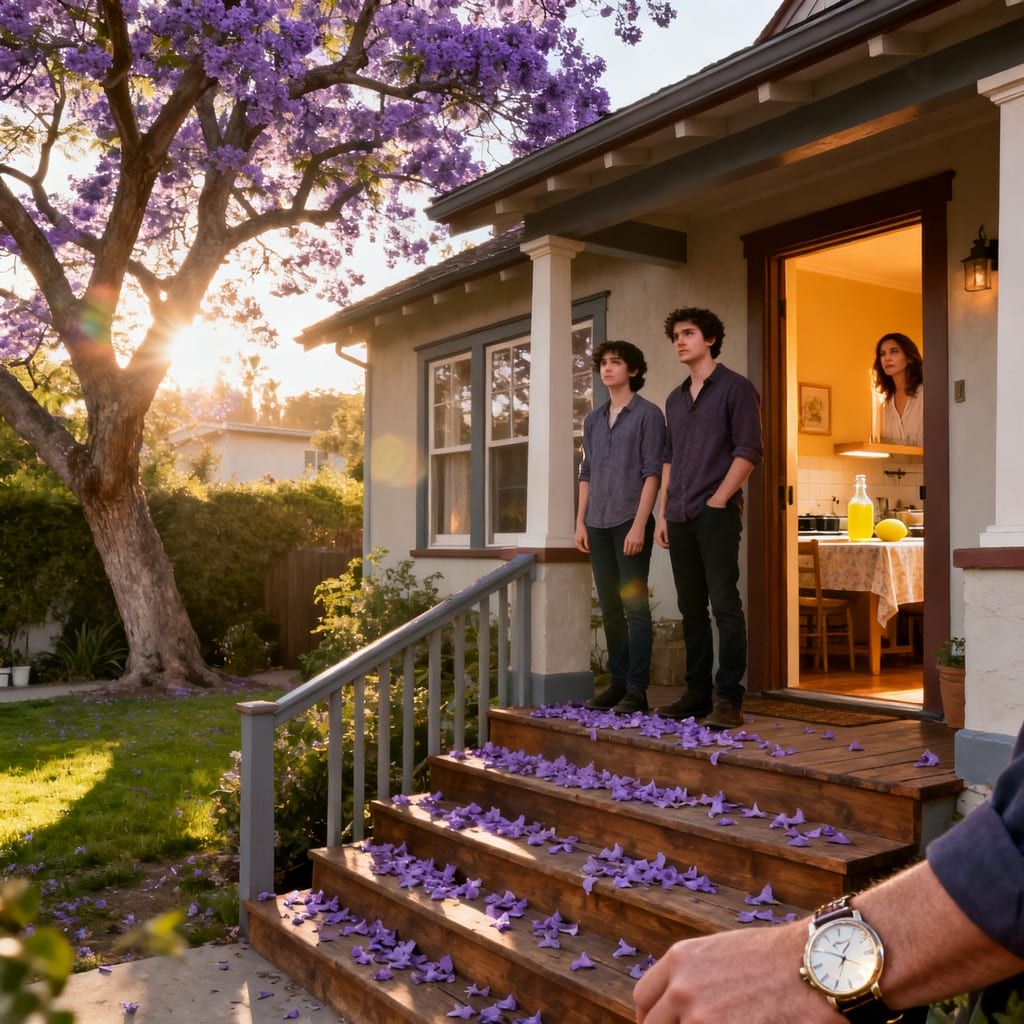
A daughter learns to read between the lines of a life split in two
Read more →
A fog-draped night, two souls found, and the quiet shape of a life
Read more →
Story audiobooks for children of all ages — a new one every day on Smarter Way Stories.