Castling Behind Barbed Wire
A quiet move beneath fluorescent lights
Read more →
At 12:07 a.m., Lila's phone pulsed against the glass of her nightstand, a small, insistent heartbeat.
She blinked away calendar grids and turned the screen toward her. A text from Harper-college friend, late-night confidante, sender of memes when the city felt too tight. The message was a link to a neighborhood fundraiser in Chicago. The thumbnail froze her breath: almond eyes she knew from the mirror, a dimple like a parenthesis on the left cheek, even the faint freckle at the cheekbone.
Lila sat up. The light flattened her apartment into a single page-neat, tidy, underlined. Her browser opened on reflex. The fundraiser was for a small bookstore-The Rag & Bone-on the brink. The woman in the photo was named Ana Morales.
She told herself every reasonable thing: filters, angles, a glitching algorithm, the great cosmic convenience of the internet. It's a trick of the light, she thought, flexing the organizer muscle that had ferried countless launches over countless finish lines. But then Harper added: You have to message her.
By 12:19, reason had thinned to gossamer. Lila dug into the image like it could become a place-reverse-searching, clicking through café tags and zine fairs. Ana's world appeared in handheld videos: photocopied poems, thrifted cardigans, laughter that made the camera hiccup. She watched longer than she should have, her own reflection hovering in the bezel, another specter in a chain of faces.
She drafted a message, deleted it, drafted another. Her final version was carefully neutral: a hello with soft edges, a link between their birthdays (if hers was correct), an apology for the intrusion.
Ana replied before morning. There was no alarm in her words, only warmth that seemed to arrive with steam: My whole life people have said I have a twin somewhere. She added a laughing emoji that, unusually, didn't diminish the sincerity.
They compared the ordinary scaffolds of living the way surgeons compare X-rays. Birthdays (same day, same year). Childhood allergies (peanuts, the both of them, as if fate had taken a red pen to their snack tables). They sent curls of handwriting. Lila's tidy loops leaned right; Ana's leaned left, eerily mirrored, the same satisfaction tucked into the cross of the t.
When Ana suggested meeting halfway, Lila opened three tabs-Amtrak schedules, a map, a Milwaukee coffee list that someone on the internet swore by. She watched the calendar fill in her head, each block sliding into place with a small, clicking pleasure. She did not believe in fate. She believed in good Wi-Fi and backup plans.
And yet there she was Friday night, suitcase light as a question, train rocking her toward a city she had no story in.
Milwaukee in winter was a kind of hush. The station's fluorescent wash made everyone a character sketch-essentials only. Announcements floated like a metronome.
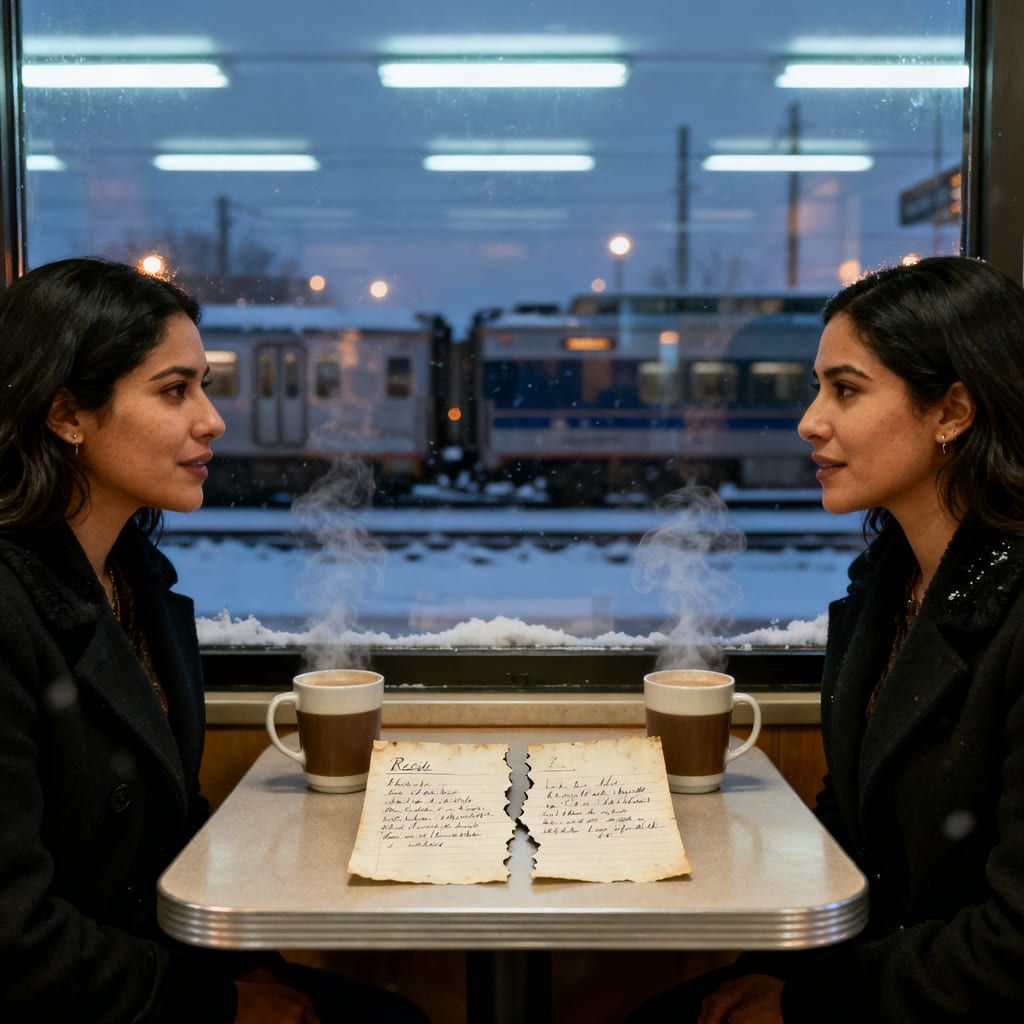
Lila spotted Ana before she moved, the way you notice movement within your own periphery. They squared off the way reflections might if they decided to climb out of the pane: two women with city-scarred boots and weather-pinked hands, hair pulled back with the same unthinking efficiency.
Neither of them cried. It was stranger than tears, the laughter that overtook them-choked and disbelieving, relieved and unspooling. It sounded like a language they'd forgotten they knew.
"Okay," Ana said, breathless, eyes traveling Lila's face with the soft shock of recognition. "You're real."
"Apparently," Lila said, her mouth folding into the parenthesis it had been destined for. "Coffee?"
They sat with cups that fogged the windows and set their coats in a pile that looked like the beginning of a life. Outside, the city wore a crust of salt on its sidewalks; inside, table numbers flickered under the hot light like they were trying to signal something urgent.
Words braided. Lila talked about product roadmaps and how a team moves like a flock-only if everyone feels the air around the others. She spoke, before she could stop herself, about the early years she didn't have language for. Her mother-Elena-who filled their apartment with plants but never answered questions about roots. The small, unyielding space between a question and a closed-mouth smile.
Ana's story arrived in cups and napkins. An aunt who made rent by the month and soup by the gallon, who taught her to leave shoes by the door and grief by the stove. The caginess that crept in on certain words: hospital, papers, the neighbor who used to drive them across town and would pinch Ana's cheek like she was a coin.
"I've had this since I was six," Ana said at last, rummaging in a soft, ink-splotched tote. "She said it was part of who I am. Like a... I don't know. A map you keep in your pocket."
On the napkin lay half a recipe card, edges torn clean as a decision. In faded blue ink: Almond Pan Dulce. The measurements cut mid-breathe: 1 ½ cup-
Lila's hand went to her wallet without instruction. She had always kept a card in the billfold, the way other people kept pressed flowers. She'd never made the recipe. She'd never tossed it. Her mother had smoothed the card into her palm once and said, "Because it's part of who you are," with eyes that flickered away, light checking the lock before leaving the room.
Now, Lila placed her half on the table. The world narrowed to a seam.
Click.
The halves aligned. Instructions stitched themselves back together with a grace that felt mechanical and miraculous. At the bottom, revealed in the mended shape, a name in hurrying script, a number with an out-of-state area code, and the scrawl: For my girls, when they are ready.
The café's sound dropped to a soft kerosene hum. They looked at each other like witnesses.
"Girls," Ana said, the word trying out its corners in her mouth.
"Ready," Lila answered, and felt, deep in her ribs, something unclench.
They called from a plastic booth in the station as if it still charged quarters for courage. The phone rang six times and then a woman's voice-older, sanded by desert wind-said hello like an exhale she'd been holding for years.
Are you-? Lila began. We might be-, Ana tried. The woman's inhale crackled like dry leaves. "I'm Rosa," she said. "I've been waiting for this call."
The story unspooled in halting strands between static and the clatter of boarding. New Mexico, a small town three bus routes from a clinic that asked for more names than she had. A young mother-undocumented, alone-told by a midwife that two infants would light too bright and invite too many questions. A sister who whispered, I'll keep her safe, just for now. A neighbor who knew a family in New York with quiet mornings and a bookshelf full of lullabies.
"'For now' became years," Rosa said. "Then years became a shame I did not know how to live around. I promised I would find a way to bring you both back. Life..." She paused, searching for something adequate. "Life kept being a fire. I kept a phone for that number like a candle for a window."
Silence gusted through the receiver, a kind that asks to be respected. No one said forgive me. No one said how could you. The train board clicked over a new set of cities. A man in a wool hat laughed at a text and then pressed a hand over his mouth like he'd startled the air.
"Can we-" Ana began, and stopped, because what could you ask? Can we rewind. Can we edit.
"Can we take this slowly," Lila said. The words surprised her with their ease. "But together."
Rosa cried, not the way the movies do, noisily and purgative, but like the body permits itself a creek where it can. "I am here," she said. "When you are ready."
The call ended in a quiet that rearranged their faces from the inside. Their reflections in the booth glass looked like women who had just been introduced to their names.
They found a small Airbnb with a kitchen that smelled faintly of garlic and lemon cleaner. Snow feathered the streetlight outside to a private snowfall. A dog somewhere barked twice and then decided the world could wait.
The grocery store was nearly empty, as if the city had curled into bed. They moved down the aisles with the concentration of people carrying a fragile thing between them. Flour. Yeast. Almonds whole, then slivered. The card lay on the counter, the crease where the halves met a new river on old paper.
They measured like they were testing gravity. Lila's hands worked cleanly-level, precise, the years of kitchens where mess meant you were losing control. Ana's hands made a soft wilderness of the counter, flour drifting like lake fog. They did not correct each other; they mirrored, then learned.
"Do you ever..." Ana began, then kneaded her question into the dough. "Do you ever feel like planning is a way to not feel something?"
Lila's laugh was small and unarmed. "Every day. I make lists until the edges blur."
"I make zines," Ana said. "Then I give them away like proof I exist."
They waited for the dough to rise. The room warmed with yeast and almond, the kind of sweetness that lifts a roof. Lila leaned back against the fridge and felt something winged open in her chest-an unplayed harmony, not an emptiness. The timer on the oven ticked in an accent.
Ana read the last line of the card out loud, as if translating it into the present. "'For my girls, when they are ready.' I think I've been angry at that line my whole life."
"And now?"
"I hear her hands shaking as she wrote it."
The oven hummed. The dough domed. They brushed it with beaten egg and sugar and watched it bronze into a future.
They ate warm slices on thin plates, the kind every short-term rental has-the ones that pretend to belong to no one. The bread was imperfect, dense in the middle where they'd been tender with proofing. They laughed with their mouths full. Sugar crust stuck to their fingers like a sacrament.
Morning arrived like a postcard: crisp, with too much white space. They made coffee with a socked-in machine and sat on the floor, backs to the cabinets, knees bumping like they'd been placed at the same table and decided to sit close anyway.
"So," Ana said, "do we go?"
Lila looked at the calendar on her phone, the grid of her week a comforting knitting. Deadlines, stand-ups, a dentist appointment that she'd postponed twice and rescheduled with the ceremony of someone rearranging deck chairs.
"We don't have to fix anything in one visit," she said, surprised by the relief in the suggestion. "We just have to show up."
Ana nodded, a rhythm catching. "I can cover shifts at the café. I'll tell the bookstore I'm off-grid for a couple days. They'll survive." She smiled, rueful. "Books always do."
Lila texted her manager with a succinct emergency-leave note she might explain later, or never. She felt her fingers go light. She saw, with alarming and thrilling clarity, the version of herself who allowed a plan to be a door, not a fortress.
They booked two seats on a flight to Albuquerque, the cheapest times and the longest layover, because the point now was not efficiency. The point was breath.
They packed the mended card between a cookbook they found on the Airbnb shelf and a scarf that still smelled faintly of baking. Outside, the city had already erased their footprints with new snow.
In the ride to the airport, they compared nothing and everything. Favorite colors that had changed with age (hers had gone from purple to the exact green of a traffic light at night). First concerts (a band that no longer existed, a boy she'd kissed in the aisle). The trivialities of a life that, in accumulation, feel like a song you've hummed without knowing the words.
On the plane, when the engine roared its reminder of physics, they reached for the same armrest and left their hands there. Not tentative. Not performative. Just placed.
Somewhere over New Mexico, the land unrolled into ruddy seams and a sky so clean it could sting. Lila's reflection in the airplane window overlaid the ground, her face a palimpsest over lines she was about to step into.
Ana touched the pocket where the card sat as if it could heat through fabric. "Do you think she'll look like us?"
"I think we'll look like her," Lila said, and felt her heart set to a new tempo, steady as a metronome unplugged from the wall and still swinging.
The wheels thumped. The cabin bucked. Everyone became briefly, beautifully aware of being held by something larger-air, math, luck, prayer, the way a decision can become a landing.
As they taxied, Lila opened her notes app out of reflex. Then she closed it. She chose to step into a day with fewer boxes. She chose to carry the unfinished edges not as problems to be sanded down, but as lace-delicate, intricate, evidence of what had been worked by hand.
They stood when it was time-no rush, no theater. At the door, the desert air reached up the jet bridge and found them. It smelled like sun-warmed metal and distant water. They looked at each other, sharing the grin of conspirators.
"Ready," Ana said, teasing the word like a thread.
"Ready," Lila echoed, and in the echo she heard the laughter in the Milwaukee station, the click of two halves making whole, the promise of a voice that had waited by a phone like a lit window.
They walked toward it-the woman who had written their names on a card and sent it like a message in a bottle, the street where the bottle had washed up, the kitchen where almond and air would lift again. Not to fix the past in one visit. To start.
And somewhere in Lila's pocket a list began, not with tasks, but with names.
Story audiobooks for children of all ages — a new one every day on Smarter Way Stories.