How to Argue Without Leaving
A bowl of unsent sentences, a jar on the porch, and the slow craft of staying
Read more →
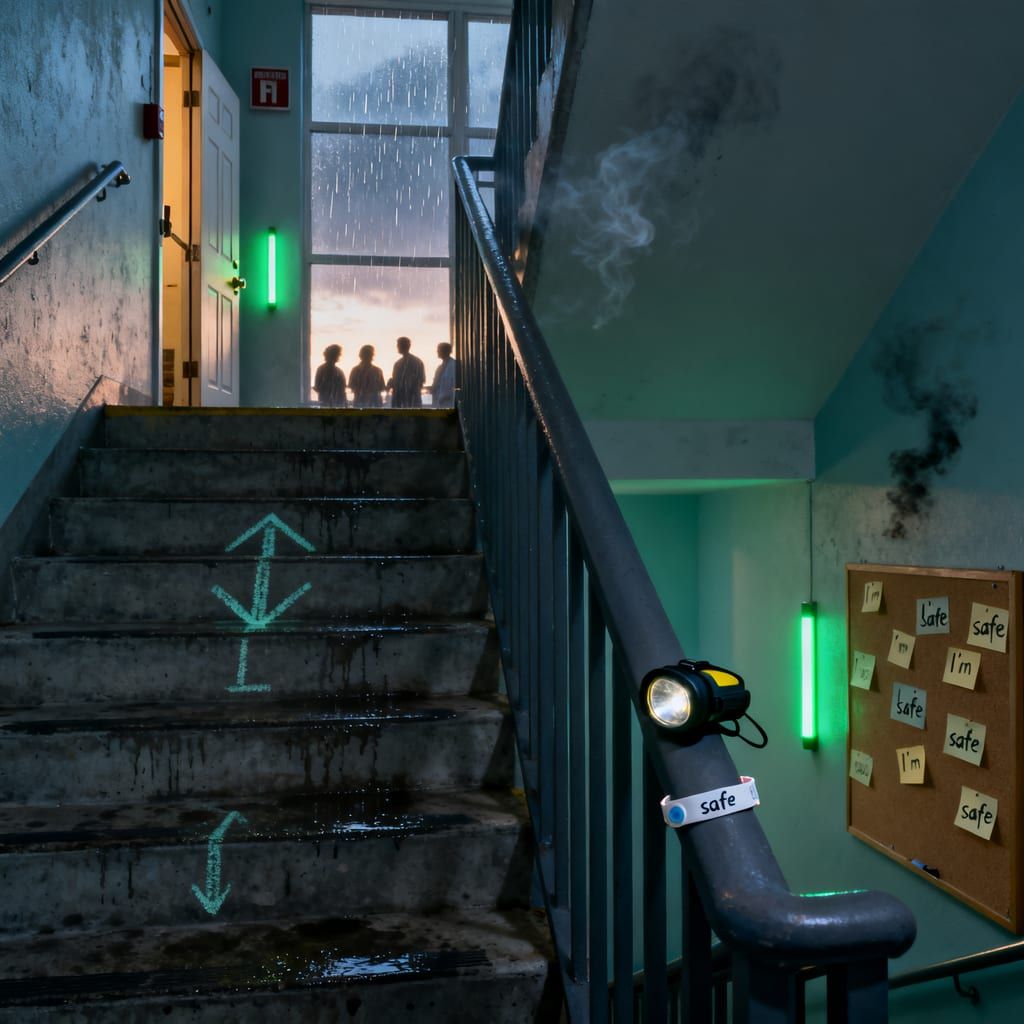
The first time Arjun taped an arrow to the third-floor landing, a woman in gym leggings stood aside and said, "So... scavenger hunt?" Her ponytail glistened with sweat; the air held the clean, chlorinated smell of the building's never-empty pool.
Arjun pressed the tape smooth with the flat of his palm. "Practice path. Glow sticks go here, radios there." He had the calm voice of someone explaining oven mitts to a house that had never caught fire.
By the mailboxes, two retirees compared grocery coupons and watched him like he was writing on their skin. In the lobby, a baby stared from a stroller and twisted her fist in her blanket. The doorman gave a polite, skeptical nod. A breeze from the open doors lifted the corners of the flyers he'd posted: floor captains, buddy system, go-bag checklist. He'd printed them on yellow cardstock so they'd be hard to ignore and easy to forgive.
Later that night, he ran a drill no one had asked for. He knocked gently, door to door, not selling anything, just trading numbers. "Text me your unit and who to call," he said, and people rolled their eyes and typed and then, almost always, started telling him stories.
"We've lived through worse," Mr. Rubin on five said, folding his arms. "Andrew flipped my roof like a coin." He signed anyway, hands trembling, as if the pen were heavier than it ought to be.
Lila Moreno, the condo board president, opened her door only as wide as the chain would allow. "Dramatic," she said through the gap, voice even and tight. "You're scaring the residents, Mr. Patel. We're not a bunker."
He kept his face still, his tone easy. "Not a bunker," he agreed. "Just good at stairs."
In the fluorescent stairwell, the hum of transformers filled the bones. On seven, a fire door stuck like a hand reluctant to let go. He leaned his shoulder into it, then crouched with a hex key and a tube of graphite, breath fogging the metal. The door finally swung true with a whisper and a small, satisfied click that no one would hear until they needed it.
He handed a teenager named Diego a stack of city maps and a pencil. "Project?" Arjun asked, tilting his chin to the street grid.
"For school," Diego said. He wore a hoodie despite the heat. "We have to make something useful."
"Storm drains," Arjun said. "Mark them. Figure the flow. You can teach me later."
Diego's smile was there and gone, like a fish flashing near the surface.
Every evening, Arjun moved through the building as if it could be taught to save itself. Chalk dust settled in the obi of his belt. He had a headlamp on his shelf by the door and a row of battery radios in a cardboard box that had once held mangoes. He named the box "For When" in neat, slanted letters.
Sometimes he practiced saying his sister's name out loud. Not to anyone. Just to the fan, the microwave, the quiet sink. Mira, he would say, and the word would flood his mouth, then leave behind a taste like coins.
He didn't say it to anyone else. He let his work be the sentence he could finish.
The afternoon the forecast went soft with indecision, the building edged toward evening. You could taste salt riding the air, a gray tang that sketched itself on tongue and windows. People checked their phones and then looked out the glass because the phones had said one thing too many times.
At twilight, the sky went lavender and thin. There was a pop like a champagne cork and a sudden stink of ozone. Somewhere on the block, a transformer bloomed green-white and then died. The lights hiccuped. The elevator made a surprised sound and fell silent. The AC exhaled and stopped.
Smoke, lazy and mean, began to drag itself through a service shaft like a bored guest trying on rooms. Rain threaded the street, then stitched, then pulled tight. A car out front became a low boat without oars.
Arjun was halfway up the stairs with a canvas bag when the stairwell took a breath and swallowed light. For a second, darkness had weight. Someone on four screamed-the sound snapped and ricocheted up the concrete like a flock of sparrows startled into flight.
He clicked the headlamp on and spoke before the scream could make echoes into panic. "Floor by floor," he said, not loud, exactly, but steady. "We do this the way we practiced."
There were glow sticks taped at the landings, as ridiculous and miraculous as Christmas. A retiree-Mrs. Chen-fumbled and cracked one; the liquid slid neon through the stick, an alien worm. She breathed out. "I call my neighbor," she said, not as a question, already dialing the number from the index card he'd given her.
"You call. You text," he confirmed, words like the rails on either side of the stairs. "Buddy system. We move together."
On three, Diego's abuela was already pulling the pre-packed tote from beneath her sink, Diego's marker-scrawled list taped to the front: meds, charger, documents, water. Diego slung it over his shoulder and met Arjun's eyes across the green halo. "Storm drains back up on Tenth," he said, like he'd been waiting to apply.
"Good," Arjun said. "We avoid the west door."
A nurse from seven-Lupita-snapped on a headlamp identical to his and counted oxygen tanks by touch, lips moving without sound, saving her phone for whatever came next. She nodded when the numbers added up.
On four, the smoke hung low, a dog no one wanted to startle. A boy with an inhaler sat on the steps between landings, his mother fanning his face with a wet towel that smelled like Tide and worry.
Arjun knelt to the boy's level and pitched his voice to the hum of elevators that no longer hummed. "Inhale slow on three, hold for three, out for three," he said. The count had a metronome kindness to it. He remembered leaving his own messages years before-Do you hear me? Are you there?-and remade them into this instead: "We're with you. We're going down together."
The mother mouthed thank you as if the words might use up the air. He shook his head and set a hand on the rail, leading the rhythm of their descent.
They found the seventh-floor fire door already swinging without complaint. When it opened, a woman stood in the dim, hair wet against her cheeks, a baby pressed to her chest. The baby wore a hospital bracelet too big for her onion wrist. The plastic caught the headlamp's beam. ARJUN read the mother's mouth forming a hello that looked like relief and apology at the same time.
He saw the bracelet. The name was printed in black block letters that took up more room than the baby's arm: MIRA.
Heat smacked his face harder than the smoke. He felt his breath falter, just once, like a misstep on a well-known staircase. Then he tightened the strap of his lamp and made his voice an oar.
"Hi, Mira," he said to the baby, and the word did not drown him. "Welcome to your building."
They moved-down, pivot, down. Chalk arrows glowed like moon-scratches on the concrete. Somewhere below, water shouldered against the glass doors and came in at the seams. Someone knocked the broom closet open and found the buddy list inside, the laminated sheets still beading water like leaves. Names rang on landlines that had gathered dust.
A man who'd teased him about the go-bags pulled one from beneath his sink and handed the spare battery to a neighbor whose phone was a fading ember. "Take it," the man said, sheepish and proud. "I have another."
People spoke to each other like conspirators. The nurse counted, calm as rain. Mrs. Chen checked on Mr. Rubin, hand warm on his elbow where it had trembled. Diego pointed to the east exit. "That way," he called, voice cracking with responsibility and thrill.
On two, Lila stood in the doorway of the stairwell with a flashlight held too high, the beam making sky out of dust. She looked at him, at the procession, at the baby. Her mouth opened. Closed. Open. "What do you need?" she said.
He kept moving. "You on the lobby desk. List the units. Who's out. Who's in."
Lila nodded hard like a swimmer. "Okay," she said. "Okay."
In the lobby, the dark had shape and edges. Someone had dragged a corkboard from the library. Thumbtacks lived in a cracked teacup. People pinned handwritten notes in a crooked grid: I'm safe. On my way. With Mrs. C on 5. Took stairs. Dog with me. Call Mom. The board became a hive of small proofs.
The water in the street rose to shin, to knee, and then flattened into a slow, patient river. They did not open the west door. The east held. The building moved like a practiced organism, each limb doing a small, right thing.
And then, quietly as a song looped back to its beginning, the worst part was over.
By morning the rain had lost its teeth. The street glittered with a film of oil that made rainbows where tires parsed it. Palmettos shook themselves like wet dogs. The building had slept in its clothes.
Three minor injuries. No names on the board without a checkmark. A maintenance crew in damp polos stomped water from their boots and went to reset breakers with the grave cheer of men doing normal jobs.
No cameras. No trucks with satellite dishes and smooth-haired anchors. A woman in pink slippers poured coffee into paper cups and told people to take sugar if that's how they took it. The doorman handed out towels like diplomas.
Arjun sat on the loading dock in a folding chair with a rip in the seat and used a rag to wipe soot from his hands. He did it the way he did everything else-methodical, patient, as if someone might be watching and could learn just from the way he rinsed the cloth between swipes.
Lila found him there, shoulders drawn in around her ribs. She was the kind of tired that makes your wrists look smaller.
"Mr. Patel," she said.
He stood and then didn't, because sitting felt like a permission he'd earned and she seemed like she might need him to be a person, not a post.
Her eyes slid to the rag, to his hands, to the street where water still argued with the drains. "My husband died in a warehouse fire," she said. The words came carefully, like heavy plates. "They told me later the alarms worked. The drills worked. It didn't matter that time. Since then... every drill sounds like grief wearing a whistle." She blew air from her cheeks. "I couldn't bear the reminder. I still can't, if I'm honest. I was-unkind."
He nodded, not with forgiveness, but with the realism of someone who had also learned the limits of plans. The sun slid around a cloud and warmed one side of his face.
"You don't need to-" she started.
"No," he said. "You don't need to thank me." He reached into the bag by his foot and took out a laminated index card-the same kind he'd given everyone else-and held it out. "But here. So you have it."
She took it like a fragile thing. The edges were smooth under her fingers. The boxes on the card waited for ink. Unit. Contact. Meds. Pets. A blank where people could become accountable to themselves.
They stood together and watched the residents tack up new notes. I'm safe. With Diego and Abuela. At work, call back later. Under one, someone had sketched a tiny raincloud with lashes.
A kid with a pink piece of chalk-Diego, hair sticking every direction now-wrote on the cinderblock wall near the stairwell: Thank you, Tomorrow Man. The letters were crooked and too large, as if gratitude didn't know its own shoe size yet.
Arjun let the smile arrange itself gently. He didn't look for a camera that wasn't there. When Lila handed him a cup of coffee, he blew on it, careful, and drank.
He thought of the seventh-floor door swinging open like a good idea. He thought of Mir-of the baby with the paper ring too big for her wrist, of the name he had finally said aloud to a face that turned toward it. He didn't ask for the story of the name. He didn't tell his.
Later, as he pulled down the soaked flyers to print new ones, a breeze picked up. The air was scrubbed clean, all edges and light. The chalk arrows in the stairwell had smudged under wet shoes into a pale constellation. He rubbed his thumb over a star and left it be.
Through the lobby's damp glass, the city glittered like a thing rehearsed. Cars lined up at a light and then moved through it with the comfort of choreography. The doorman laughed at something Mr. Rubin said. A nurse counted, again, but now it was sugar packets. Somewhere, a baby cried, then hiccupped, then settled.
Arjun folded the last of the cards and slid them into his bag; the laminate clicked softly against itself. He could feel the building remembering what it had learned in the dark, the way muscles keep a move even after the music ends.
He went back to the stairwell and pressed a new arrow flat against painted concrete, smoothing the tape with the same two strokes. The adhesive warmed under his palm.
Outside, the sun made the puddles into skylights. Inside, the arrows pointed down, then out, then nowhere in particular. He stood there and listened to nothing happening the way other people listen for thunder.
It sounded like a city block staying ordinary.
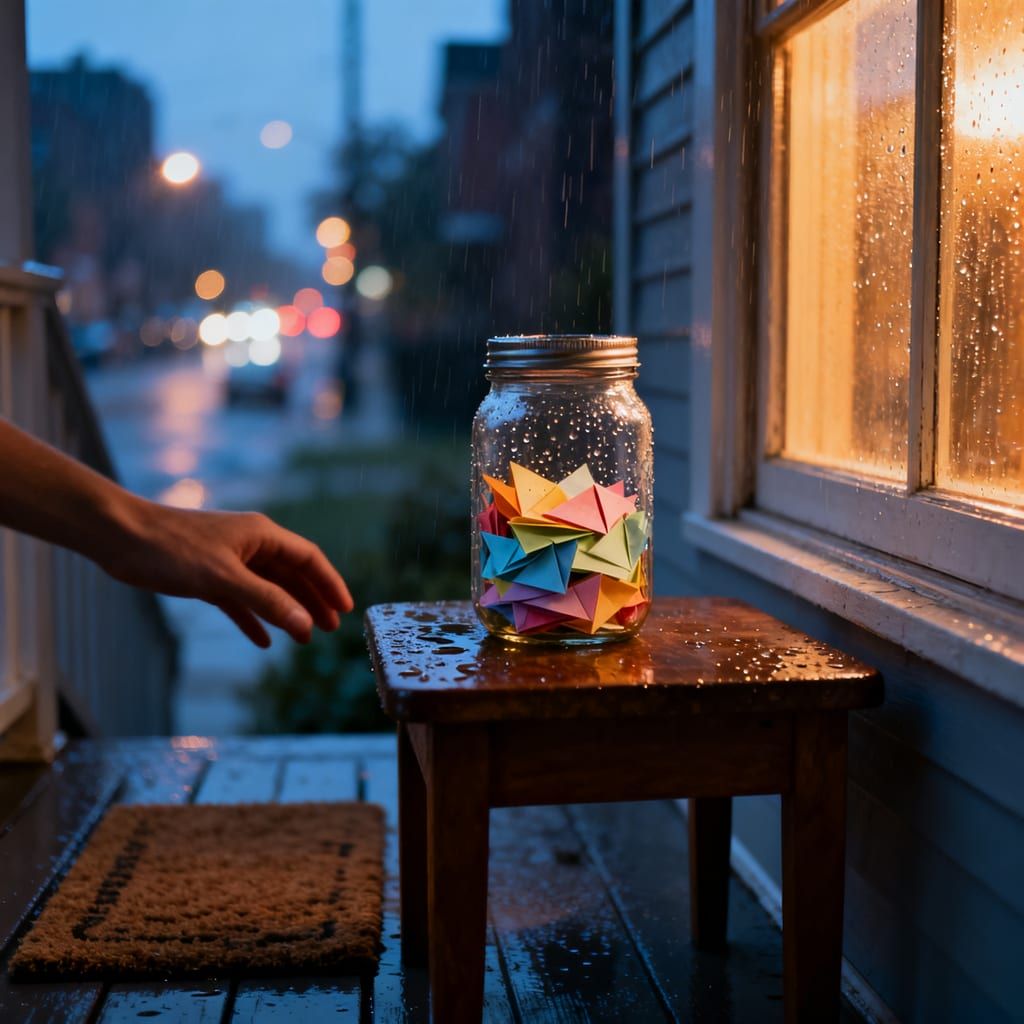
A bowl of unsent sentences, a jar on the porch, and the slow craft of staying
Read more →
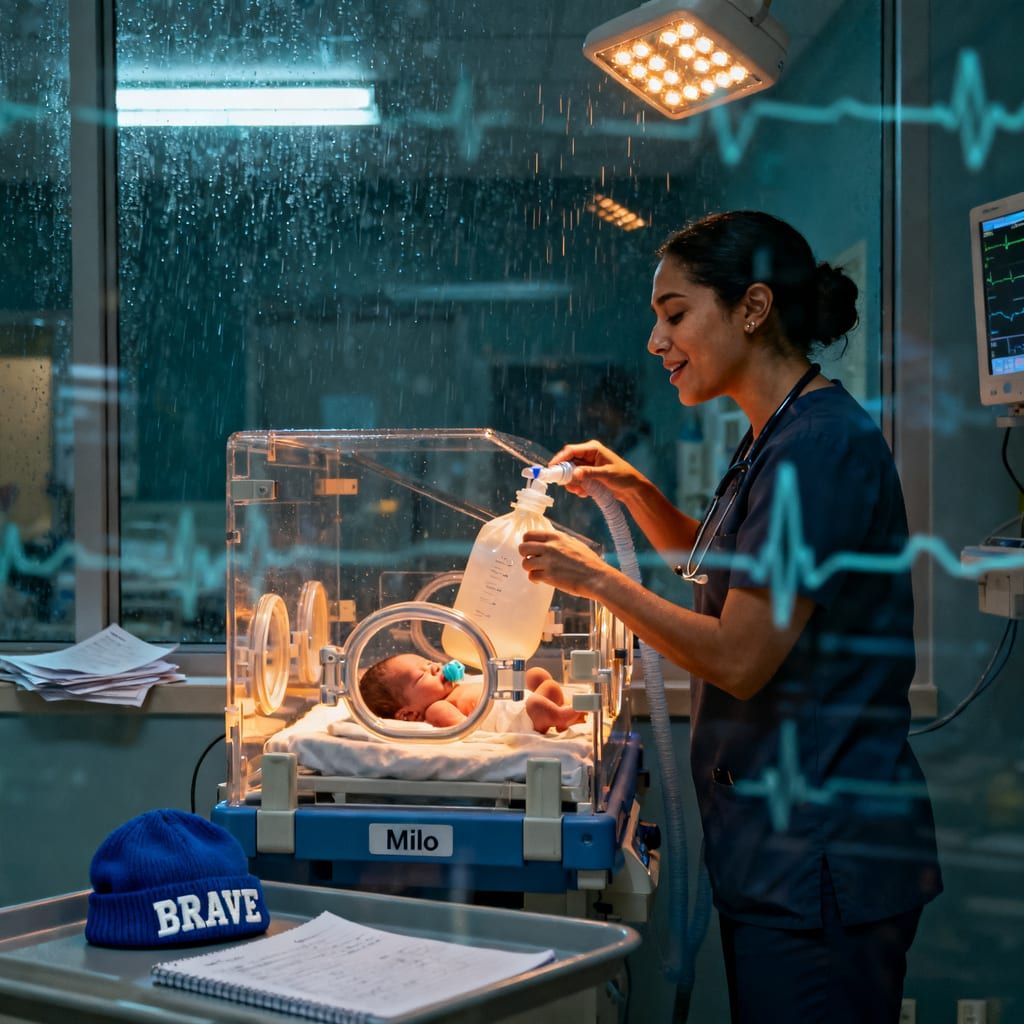
In the NICU, the smallest hours carry the longest echoes
Read more →Story audiobooks for children of all ages — a new one every day on Smarter Way Stories.