When Nothing Happens Because of You
A quiet storm, a building that didn’t make the news
Read more →
On Tuesdays the lobby smells like salt and wet wool. Boots drip onto the community center's rubber mats, gloves steam on the heaters, and it is always five degrees colder than the city promises on the news. Arun sets a metal bowl on a folding table and drops in a stack of folded index cards-cream, chalky, the kind you used for vocab words in sixth grade.
He writes in block letters across the rim: Things I Meant to Say.
When the couples trickle in-their shoulders squared, their jests too sharp, their coats refusing to touch-he smiles without insisting. He gestures to the bowl, to the circle of mismatched chairs, to the analog kitchen timer he bought for seven dollars at a pharmacy on Clark Street. He asks them to do the ridiculous thing.
"Pick a card that's not yours," he says. "And read it as if it is."
A laugh skitters around the circle. Someone says, "This is corny." Someone else says, "I like corn." Someone sits.
Arun is good at this. He knows, for instance, that people will speak if no one corrects their grammar. He knows that when you give anger a job-repeat back what you heard until the other person says, "close enough"-it stops smashing things and starts sorting them. He knows better than to make it sound grand.
"Name the need, not the blame," he says. "Say, 'I need to feel consulted,' not, 'You always decide without me.'"
He hands out two laminated pause cards-"Speaker" and "Listener"-and the kitchen timer. "Sixty seconds," he says. "After the Listener repeats what they heard, you both sit in the quiet. No fixing. Let the nervous system catch up."
People roll their eyes. They do it anyway. The room changes timetable: laughter thins; the vents hum; fists unclench when they find a job.
He carries the room like a stack of plates. He does not think about how he has not eaten dinner at his own table in weeks, how the lavender plant on the windowsill at home has shriveled around its soil. He is buoyed by the fact that strangers line up to try.
They arrive one winter night half packed to leave each other-Jessa with a suitcase in the trunk, bright as an ambulance, and Nate with a rolled duffel under his desk at work, like a parachute you keep eyeing.
They sit at opposite ends of the circle, then drift two chairs closer without looking at each other. Jessa's mouth is already going.
"I texted you three times about the lease and you sent a meme," she says.
"Your text said 'K' when I asked if you were home safe," he says.
They keep score with perfect penmanship.
"Let's try the ritual," Arun says. He places the pause cards between them like coasters, sets the timer where they can both see. "Remember-repeat back, then silence."
Jessa reads from a folded card she didn't write. Her voice trembles like a notched branch. "When you turn away in bed, I tell myself it's because of me."
Nate swallows. "What I hear is-when I turn away, you think you did something wrong."
"Close enough," she says, already blinking too fast.
The timer ticks like a cranked heart. In the enforced minute, their chins soften. Their hands find their own knees.
They come back the next week like people who saw a lake and want to prove it wasn't a mirage. They come in from a night so cold the sky feels like black glass. They sit closer, fight cleaner. They laugh when they flub the script and correct themselves without flaying open the other person's chest.
On week three, when no one else shows up because of freezing rain, Arun offers them a more daring exercise. "Not to snoop," he says, "but to practice honesty with training wheels. Swap phones. Go to the unsent folder. Read each other the drafts that never left."
Jessa huffs, wary. "You said boundaries."
"I did," he says. "You're choosing this one together. You can stop at any time."
They scroll. The room is so quiet that Arun can hear the building settling, a soft click in the rafters like a neck stretching. Nate clears his throat.
"This one's from... last month." He reads. "'I don't know how to not perform around you. It's like I'm auditioning for a role I already got and I cannot stop apologizing for breathing.'"
Jessa's fingers tighten around her phone, then loosen. She doesn't look at him. "Close enough," she says, hoarse.
"Your turn," she says a moment later, and her voice goes smaller, more real. "This is from your drafts?" She reads. "'Couples hiking near Starved Rock'... Nate." She flips to another. "'Places to sit and talk without a reservation.'" She laughs, a sound that startles her with its lightness. "You weren't Googling apartments."
"I was Googling not-doorways," he says. He reaches like he might touch her cheek, then stops. "I miss the version of you that sighs when you take off your shoes."
Her eyes fill. She sets the suitcase handle down between her shoes, as if obeying a command she didn't hear until just now.
Arun watches anger learn to whisper. He watches, in these winter-bright weeks, the room build a kind of cartilage around all its bones.
A woman named Darlene flips her Listener card and says, "So what I'm hearing is when I slam the drawer I'm trying to ask if you care," and her husband says, "Close enough," and then they sit through silence like people who finally understand that a lullaby is not always sung out loud.
At home, the sink grows an archipelago of bowls. His wife's toothbrush-Lila's-rests in the old blue glass. The last time they spoke beyond logistics was the night in late summer when the cicadas screamed and the doctor said the word "missed" as if loss were a train you could have caught if only you'd run faster. After months of silence that tasted like unswallowed pills, they decided she would stay at her sister's for a while. He stopped moving anything that could remember her touch.
He teaches strangers to rehearse staying. He does not walk the two blocks to Lila's borrowed apartment.
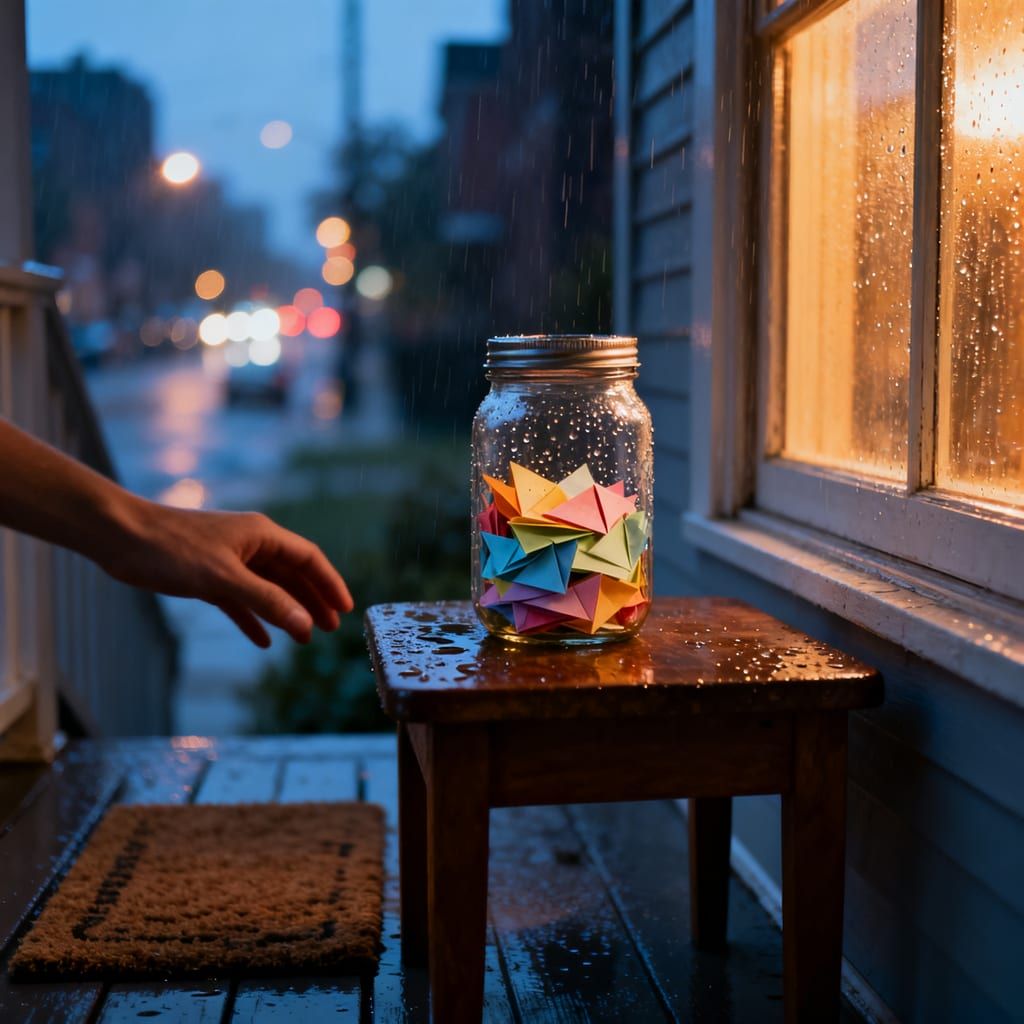
In March, the ice in the gutters pulls away like a scab. On a rain-slicked evening, he finds a mason jar on his stoop, beads of water clinging to it like animal fur. Inside-pale blues, pale pinks, bleached yellows-notes are folded into house-shapes and hearts. Someone tied a piece of twine around the mouth, a small heroic bow.
He takes it inside. The apartment smells like damp and cardamom. He turns on the lamp and empties the notes across the table.
"We took a walk before we answered."
"We asked what the other feared."
"We used the timer even when my mother called crying."
"We left the nick in the living room wall unfixed. A reminder."
He recognizes Jessa's tight, loopy script. "He bought boots, not boxes," hers says. There's a photo tucked in-two pairs of muddy hiking boots on a kitchen mat, their toes muddled together like they tripped returning home.
His breath does the thing it hasn't in months-it goes all the way down. He's moving to scoop the notes back into the jar when he sees the envelope folded under the rest. His name in the familiar curve. Lila's handwriting, which used to end its lines like dancers bowing.
He stands there for a long beat with his thumb under the flap. The dryer in the basement kicks on, and the floor hums.
Inside is a single card. On one side-a workshop schedule from the community center. On the other-the sentence he has asked a hundred people to risk.
"When I snap at you, I am asking if you still want this."
There are other lines, smaller, almost shy. "I sat in your workshop across the hall two Tuesdays ago. I listened to you say, 'Close enough,' to other people and I wanted to throw a chair at fate. I want to try. I don't know how to start without breaking something."
It doesn't hit his throat like a fist. It opens something-like a door latch that's been painted shut and finally gives.
He pulls on his coat. The jar goes under his arm. He takes two pause cards, the kitchen timer, and the letter, and he climbs the stairs to the second-floor walk-up where Lila has been living with her sister. He has not rehearsed this part. He has made a career telling people they do not need to be clever.
He knocks.
She opens the door and for a second all he can see is that same blue glass on a different sink, her hair damp, the smell of ginger. Her face changes three times-surprise, bracing, a softer thing.
"I brought props," he says, because humor is a rope he can still throw.
She huffs a laugh, then tucks her hands into the sleeves of her sweater like a child does. "Come in," she says.
They sit at the small dining table, knees almost touching. He sets the timer down like a small moon between them, the pause cards like train tickets. He puts the mason jar in the center. The notes brighten the room.
"I read your letter," he says.
She nods. "I almost took it back."
"Do you want to... try?" he asks. He hates that his voice wobbles. He allows it.
A long inhale. "Yes," she says. "But can we be exactly like your strangers?"
He smiles. "We can be worse." He slides the Speaker card toward her.
She holds it like a leaf. "When I snapped about the spoons," she says, breath shaky, "I wasn't angry at you. I was angry that the drawer still opened."
He repeats. "What I hear is-when the spoons clattered, it reminded you that the world didn't stop when we did."
Her eyes flick up to his. She nods. "Close enough."
He sets the timer for sixty seconds. The tick is so loud in the little apartment it becomes its own weather. In the silence, he feels the room arrange itself-a new diagram where both of them fit.
They trade cards. Time clicks. He says, "When I didn't come to bed, I wasn't trying to punish you. I didn't know how to sleep without waiting."
She repeats. "You stayed up because your body was a guard dog."
"Close enough," he whispers.
When the timer dings, they both flinch and then laugh because of the flinch. They let it be foolish. They let it be small.
He tells her about Jessa and Nate, about the unsent drafts and the muddy boots. He doesn't frame it as a victory, only as practice others have kept at. Lila listens, eyes wet, mouth thoughtful.
"My sister sings in the shower," she says suddenly. "I didn't realize I missed wanting to make room for another person's noise."
He nods, and they set the timer again.
Over the next weeks, messages arrive like robins testing the air. A photo text to Arun's phone from an unknown number-two mittens pressed together on a bench, captioned, "We asked what the other feared." An email with a .wav attachment of a man humming tunelessly, subject line, "It's coming back."
On a Thursday, Jessa sends a picture of a scar on drywall near a light switch. "Left it," the text says. "We like what survived."
He shows Lila these like weather reports. They put the jar on the table each time they practice, unscrew the lid as if the room needs air from other rooms. Some nights they have nothing to say. They set the timer anyway and sit through the minute of quiet like a liturgy. Some nights they brave the deep end.
Once, when he blurts something ungenerous about a friend who keeps canceling plans, Lila slides the Listener card to herself and says, "What I hear is you're afraid if you don't hold everything, it will fall." He wants to argue about fairness. Instead, he nods. The nod loosens something else.
Their grief doesn't bow with ceremony. It shows up in the grocery store aisle with the diapers, at the red light by the park where the swings wail like sirens, in the shape of a date on a calendar they move past with tenderness, even when neither of them says the word.
When it's too much, they take a walk before they answer.
Spring fumbles into the city with wet socks. The bowl of index cards at the community center fills and empties and fills again. A man in a paint-splattered hoodie writes, "When I clean the garage I'm asking you to see me," and his boyfriend says, "Close enough," and they both cry like dogs.
Arun still teaches the steps like he's calling a dance. He still forgets sometimes to bring that same patience home, and then remembers with the timer halfway to his hand. He texts Lila, "Walk?" and she sends back only the shoe emoji and a heart, and he laces up.
On a Tuesday that looks like every other Tuesday, he opens the workshop with the same ridiculous bowl and the same instruction. "Pick a card that's not yours," he says. "Read it as if it is."
A new couple laughs nervously. Outside, buses hiss. Inside, the heat stutters on and the room takes a long breath. They begin.
Later, he will bike home with the mason jar in his backpack because Lila likes to shake the notes like a snow globe. They will sit at the small table, turn the timer to a minute, press start, and listen for what their own words sound like in the other's mouth.
It is not resolution. It is rehearsal. It is choosing, one minute at a time, to argue without leaving, to make a room out of two people who once felt alone, to stay long enough to say what they meant.
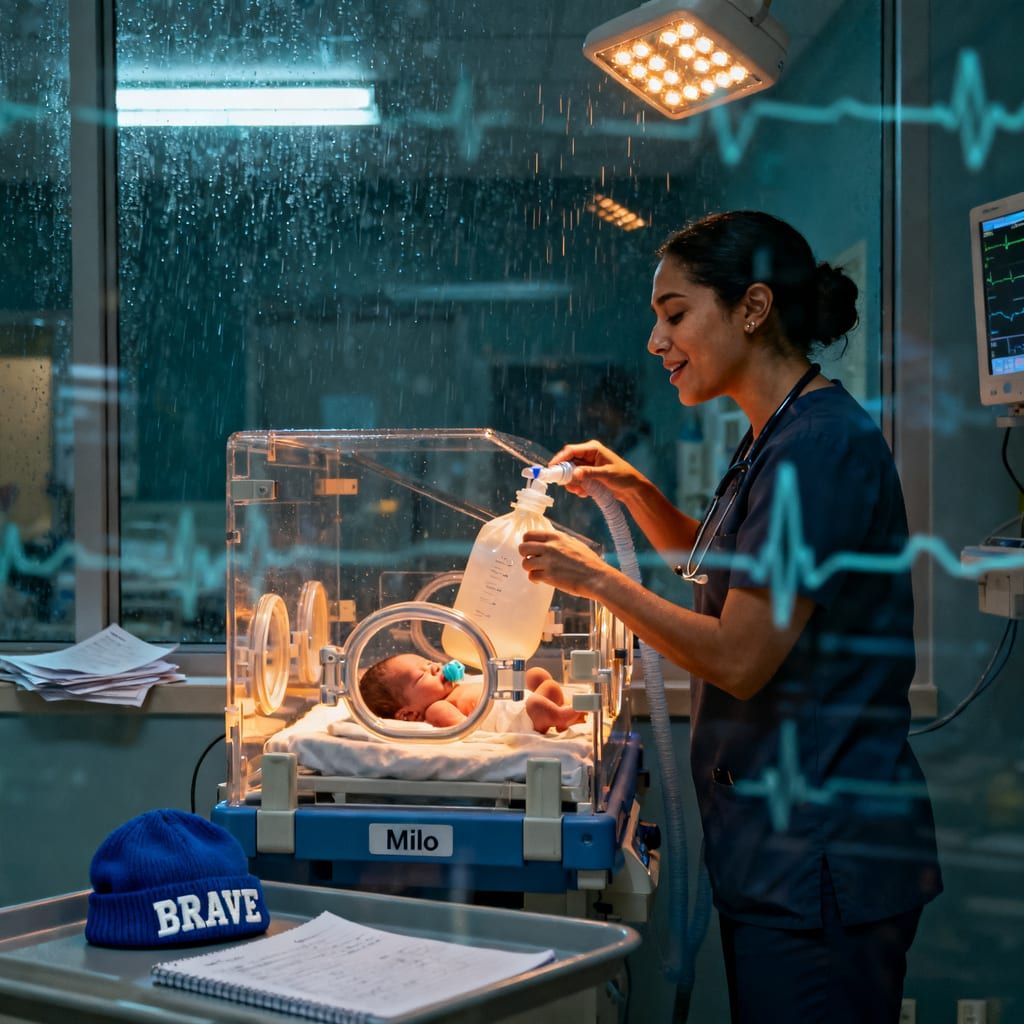
In the NICU, the smallest hours carry the longest echoes
Read more →Story audiobooks for children of all ages — a new one every day on Smarter Way Stories.