The Weight We Hold Together
In the soft hours before dawn, staying becomes its own kind of rescue
Read more →
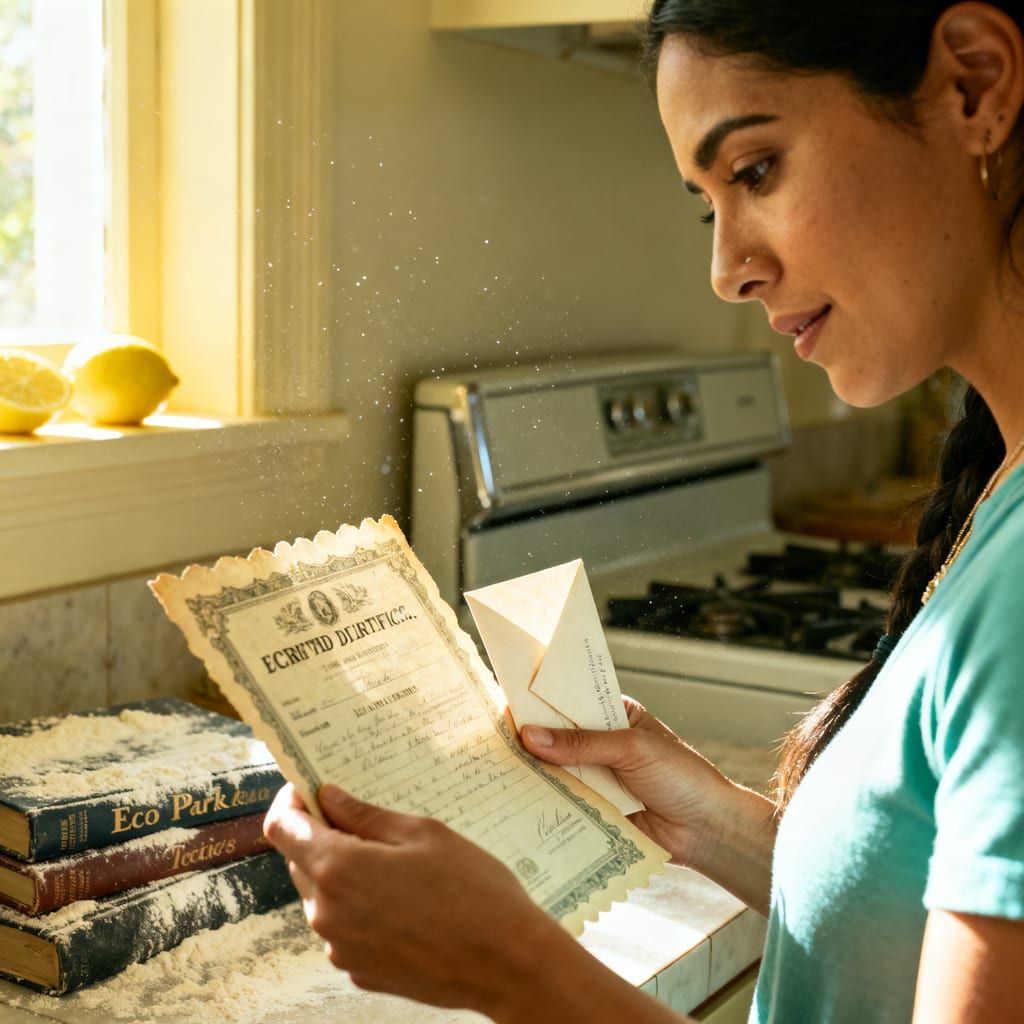
By midmorning the apartment had started to echo.
Leila stood in her mother's kitchen where the light always seemed filtered through a lemon rind, soft and bright. Boxes lined the tile like ships moored to a shore of linoleum. The counters were emptied, save for a tower of recipe books-spiral-bound, flour-dusted, their pages stuck together with vanilla and time.
She ran a thumb along the wavy edges and pulled the top one free. A handwritten index card slipped out, fluttering like a startled moth. Tucked deeper, beneath a page dog-eared for arroz con pollo, lay a thin blue certificate.
The paper had the municipal look of truth-embossed seal, perfect block letters, official ink that refused to fade. She read the name twice, then a third time.
Marin Sol Navarro.
Her heart gave a small, private jolt. It felt like stepping off a curb you hadn't seen. Her own name was absent-no Leila anywhere on the page. The tiny type that should have stabilized her-time, place, parents-only swam.
"Mom?" she said to no one. It landed in the room and dissolved.
She sat on the floor and called her father. The call rang to voicemail. She tried again. A text came back minutes later, curt as a handshake: Busy. Talk later.
The clock ticked as if it could be bargained with. Outside, Echo Park offered up the thrum of sprinklers and a dog's distant bark. Inside, the past had chosen its own lock.
She turned the birth certificate over, as if something would be scribbled on the back-an apology, a correction, a clue. The paper remained neat, official, ungenerous.
Her fingers found a crease in the vinyl of the kitchen chair, the place her mother had once worried at during phone calls. Was I adopted? Renamed? A clerical footnote? She pressed the thought down like dough and felt the rebound.
On the fridge, a magnet held up a photograph of the two of them at the Silver Lake reservoir, wind lifting hair off Leila's forehead. Her mother's mouth was open mid-laugh, the laugh that always started quiet and ended with her eyes shining. That laugh lived in Leila's own chest. She could call it up on command.
Names are meant to make a person smaller and more precise. This one made her wider.
The county records office was a room that smelled faintly of paper warmed by sunlight. Security trays swallowed keys. Numbers blinked their slow arithmetic on a red display. Behind the counter sat a woman with silver-streaked hair pinned back in a loose twist, a row of delicate rings climbing the length of her fingers like small moons.
Her name tag read: Marin.
Leila's mouth went dry. "Hi. I-hi." She lifted the certificate from her bag as if presenting an offering. "I think there's...there's a discrepancy."
The clerk-Marin-smiled the kind of smile that folded the day into halves: before someone regarded you and after. "Let me take a look," she said, voice low and unhurried. She slid on readers with tortoiseshell frames.
As Marin read, her rings clicked faintly against the counter, a sound like tiny wind chimes. "It's not uncommon," she said, eyes steady. "Amendments. Corrections. Stories with paperwork that couldn't keep up."
"I thought I knew my own story," Leila said. She heard the thread of panic in her voice and softened it. "I lost my mom last month. I'm clearing out her apartment."
"I'm sorry," Marin said, and the words didn't feel like a formality. "We can request old filings, see if there were any amendments that were started and never finished. Sometimes the county has footnotes even if families don't."
Leila gave her the necessary details, the ritual of forms and signatures. Marin moved efficiently through menus, the glow of the monitor painting her cheekbones with a blue tenderness. Bureaucracy, but with touch.
"We might run into some delays," Marin warned. "Records from that year are..." She made a little seesaw motion with her hand. "Let's say they're fond of hiding."
Leila exhaled a laugh that didn't quite make it to the surface. "Seems to be a theme."
Marin's smile returned, brief and companionable. "We'll look together," she said. "Sometimes a story needs two sets of eyes."
That afternoon, the heat in the Echo Park kitchen pressed against her like a hand. Leila pulled the stove away from the wall to clean behind it-grease, coins, the hardened rice that had escaped every sauté pan. Something pale was wedged along the baseboard. She reached in and fished it out: an envelope, thin, sealed, the flap stuck down with a line of old glue as clean as resolve.
On the front, in her mother's looping script: To Marin.
The room contracted then widened, like a lung. Leila sat on the cool tile and opened the envelope with care taught by years of watching her mother slice vanilla beans down their bellies.
Inside, a single page, creased and careful.
"Dawn was gray and silver," it began. "Your father made coffee with too many scoops. The nurse said your breathing sounded like a moth on a window. You were perfect and small and furious, fists like leaves.
"We named you Marin Sol because the window looked east and we wanted the sun to come, and because the sea was the first place I found my own name. We said it out loud and the air went sour with fear, as if we'd tempted something by daring to love you so much.
"You were here for hours, and then you were not. The room emptied of a sound I didn't know was yours until it was gone.
"Days later, I said your name into my pillow. It bruised. Your father couldn't say it at all. We tried to put it on paper and the pen shook. We couldn't bring ourselves to walk back to the office where the clerk smiled with dimples and asked us to spell it. So we swallowed it and, weeks later, when the ache made a small ring of clearer air, we chose another name to carry forward-the name that means night but feels like morning to me: Leila.
"I have been a coward and a mother. I didn't legalize what I couldn't bear to face. Forgive me. If you ever find this, know you are not a replacement. You are a harbor. You are how I survived loving what the world did not let me keep."
Leila's vision brightened at the edges. The tile cool beneath her, the oven's faint metallic tick as it settled, the honeysuckle pulling itself in from the window-everything gathered.
She pressed the paper to her chest. "I hear you," she whispered. It was not a vow so much as an answer.
She returned downtown with the letter in a protective sleeve, as if it were a small creature that needed air and a boundary. Marin looked up when she approached, recognition mellow as afternoon.
"Any luck?" Marin asked.
Leila nodded and handed over the letter. "I found this. Behind my mom's stove."
Marin read, careful as someone tending a flame. Her hand, the one with the thin gold bands stacked like horizon lines, rested on the counter between them. "I can help you amend the record," she said softly. "We can add a middle name. We can make room for her, and for you."
"Marin," Leila said, and the name felt like water. "If that's okay." A negotiation, not with law, but with breath.
Marin's mouth made a shape that wasn't quite a smile. "Good choice," she said. "I'm partial."
They filled out the request. A clerk in the back rolled a ladder along a track and disappeared into shelves of boxes whose labels meant something only to the initiated. There were delays: a form missing a field, a signature required in blue ink. Each obstacle was met with Marin's steady patience, the firm kindness of someone who understood that paperwork is only the visible part of grief.
When they were done, Marin stamped a final page with a heavy seal. The sound reverberated like a small gavel. "It'll take a few weeks," she said. "But it's in motion."
Leila felt some internal ligament loosen. "Thank you," she said. "For...all of this."
Marin shrugged one shoulder. "I like when a name finds its right place." She slipped a business card across the counter, its edges crisp. "Call if anything gets tangled."
Leila tucked the card into her wallet, next to a photo booth strip in which her mother had looked too solemn for a first frame and then cracked up so hard in the fourth that the picture blurred.
The cemetery lay quiet between a chain-link fence and a row of jacaranda trees, their bells dropped purple at her feet. Her mother had volunteered here for years, trimming back vines that wanted to claim what the city had forgotten.
There was an unmarked patch near the far wall, a place her mother had once called "the nameless garden" on a day when the word stillborn had rolled off her tongue like an old coin she kept in her pocket just in case.
Leila knelt, the grass cool against her knees. She placed the letter in her lap, then a small jar of seawater she'd collected that morning down at the pier. The air smelled like cut stems and warm stone.
"Hi," she said, and didn't bother to be eloquent. "I'm your sister." The statement felt both too big and perfectly sized. "I'm here."
She poured a trickle of seawater onto the earth. It darkened, then disappeared. The jacaranda leaves made a lacy shade over her hands.
She thought of her mother's mouth shaping the syllables that hurt. Of her father, reachable only by a text that might arrive late and say too little. Of the clerk with the patient stamp. Of a dawn room silver with fear and love.
"Marin," she said, the word nearly a hum. Her chest loosened. Something lifted its head and didn't run.
At the corner café, the barista had a tattoo of a constellation climbing her forearm. The grinder sang. The air smelled like bitter brightness.
"Name for the order?" the barista asked, Sharpie poised over the white curve of a cup.
Leila looked at the menu as if the answer might be listed there between oat milk and almond. She felt for the weight of her wallet, the crisp edge of Marin's card, the crease of her mother's letter in its sleeve.
"Leila," she said, then added, the way you add a door to a house you already love, "Marin. Leila Marin Navarro."
The barista tilted her head, a little theatrical flourish. "Beautiful. Spell it?"
Leila did, slowly, loving the vowels as they left her mouth and settled in the air. She watched the black ink curve the letters into place, the two names sharing a line without crowding.
She stepped aside, the café's sound gently at work around her-steam, spoons, someone laughing into their phone. Sunlight reached across the floor, marking out a rectangle of warmth. She stood in it, palms wrapped around the paper heat when the cup came, her name-both names-sweating faintly through the lid.
She took a sip. The city moved outside, never pausing, always returning. She watched a couple cross the street, a dog tugging at its leash, a bus sighing to a stop. It was all ordinary and, today, exactly what she needed.
She tucked a strand of hair behind her ear and thought, not for the first time, that love is sometimes a map with one road folded over another. You learn to drive by listening for the place where the paper thins.
The cup warmed her palms. On the lid, a smudge shaped like a small, dark sun. She carried it out into the day, the syllables of her name soft in her mouth, a harbor and a tide, the starting and the staying.
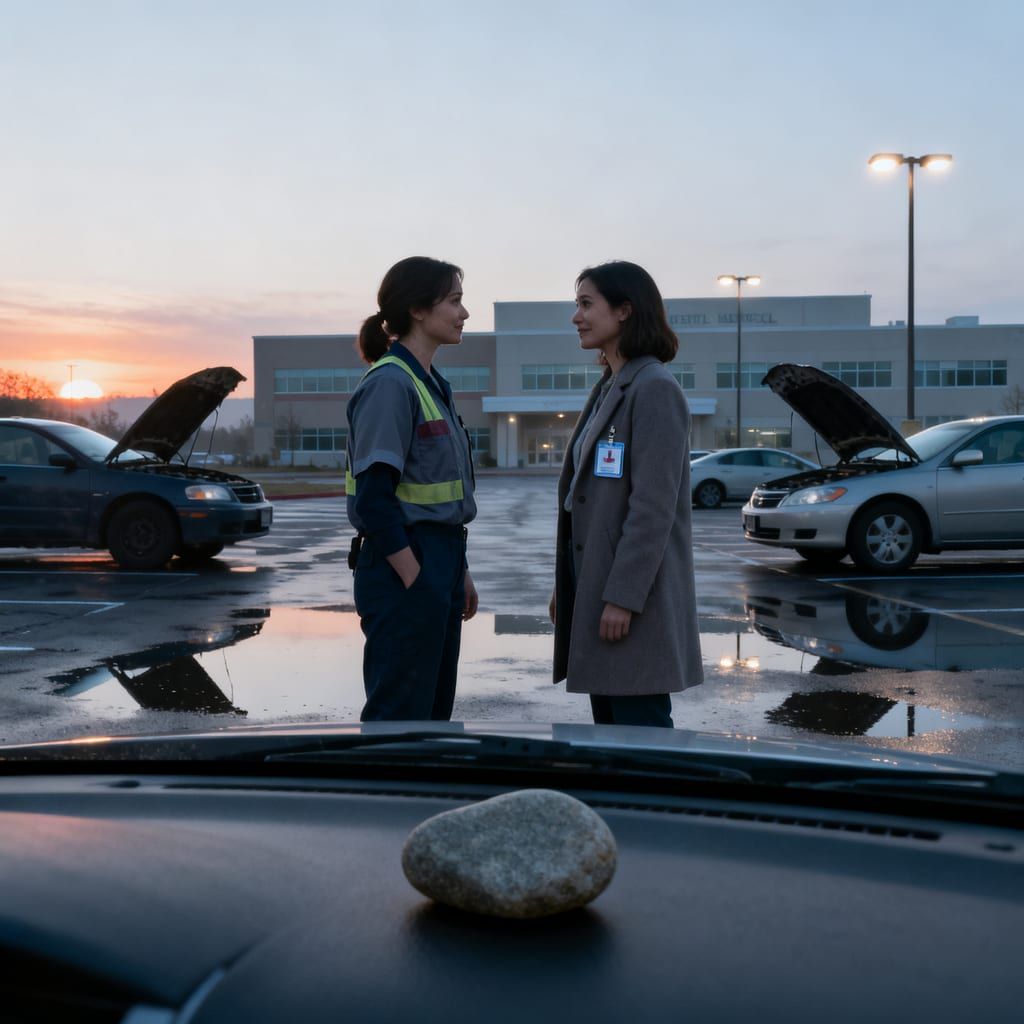
In the soft hours before dawn, staying becomes its own kind of rescue
Read more →
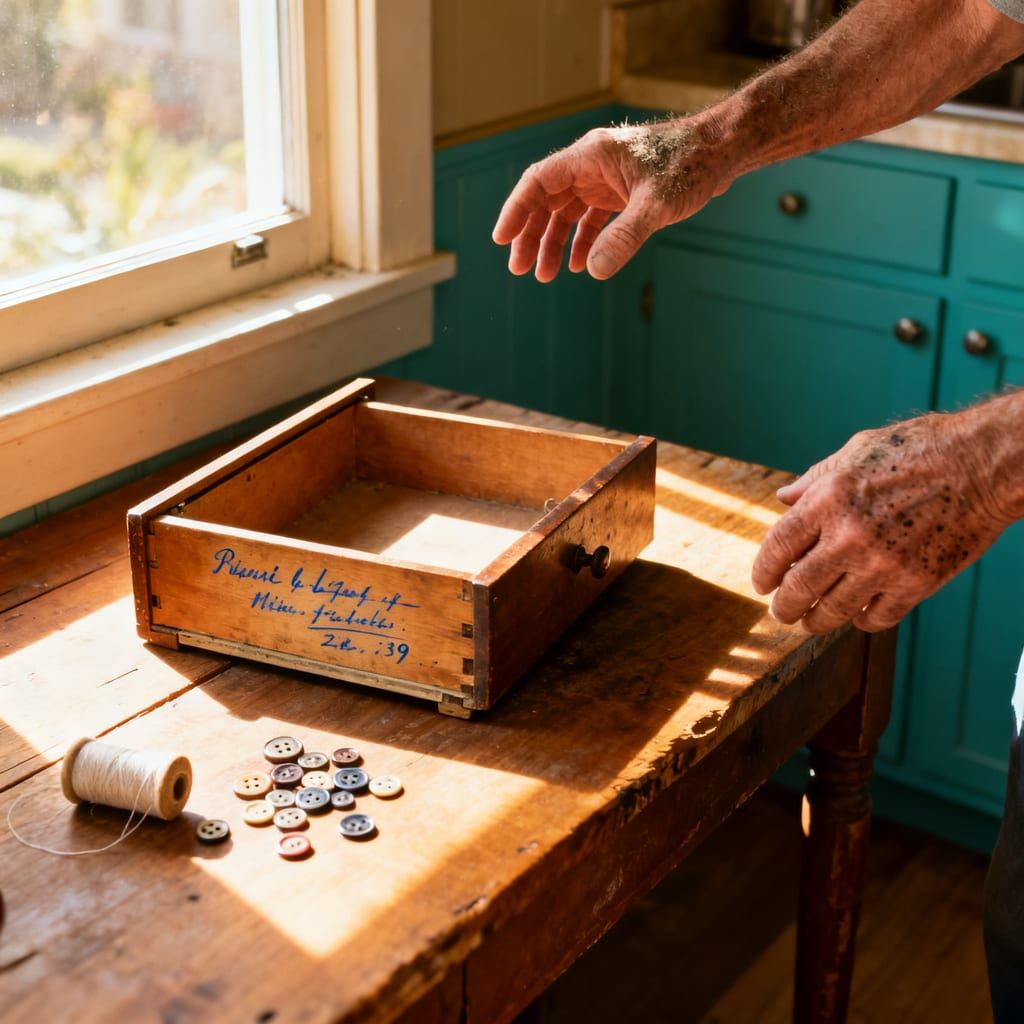
Story audiobooks for children of all ages — a new one every day on Smarter Way Stories.