The Thread Between Unfamiliar Kin
Pieces of a puzzle, chosen into shape
Read more →
The email subject line might as well be lit with hazard tape. It sits at the top of Leena's inbox like a bright fish she refuses to net: BRCA1/2 Results - Ortiz, L. Unread, for twenty-one days, a small square of defiance in a life built on measured risk.
She flips the laptop shut with two fingers and tucks it beneath a folder. Her badge lanyard leaves a cold crescent on her collarbone as she lifts it. Outside, sirens slide past the hospital like distant whales. In the mirror by the door, the face that looks back has slept, but not deeply. Thirty-seven, steady hands, a mouth that keeps secrets and measures syllables.
She tells herself, not yet. And then she steps into the morning.
The clinic's waiting room is a spill of winter coats and murmured apologies. Coffee scent rides the air from the cart down the hall. Leena signs into her terminal, palms flat on the desk for a beat, then calls the first names.
"Mara? Eli?"
They stand together but not touching. Mara's sweater is the color of wet clay; Eli's knuckles are red from the cold. In the consult room, Leena offers water they don't want and a sliver of silence they take.
"I know you've seen the ultrasound," she says, easing the folder open, "and the report."
Mara nods. Her eyes are wide, ringed without mascara. "They said markers," she says, as if the word is a pebble she could spit out.
Leena sets the chart down, palms open on the table. "There are findings that suggest a neurodegenerative disorder. Not a certainty. But a risk we need to weigh."
Eli leans forward. "What should we do?" His voice is hushed, imploring. There's a nick on his jaw where a razor cut didn't quite clot.
Leena inhales slowly, feels the old familiar tightrope rise under her soles. The script isn't a script so much as a ritual: acknowledge, clarify, translate. "I can tell you what the outcomes could be. I can tell you how other families have chosen. I can't decide for you. My job is to make the path you choose as clear as it can be."
They listen like students at the edge of a cliff. Leena draws circles on the paper pad, percentages in neat, dark figures. She reaches for language that fits inside a body-what it means to feed a child who cannot swallow, to hold a hand that will forget your name, to love someone whose timeline is an accordion you can't stretch evenly.
"We got engaged under a magnolia," Mara says after a while, voice tunneling. "Back home, there's this courthouse lawn. The petals come down like snow."
Eli's jaw moves. "We picked a name," he says, then stops. The name hangs in the air like it has its own weather.
Leena does not write it down. She lets the room be held by it.
"What should we do?" Eli says again. She can feel the weight he wants to hand her. She knows the shape of it; her palms remember. But she keeps her hands where they are.
"I can sit with you," she says. "For as long as you need."
They argue in whispers that grow louder and then fall away. They ask for time. They take it. When they leave, they're holding the same pen as if it is a tether.
At lunch, the cafeteria's soup is thick enough to stand a spoon. Leena carries a small bowl to her desk and forgets to eat it. The next consult is marked in the calendar as Predictive: Huntington's.
Julian arrives with a knit cap in his hands and an apology already on his lips. "I'm early," he says. He isn't. He is exactly on time in a day that has felt otherwise.
He sits, folding himself carefully, as if he could crease sorrow into something smaller. "My dad died last year," he says, eyes on his cap. "I made him a playlist. I kept thinking-if I can get the songs right, the room will soften."
"What did you put first?" Leena asks.
He and the question both brighten. "Nick Drake. Then some boleros because of my grandmother. It made him smile. Or I think he smiled." He half-laughs. "I also bake. It's new. Pies. My crust is terrible. But I'm getting there. I'm practicing until it tastes like something he would've asked for twice."
He tells her he cannot bear the weight of not knowing and also that he is terrified to know. He uses the word terrified without drama, just an offering to the center of the table. Leena slides the consent form over, explains the saliva kit, the way DNA unspools like ribbon and tells on us.
"And if I change my mind?" he asks softly, thumb at the corner of the paper. "If I ask you to hold the result and I don't look-does that still count as choosing?"
Leena feels the question move through her like a breeze through high grass. She thinks of the email at the top of her inbox, the way light kept catching the subject line like a vein of quartz. She looks Julian in the eyes. "Yes," she says. "It does." She pauses, sifts for honesty's finer grain. "Sometimes not knowing is a way of knowing what you need."
He nods, looks relieved and sad at once. "Thank you," he says. His voice makes the thanks larger than the room.
After he leaves, she stares at the empty chair across from her as if it will tell her what to do next. The soup has skinned over, a quiet proof that time moves whether or not you grant it permission.
In the break room, the vending machine hums like a patient. Leena presses 2-B for almonds and reads the nutrition label she's memorized anyway. Her phone buzzes: a photo message. It is Mara and Eli, arms wrapped around each other beneath a bare-limbed magnolia. No faces-just the frame of them, and at their feet a single white ribbon tied to a twig. The text says: We made a decision. Thank you for sitting with us.
Leena feels the ache low in her ribs. She replies I'm here if you need me. She deletes and types it again without the I'm, makes it less about her, more about the air around them.
By late afternoon, the clinic slows. The hallway clock clicks so gently it's almost kind. She consults with a resident about a case that will haunt them both for a week and then fade to a warning bell that tolls whenever a similar file number crosses her desk. She signs forms until the signature stops looking like her name. She keeps not opening the email.
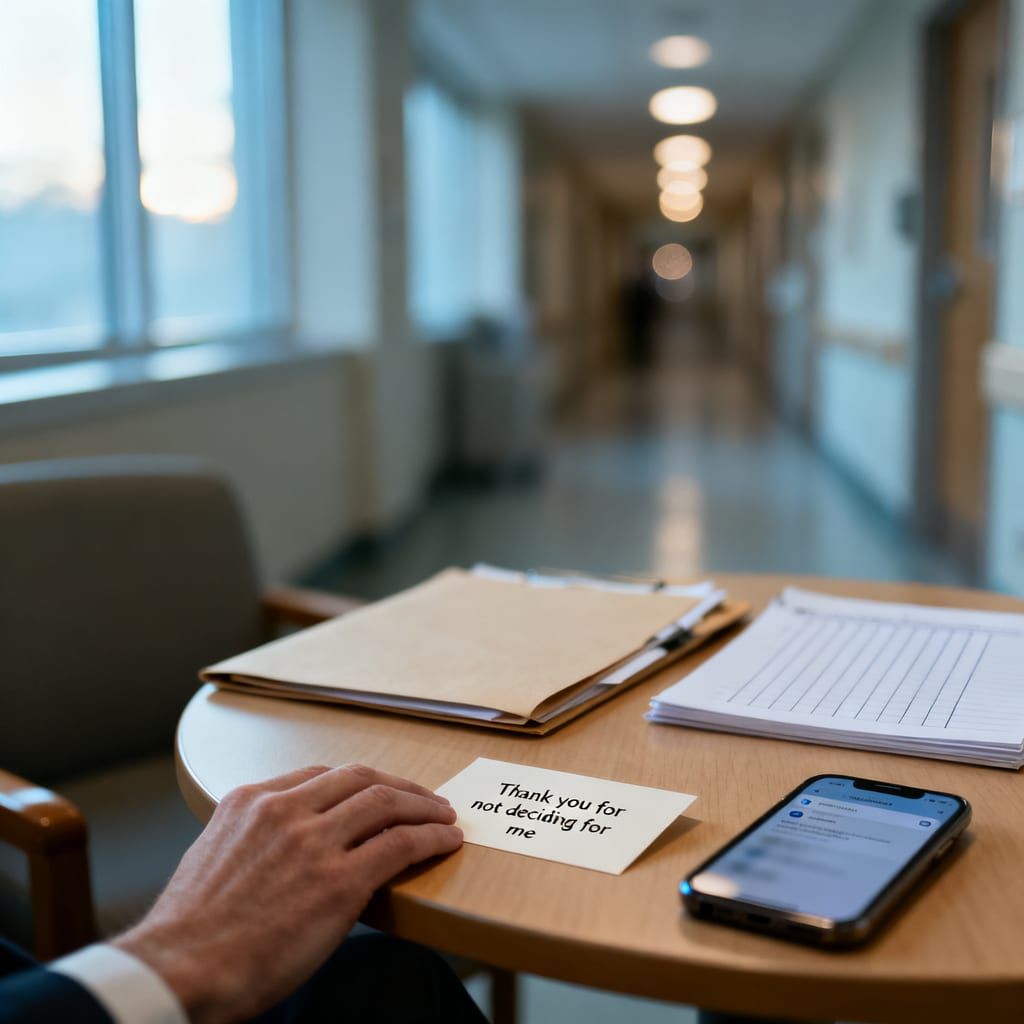
On her way out, the front desk hands her a small square envelope. No return address. Inside, a card printed neat as a typewriter: Thank you for not deciding for me. No signature, but she knows whose hand hovered over the period before letting it fall.
She presses the card to her sternum and feels its coolness.
At home, the apartment is a box of plant leaves leaning toward a winter window. A mug with last night's tea ring waits by the sink. Leena sits at the tiny table that has seen more forms than meals and draws a line down a notepad. Two columns. She writes at the top of one: If positive. At the top of the other: If negative.
She writes the same first item under both: Call Sofia. So we can open it together.
Sofia answers on the second ring, the rustle of her kids somewhere in the frame of sound. "You finally ready?" she says, voice warm, an oar in choppy water.
Leena looks at the laptop like it might jump. "I think so." She presses the power button. The screen spills light across her hands.
"Put me on speaker," Sofia says. "I'm sitting in the hallway. If I sit in the kitchen, everyone will want to know what I'm whispering about."
They laugh-a thin thread, but it holds. Leena opens the email. It is bare as a clean plate, the details precise: BRCA1 pathogenic variant, associated risk percentages marching down the page like a well-meaning army.
The room narrows and brightens. "I'm positive," she hears herself say, and for a beat the word feels like a door slamming and opening at once.
Silence on Sofia's end, then a breath. "Okay," Sofia says. "Okay. We know what to do." Not we will fix this, not we will undo it. We will do.
Fear arrives. It sits. It is not alone. Clarity slides into the chair beside it and smooths the tablecloth. Leena feels the two of them, twin presences, neither louder than the other.
She books a surveillance appointment for next month with fingers that only tremble a little. She opens a draft to their mother in Puerto Rico, the words soft and steady, like stacking plates one by one. I want you to hear this from me. I'm okay. I have a plan. She does not lie. She arranges the truth so it will not cut their mother's hands when she picks it up.
"Do you want me to come up?" Sofia asks. "I can get a flight this weekend."
Leena thinks of Magnolia petals falling like slow snow. Of a boy-man with flour on his knuckles and a playlist cued to bolster a quiet room. Of a card with a period placed like a candle. "Not yet," she says. "Soon. Let me-" She looks around her small kitchen, the stacks of bowls, the basil plant that refuses to die. "Let me feel it. And then yes."
They stay on the phone until the hallway on Sofia's end hums with bedtime. After they hang up, the apartment sounds like the ocean pressed to a shell.
She orders a packet of magnolia seeds online, fingers hovering, then pressing, then still. She takes Julian's card from her bag and slides it into the planner she lives by, a stiff little flag reminding her that choosing is not a single act but a practice.
Morning comes bright and brittle. The hospital lobby smells of disinfectant and the promise of coffee. On her desk, between the mouse and a jar of paper clips, someone has left a photo printed on vellum: a sapling, a narrow tag looped to it with twine. A name on the tag, simple and perfect. No message. None needed.
Leena sets the photo upright against her monitor. She keeps her palm on it for a breath, as if to encourage roots.
The clinic day refills. There's a call from a pharmacist, a student shadowing with eyes like buttons, a mother who wants science to change its mind. Leena keeps making space where she can. She learns, again, to wait in the right places: on the near side of a long breath, beside a couple in the grove of a hard choice, across from a young man who may or may not want to press play on a truth he already hums.
In a lull, she opens her planner and touches the edge of the card. The sentence inside her, the one she gives and takes, shifts its weight.
She realizes she has never carried anyone over any threshold. She has stood at the seam and held their coat, made sure the hallway light worked, waited until they reached for the knob. And then, last night, she reached, too.
On her way home, she buys a pie from the bakery near the hospital. The crust flakes onto the sidewalk as she walks. She licks sugar from her thumb and thinks, next time I'll try to make it. She imagines the recipe card smudged, the first attempt too salty, the second nearly right. Practices of love.
At her apartment, she waters the basil and clears the table. She opens a new list, not split in two this time. At the top she writes: What to grow. Below it, with small, careful letters: magnolia. courage. patience. She doesn't need to underline any of them. The words already know how to root.

A thrifted cookbook, a phone number, and a kitchen that learns to breathe again
Read more →Story audiobooks for children of all ages — a new one every day on Smarter Way Stories.