Two Houses and One Quiet Heart
A daughter learns to read between the lines of a life split in two
Read more →
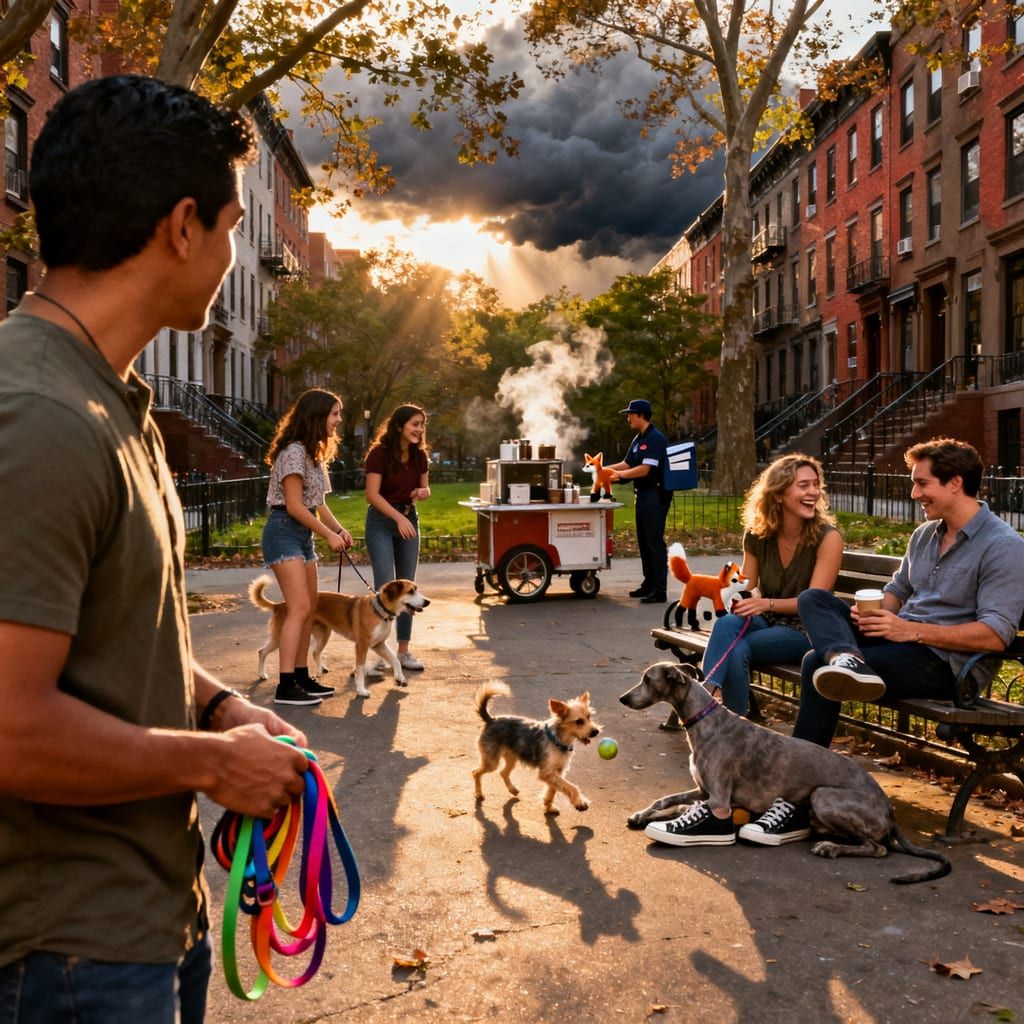
Leo Alvarez learned the new city by its paws.
The first week he walked other people's dogs, he could feel his pulse drop to the pace of their patrol-stop to sniff, shoulder-check a stoop cat, hesitate at the hairline crack of a driveway. He traded scales and lesson plans for loops and knots of nylon, finding a rhythm where no one asked for crescendos.
At 6 a.m., the block was a low hum-coffee carts hissing, pigeons heckling from cornices, a newspaper flapping like a flag against a gate. Leo's shoes remembered the shortcuts: the cut-through behind the laundromat, the triangle of grass that passed for a park, the alley warm with bread.
He noticed the patterns before he admitted he was looking. Two neighbors whose dogs lunged happily every time they neared, while their people stared at a distant point above the curb. A divorced couple who performed a custody exchange with military precision on opposite ends of the street, Terrier rotating between hands like a baton, faces turned away. Sisters-he sensed it in their mirrored mouths-whose rescue mutts went sentinel-stiff when the humans' shoulders tipped toward frost.
He did not say a word. He adjusted his routes.
He slid his watch forward five minutes before one building, back three before another-so leashes would cross like strings at a crosswalk. He left small notes where feet already paused: a hydrant chalked with a smiley face and the words "Good sniff spot"; a bench sticky with sap and a folded card beneath the armrest that read, "Sit if you want to see sparrows at 7:10."
In the park, he posted a hand-lettered sign on a clipboard duct-taped to a fence: Quiet Hour, 6:30-7:30. Bring coffee. Bring patience. Let the city wake before we do. People came. Dogs learned that silence could also be a game.
The greyhound was the kind that looked like a line drawing-every angle a decision. She flinched at sudden hands and loved the underside of leaves. On Tuesday, rather than turning east toward the river, Leo guided her along the block where an anxious man sat on a stoop, scrolling headlines until his thumb went white.
The greyhound saw him and leaned in as if magnetized. The man startled, then barked a laugh that surprised both of them. He scratched her chest with the tentative reverence of someone touching a violin.
"Arun," he said, when Leo nodded hello. "I'm... I'm trying to read less disaster before nine."
"Greyhounds are good for that," Leo said. "They edit."
The next morning, Arun had treats folded into wax paper and a travel mug that steamed in the cool. The woman who walked past every dawn with a baseball cap and a braided leash-Maya-paused when the greyhound grinned at her. Arun said something self-mocking about headline diets; Maya laughed like a door unlatched. The dogs tangled their leashes into a rope no one minded taking time to solve.
Other orbits tightened. A chew toy-a fox with one eye and a squeaker that sounded like a soft apology-appeared on the slatted bench near the bus stop. It had a name written on the tag: If found, please share. The barista in the truck on the corner glanced up when the mail carrier passed; the fox tumbled between them like a dare. "About that package," the barista began. "We can-" The mail carrier shrugged. "Let the fox decide," she said. The fox squeaked. They split a muffin.
At lunch, Leo detoured by the empanada truck, where a widower in a corduroy cap ate at the shadowed side and a young mother juggled a stroller and a pit mix who loved everyone. The dogs dragged their humans under the same gingko, tongues pink, backsides planted in a shared patch of shade. "You can hook your bag on the handle," the widower offered, fingers trembling the way age dictates. The mother clipped the diaper bag to the stroller and closed her eyes for one whole breath. When she opened them, there was a napkin on her knee and a story in her lap about a dog that had eaten a shoe.
Leo listened without lingering. If they wanted him to stay, they would ask. Mostly, they didn't. Mostly, the dogs did the introductions and the people remembered how to follow.
Heat wobbled over the street in late July like a mirage. The bark chips in the dog run baked to cinnamon. Thunder grumbled and then the sky unzipped.
Power winked out at 4:12. Air conditioners died jewel-toned quiet deaths. The city was suddenly, wildly unplugged.
Leo sprinted, rainneedled, with three leashes bracketed around his wrist. He ferried a corgi to a fourth-floor walk-up by the light of a phone that gave out at the second landing. A yowl from below-"I can't find them!"-made him pivot.
He pressed his flashlight into the hands of the teenage boy on the third-floor landing. "Aim it up," he said. "You're the lighthouse."
At the corner bodega, Mr. Ruiz propped his door with a bag of rice and shook out tea lights like dice. Leo handed a border collie to the yoga teacher from 3B and said, "He knows your stairs," then sent her across the hall to collect the older woman who refused to touch handrails.
On the block where no one had spoken in years, umbrellas bloomed like cautious flowers. Someone called a dog's name and three people answered. A man held a door with his foot while he balanced a pizza box and a dachshund like groceries. The terrier-custody object, messenger-bolted out of someone's grasp and made a muddy half-circle, squealing like a violin that refused to be anything but joy.
"Hey," a voice said, ragged as a storm edge. It was the ex-husband, hair plastered to his temple. "You should probably-" He didn't finish. His ex-wife was already laughing at the terrier's refusal to come unless both of them held the leash.
Leo's shirt clung to his back. He smelled ozone and wet fur and the almond of someone's shampoo. He moved like a metronome set to Allegro-steady in speed if not in spirit-returning each dog to its origin point, sending each human toward the stairwell where they'd become someone else's shoulders.
By full dark, the neighborhood was glow-lit from candles and talking in the language of borrowed lighters. Dogs shook rain onto legs and into shoes and nobody swore. Someone started singing-a thin rope of tune that tugged others closer. Leo stood under the awning of the daycare, pinched the water out of his sleeves, and let the sound go through him like weather.
In the week after, the city remembered itself in pieces. A power strip on a stoop with a hand-painted sign: Charge Your Phone. The barista handing free ice to whoever asked. Mr. Ruiz with popsicles thawing in a cooler and a fierce look that said don't argue, take two.
The park, which had always been there-patchy grass, a limp swing, a gate that creaked-became a place. People carried chairs down their stoops. Dogs negotiated whose stick belonged to no one. The divorced couple arrived a beat after each other, then in time. The terrier refused to distinguish between owners or the game of fetch and diplomacy. "He only brings it back if you're both standing," someone observed, and the couple shook their heads, laughter rinsing them clean.
The sisters started coming together on Sundays. Their dogs mirrored the change-less stiff, tails experimenting with arcs. They told a story once about a grandmother who could shell peas without looking; it lasted three laps around the path and ended with a sigh that wasn't sad.
Leo was thanked in sideways ways. A thermos of coffee left on his stoop, heat still in it. A paper bag that rattled with biscuits, ribboned and clipped to his gate. A card without a signature, block letters that read: For Quiet Hour, for quiet everything.
He taped the card inside his closet. He sharpened a pencil.
Maya noticed the notebook when it fell from his pocket near the lamppost by the swings. It flopped open like a small bird and lay on its spine, pages flaring in the breeze. She bent to gather it, meaning to hand it back with a joke about lost homework.
What she saw made her stay low for a breath longer than politeness required.
It wasn't a ledger of miles-no times or fees or bathroom breaks. It was a network drawn in the shorthand of someone who thinks in music: names sketched like motifs, dogs as notes that moved under them, corners annotated with tiny symbols-sun, freight, kestrel-to mark the feel. Arrows threaded softly from stoop to bench to truck. Next to Arun: "leans into breath, 6:12." Next to the barista and the mail carrier: "meeting key = fox." By the widower and the young mother: "shade under ginkgo-12:40, both smile." At the terrier's corner: "handoff, then, when ready, together."
At the bottom of one page: where they already want to go.
She looked up. Leo had that embarrassed half-shrug that people wear when caught being tender. "It's just to remember," he said, voice soft as the greyhound's ribs. "Who's ready for whom."
Maya closed the notebook and pressed it back into his hand. Her palm was damp from the grass. "It's a good score," she said. "It sounds like us."
He smiled, a small thing, like clearing a throat before a piece you love.
September sheared the heat clean. The trees along the park's edge tipped toward yellow, as if remembering the word. Mornings smelled like apples and exhaust again.
Leo turned a page and instead of adding an arrow, he rubbed one out with the edge of his thumb. The graphite lightened and then was gone, leaving the faintest ghost of a line that only he could see.
He watched as the divorced couple arrived mid-laugh, already in conversation about a plumber and a ceiling leak that refused to be discreet. The terrier dropped the ball at their feet and sat-as if he, too, had edits.
He watched as the sisters' dogs tumbled into a play-bow, chests low, mouths loose-soft learning its way into muscle memory. The sisters' hands brushed at the treat bag and neither pulled away.
He watched as Arun and Maya, both early, both newly un-urgent, shared a bench and a thermos. The greyhound sprawled over their shoes like a shawl.
"Quiet Hour's almost over," Arun said.
Maya tipped her head toward the playground, where a child had started to squeal with the particular insistence of swing joy. "It never really ends," she said. "It just changes key."
A breeze lifted the page of Leo's notebook. He placed his palm on it without looking and felt the tooth of the paper, the give of the binding, the ordinary, miraculous weight of something held lightly.
He erased another arrow. He watched two people he'd only ever known by their dogs' names spot each other across the path and wave as if remembering a dream.
Some routes you trace in pencil until they write themselves in shoe soles. Some music you teach by setting the tempo and then stepping back.
Leo looped a leash around his wrist and stood. The dogs tugged toward where they already wanted to go. He let them.
The park filled with the sound he had been waiting for all summer-the one that didn't need him, not really. It was the thrum of a neighborhood practicing being itself, a chorus without a conductor, the soft percussion of paws on pavement keeping time as the light slanted gold.
A daughter learns to read between the lines of a life split in two
Read more →
A fog-draped night, two souls found, and the quiet shape of a life
Read more →
Story audiobooks for children of all ages — a new one every day on Smarter Way Stories.