A Different Name, The Same Heart
In Los Angeles, a daughter learns how to carry two lives forward
Read more →
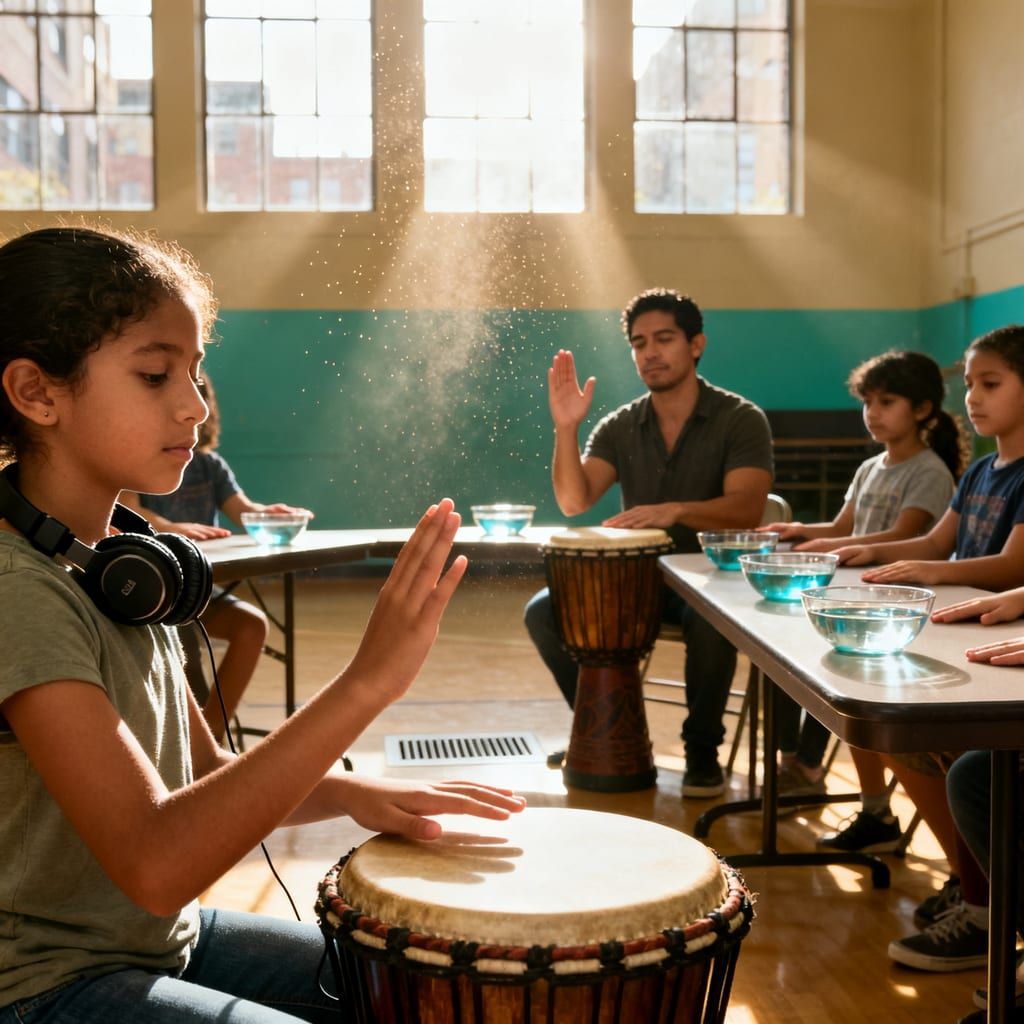
The snare cracked like glass breaking in sunlight. A boy at the back shrieked, a high, thin rope of sound that made the room lift its shoulders.
"Okay," Jonah said, palms up, sticks cooling in his fist. "Okay, my bad."
Dust floated where the light poured through the tall windows. The floor was a grid of scuffed linoleum and scuttle-marks, ceiling tiles humming with the HVAC's low, steady thrum. He'd brought his sticks, shakers, a handsome Bluetooth speaker that made his kit sound like stadiums, a plan with beats-per-minute written in a tidy notebook, boxes to check. Ten minutes in, the plan was confetti.
A girl near the radiator-Aria, her name had been on the roster-stared at the dust as if it were telling secrets. Headphones swallowed her ears. She didn't look at the drums. Her fingertips brushed her shoelaces and then tapped them against her knee. Whisper on denim. Private weather.
On the far side, a boy flapped his hands in a tempo that ignored everything but himself. Another pressed both palms to his ears and rocked with the HVAC's hum, slow and sure. The Bluetooth glowed blue, then red, then blinked like a drunk eye and went dark. His metronome app glitched mid-count-in and froze.
The old panic rose, familiar as scar tissue. Sound became static; the edges of the room smudged. Inside his ribs, his heart beat a marching snare, tight and fast. He heard his father's voice from a thousand half-finished lessons in a garage that smelled like oil and oranges: Keep time, don't stop.
But everything in this room seemed to be asking him for the one thing he'd never been taught to give.
Stop.
He set the sticks down.
"New rule," Jonah said, voice low enough that it didn't rattle the dust. "No loud on purpose." He lifted both hands and spread his fingers. Yellow, he decided, even before the word had a job. "Just-hold."
The boy who'd shrieked leaned into the quiet as if it were a cushion. Aria's shoelace rhythm sharpened, not louder, just more sure. Tap. Tap. Pause. Tap.
He felt for the hum-it lived at the edge of hearing, the building's patient animal. He pressed his palm to a bass drum head and felt it in his skin. What if I start there?
The next week, he came with foam mallets and wristbands threaded with bells that sighed instead of shouted. He taped three colors of circles to the floor tiles, careful to make them big and friendly. Blue. Green. Yellow. He knelt on the linoleum until his knees went numb. He set bowls of water on the drums and flicked them gently so the surface turned to rings.
"This is what a beat looks like," he told no one in particular, because words weren't the thing here. He tapped the drum with two fingers and watched the ripples run out to the edges. He tapped again, softer. The rings lifted and lay down. "Same room, different touch."
No one answered out loud. A small boy in a red hoodie put both hands on his ears and peeked between his elbows. The hand-flapper widened his eyes at the water and then flapped bigger, delighted to see a rhythm he already owned.
Aria watched the bowl until the rings smoothed. Then she lifted one palm and hovered over the djembe head. Not touching. Just there. Her shoelaces kept their whispered time-tap, tap, stillness-as if she were counting a language that didn't need verbs.
Jonah mirrored her with his own laces-he'd never thought about how often he'd fidgeted with them, even as a kid at the back of math class. He looped and tapped, keeping his gaze on the space between his shoes. No eye contact. He let his breath find the HVAC's note and sit there.
He lifted his palm. Yellow. He touched the rim with one finger. Blue. He tilted his head toward the boy in the hoodie, a small grin. Green? Copy me.
The boy's hands slid down from his ears. One finger landed on the rim. Then another. Two taps like rain. He giggled, a hiccup of sound he didn't try to hide.
The rests-those little hovered moments when the hands didn't strike-started to feel like electricity. Instead of collapse, the quiet held shape. They breathed together without deciding to.
He tuned the low drum to the HVAC's hum, loosening the lugs until the skin sighed into pitch. He had never tuned a room before.
They made the code official the fourth Saturday. Jonah tapped three circles with his mallet and lifted his face to the room like an invitation.
"Blue is touch," he said. He put his palm on the drum and pressed gently until the center dimpled, as if the instrument were a chest filling and emptying.
"Green is-" He tapped the boy in the hoodie, who was watching the light bead on the bowl's rim. "-copy a neighbor." He made his hand into a little mirror and waggled it. The room's edges softened around a few crooked smiles.
"And yellow is rest." He held both hands up like stop signs, then let them hover. "We hold the room together."
Aria didn't look at him. She glanced at the ductwork instead, head tilted. The small movement at her knee didn't stop. Tap. Tap. Stillness. She pushed her palm to the drum and then lifted, then didn't. Her breath fogged the skin and cleared.
Jonah didn't count them in. He didn't pull out the speaker. He held up yellow and waited, breathing with the machine in the ceiling. He had the strangest thought that the building had been keeping time for them all along and this was just them admitting it.
Blue, he showed with one finger.
The boy in the red hoodie answered with one of his own.
Green, Jonah indicated, eyes sliding to the hand-flapper.
The flapper watched the finger and then made his own-a tremble becoming a line, the line becoming a tap. He stared at the bowl while the rings ran out, a delighted scientist.
They built it slow, no names for measures, no taped sequences on the floor. Two touches, rest. Three touches, rest. Long rest. Quiet is safe. Quiet is part of it.
By the time the email about the family showcase pinged into Jonah's inbox, his notebook had stopped being a list of tempos and become a map of small experiments. HVAC C-sharp-ish. Aria's shoelace is 76ish when calm. Blue taps softer if I exhale first. Water ripples make them watch each other. Somewhere between Saturdays he'd realized the plan had not survived because it hadn't been listening.
His father texted a thumbs-up when Jonah mentioned the showcase. Keep time, the message didn't have to say. He set his phone face down and felt his pulse settle to the building.
Parents came with coffees and cautious hope. Someone's grandma wore earplugs and a sweater the color of spring leaves. The children's chairs made a bright half-moon, the drums in their laps like tame animals. The bowls of water waited on the tables with a patience Jonah envied.
He tested the Bluetooth speaker an hour before, and it said it loved him. It burbled contentment. It threw its blue light at the room and made it hers.
Five minutes before they began, it blinked, stuttered, and went dark.
His throat went dry in a sudden, schoolboy way. He thought of his father's drum key on a ring of battered house keys, how rules had often been hardware. He raised his palm without thinking.
Yellow.
In the second that could have turned to scramble, the room did the opposite. Aria lifted her hand higher, a queen claiming her air. Her palm held there, the line of her wrist sure. One by one, the others froze with her. Even the boy who flapped stilled as if landing.
She dropped her palm to the drum-soft as rain.
Blue.
Two taps. Rest. Three taps. Rest.
Jonah didn't lead. He didn't even breathe louder than the HVAC. He watched Aria's shoelaces keep their ghost-beat and let his hands follow the pattern she gave. The boy in the hoodie found three taps he wanted to own and did. The hand-flapper lifted, paused, landed-his hands writing punctuation in the air. Their rests became bright threads; they glowed. He could feel the parents' shoulders easing, a visible decrescendo.
At the edge of the room, someone's grandma pressed a palm to her chest and closed her eyes. One dad dragged his sleeve across his face with the same startled annoyance Jonah had always used on his own tears.
Aria guided them with a tilted chin and the smallest raise of wrist. Jonah had been drummers in great rooms, felt the body-joy of being the engine. This quiet engine did something different: it made his edges porous. He was not steering. He was inside the thing that was steering itself.
Two taps. Rest. Three taps. Rest. Long rest.
In the long rest, the children's shoulders dropped, then the parents' did, then Jonah's did. The bowl on the table held a last ring that took its time flattening. Dust hung inside the windowlight like a new language.
Aria's hand lifted again, higher even than before. A question mark. The room answered with nothing. The best kind.
Then: blue. A single, perfect touch.
It was enough like a song that a few people clapped when they finished. It was not a song in the way Jonah had written in notebooks. It was a circle with a pulse you could wear.
Afterward, someone brought cupcakes with too much frosting, which turned children's tongues blue and green. Parents drifted toward Jonah in little currents to say thank you for nothing he'd done alone.
Aria stood a half-step behind her mother, headphones around her neck now, not on her ears. She watched a streak of sunlight creep up the wall as if it were music advancing.
"She's never led anything in public," her mother said, not softly, not loudly, exactly the volume that fit. "She doesn't-" She stopped, hand fluttering, then smiled at her daughter's profile. "She leads at home. The cat follows her around like a believer."
Aria's mouth moved. No sound came. Her hand lifted the smallest bit and then fell, decisive and fine.
Jonah's chest did that thing it did when he was twelve and the cymbal wash got so bright he thought he'd disappear. Except this time it wasn't panic. It was recognition.
He saw himself at eight, counting everything in threes while the teacher droned, the overhead lights a buzz-saw. He saw himself at sixteen, wanting to leave the garage because the ride cymbal's overtones turned the room to static but finishing the measure because stopping was a failure. He saw himself at twenty-six, halfway through a gig when the click in his ear went dead and he couldn't remember where his body ended.
He had not been fixing anything in these kids. He had been unlearning the way he'd sanded his own edges to fit.
"Thank you," Aria's mother said, adjusting a headphone cup so it didn't pinch. "For listening."
"Thank you," Jonah said back. He meant it the way you mean a debt you finally have the words to claim.
He texted his primary care doctor in the hallway, thumb hovering too long over the words. He typed and erased and typed. Evaluation? Sensory. Attention. Lifelong. He didn't need a word to change his past, only a name that let him stop pretending he had never needed to breathe between things.
Back in the room, the bowls of water were still. He brushed a fingertip along one rim and made a single ring. The hum in the ceiling went on-faithful, unambitious.
He imagined telling his father about a downbeat you stepped into by not moving. About a class that taught him to count by what they didn't hit.
On the way out, Aria tapped her shoelaces against her knee once, twice, and then didn't. She lifted her palm-yellow-with a sureness he envied. Jonah lifted his too and met her in the space between their hands.
Trust, he thought, as the dust wrote slow sentences in the light. It sounds like nothing at all.
He let it be the loudest thing in the room.
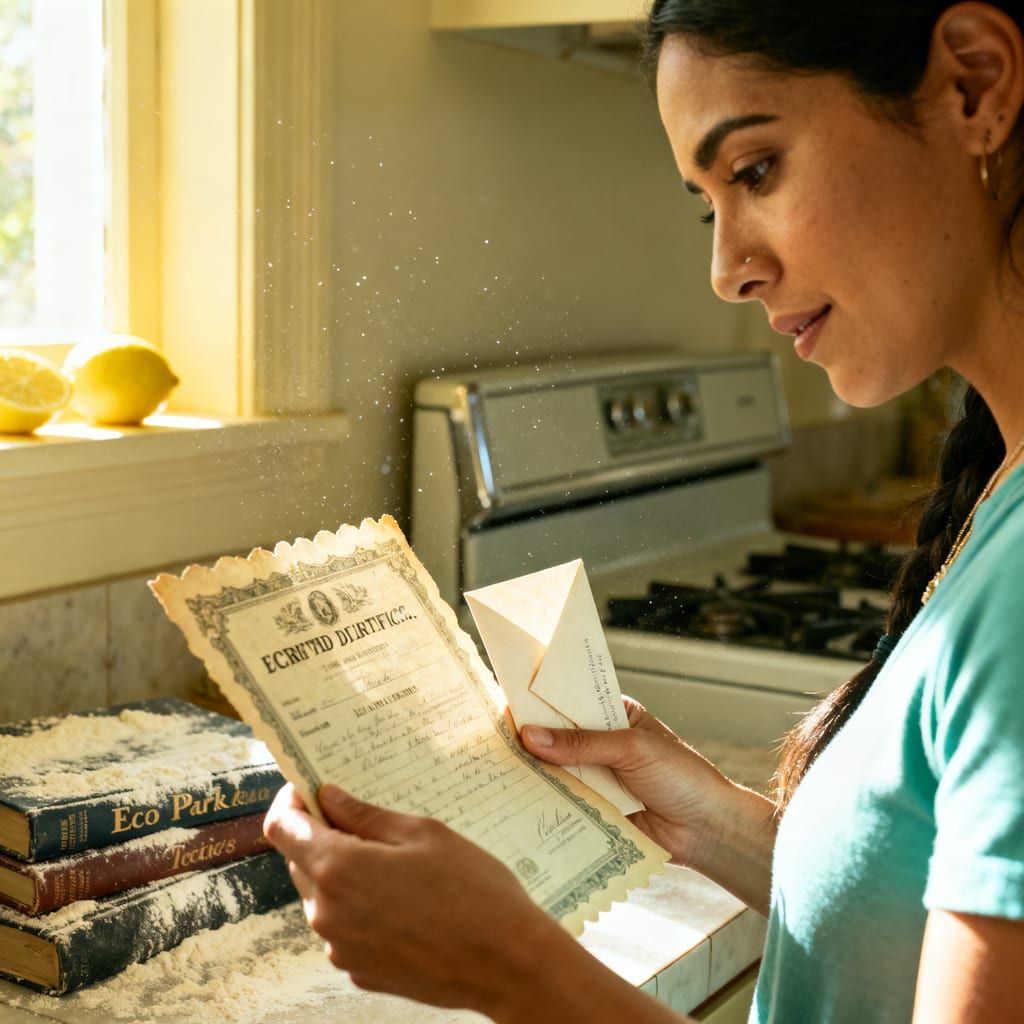
In Los Angeles, a daughter learns how to carry two lives forward
Read more →
In the soft hours before dawn, staying becomes its own kind of rescue
Read more →
Story audiobooks for children of all ages — a new one every day on Smarter Way Stories.