Two Houses and One Quiet Heart
A daughter learns to read between the lines of a life split in two
Read more →
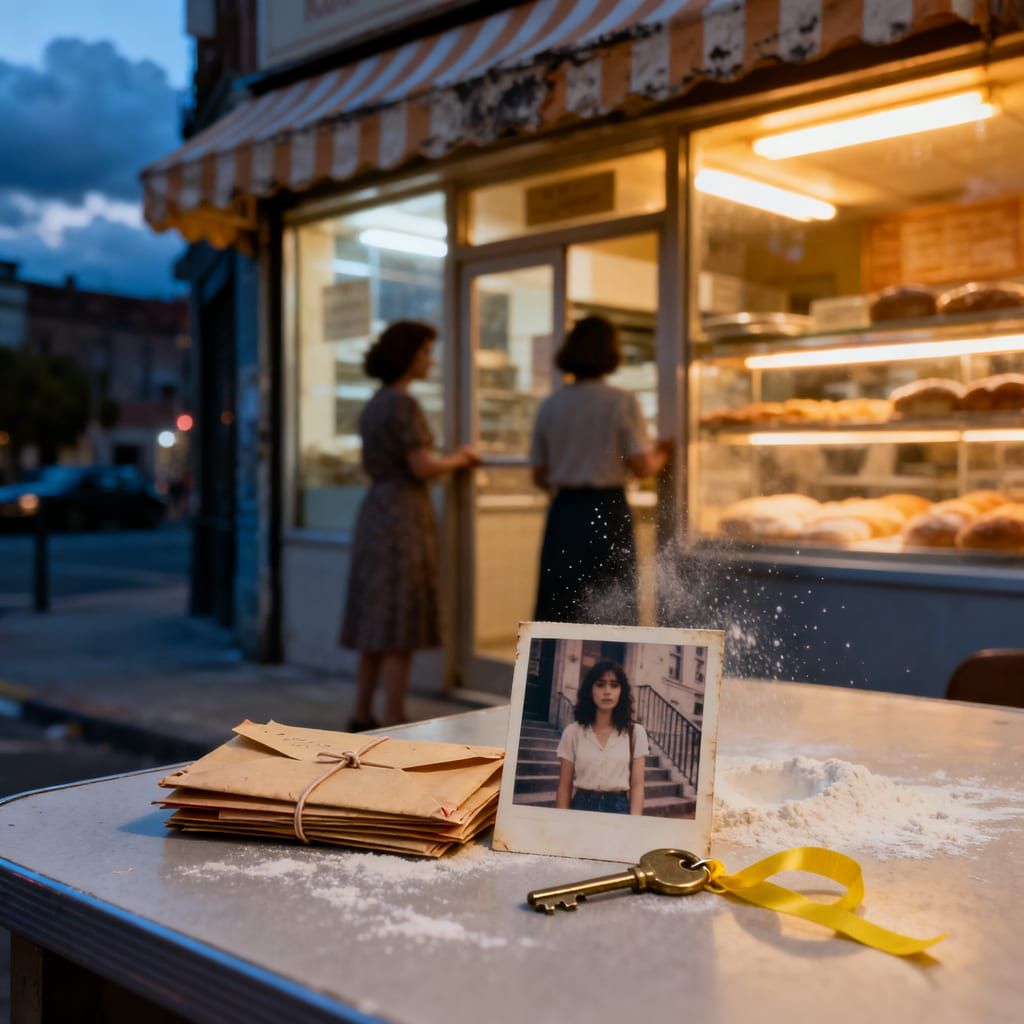
The storage unit breathes dust and lemon oil and the faint ghost of my father's aftershave. Cardboard, twine, a toppled lamp shade, the brittle rind of a life sorted into bins. I tug a dented tin from between two guidebooks and a stack of canceled checks, the lid sticky with time.
Inside: a Polaroid, its white border thumb-smudged. A girl on a city stoop, hair whipped across her mouth, eyes wide as if the wind had called her name. She looks both braced and breakable. On the back, a looping hand has written an address I don't recognize.
My father's funeral was quiet-hushed hymns, paper cups of coffee, the minister's collar askew as if he'd dressed in a car. People pressed my hands and said he had been a good man, which he had. My parents never hid my adoption. The past is a room we don't know how to open, my mother would say, a half-smile to make it less sad. Now the key slides stubbornly in my pocket.
Two neighborhoods from the storage unit I walk to a corner where the light always looks like late afternoon. I've stood here a hundred times under a flaking striped awning, ordered coffee and something cinnamon, watched the window fog in winter. The sign says Riva's, the glass is forever cloudy, the smell of warm sugar is a halo around the door.
Rosa moves behind the counter in a rhythm that has worked its way into my bones over the years: scoop, press, smile; a palm light on a paper bag. She has laugh lines and a jaw that lifts when she listens. She always tucks an extra cookie into my bag "by accident," a ritual we never name.
When I push the Polaroid across the counter, her hands still. Flour dust bathes the photograph in a small snowfall. Her face softens, then tightens, then settles somewhere careful.
"Can you wait until closing?" she says, voice low. "Give me half an hour."
I do not trust my mouth, so I nod. The bell at the door keeps chiming as people leave with their sweetness. I watch the sun slide down and butter the tops of the rolls in the case.
In the back office the air is powdered with sugar and paper. Invoices lie like drifted snow; a string of Christmas lights has been left up all year. A space heater ticks. Rosa closes the door and leans against it, as if bracing herself against a wind from long ago.
She touches the Polaroid with the back of her knuckles. "Nineteen," she says. "That day, I was nineteen. My friend took it because she thought I looked like a movie star. I felt like a cracked plate."
She reaches into a drawer and lifts out a rubber-banded stack of envelopes, the corners worn soft. My name is written on every one. The postmarks: a history of years-Queens, Hoboken, Tacoma, back to Queens. The stamps change from flags to flowers to forever.
"I wrote every birthday," she says. "One, ten, twenty-one. I wrote when I heard the Mets lost and when the cherry trees bloomed. I wrote when I had nothing but I wanted you to have a story. They came back unopened. Every time." She places a hand on the stack like blessing bread.
The ache in my chest rearranges itself-sharper, stranger. "My parents..." I start, and the words tangle. They never hid me; they never named anyone else. Documents lived in a blue folder. There were birthdays with roller rinks and ice cream, school photos with crooked bangs. There was love, an ocean of it. There were things not said, rooms walked past.
"Did you know me?" I ask. The question sounds like a child's-too open, too small.
Rosa's mouth bends. "The first time you came in," she says, "you tilted your head when you asked for a latte like you were listening to music only you could hear. And there"-she gestures to her neck-"the little birthmark, that comma under your jaw. When you took your first bite you closed your eyes. I used to do that."
She laughs without sound, the way someone cries without tears. "The social worker made me promise not to come looking. Not to intrude. I promised myself too. I thought-if you were happy, I would not be the hand that shook your life. So I... stayed near. I learned your order. Some days I put an extra cookie in and said it was an accident. It was as close as I knew how to be without taking."
I look at the envelopes, the world she tried to send me and failed. My thumb finds the curve of my jaw where the comma of skin sits like punctuation at the end of a sentence I never read. The shame is there, because there is no tidy place for anger to sit when someone offers you love like this. I had rehearsed, in private, how to assign fault, neat as invoices. But the ledger goes blurry. I wanted to blame someone so I could stop blaming the air.
"Why did my parents-" I begin, and can't finish.
Rosa eyes me, not defensive, not asking pity. "Maybe they were afraid of losing you twice," she says. "Maybe a clerk at a desk put letters in the wrong bin. Maybe someone thought they were doing the right thing." She shrugs, flour floating. "I don't know that room. I only know this one."
We sit on two low stools. The office hums. Somewhere, a timer dings; the smell of caramel creeps in. Silence unfurls between us like a cotton tablecloth. Rosa tells me about that year-how she took the bus to work, how the city felt like a dare, how her mother didn't speak to her for a long time and then did, how the social worker said there is a couple who will love her like their own.
"They did," I say, and my voice is both sure and shaking. I do not want to stand on loyalty like a podium and speak declarations into a microphone. I want my mouth to be a porch light. "They loved me so well that sometimes I forgot I was anything but theirs. And then other times I remembered all at once, like a smell you can't place, and it hurt for no reason I could explain."
Rosa nods. "When you were born," she says, "you were quiet. The nurse said you looked like you were working something out. I thought, she is an old soul, translating us."
I laugh then, soft. I want to ask a hundred questions-What do I look like when I sleep? Do you drink your coffee black? Do you hum when you wash dishes?-like I could backfill an entire life with tiny answers. Instead I pick up the top envelope and flip it over. The adhesive is brittle. My name stares back. The postmark is my tenth birthday.
"Do you want-" I start.
"No," she says gently. "They were for you then. You now can choose."
I hold it closed a moment longer, then slide it under the stack. The letters have lived a kind of life without me. I am not ready to break their skin.
"I am sorry," Rosa says, and the simplicity of it unthreads me. "Not that I chose adoption. That was what I had. I'm sorry for the space it left. For the way I let fear do my thinking."
We laugh, small and ridiculous, when a tray clatters in the kitchen. The spell wobbles and steadies.
"I'm angry," I say into the space, the honesty a relief and a risk. "At the letters, at the not-knowing, at them, at you, at myself for wanting a neat story I could hold up like a shield. And I'm... grateful. That you didn't disappear. That you made cookies. That you waited for me to ask."
Rosa exhales, a sound like a door loosening. "Two truths can live in one room," she says. "I tried so hard to be good that I forgot being good is sometimes just being honest."
We follow the sound of the front bell. The sky has bruised to purple. She flips chairs onto tables while I wipe down glass, our hands moving around each other like they've done this before in another life. She ties the bread with twine. I fold the paper bags so their creases meet. Small work to keep from tipping over.
Before I leave, Rosa slides a key across the counter on a ribbon the color of egg yolks. "Mondays I'm closed," she says. "I make stew. I say I'm resting but really I'm lonely. If you want-my apartment is three blocks over. Come eat with me. Or don't. The key works either way."
I pick up the key. It's warm, like it was sitting under a lamp. My hand closes around it without my permission.
On the way home the city feels slightly altered, as if someone adjusted the focus on a lens. Bodega cats blink from their cardboard thrones. A kid on a scooter leaps a crack with the concentration of a tightrope walker. I stop at a light and press my thumb into the small comma at my jaw. I do not open any envelopes on the train. I don't throw them away either. I hold the stack in my lap like a sleeping cat.
The first Monday, I don't go. I put the key next to the tin on my dresser. I make toast and eat it over the sink. I answer emails no one is waiting for.
The second Monday, I walk over in the rain. The hallway smells like onions and old paint. Rosa opens her door wearing socks and a face that looks like mine around the eyes. On the stove, a pot sings. The apartment is small and returns to itself like a well-loved sweater. There are no photographs on the walls, only a calendar and a crooked clock. On the table, two bowls and a loaf of bread bow to each other.
We move carefully, like people walking on a dock that's a little loose. We talk about bad television and basil. I ask, "Did I cry when I was born?" She says, "Not at first. Then, all at once." We laugh like we mean it. We don't touch the letters.
Weeks lengthen. I bring peaches. She teaches me the exact moment to turn off the heat under caramel. I show her the app I designed that helps people find street trees nearby; she pretends not to be impressed and then texts me a photo of a maple with the caption: found her. We pass stories like salt, unsparing, unadorned.
One evening, I read a letter. It is about a robin that kept building and rebuilding a nest on a fire escape no one used. It is about the sound of thunder traveling down stairwells. It is about me, always, even when it's not. I don't read all of them. I don't need to. The unopened ones do not feel like accusations anymore; they are just futures that found other ways to arrive.
I think of my parents-my father in his suit that never fit quite right, my mother with the blue folder and her hands that knew my fevers by touch. I tell Rosa about them: the way my father whistled off-key, the way my mother burned grilled cheese because she liked the charcoal. We let them into this new room. It gets bigger to make space.
One afternoon, as we sweep, Rosa says, "You know, I kept that Polaroid in my wallet until the edges went soft. I thought if I held on hard enough, I'd know what to do."
"You did," I say, surprising myself with how sure I am. "You baked cookies. You waited."
She looks at me for a long second, the same look from the Polaroid-defiant and scared, and now something else: relieved.
When I leave, she tucks an extra cookie into the bag on purpose. "It's an accident," she deadpans, and we both smile.
Outside, the air smells like warm sugar and the possibility of rain. I slip the key back onto the yellow ribbon and into my pocket. The photograph sleeps in the tin at home, the address on the back like a doorbell I finally rang. The room it opens is not what I imagined. It's messier, kinder. I step in without taking off my shoes.
A daughter learns to read between the lines of a life split in two
Read more →
A fog-draped night, two souls found, and the quiet shape of a life
Read more →
Story audiobooks for children of all ages — a new one every day on Smarter Way Stories.