Threads for Chosen Names
A room, a red blazer, and the courage that fits at last
Read more →
The app glowed like a small hearth in the blue of her studio, a square of light on a coffee table smudged with tea rings and sticky notes. Outside, Chicago threw its voice through the window-plows grunting down side streets, wind shouldering the glass, a siren slipstreaming the lake.
Lina had spent the evening assembling other people's pasts. She'd watched strangers try on surnames like coats in a mirror, reshuffle dates till a face matched a decade, toggle open a tree and breathe when a missing parent snapped into place. By midnight, she closed the last test case and opened her own account the way you dip a toe-knowing cold but still surprised.
The notification chimed. Strong match: Close family-possible half-uncle.
Her mouth went dry. The name carried its own weather: Tom Rivera. Two neighborhoods away.
She stared at the word "close," its edges warm, and felt a part of herself-kept folded for years-uncurl.
She messaged. He replied within an hour, the sentences gentle, no tug. He wrote about a sister, Elena, who had been nineteen and laughed like static catching, who'd sketched radios and carved lino blocks at the kitchen table, who made lemon bread on Sundays because the house needed that smell. Elena, he said, was gone five winters now. They had kept her room like a pocket of summer.
They met a day later at the community garden. Snow freckled the raised beds. Tom wore a navy beanie and the kind of work gloves that tell two stories: labor and care.
"You must be freezing," he said, voice sanded smooth by years outdoors. "We can walk a bit. I like it when the soil sleeps. You can hear things without all the green shouting."
They walked the mulch paths bordered by sticks and seed markers. He moved slowly, naming plants as if introducing old friends not present. "Here's the marigold row Elena insisted on. Felt gaudy until September, then it saved everything."
Lina listened, the rhythm of his talk familiar in a way that tugged at her ribs. It wasn't content. It was cadence-the way he rested on verbs, let them breathe.
"I don't want to bulldoze you," he said after a loop. "We have some things of hers. Saved for... I don't know, someday."
Lina tasted the word. It dissolved on her tongue like a sugar that had waited years to be water.
The house smelled like roasted chilies and furniture polish. A gold-leafed radio anchored the shelf, dented at one corner like a tooth nicked in childhood. Crocheted doilies softened the armrests. The Rivera living room held family by the square foot-frames nested into frames, school pictures laddered in time.
A woman with silver threaded through her braid stood at the threshold of the room like a gate you hope opens. Tom's mother. Elena's mother.
"Ven," she said, and the syllable found a place in Lina's chest. Come.
They sat at the kitchen table spread with a plastic cloth patterned with grapes. The woman's hands were small and capable, the hands that learn the weight of a baby in weeks. She pressed a smooth stone into Lina's palm-river-worn, thumb-sized.
"For steadiness," she said. "For when the wind makes corners out of us."
Lina closed her fingers. The stone warmed fast as a heartbeat.
They brought a box from the hall closet. On top lay a cassette with a smear where a price tag once clung. In blue ink, a label: Elena-Station ID.
"She did a radio class," Tom said. "College nights, the semester she..." He didn't finish. He didn't need to.
Lina lifted the tape the way you lift a sleeping child-careful not to wake a thing before you're ready to hear it.
"I can digitize this," she offered, and her voice had to navigate around the stone in her hand. "It's what I do. For work. For people who find... pieces."
Elena's mother nodded. "We were waiting for someone who knew how to listen."
At home, Lina pulled the old deck from the closet, a loan from a friend that smelled like attic and college radio. She set it on the desk beside her monitor. The window fogged with her breath. She threaded the tape with the reverence of a ritual.
Static unfurled. Then-
A laugh. A sound she knew in her own throat, a chord you only hear when you drop a glass and it does not break.
"WCRX," a voice said, warm and untrained, the way you talk to a room you can't see. "This is Elena Rivera, hoping you're listening, hoping you're out there."
Lina's cheeks prickled. She let the tape run.
Elena spoke of music and mornings, of how the radio could make a stranger a neighbor for the length of a song. She stumbled once, and in the stumble you could hear someone grin.
Then, softer: "Names are weird, you know? I keep saying mine into mics and it gets rounder. Elena Rivera. Like a river who can roll her Rs." A breath. "I had to name a baby this week. She won't stay with me. I'm nineteen and good at carving but not at holding time still. I named her Catalina. Clean. Like sunrise after fog. If she ever finds a station that reaches me-hey, Catalina. I'm sorry. I'm making you a map."
The room tilted. Lina pressed her palm to the desk, stone and wood meeting. Her adoptive parents had told her what they knew-very little. They had named her Lina because it felt right on their tongues. Catalina, she thought, the longer arc of the same bell. The syllables didn't press; they nested.
Elena's voice filled the room a few minutes more-station IDs, a joke about how she only had two good jeans and a relative who kept trying to feed her. The tape clicked, stopped.
Lina sat very still. She felt like a radio tower in winter-ice-sheathed, humming.
At the public archive where she worked two days a week, the stacks had their own weather-cool and papery. She'd digitize family VHS tapes, cassettes, mini-discs, turning ghosts into files you could drag to desktop. That afternoon, the intake log held an oral history project from a neighboring high school-1998, Latino youth arts.
She clicked. A file bloomed. The voice that met her was already in her skin.
"Elena Rivera, nineteen," the interviewer said. "Tell me about your art."
"I like things that leave a mark," Elena replied. "Ink. Carving linoleum so what stays is what you decide. I'm trying to leave breadcrumbs so future-me or future-her won't feel erased."
Pages rustled. "I started a family tree," Elena continued. "But I left some lines blank so there's room. I don't know what she'll be called. I wrote Catalina because it felt... clean. Like after fog."
Lina moved the cursor back and played it again, greedily. Each time, the same lift on clean, the same catch before fog.
She emailed Tom. She asked, in careful words, if there were papers-sketches. He sent a photo two hours later of a pencil tree on looseleaf, soft lead faded from fingers. Lines radiated outward. At the bottom right, a branch fanned to a space without a name. Next to it, light in pressure, the note: someday.
She printed it and slid it under the magnet shaped like a pepper on her fridge.
Back at the Riveras' the next week, Elena's mother unrolled a map on the table. The paper had a backyard smell, sun and lint. In blue pencil, streets stood in thin winter, snow along the gutters. Notes hovered-"Mr. Jiménez's plum tree," "Best elotes truck"-a city annotated by affection.
A wall was circled two blocks from Lina's apartment.
"Elena's mural," Tom said. "She started it the spring before she left for... well. For whatever comes after a hard choice. She meant to finish during break. Life had other breaks instead."
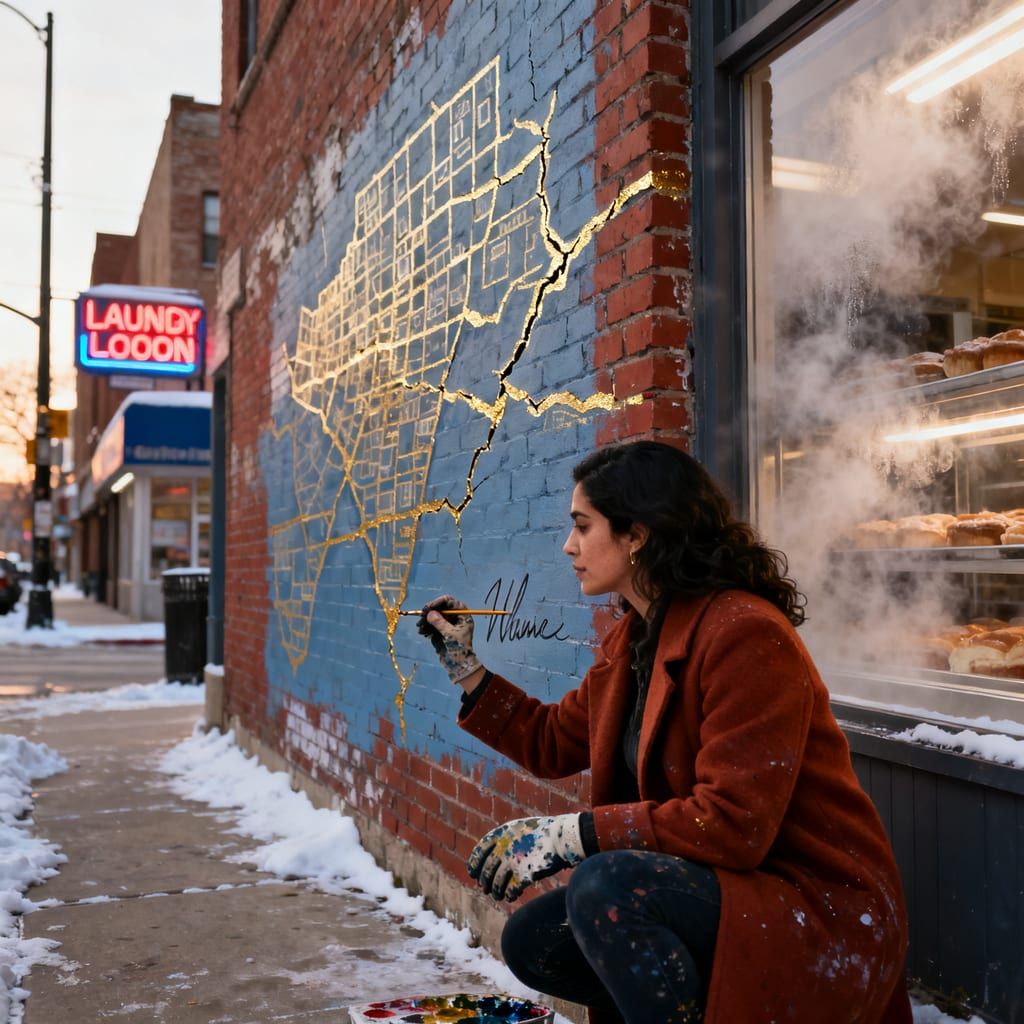
Lina recognized the corner instantly-the laundromat with the bowing neon, the bakery window fogged by conchas. She'd bought parsley at the bodega a hundred times and walked home beneath it, thinking only of dinner.
The knowing landed the way quiet does after thunder.
"Can we-" she began.
"Finish it?" Elena's mother asked, mischief cutting through grief like sun through blinds. "Not finish. Continue."
They got permits the way neighborhoods do-by asking, by bringing tamales, by vouching. Winter made progress slow. Paint doesn't like to set in cold; neither do hands. But there are afternoons in February when Chicago pretends at April, and they used them like found money.
The wall, peeled and pocked, drank primer as if thirsty from decades. Elena's grid-faint, faithful-awaited hands humble enough to follow and brave enough to edit.
Lina held a brush and felt the reach of it in her shoulder, a line from wrist to ancestor. Tom took texture, stippling where concrete had lost its memory. Elena's mother worked edges, steady as a seamstress. Neighbors joined, kids with mitten strings flapping, a postal worker on her route who dragged a roller between deliveries.
At the center of the mural, a map unfurled-a neighborhood heart with streets like veins. Elena had begun-blue pencil translated to thin black lines-and left gaps where city had changed. Lina suggested gold leaf to knit the cracks, a trick she'd seen in a ceramics exhibit, kintsugi logic brought outside.
"Repairs that don't pretend they weren't needed," she said, the words surprising her with how right they were.
They glued and pressed, breath held, then peeled away tissue to reveal rivers of gold stitching history to itself. The wall gleamed like it had learned to say its own name.
While paint dried, Lina texted her aunt on her adoptive father's side. They hadn't talked much since he'd passed-a quiet man who always left the porch light on when she visited. She told her about the Riveras, about Elena's voice, about the name that had waited for her like a coat on a hook.
Her aunt called. "Honey," she said, and the word was a blanket. "Your dad took one of those DNA things a while back. He put a note in. I didn't want to push you. He said, 'If she ever looks, tell her she has my blessing to find all of herself.' He always wanted you to know that. He just didn't know how to make it land soft."
Lina sat on the stoop outside the mural, phone warm at her cheek, the smell of wet paint sweet and mineral. She looked up at the grid they were making whole and felt two hands at her back, one from each direction, not pushing-steadying.
On the last day, breath smoked from mouths and paint did that gummy half-set thing it does in cold. They leaned in anyway. A neighbor's boombox played a station that still used call letters like a salutation. At the corner of the map, Elena had left a tiny radio, drawn in outline-a joke, a signature.
"Go on," Tom said, handing her the thin brush. His gloves were flecked with gold.
Elena's mother stood to the side, the river stone gleaming in her palm. She'd borrowed it back for the day, then pressed it to Lina's hand again. "Para siempre," she murmured. For always.
Lina crouched at the base of the wall where artists hide their names like secrets that want to be found. Her breath fogged, then cleared. She wrote small, modest, the letters honest as block print in a first-grade workbook:
CATALINA / LINA
Not a slash that cut; a bridge that held.
For a moment, the street hushed-the bus brake gasp softened, a car idled more gently, a kid on a scooter coasted just so. The mural's gold veins caught a pale sun and returned it, re-labeled light.
She stepped back. The wall mapped more than blocks now. It held a radio station nobody could tune but everybody could hear if they stood still.
Her phone buzzed. An email alert from the app. A shared tree invitation blinked. Tom had added a branch, not claiming-making space. In the note field beside the line where a name once was blank, he'd typed: someday-today.
Lina looked at the wall, at the place where her mother's hand had lifted years ago and her own had followed. The air smelled of chilies someone roasted two streets over, of paste, of winter, of something sweet-maybe lemon. She found the smooth stone in her coat pocket and turned it until the groove fit her thumb.
There was no anthem in her. Just a settling. A chair pulled up to a table where the cloth had grapes. A room keeping time. A radio with a dent still playing. Two names breathing without hurry.
She walked home under a sky the color of tin and, for the first time, every branch she passed felt like it knew her.
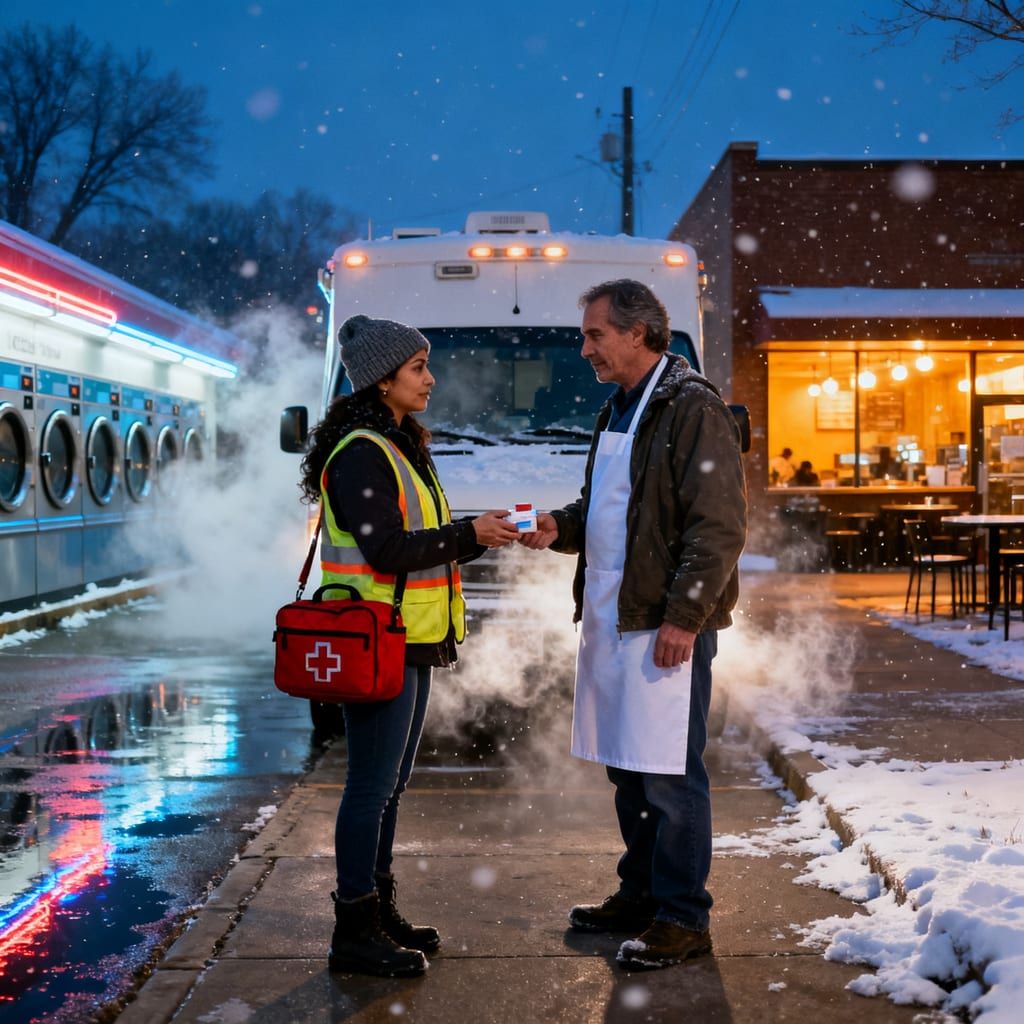
Between a laundromat's hum and a café's light, a van keeps score another way
Read more →Story audiobooks for children of all ages — a new one every day on Smarter Way Stories.