Two Houses and One Quiet Heart
A daughter learns to read between the lines of a life split in two
Read more →
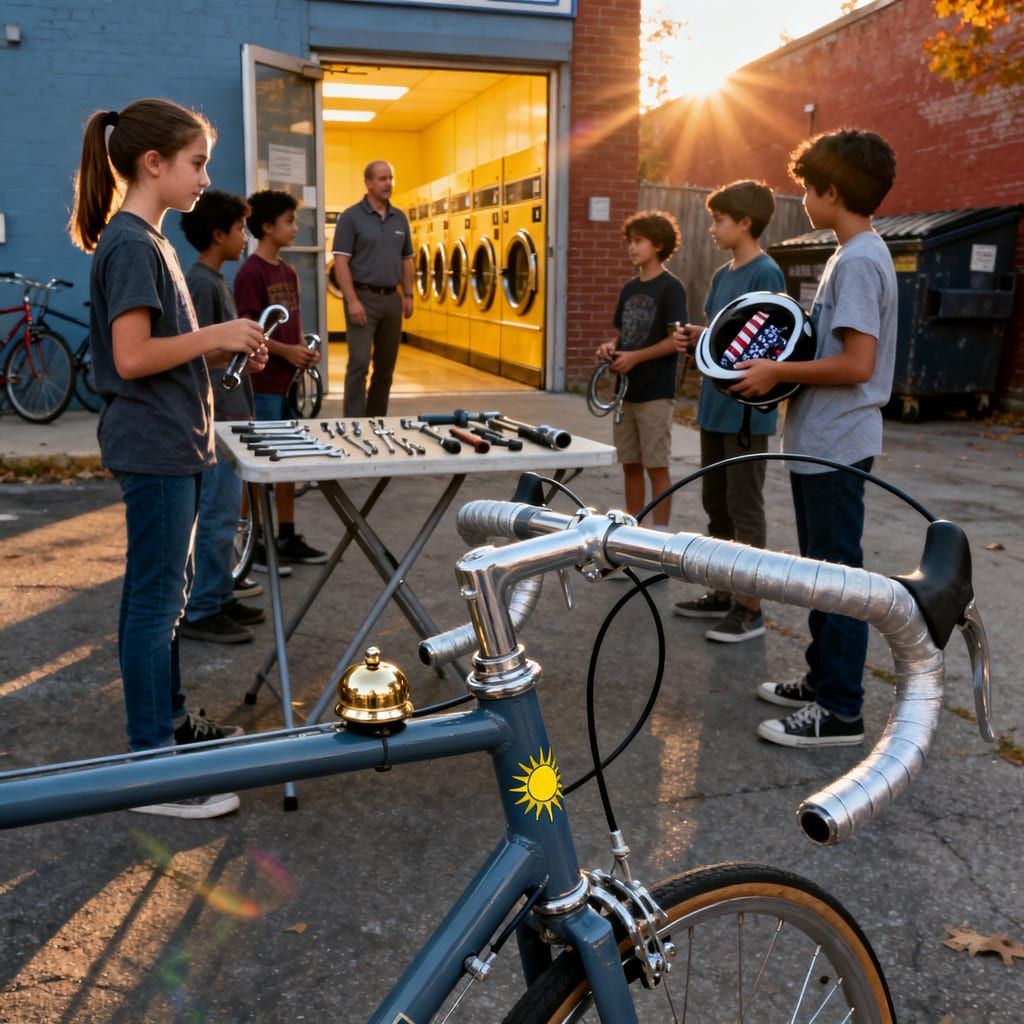
The hum of the laundromat was a tide-washers gulping, dryers shushing hot air-and behind it, in the sliver of alley between dumpsters and a chain-link fence, Ravi Desai unfolded a plastic table that had learned the shape of his Saturdays. He set out hex keys in a neat fan, lined up brake pads like dark little commas, unspooled a ribbon of chain lube that glinted in the sun.
If you stood there, breath full of soap and hot lint, you could hear the other music: freewheels clicking as a backpedal found rest, spokes singing under tension, a loose headset knocking a soft and hopeful metronome. Word traveled on that music. Kids arrived by whisper and rumor, by cousin and cousin's friend, bringing frames that came from alleys and yard sales and the bottom of someone's basement stairs. Ravi called the table Second Wind. He never wrote the name on anything. He didn't have to.
He wouldn't ride, though. Not since the night a car door split the dark like a bad joke and sent his brother into silence twelve years ago. Ravi folded his own bike into a closet, slid it behind winter coats, and let dust say what he couldn't. But he could still listen to metal, read its language: the patient logic of a bent derailleur, the soft-firm click of a brake cable settling home.
The girl showed up with a BMX that looked like it had been weaponized against curbs. Stickers pelted the top tube. The whole frame leaned left, a tired dancer.
"You're the bike guy?" she said, chin up. Her ponytail was a line drawn in pencil-sharp, undecided.
"Depends who's asking," Ravi said. He'd learned the careful shrug that kept kids from bolting.
"Lila," she said, and let the front wheel clatter to the ground. "This thing's trash." She said it like an accusation aimed at the world.
Ravi traced the warp with two fingers. "Trash is a little dramatic," he said. "Bent, yeah. We can true the wheel and see how the frame behaves. Might need a new fork."
He felt, rather than saw, her hand drift toward a loose quick-release skewer in the parts bin. Her fingers palmed it, adolescent sleight of hand.
"Trade you," he said, holding out his open palm.
Her eyes flashed. "For what? I didn't take anything."
"For a lesson," he said gently. "You put that back. I show you how to do this the right way. You learn, you don't have to take things that aren't yours."
A muscle in her jaw worked. She set the skewer in his hand like a dare. "Fine. But if this bike dies, I'm haunting you."
He smiled. "Deal. We'll start with the wheel. You ever hear a spoke sing?"
She laughed, a short bark. "Spokes don't sing."
"They do if you listen." He pulled the stand closer, eyes already on the wobble. The laundromat's vent breathed warm air onto the back of his neck. "You pluck a good spoke, it's almost musical. We're just bringing it back to pitch."
They worked in slices of time: late afternoons while shadows grew long; Mondays when the coin counter clattered like rain; Fridays when the neighborhood kids drifted past and slowed, curiosity pulling at their handlebars.
"Turn a quarter turn," he'd say, his thumb guiding Lila's on the spoke wrench. "Now the one opposite. Hear it? Higher, right? We're moving the whole circle back to center."
"I'm not a musician," she grumbled, but her ear leaned toward the sound. Her jokes arrived like paper airplanes, folded quickly and flung before she could think better of them. "So we're like... bike whisperers?"
"More like translators," Ravi said. "Metal speaks a language. You can learn it."
Between jokes, pieces of Lila's life slid across the table: her dad was gone; her mom worked nights at the hospital laundry, which felt like a bad punchline; the bike was how she kept up with friends who could Uber without counting change.
"Rule one," Ravi said, sliding on a new set of brake pads. "No night rides without lights and a bell." He reached over, tapped the empty handlebar like a metronome. "And I don't chase you down when you break rules. You just don't bring the bike back until you've thought about whether you want help."
"Rule two?" she asked, mocking, but her hands were careful on the cable.
"You learn to fix what you break."
"Rule three?" Her eyes were serious, though she made her voice sing-song.
"You don't ride alone at night." He'd meant the sentence to land lightly; it came out heavier than he intended.
"You don't ride at night at all," she said, watching him as if testing a door. "Right?"
Ravi's hands paused on the barrel adjuster. The vent blew hot, then cool. "Right," he said quietly. "I don't."
Word threaded its way through the neighborhood, link by link. Kids began to come after school, crosstown and across languages. A boy named Mateo arrived with a frame that was mostly rust and intent. Dara brought a pink cruiser that had belonged to an aunt who moved and didn't leave a forwarding address.
They leaned, listened, learned. Ravi showed them how to patch a tube with glue that smelled like summer camp. He watched them map cause and effect on their palms, on their faces. Problems made sense here. Answers clicked.
A landlord with a tucked-in polo-Mr. Rinder, who oversaw three blocks of leaky plumbing and warbling fluorescents-wandered back one Saturday, frowning like he'd heard a rumor about himself. "You taking up tenants' parking with this?" he asked, nodding at the folding table, the sprawl of kids.
"Just the alley, sir," Ravi said, wiping his hands. "We clean up. We're out by six."
Rinder squinted at a pile of axles and bent seatposts. "Liability. Noise. Trash." He ticked each word like a finger on an invisible list.
Lila stepped between them, chin sharp again. "It's quieter than your dryers," she said, and before Rinder could retort, a woman came out with her basket and said, "My nephew got that Schwinn from here. He's off his Xbox and riding to school." Another voice chimed in-"My kid fixed a flat, all by herself." The murmurs became a tide. Even the washers seemed to pause.
Rinder's mouth opened, shut. He looked at the kids-hunger for motion scrawled in their bodies, the way they perched on their toes as if gravity were negotiable-and for a flicker, Ravi saw something soften. Rinder looked like a man remembering being someone else.
"Fine," he said gruffly at last. "Don't block the dumpsters. And sweep." He jabbed a finger at a dustpan as if it were a legal document. When he turned to go, he picked up a fallen reflector and set it on the table like an accidental blessing.
By August, the air held that late-summer gold that makes even trash cans look cinematic. Ravi set out a clean jar and dropped in a dollar, a joke more than a jar.
"For what?" Lila asked, suspicious.
"Bells," he said. "Every bike leaves with a bell. Even the cool ones."
She rolled her eyes. "You're going to have a gang of dorks."
"We'll be the safest dorks on the block." He tapped the glass. The joke became a ritual. A neighbor dropped in quarters. Someone's uncle folded a ten. The kids rang their bells ceremonially when a build rolled out, tiny metal halos.
On a wind-stitched Tuesday, a package arrived: narrow, heavy, packed in foam like a secret. No return address. Inside lay a vintage steel road frame, slate-blue under dust, lugs like carved lace.
Ravi's breath caught. He ran a thumb along the top tube and felt history hum there. These didn't show up by mistake. He checked the packing tape for a clue. Nothing.
"Did Santa come early?" Lila asked, peering in.
"Someone's either very generous or very confused," he said, keeping his voice light. He set it on the rack and tried not to touch it again. The frame was a ghost at the back of his mind, standing very still.
The kids whispered. Ravi pretended not to notice the way they gathered, the way their eyes slid toward that slate-blue like birds drawn to a wire.
Early fall caught on the chain-link in cracked leaves. The circle of kids thickened with sweaters and talk. Lila returned her BMX to life one piece at a time, a kind of stubborn faith you could ride.
"You ever race?" she asked, surprising him. They were setting brake centering on Mateo's Frankenstein commuter, hands dirty in mirror image.
"A long time ago," he said.
"You should..." she began, then ended with a shrug that said too many things at once. "Never mind."
He looked at her. "Some things take longer than others."
That Friday, Lila arrived late, helmetless and flushed. She stood very still by the table. "I found something," she said, and pushed a frayed strip of cotton across the plastic.
Ravi froze. It was from a shirt he'd given Sunil on a humid June night, a pattern like tiny suns. He had forgotten the feel of it until that second. He must have shoved the shirt into his toolbox years ago-one of those practical griefs, a thing kept without knowing how to keep it.
"Where was it?" he asked, his voice far away from the alley.
"Bottom of the red box," she said. "Under the cone wrenches. It was... it seemed like it mattered."
He brushed the cloth with the back of his fingers, as if it could break. "It does," he said.
They called him out on a Saturday that had the brittle hiss of leaves underfoot. Dusk was the color of long-ago photos. The laundromat lights threw a warm rectangle on the concrete where the folding table usually stood. In its place, the circle of kids fanned out, each with a bell hidden in a palm, grins trying to swallow themselves.
"What did you do?" Ravi asked, not quite alarmed, not quite ready.
They stepped aside. On the work stand, then gently wheeled into the alley, was the slate-blue frame reborn: thin tires, silver bar tape, a saddle worn just enough to feel honest. The head tube bore a small hand-painted sun, yellow-gold and a little wobbly. It burned steady.
Lila lifted a helmet like it weighed history. Inside, the padding had been lined with the strip of cotton, tiny suns facing in. She pressed it into his hands. "We didn't know the size," she said, words falling over each other. "We guessed from your old seatpost. We... we all worked on it. Even Mr. 'Liability.'"
The landlord cleared his throat somewhere behind them, a cough caught on something softer. "Someone fixed my bike when I was a kid," he said, voice stiffer than his eyes. "Didn't charge me a thing. I mailed the frame. Figured it was time."
Ravi looked at the bike. He'd learned the weight of loss; he knew how to hold it without dropping anything else. This was a different kind of weight-lighter, but somehow harder to lift. He ran a hand along the top tube. The paint was not flawless. That helped. Perfection makes liars of us all.
"Rules," he managed, because rules had kept them all from floating away. "Lights. Bell. No night rides alone." He met Lila's eyes. She nodded solemnly and, from her pocket, produced a brass bell with a lever like a wink.
"Clip it," she said. "Before you weasel out."
The strap settled under his chin, click finding home. His hands knew where to go; they'd been moving other people's handlebars for years, rehearsing this moment without permission.
He swung a leg over. The alley seemed narrower and wider at once. He put his foot on the pedal and felt the bearing turn-a clean, willing spin. The kids stepped back like stagehands who knew where the light would fall.
"Ready?" Lila asked, grinning in a way that made her look smaller and older at the same time.
He nodded. Breath in. Breath out. He pushed.
The first rotation was a door opening. The second was a room he'd lived in once, furnished but covered in sheets. On the third, something inside him that had been stuck to the floorboards tore free.
Bells burst around him, bright and insistent, an alleyway choir. He steered to the mouth of the lane where the street opened into the almost-night. Wind found him and said his name the way family does-without punctuation.
He didn't go far. A loop to the end of the block, a slow coast back through the tide of kids who parted and then closed behind him, a river knitting itself. He braked, skidding just enough to read as flair. He could hear Sunil somewhere, half an echo and half the shape of his own breath.
He put a foot down. The earth felt like it had tilted a degree toward something kinder.
The kids were all talking at once-the seat height, the chainline, the way the bell sounded like a hand on a shoulder. The landlord pretended to fuss with the trash bin lid. In the laundromat window, a woman leaned against a basket and wiped her eyes.
Lila came close so only he could hear. "Good?" she asked.
He laughed, the sound rusty and then, suddenly, clean. "Good," he said. He touched the bell lever and it sang once, a small perfect note.
He looked down at the sun on the head tube-the way it faced forward, not back-and at the cloth with its tiny suns against his temple. They hadn't just been rebuilding bikes. They'd been truing his silence, quarter turn by quarter turn, bringing something back to center.
Around them, dryers rumbled, and the air held that ordinary holiness of warm lint and effort. Ravi set the bike gently against the table, then turned to the ring of faces tilted up to him, expectant and already talking about next weekends and winter gloves and whether reflective tape made you faster.
"Okay," he said. "Bring your bikes. Bring your bells. We've got work to do."
He stepped back into the alley's wash of light and shadow, the freewheels ticking their little truths, keeping time with the pulse he thought he'd lost. And when the kids rang him out again, laughter spilling into the street, he answered with the bright flick of brass-ready to ride, and to stay.
A daughter learns to read between the lines of a life split in two
Read more →
A fog-draped night, two souls found, and the quiet shape of a life
Read more →
Story audiobooks for children of all ages — a new one every day on Smarter Way Stories.