Recipes Hidden Between the Lines
A thrifted cookbook, a phone number, and a kitchen that learns to breathe again
Read more →
Lina Mercado turned the corner with the sunrise still deciding whether to show up. After a twelve-hour shift, the street looked underdressed in the cold light-trash lids asthmatically rolling, a dog nosing at the base of a sycamore, porches yawning open like mouths.
On her triplex's iron fence, a new sign gleamed like a smile with too many teeth: FOR SALE. Cheap stakes, fresh plastic. The phone number felt like a dare.
Her apartment knew her by the sound of her keys. She set down her tote, peeled off the badge still clipped to her collar, and put water on. The kettle rattled like a small train.
She wrote the names in a column on the back of an envelope-first the obvious: Mrs. Patel, apartment 1B, whose turmeric always perfumed the vents at six. Tasha and her twins. The García brothers who fixed bikes on the sidewalk and never returned wrenches. The retired teacher in the yellow house that looked tired and loved at once. The church at the corner with the crooked bell and the blue-tinged windows.
By the time the coffee went lukewarm, the envelope had ink freckles where she'd hesitated. Rumors were already hurrying down the block like wind: a developer wants the whole row; cash on the table. Leases would double. People were saying it the way people talk about weather-impersonal and unstoppable.
Lina gulped coffee and Googled until "community land trust" was a phrase her mouth could hold. Land held in common, homes affordable in perpetuity. In perpetuity didn't sound like something you could touch, but she had touched a night's worth of heartbeats. If a pulse kept going because someone refused to stop pressing, then maybe a block could, too.
The first living-room meeting smelled like Lysol and banana bread. Ten people, mostly in shoes they hadn't meant to wear indoors. No one knew where to sit. A plate of cookies skated between knees as if looking for a safe place to land.
"We can't outbid a developer," Mr. Lou from the laundromat said, not unkindly. His knuckles were raw from cold water. "We barely outbid our own heating bill."
"We don't have to outbid," said the retired teacher-Evelyn-softening her voice the way you talk to skittish cats. "We can outlast. Land trust holds the ground; people lease long-term. It's not about flipping. It's about staying."
Lina had a sheaf of printouts in a binder that looked more official than it was. "We need a board," she said, feeling foolish hearing herself. "A name. Articles. A bank account. We need... time."
Time is the only currency they didn't have.
They passed a shoebox. It made a dry sound when coins hit cardboard. Evelyn placed five crisp hundreds under the cookies as if tucking a child to bed. "For seed," she said. She didn't look at anyone when she did it.
City Hall looked like it had been built to intimidate pigeons. Lina arrived at 4:57 p.m., hair still smelling faintly of antiseptic, breath fast. The clerk's window snapped shut at 4:59 in a display of precision you could build a bridge on.
"Tomorrow," the clerk mouthed without an ounce of malice. The lights ticked off as if by remote.
Lina pressed her forehead to the cool glass and laughed, the sound more of a leak than a joke. At least a closed window is honest, she thought. You can see through it while it refuses you.
The next morning, she got there at 8:01. Paperwork named new species of confusion. She learned, in a week, the difference between bylaws and articles, between a 990 and a 1023, between saying we and meaning it.
The block association had for years been a ceremonial shell: a banner in a closet, a dusty sign-in sheet. Now, beneath a string of burned-out fairy lights, neighbors gathered each night with folding chairs and thermoses.
"I can do the website," said Andre, a junior with a hoodie dark with paint. "Robotics team needs a service project anyway." He grinned like a secret was breaking good. By the weekend, they had a clean site: a photo of the block at golden hour, a Donate button that didn't look desperate, a page titled Why We Stay.
"Childcare swaps," offered Tasha, checking her phone every three minutes. "If you all need to go to those meetings, I can take kids six to nine. But I might need rides Sundays."
"I'll cover the porch light," shouted Mr. García, holding up a screwdriver like a flag. "And I'll fix any loose step I find. Charge you in cookies."
A carpenter named Louis-stooped, forearms an archive of nicks-volunteered sweat equity to rehab the foreclosed duplex on the corner. "You buy the nails," he said. "I'll do the rest. I remember when that place held laughter. Drywall's just memory covered with paint."
Some elders crossed their arms and looked elsewhere. "We've seen promises," said Mrs. Cho from her porch throne. "Men with maps. Then rents climb even when no one paints the stairwell."
Others, quietly burned-out from old battles, nodded but kept their hands in their laps. "We tried in '09," one murmured, a scar tucked under the words.
Friends flirted with the developer's offers-a check waved like a wand; the math of relief. "I could pay off Mom's hospital debt," whispered Ruth while wiping a counter. "You tell me that's not freedom."
Lina didn't tell anyone anything. "Do what you need," she said, and believed it. At night, she added names and arrows to her envelope until it looked like a nervous system.
The first real break arrived looking like a small mercy. St. Matthew's, with its wavering bell and stoic brick, offered to ground-lease its vacant lot. The price: a garden anyone could water, and a small memorial-just a stone with ten names of those who'd died alone in rooms nearby.
The pastor slid the memorandum across a metal table beneath a basement Jesus whose eyes had faded to kind. "This land has fed sorrow long enough," he said. "Let it grow tomato vines and children who know where to set down their backpacks."
They planted raised beds that weekend. Dirt under nails, the city soft for once. Lina pressed a marigold into place and thought of her mother's shoebox of rent receipts-the ones with pink carbon copies-kept under the sink with the bleach. They outlived her mother. She could still see the dates in a slanted loop that was almost cursive, almost laughter.
The public hearing unfolded under dim gym lights that hummed like tired insects. Folding chairs. A dais where councilmembers pretended not to see they were balancing on a cliff.
The developer's team wheeled in glossy renderings the size of toddlers. A woman in an eggplant blazer described a vision: rooftop pool, activated retail, a café that looked like any café in any city. Future was the word that did the most work.
When Lina stood, her knees were uncomplicated: they simply held. She didn't reach for a speech. "My neighbor keeps our spare keys," she said. "She remembers who worked which shift and when to knock soft. When my mother was sick, the woman upstairs made arroz con pollo and left it outside our door without speaking because she knew the smell of grief. I have my mother's rent receipts still. This block remembers who we are. We're not against beauty. We're for staying."
Behind her, the room filled with work uniforms and paint-streaked hoodies. People whose hands had learned to carry more than their share. She felt their steadiness like a bench at her back.
The council's approval was conditional, like a promise traded for a chore. A modest grant. A path through the thicket if they could keep walking.
As closings crept closer-signatures lined up like patient trains-the landlord, Mr. Keene, slid Notices to Vacate under three doors, their language crisp and airless. Timeline unrealistic, he said, suit-wrinkled and efficient when cornered at the curb. "I run numbers, not a charity," he added, looking past Lina at nothing in particular.
Lina's resolve, usually a stone on the riverbed, went briefly to sand. In the church basement, folding tables bowing under donuts and hope, she pressed the heels of her hands into her eye sockets until sparks came. "It's not enough," she said to no one and to everyone. "We're not enough."
The man stood near the coffee urn with fingers the color nicotine makes. His jacket had lived several lives. He held a folder the color of tea left too long.
"Mercado?" he asked, as if trying out a word on his tongue. "I'm Keene."
The room tightened. Chairs did the thing metal does when it's trying to be polite.
He set the folder down and opened it like a shared secret. Inside: a 1927 ground lease, creased into quadrants, city stamp bled to blue. A sepia photo of a boardinghouse kitchen-long table, mismatched chairs, a line of cups waiting with the patience of old crockery.
"My grandfather signed this," he said, tapping the paper as if it could be woken. "He came here with tools and no English. Rented rooms cheap because there were men sleeping in shifts and no one wanted them." His mouth worked around a memory. "I grew up in those rooms. We ate at that table." He looked up, and the villain in him stepped out for a smoke. "I didn't mean to become... what I became. I raised rents because the math said I had to. The city changed. I told myself I was just staying afloat. But this-" He pushed the lease toward Lina. "This says we promised something once."
He cleared his throat. "If your trust can close on two of the properties, I'll donate the land under the Maple Street four-unit. I'll sell the structure at cost. Keep it under you so nobody can yank it." His eyes were red around the rims, not from tears so much as exhaust.
No one applauded. It didn't feel like that kind of scene. Tasha reached for a pen like a reflex.
The trust moved as if a whistle had blown. The local credit union, whose manager wore ties that looked like exclamation points, underwrote a bridge loan and brought cookies that broke clean. Evelyn, the retired teacher, wrote another check with a hand that only shook when she stopped. "My pension can do more than gather dust," she murmured, half-to herself, half to the rows of chairs.
The robotics kids hosted a midnight fundraiser in the high school gym-LEDs snaking around rafters, drones sketching the word HOME in pulsing blue. Parents arrived in work boots, dropping bills into a plastic tub with a sound like rain. Someone made empanadas that disappeared between songs.
Louis the carpenter worked until his headlamp made a halo. He pried rot from the duplex like a dentist pulling pain. "This beam wants to live," he said, palm pressed to wood.
Lina visited apartments with a clipboard and a listening face. She wrote down worries the way a pharmacist counts pills. Every no she heard turned into a maybe when you set it alongside two or three yeses. She slept in forty-minute pieces and called that rest.
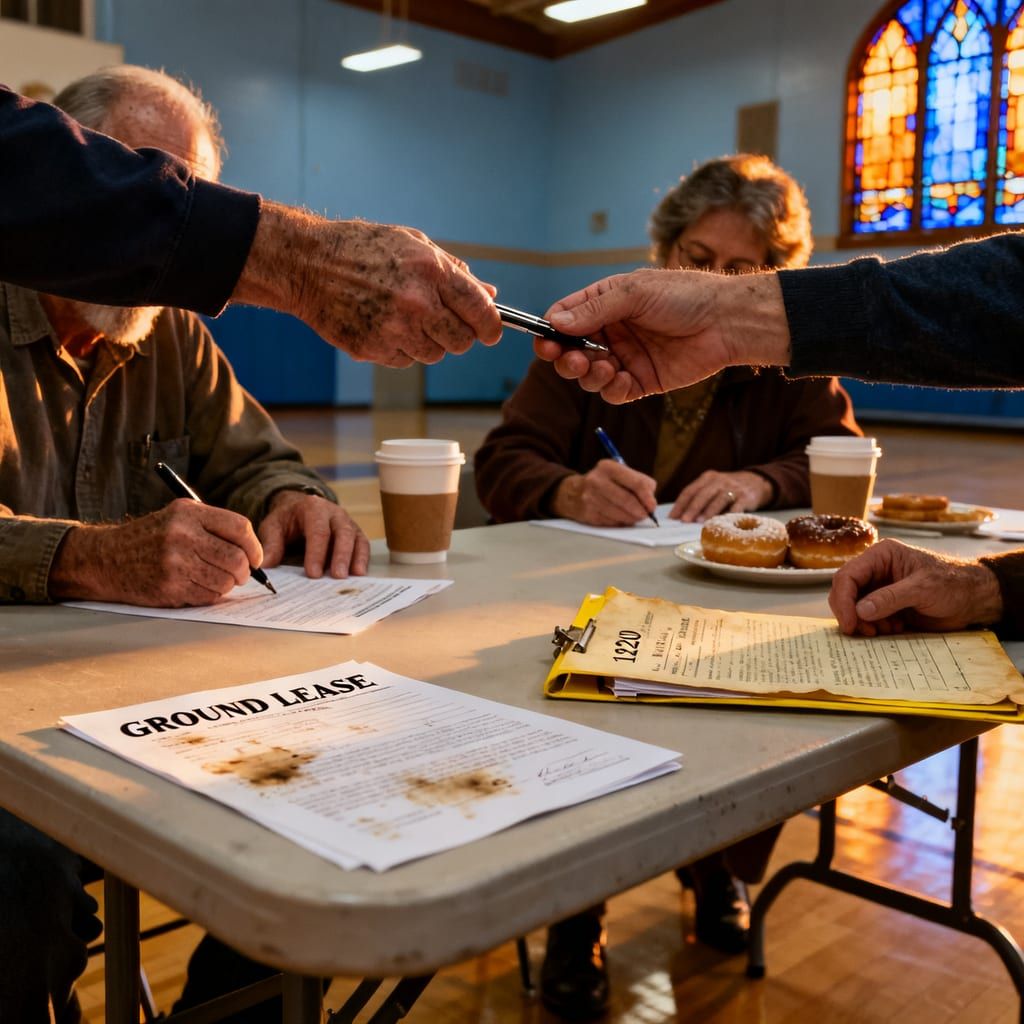
The day the papers were ready, the church basement smelled like coffee and damp hope. The folding table had new circles from cups set down hard. The attorney-a woman with hair like a neat question mark-placed the ground lease where everyone could see the lines meant for names.
Lina signed first because someone had to. Her hand shook and then didn't. Ink sank into the page like a seed taking water.
She passed the pen to Evelyn, who pressed too hard and didn't apologize. To Louis, who wiped dust on his jeans before writing as carefully as a man cuts a board. To the García brothers, to Tasha whose twins drummed on the underside of the table, to Mr. Lou who traced each letter as if it had a flavor.
One to the next, the pen moved-a metal baton passed in a relay they hadn't known they were running. The names lined up: Mercado, Sharma-Patel, García, Cho, Lou, Grant, Alvarez, Keene-for the land donation, his face the strange calm of a man setting down a box he'd carried too far.
Outside, the plastic For Sale sign was gone. In its place, a small wooden stake leaned slightly, as if listening. Someone had Sharpied the words with care that made up for the wobble: Held in Common.
Lina touched it with two fingers, like you might bless yourself without the belief but all the muscle memory. The block wasn't saved; it was held. Like a hand clasped around another, pressure enough to say I've got you, not enough to bruise.
On her way back in, she looked up. Windows made squares of evening. Inside them, lives reframed themselves-pots set to simmer, someone practicing scales badly and with conviction, a laugh pinwheeling down a hallway. She could feel her mother in the angle of the stair, in the shoebox of receipts now transferred to a drawer labeled with something braver.
The kettle on the church's hot plate hissed. Someone shouted for more pens. Ink pooled briefly on signatures before drying to a quiet fact.
Outside, in the thin light, marigolds bowed toward the dirt they were learning to trust. The street took a breath and, for once, didn't hold it.
A thrifted cookbook, a phone number, and a kitchen that learns to breathe again
Read more →
A bowl of unsent sentences, a jar on the porch, and the slow craft of staying
Read more →Story audiobooks for children of all ages — a new one every day on Smarter Way Stories.