When Nothing Happens Because of You
A quiet storm, a building that didn’t make the news
Read more →
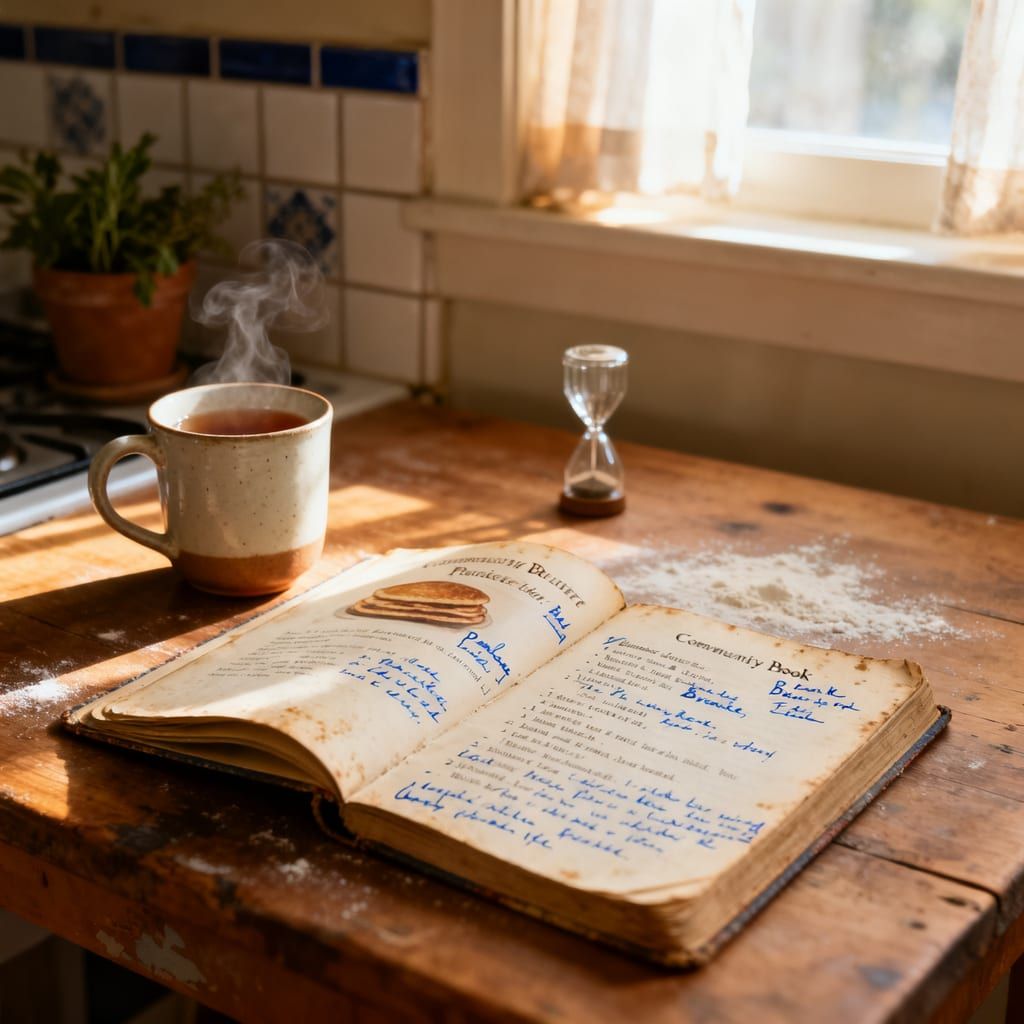
The new apartment smelled like someone else's dinners - onions sweetening in a pan, garlic toasted too long, a memory you couldn't open a window for. Lena left the windows cracked anyway, even in February, and set the thrift-store bag on the counter where the laminate peeled like sunburned skin.
She didn't cook. Not really. The last time she'd browned anything, the smoke alarm narrated her breakup in staccato beeps while her ex packed a backpack with the efficiency of a thief. After that, she learned the exact tilt of boxed soup over a mug and the timed mercy of microwaves.
But on her way home from yet another apology-filled call with a customer who wanted their late pad thai refunded, she had drifted into the thrift store like an unmoored leaf. The cookbook hadn't called to her; it sat squat and unassuming among novelty mugs, its spine cracked, the dust jacket gone. Butter stained the edges in thumbprints. It felt like a palm against her hand.
She bought it for three dollars, because sometimes you invite someone else's dinners in before you can oust the old ones.
Her ritual began the next evening: tea kettle steaming like a train, socks pulled high, the book opened on her lap at the tiny kitchen table that listed a degree to the left. The pages were stiff from years near heat. Every few pages, she'd find a smudge, a flour fingerprint, a dot of grease that had seeped like a small bruise.
And there were notes. Blue-ink handwriting in the margins that spoke in the second person, the way you do with someone whose face you've memorized.
Next to pot roast: "Not too hot, Ruth. You scorched the last one. This time, low and patient - like church."
Beside corn pudding: "Half the sugar, remember? Or we both nap through the game."
Under a lemon cake: "No zest if you can't find the zester. The box grater took off a knuckle last time." A smiley face followed, lopsided and shy.
A conversation emerged across pages. It had laughter in it, the kind that shortened your exhale. It also had an argument near meatloaf, a slash of blue that broke mid-sentence as if the pen sighed and gave up. Then, on the brownie page, a careful confession: "I'm sorry I forgot again. I'll write it bigger."
Lena's tea went cold. She flattened the book to read more. The notes shifted from cheek to cheek - from banter to instruction.
"Turn the burner off now."
"Set a timer, darling. Put it right here on the counter."
"If you can't remember where the nutmeg is, check the top left of the second shelf."
She traced the lines with a fingertip that still remembered another kitchen, another set of hands that had taught her to chop an onion without crying. Her mother's voice rose up out of the paper and then dissolved, the way steam does when it reaches the ceiling.
The pancake recipe hid the number. A little star next to "add milk until batter is pourable," and then, as if it had always been there: "Call me if the batter looks too thin -" and a string of digits written darker than the rest.
Lena stared. The number pulsed on the page like a lighthouse. She thought of spam calls, of wrong numbers, of a man somewhere who'd answer and make a joke about flapjacks while his wife shouted something from the other room. She thought of doing nothing and closing the book, and the thought flattened her like a hand over a candle.
Her phone felt heavy as a skillet in her hand. She dialed with the care of someone cracking an egg. One ring, then two. On the third, a voice: cautious, gravel brushed with honey.
"Hello?"
"Hi," Lena said, her words falling over each other. "I-this is strange. I found a cookbook at a thrift store. There are notes inside and a... a phone number next to pancakes. If I'm bothering you, I'm so sorry."
Silence, then the soft kind of laugh you give a memory when it startles you.
"Oh," the woman said. "Oh my. Does the book have a rip on page twenty-seven? Where the pie crust is?"
"It does," Lena said, flipping, relieved when the tear greeted her like a ragged grin.
"You've found my Sam's handwriting," the woman said. "I'm Ruth." Her voice warmed as if she'd cupped it between her hands. "I thought that book was gone forever."
Lena exhaled into the room where the smell of old dinners had finally thinned. "I'm Lena. I think it got donated by mistake."
"Yes," Ruth said, and the word seemed to turn toward a wall and bow its head. "I moved last summer, and my daughter did most of the boxes. She meant well. Everyone does."
They spoke as dusk deepened. Ruth explained without embellishment: Sam had started leaving notes years ago, when she began misplacing names like saltshakers. "He didn't like bossing me around," she said. "So he made it our joke, and then it wasn't a joke, and then it was a map." The voice that had begun cautious found a pace, like a song catching its chorus.
Lena watched the pancake number like it might dissolve if she blinked. "I can bring it to you," she said, surprising herself with how quickly it left her mouth. "If you want."
On the other end, Ruth seemed to lay a hand over the phone. "I'd like that. Bring your appetite, if you can find it."
"I'll look on the top left of the second shelf," Lena said, and Ruth's laugh bubbled warm as sugar melting.
Ruth's bungalow was sunlit in a way that felt deliberate, as if the house had been taught to pivot its shoulders toward afternoon. The front yard was tidy without being stern; a ceramic bluebird oversaw the herbs like a neighborhood watch.
Ruth herself wore a cardigan the color of chamomile tea and a lipstick Lena envied for its confidence. She took the cookbook in with both hands and held it to her ribs before setting it on the kitchen table as if it were a friend she wanted to sit beside.
"Tea?" Ruth asked. "Or coffee? Or I have lemonade but it's February so that feels like a dare."
"Tea," Lena said, and then, surprising herself again: "Could we... would you want to make the brownies?" She tapped the open page where the apology lived. The missing step in the middle bloomed like a smudge, a thumbprint where a sentence had washed away.
They assembled ingredients with small rituals - Ruth talking to cupboards, Lena lining up metal measuring cups that chimed when they knocked together. Ruth narrated by muscle memory more than words. "Grease the pan, the corners count. Crack the eggs cold - no, let's warm them in water, they behave better that way."
When they reached the confounding gap, both paused. The recipe leapt from "mix sugar and eggs" to an instruction that had been erased by time and heat. The bowl of batter stared up, dull as winter sky.
Ruth's hand hovered over the spoon. "He used to say it right here," she murmured. "Something about the shine."
Lena leaned in, as if a missing sentence might rise like steam. She took the wooden spoon and began to stir slowly, feeling the batter resist, then surrender. "What does it look like when it's ready?" she asked.
Ruth's eyes softened, the kitchen reflected there in a tiny square. She reached and covered Lena's hand where it circled the bowl. Together, they pushed, folded, coaxed. The dullness gave way to gloss.
"Like that," Ruth said, her voice gone faraway and present at once. "Stir until the batter shines like a rainy sidewalk." She didn't blink, or she did, and the world blinked with her.
They set a timer because a blue margin voice had asked them to. They made tea because you could bruise a waiting time without something warm in your hands. The kitchen smelled like sugar remembering its childhood.
When they cut squares from the pan, the center was barely set, the edges crisped just so. Ruth pressed one into Lena's palm as if giving back a language.
"Sweet," Lena said, surprised at the word's weight.
"Necessary," Ruth corrected, and they both smiled.
She visited again because Ruth had lemon bars that needed old hands to zest, because there were carrots in the crisper that wanted to be a soup, because Lena's evenings were too quiet otherwise. Her job's apologies felt lighter when she knew there was a kitchen where timers ticked on purpose.
They learned each other in recipes. Ruth discovered Lena's reluctance to touch raw chicken and gave her onions to own. Lena learned the cadence of Ruth's silences and where not to put the kettle unless she wanted to hear the story of the melted trivet again, which she always did. They traded histories not as confessions but like spice jars - briefly uncapped, inhaled, returned.
Sometimes Ruth forgot a name mid-stir and set the spoon down like a thought gone vague. She would look toward the pantry and retrieve it, triumphant. Sometimes she did not. The cookbook stayed open on the table, Sam's notes smiling up, their lines darker where his pen had pressed to make sure.
"Who writes instructions like this?" Lena asked one day, laughing softly at a margin that read: "Toast the nuts first - we're not barbarians."
"Sam wrote for me," Ruth said. "And then he wrote for time." She wiped a thumb across a sentence and held the smudge as if it were a photograph. "And I suppose he wrote for someone like you. Someone who would open a book and answer it."
Lena stirred her tea. The spoon chimed against porcelain. She didn't say that she had forgotten herself, too, these past months - the part that believed you could nourish more than your inbox. She didn't say that a stranger's margins had handed her a key.
On a late afternoon lilting toward spring, pancakes happened. It felt ceremonial to let the book fall open to the page with the number that had started it all. Ruth measured flour with her eye, milk with the soft decant of memory. Lena cracked eggs with the calm of someone who knew the yolks would let go.
As the first round sizzled, Lena wiped the counter and felt paper rasp under her cloth. She looked. At the bottom edge of the recipe, just beneath the listless curve of a batter drip dried into beige, a line of ink glinted darker than the rest. Same hand, firmer pressure.
"Whoever finds this, thank you for taking care of my girl."
Her chest stuttered. The words didn't ask. They nodded, all faith and hallway light.
Ruth flipped a pancake. She did it with ceremony, as if blessing both sides. "What's that face?" she asked, not unkindly.
Lena considered keeping the sentence like a swallowed coin. Then she turned the book toward Ruth. The older woman read, one hand braced on the counter, the other hovering as if to catch an egg rolling toward the edge.
"Oh, Sam," she said, not a sob and not a laugh. She pressed two fingers to the ink as if taking its pulse. "He never could resist a postscript."
They stood for a moment in the shared quiet people make when they're holding a thing that's both heavy and helium. The pancakes hissed a little, as if to remind them not to burn what was good.
Ruth moved first, sliding a pancake to a plate, cutting it into four triangles the way she had for children and then grandchildren and then herself on mornings that asked for it.
"Put the syrup on," she said, voice steady and bright. "Warm it first - don't make the pancakes do all the work."
Lena did. The syrup pooled like amber over pebbles. They ate leaning against the counter, forks clicking in the contented way of people who are present for their own hunger.
On her way home, Lena carried the smell of pancakes in her hair. The city evening exhaled, grocery bags clicked against thighs, a dog practiced diplomacy with a fire hydrant. She could have walked past her building. But she went in, trusted the elevator that creaked like it was telling a joke.
In her kitchen, she opened the window just enough to let in a sliver of blue air. The apartment didn't smell like someone else's dinners anymore. It smelled like batter and lemon zest, like cinnamon taken down from the top left of the second shelf. She set the cookbook on her counter as gently as a sleeping cat and turned to her cabinets.
She took out a pan. She didn't apologize to the smoke alarm. She set a timer because she liked the tick, how it meant she planned to stay. Oil ribboned elegant in the pan, then stilled. Lena measured nothing perfectly and everything enough.
The first sizzle startled her and then soothed her. She flipped whatever it was she was making - it didn't matter; it was warm and for her. She ate standing up, because chairs would have asked questions. She chewed and closed her eyes and felt, if not full, then filling.
Later, she slid a scrap of paper into the cookbook where the binding had loosened. She didn't write an apology. She wrote, in her own blunt hand: "Call if you run out of sugar. I'm two bus stops away." She did not know if anyone else would ever read it. That felt right.
The timer she'd set for nothing went off. She let it ring for a second, then pressed her thumb to silence.
The apartment listened, then settled.
A bowl of unsent sentences, a jar on the porch, and the slow craft of staying
Read more →
Story audiobooks for children of all ages — a new one every day on Smarter Way Stories.