Two Houses and One Quiet Heart
A daughter learns to read between the lines of a life split in two
Read more →
On the first rainy Tuesday of October, Lena Ortiz arrives early to the community center with her tote full of colored markers and faith in worksheets. The hall smells like wet wool and instant coffee. Fluorescent lights hum like held breath.
She tapes a chart to the whiteboard-polite requests, bright circles over Please and Could I-and feels the old tremor in her fingers. Her phone vibrates in her bag. Unknown number. She knows the pattern. Her mother has learned to hide inside unfamiliar area codes.
Not now, she thinks, sliding the phone between grammar packets.
Noor slips in first, rain on her scarf like a constellation. She never takes the same bus twice. Her eyes travel the room as if exits are verbs she keeps near, ready to use.
"I bring sweets," she says, setting a tin on the table. "For... how do you say? Good luck?"
"Good luck works," Lena says, smiling. "Thank you."
Ayo arrives late but grinning, helmet under his arm, jacket dark with weather. "Traffic is a movie with no ending," he says. "I practice my line in the mirror: 'I deserve better pay.' But mirror is too nice to say no."
Mikel is last, shoulders hunched against the damp, a quiet man with nicked hands, as if words themselves have cut him before. He sits near the radiator and warms his palms like he's coaxing a story to life.
They open their notebooks. Lena passes out the crinkled worksheets. "Today," she says, "we're practicing polite questions. How to ask for help, directions, a raise."
"Maybe a passport," Noor murmurs, soft as a seam.
"And forgiveness," Ayo says, half-joking, half-not.
Mikel just nods. The old ink stains on his fingers look like small maps.
They repeat after her, the class a chorus of careful sounds. Could you help me? Would you mind if-? May I-?
Lena hears herself soothing them through the structure. She likes the problem of a sentence: give it a subject, a verb, a way to move forward. Out there, beyond the humming lights, sentences sprawl and break. In here, she can make them march.
During a break, Noor asks, "How do I say the thing... the fear that puts on shoes every morning and waits at the door?"
Lena pauses, marker lifted midair. "Anxiety?"
"No," Noor says, thoughtful. "It is... polite fear. It knocks. It wants tea." She laughs without humor.
Ayo taps the edge of his desk. "In my language, there's a word for grief that is not crying but like-like the roof leaking. Slow. Every day."
Mikel looks up. "And courage that looks like... waiting at a station without shouting. Just staying."
Lena's throat tightens. She wants to give them words, precise and sturdy as furniture: Sit here. Rest here. Say this and the thing becomes holdable. But her own words feel like paper in rain.
Her phone shivers again in her bag. Unknown number. A sentence I never finish, she thinks.
By the time class lets out, rain slicks the sidewalks into mirror glass. A notice blinks on the app: Subway delay, then shutdown. Power problems along the line.
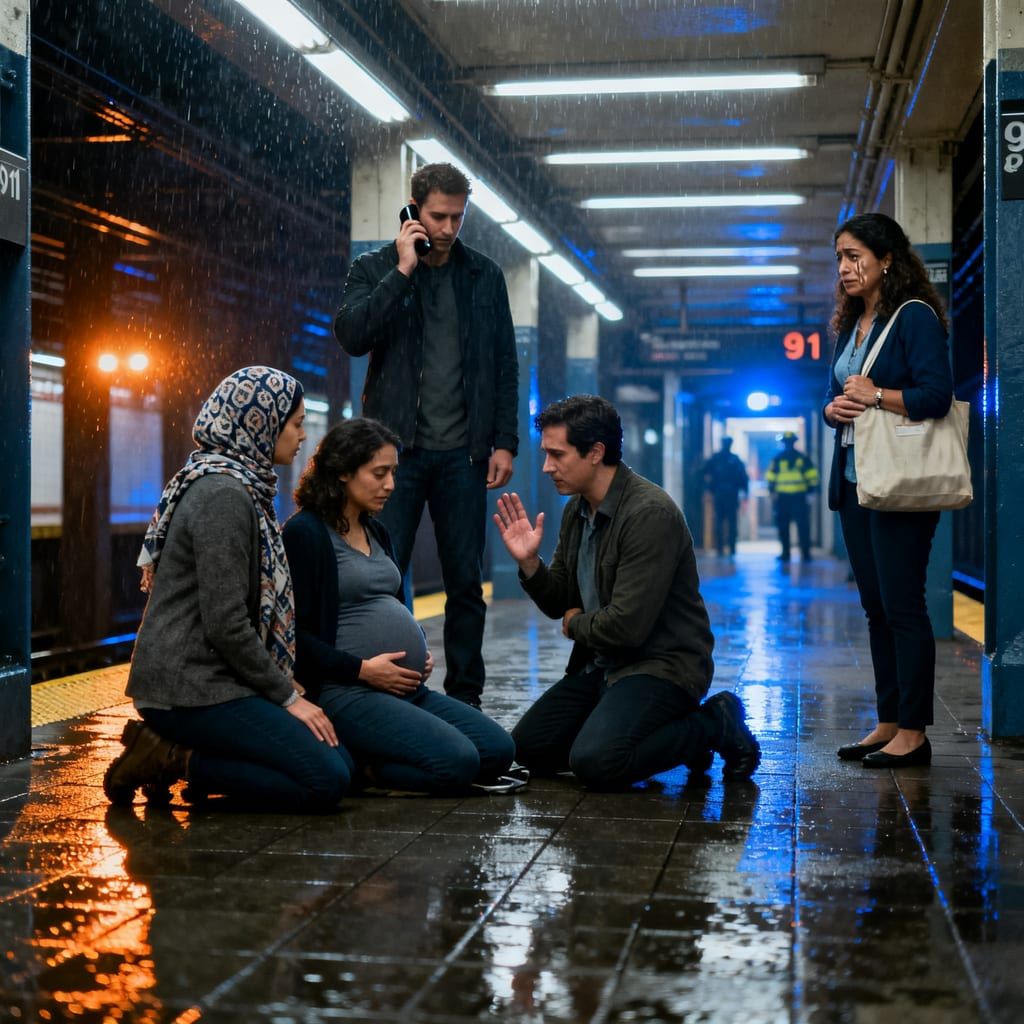
They descend into the station together, a small flotilla under leaking ceilings. The platform is a wet cave of echoes. People cluster, phones held like small lamps. The air smells metallic, like coins and wet wool.
A woman crumples ten steps down the platform. Her belly is round as a question. A sound leaves her throat that Lena has never heard, a torn piece of wind.
Someone shouts in Spanish. A man calls in Mandarin. English flickers and dies between them.
Panic multiplies in five languages.
Noor steps forward. She is shaking, Lena can see it-her scarf trembling at the edges. Noor kneels, her hand to the woman's shoulder. "What do you need?" she asks, slowly, in Arabic first, then English, then back again. Her voice is a thread she throws across the gap. "Breathe. With me. In. Out." She looks up, eyes clear. "Call. Ambulance. Now."
Ayo doesn't hesitate. He dials 911, voice flattening into a calm he didn't practice but somehow owns. "We are at Broad Street Station, downtown entrance," he says. "Pregnant woman, in pain. Breathing, yes. No bleeding I can see." He repeats questions into the circle Noor has made, lets the dispatcher's English pass through him and soften.
Mikel moves like a man who has been here before, or somewhere like it. He kneels by the woman's feet, palms open, not touching. "I count," he says, almost a whisper, then louder, for everyone. "We make rhythm. One-two, in. One-two, out." His voice becomes a metronome, a clock the sad night can trust.
Lena stands with her tote in her hand as if it could be useful. The words she knows-request forms and tag questions-go suddenly useless as wet matches. Her mouth opens. Closes. Say something, she orders herself. Find the word for fear that knocks and wants tea. Nothing.
Around them, the platform recalibrates. The circle tightens, then steadies. A stranger holds up a jacket as a screen. Another passes a bottle of water. The woman's breaths find Mikel's count. Noor's murmur threads through. Ayo shakes out his voice into the phone, a smooth ribbon, relief hiding in its grain.
The siren arrives like the end of a sentence. Blue coats. Hands practiced in catching. The platform exhales. The woman is lifted, carried, the circle opens and then dissolves.
They stand, wet and blinking, like people who have crossed a river without a bridge.
Back upstairs, the center's hallway is dark except for the EXIT glow. They return to the classroom because there is nowhere else to go, because the room is now a kind of harbor.
Lena lays out scrap paper, pens. Her fingers have stopped shaking. "Write one true sentence," she says. "One brave sentence. Something you have been afraid to say out loud."
No one asks for instructions. The rain drums soft on the window like a pencil against a desk.
Noor writes first: "I am tired of pretending I am only a seamstress." She reads it without apology. Her voice makes the syllables taller.
Ayo writes: "I deserve better pay." He laughs once, the laugh of a man who has just heard himself from a distance. "I do."
Mikel takes the longest time. When he looks up, his eyes are somewhere else and here both. "I was a journalist," he reads, each word a door. "I still am, even without my paper."
Lena stares at her page. The word mother blinks in her skull, bright and unbeautiful. She thinks of the ways she has hidden: Thanksgiving texts scheduled in the future then unsent; letters drafted and left in drafts. She thinks of the bathroom mirror where she has practiced small smiles and non-answers.
Her hand moves. She writes: "I want my life to be different." The period lands like a heel on pavement.
She reads it. The room does not change and somehow everything does.
A week later, the buses run on time and the air dries to the crispness of new paper. The whiteboard lists a fresh lesson: Phone Calls-Requests and Responses. Lena has slept for three nights without the tremor in her hand waking her.
They practice role-plays. "Hello, this is-" "May I speak with-" "I'm calling to ask-"
During break, Ayo takes his phone to the hallway. He comes back with his helmet swinging from two fingers, the grin quiet and radiant. "He said yes," he reports, disbelieving and steady. "More hours, more money. Same mouth, different words."
Noor asks for a brochure for the community college across the street. "I want child development," she says, smoothing the trifold paper the way she smooths cloth. "I thought maybe when I feel less scared. But maybe scared is... also a verb."
Mikel brings a notebook, the cover weathered, soft as leather. Inside, penciled columns of dates and headlines in Cyrillic, thin as winter light. He opens to a page where a sentence in Ukrainian runs between paragraphs like a river seam.
He hands the book to Lena. "Read," he says, gentle but insistent.
She traces the line with her eyes, hears him translate: "Courage is a daily verb."
Her chest lifts, a small astonished thing. The room hums around her-the radiator ticking, Noor's pen tapping, Ayo unwrapping candies from Noor's tin like medals.
That night, at her kitchen table, Lena opens her phone and dials the number she knows by the breath behind it. The city outside her window is a glittering paragraph. Somewhere, a siren crosses a sentence and keeps going.
Her mother answers as if pulled from a dream. "Hello?"
"Hi, Ma." Lena's voice comes out uneven, shoes on wrong feet. "It's me."
Silence stretches. A night train. Then, "Lena." A sigh, then a laugh that sounds like a wince. "I've been calling. I thought maybe-I don't know what I thought."
"I know." Lena stares at her own hands, the smallest scars like grammar marks. "I'm sorry I didn't pick up. I didn't know what to say."
Her mother makes a soft sound. "We don't have to know," she says. "We can... start. How's your... evening class?"
Lena tells her. Not the polished version. The flood and the sirens and the circle on a damp platform where language bent but did not break. She hears her mother breathe with her, a count she didn't know they could share. There are apologies without perfect tenses, stories with verbs falling out of place. It is messy and human and nothing like a worksheet.
When she hangs up, the room is not different and somehow everything is.
Two weeks later, Lena brings a new text to class: her application essay for a teaching fellowship. It is printed double-spaced, hopeful and flawed.
"I want you to help me," she says, and they grin, delighted by the swap of roles.
They circle phrases. Noor, decisive as ever, draws lines through adverbs that coddle. Ayo fixes the rhythm of a paragraph like he's tuning a motorcycle. Mikel hovers, reading not for error but for truth.
"You write 'I taught them English,'" he says, tapping the sentence. "But maybe you learned something." His mouth quirks.
Lena smiles. "I wrote another sentence," she admits, cheeks warm. "I wasn't sure if it was too-"
"Read," Noor says.
She does. "I learned how to speak by listening to the brave."
They look at one another. Nobody reaches for a pen. The sentence sits there, simple as bread.
"Leave," Mikel says softly. "Exactly as is."
On the last night before winter break, they bring food. Noor's cardamom cookies. Ayo's jollof in a foil pan steaming like a warm promise. Mikel's borscht in a thermos that leaks a little onto the desk, a magenta comet trailing.
They practice irregular verbs by telling stories slightly out of order. We waited. We were afraid. We helped. We learned. We are-
Lena caps her markers and slides the tote under the desk. Her phone buzzes once. A text: Call when you can, mija. No unknown number this time. She smiles. She will call after class. There is no perfect clause for this feeling, only the daily verb of it.
On the board, she writes one last prompt: Write a sentence you want to carry into next year.
The room rustles with pens. The radiator clicks a steady beat. Outside, rain begins again, softer this time, like someone tapping a window to be let in.
They read their lines. They sound like prayers that have learned to live without churches. They sound like trains starting in the dark and finding track.
When she turns out the lights, the whiteboard glows faintly with leftover chalk, the ghost of a sentence that stays at the edge of seeing. In the hum of the empty hall, Lena thinks of all the words English doesn't quite hold and how, somehow, they hold each other anyway.
She locks the door. She steps into the wet night. The city breathes. She breathes back.
A daughter learns to read between the lines of a life split in two
Read more →
A fog-draped night, two souls found, and the quiet shape of a life
Read more →
Story audiobooks for children of all ages — a new one every day on Smarter Way Stories.