Two Houses and One Quiet Heart
A daughter learns to read between the lines of a life split in two
Read more →
Elena Mora arrived at St. Brigid Medical Center with a box of brushes balanced on her hip and a smile she'd practiced in the bathroom mirror until it looked like hers. The door to the psychiatric wing stuck-a soft, reluctant click before it gave-and her breath fogged the smudged window in a brief cloud.
It was late autumn. The sky outside had folded in on itself, the color of unwashed bowls. She told herself she was here to fill two hours with color and scraps, to keep her hands busy until feeling returned like a limb waking up from sleep.
The art room was a former conference space with a permanent outline of a long-gone credenza etched into the carpet. A cart of paints. A coil of newspaper. Metal stools that complained when anyone sat.
"Welcome to Making a Mess," she said, lifting the lid off a tin of graphite like she was opening a pastry. "No grades, no masterpieces. Your hands know before your head." Her voice sounded exactly like the training video said it should.
Jonah sat nearest the window, all cheekbones and a hoodie with the string chewed to threads. Nineteen, wrists like saplings. He painted skylines the way a person clung to a railing-gripping, measured, eyes set on a horizon other people couldn't see.
Priya arrived ten minutes late, apologizing as if she'd broken into someone's house. Former accountant, a fact she repeated like a secret; she handled scissors with reverence, arranging blues by undertone, reds by temperament.
In the corner, Mr. Avery lowered himself carefully into a chair and folded his hands over his stomach, a man who had spent his life telling people where to find their vanishing points. Sixty-eight, retired art teacher, admitted on a Sunday after he told his daughter he could not remember how to want breakfast.
Elena tore glossy pages from magazines and handed them out like talismans. "Collage," she said. "Tear, don't cut. Let edges be what they are."
She didn't say: I haven't drawn anything that isn't a grocery list in a year. She didn't say her brother's name. Mateo was in her chest like a folded paper boat, edges softened, definitely there.
They made blind contours of their own hands. They wrapped clay into birds with wings too generous for their small bodies. Laughter surfaced-thin at first, skittering across the linoleum-and then stayed in the room like steam.
Mr. Avery didn't touch a brush for two weeks. He sat, a gentle landmass, and watched. "You can sketch without lifting your pencil," he told Jonah, and Jonah tried it-one haunted skyline unspooling in a single line that wobbled when his hand trembled and was somehow truer for it.
"For your left hand," Mr. Avery said to Priya, sliding a stick of vine charcoal toward her. "Let your right be the critic and your left be the child." Priya blew her hair from her eyes and followed the rule, breathing more heavily as blue smudges gathered on her knuckles.
Elena distributed projects that didn't need precision. She felt like a borrowed voice, an empty vessel passing around brushes worn down to familiar angles.
At the end of each class, she erased the day's notes from the whiteboard and wrote in neat block letters: "Leave one thing at the threshold."
They wrote: shame. The to-do list. Perfume samples in the elevator. Rainy Wednesdays. One day, in tidy script: Savior Syndrome.
Elena stood in front of the board longer than made sense. The dry-erase marker squeaked when she capped it. I hear you, she thought. I hear you hearing me.
The shipment came in a cardboard box that made her heart jackrabbit-labels like old friends, lids frosted with a fine dust of dried pigment. She cut through the packing tape and there it was: a squat jar of slate blue with the same manufacturer's swirl her brother had insisted made it superior. He used to call it ruin blue, ocean's underbelly blue, the kind that refused to be cheerful even in sunlight.
Her throat closed-no air, no language, only the visceral flinch of a wound remembering itself. She slid the jar behind the tempera like a guilty thing.
"Can I use that?" Jonah's voice came from over her shoulder, tentative but clear. He'd seen it anyway, the way a gull finds discarded bread.
She could have said, "Let's start with ultramarine," safe territory. Instead she nodded, pulled the slate blue forward, and set it down beside his tray. "Go easy," she said, and heard Mateo laugh in memory: Go hard or go home, Leni.
Jonah dipped his brush, hesitated, then drew the city with strokes that were at once tender and severe. As his skyline rose-bridges suspended like held breaths, windows like seed packets waiting for spring-Elena felt her lungs decide to be generous again. Inhale. Exhale. In time with his brush.
Mr. Avery watched her watching. Later, when the others had left and the room smelled of paste and coffee, he pressed a pencil into her left hand.
"Give grief the bad hand," he said. "Let the good one keep you steady."
She stared at the blankness. Her right palm opened and closed on instinct, useless and buzzing. She set the pencil to paper.
The first line stuttered. Then the second found it. She drew Mateo's paper boat-the motif he had tucked into margins, into birthday cards, into the steam of coffee cups. The boat came out crooked and too heavy, but it was a boat. She drew it again, hand loosening, ribs loosening.
"Again," Mr. Avery said, soft as weather.
The third one was simple and carried itself with an ease that made her eyes sting. Nothing dramatic. No revelation. Just a pencil making marks while a man in a cardigan kept time with his breathing.
By December, the board was a chorale of small abandonments. Perfectionism. The smell of my father's coat. Apologies I don't owe. Savior Syndrome appeared twice more in three different hands.
The room learned how to accompany itself. Priya's precise collages loosened at the edges, a sun bleeding into margin. Jonah began painting not only what he saw from his sixth-floor window but the roofs he imagined, gardens tucked two stories up where laundry lines pulsed like heart monitors.
Mr. Avery, who had once said nothing and then said everything, began to make small scenes in graphite-coffee cups deserted mid-conversation, a glove on a bus seat, a doorway half-open. He left them on the drying rack like raindrops, anonymous, and refused to take credit.
Elena wrote on the board one morning, impulsively: The belief I will be struck by lightning if I rest. She did not sign it. Mr. Avery looked at it as if it were a painting hung too high, nodded once, sat down.
The day he was discharged, snow threatened but did not arrive. Mr. Avery stood a little straighter, a new shirt with the crease down the sleeves still crisp, and held a manila envelope as if it were a casserole he didn't trust himself to carry.
"For you," he said, and then, like he couldn't help himself, added, "For all of us." He slid it into her hands.
Inside: a printed grant application, completed in tidy type. Project title: Thresholds. Language borrowed from her own notebook-the phrases she'd scribbled while pretending to take attendance translated into paragraphs about community and accompaniment and the small engineering miracle of putting color where there wasn't any.
He had secured a letter of support from the head nurse, whose hurried signature trailed off like a kite's tail. There were scrawled names under a section titled "Community Stakeholders," each one a weathered attempt at legibility. Jonah had dotted his J with a square. Priya had written in green pen.
"I only taught you what you already knew," Mr. Avery said, his smile a careful unwrapping.
Elena looked up. The room wobbled in her vision, then steadied. "You did this?"
"I typed," he said. "They witnessed. You gave me the title." He cleared his throat. "You-you should lead it. The courtyard wall means nothing alone."
She wanted to say, I'm not ready. She wanted to say, I've been waiting to feel ready for a year and it hasn't come. Instead she put the envelope back in its sleeve and held it to her chest like a life jacket.
Weeks later, an email arrived with a one-line sentence that loosened something she didn't know could be loosened: "We are pleased to fund Thresholds."
The courtyard at St. Brigid's was a brick rectangle with one brave ginkgo and a bench that only the smokers used. Winter pressed its face to the glass as they sketched in their coats, breath visible, gloves not ideal for fine work.
They primed the wall in a cold that made knuckles ache and jokes necessary. Priya brought thermoses of chai. Jonah scavenged a speaker and soft music threaded through the clank of ladders. Former patients returned, shoulders lifting when they rounded the corner and saw there was a place for them.
Elena taped the preliminary sketches to the brick. "No one owns this," she said. "We're making a place where seams are features."
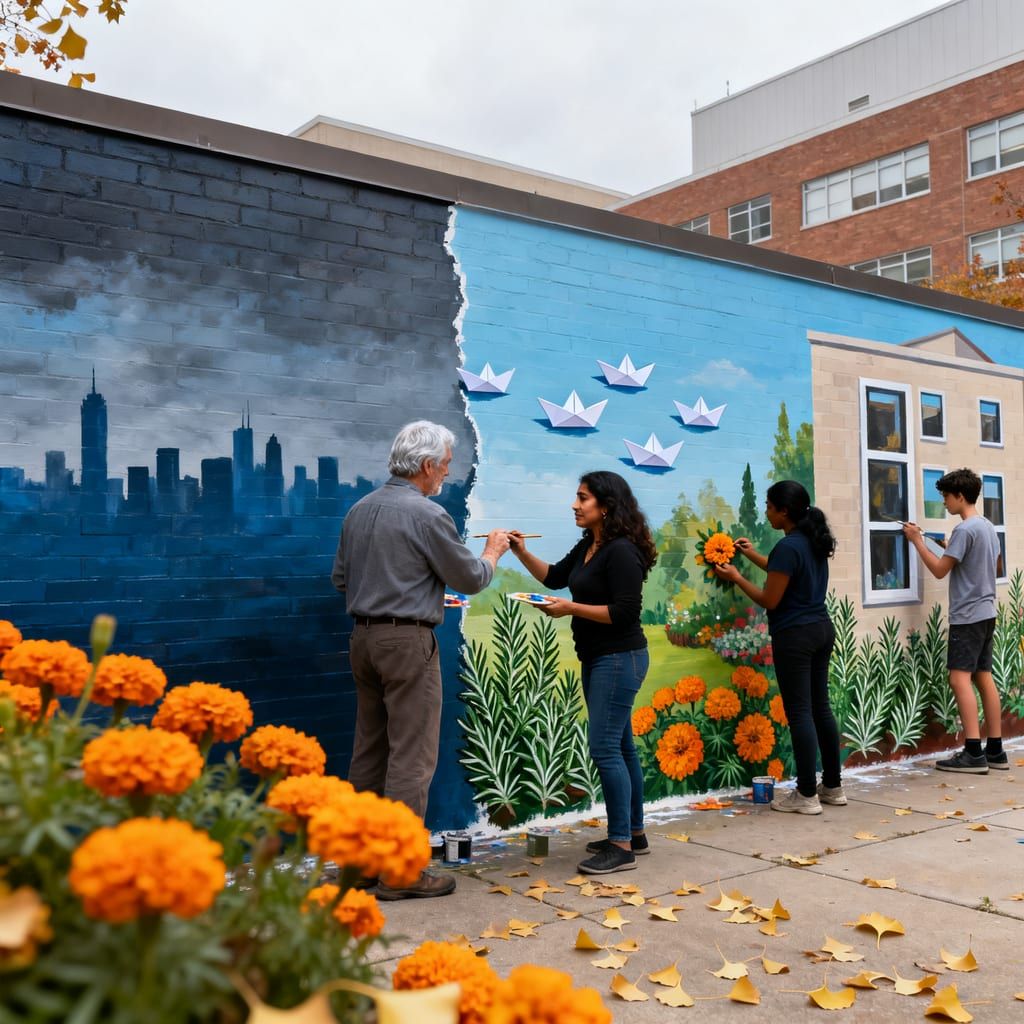
Jonah's skyline rose from the left, buildings like teeth and prayers, the slate blue making its necessary insistence. It faded at the edges into Priya's careful garden-marigolds and nasturtiums and a stubborn rosemary bush that insisted on wintering over-each petal a square torn from magazines, then rendered in paint into something alive.
Between them, a seam. Elena stood at the joint with a brush smaller than the others would have chosen. She dipped into the jar of ruin blue and lifted a shape she knew by heart: a paper boat. Then another. They drifted between city and garden like tiny emissaries of survival, carrying the weight of grocery lists and unsent messages on undramatic hulls.
People paused on their way to dialysis, to visiting hours, to the vending machine that ate dollar bills. A nurse who never came to the art room dabbed white into a cloud until it looked like something you could lie down on. A boy whose name Elena didn't know drew a set of stairs no one could see until he outlined the shadow.
"Your hands know," Mr. Avery said, passing her on his way to wash brushes. He worked slowly, steadfastly, like a person hauling rope hand over hand.
Elena looked at her own hands. The right one was steady. The left had learned to be braver than she had expected. The boats moved across the seam not as solution, not as cure, but as connection.
They unveiled the mural on a day the ginkgo cast a shadow shaped like a fan over the bench. Someone taped a paper sign to the wall that said THRESHOLDS in a font that misbehaved. The head nurse brought store-bought cookies. There weren't enough paper cups, which made sense in the way misses always did.
Elena stepped back until the brick blurred and then returned to focus. She saw how Jonah's nighttime lit Priya's dawn. How the boats threaded loss without explaining it. How the blank spaces mattered as much as the paint.
People applauded the way people clap in hospitals-careful, as if startling something might make it vanish.
When the applause thinned, Elena's chest did a small, private thing, like a bird choosing to land. Tears came-not the levee break she had dreaded, but a quiet overflow that did not threaten to drown her. The wet on her face felt like weather she could stand in.
She did not look for Mateo in the crowd. She did not tell herself a story about what could have been. She stood in the courtyard with Jonah and Priya and Mr. Avery and the others, and she let herself be a person holding a cup of bad coffee, watching a wall that had not existed before this moment exist because their hands had decided together that it should.
A drop of slate blue dried on her wrist. She didn't wipe it away.
Later, when the courtyard emptied and the ginkgo shivered, she wrote on a small card and taped it low on the corner brick where only a kneeling person would see: "Leave one thing at the threshold." She left it unsigned.
Walking back through the door that stuck and then gave, Elena felt the hinge in her chest do the same. Not fixed. Not whole. But opening, and opening again.
A daughter learns to read between the lines of a life split in two
Read more →
A fog-draped night, two souls found, and the quiet shape of a life
Read more →
Story audiobooks for children of all ages — a new one every day on Smarter Way Stories.