Two Houses and One Quiet Heart
A daughter learns to read between the lines of a life split in two
Read more →
On Tuesdays, the city smells like onions and heat-food trucks staking their corners, a SEPTA bus sighing to a stop, steam rising from a manhole like the street's own breath. Amara's sneakers tick a private metronome. She cuts left where she has never cut left. The asphalt is freckled with mica; light winks back like someone trying to get her attention.
She keeps a game no one else knows: a new route home, every day if she can manage it, to keep her mind from calcifying in spreadsheets and Slack threads. She maps small miracles in the margins of her thoughts. Mailboxes with dented hearts. A stoop where a grandmother shells peas into a blue plastic bowl. An alley that smells like oranges after rain.
Amara is thirty-four and good at being efficient. Her boss says it like a compliment and a caution: You get things done. She smiles, nods, spins decks until past midnight. But on the walk home she slows herself-counts brick patterns, catalogues the first cold twinge in the air like a rumor of winter. Somewhere a radio drifts out of a basement window and gives her Donna Summer. In a high window, a cat watches her with basil-green eyes.
She has been here long enough to know how to thread the grid of South Philly rowhouses, longer still to suspect that maps tell only one version of the truth. A place is also its faded murals, its borrowed porches, the chalk flowers that reappear after each rain.
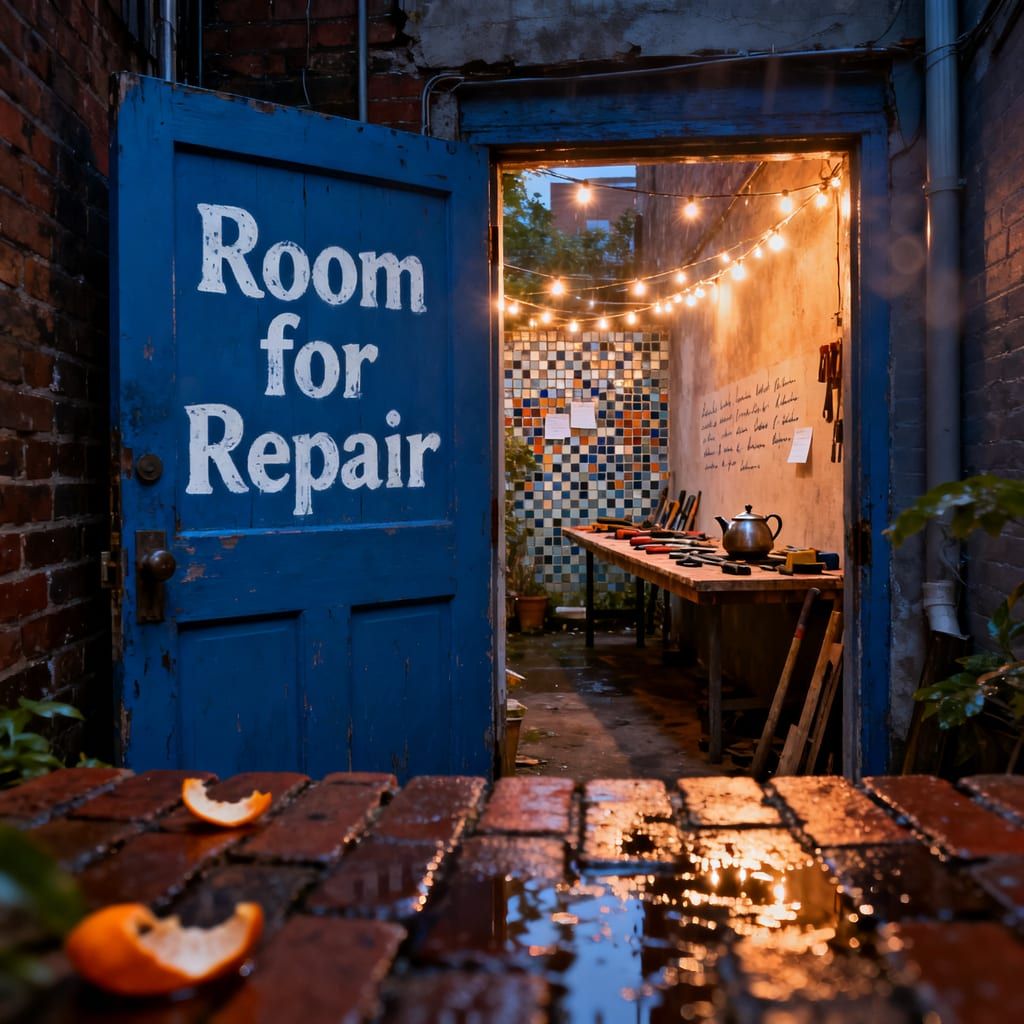
That evening, she follows a flicker of a cat's tail past a shuttered laundromat and into a narrow service walk that seems meant for deliveries and disappearances. The bricks are close enough to scuff her shoulders. A drip echoes somewhere. A door reveals itself last, the color of found sky-blue despite the grime, blue like it has decided to remain so.
Three words are stenciled in careful white: Room for Repair.
Her breath does that small, involuntary catch that arrives before delight.
The door sticks just enough to test her. Then it gives, and the smell hits her first: citrus oil, hot metal, black tea, the wetness of stones that never see full sun. A courtyard tucks itself between buildings as if it's always been there and also as if it might vanish if she blinks.
String lights swoop from window to window, warm as a low voice. A long table runs down the middle, its surface a geography of tools-needle-nosed pliers, darning mushrooms, bike-chain grease in a jelly jar. Next to a chipped teapot, a bowl of clementines glows like a pile of small suns. Against the far wall, a mosaic blooms: scraps of tile, bottle-green glass, and handwritten notes laminated against weather.
Lost: faith in people, one card reads in schoolteacher's cursive.
Found: a yellow mitten and an apology, says another.
There are others like snowflakes you have to catch: Missing: the name of that song my mother hummed. Misplaced: the reason I left the porch light on.
"First time?" The question is gravel with a chuckle attached.
A man steps from behind the long table, wiping his hands on a towel so threadbare it's turned to lace. He wears a flannel shirt softened by many laundries. His hair has retreated and then changed its mind; a stubborn grey curls over one ear. His eyes are a cartographer's: always oriented.
"I followed a cat," Amara says, then wonders if that is too odd to be a greeting.
"That's as good a compass as any," he replies. "I'm Whitaker. Mr. if you must. Tea?"
She nods, cups warming her fingers before the heat gets to her mouth. People are here-how did she miss them at first? A girl taping the spine of a book with ceremony. A delivery worker holding a backpack whose seams gape like wounds. A man with a toaster turned belly-up. A nurse with a hem pinned at her hip, her ID swinging against her sweater with each laugh.
"What do you do here?" Amara asks, though the answer is all around.
"We mend what's mendable," Mr. Whitaker says. "And sometimes what isn't, but only because naming it helps. Leave your pride at the blue door; bring your hands." His smile lifts like he's showing her a shortcut on a familiar block.
A hand-painted clock on the wall has no numbers. Where twelve would be, it reads: Open When You Need.
She returns three days later with a spool of strong thread and a cautious heart. First to watch, then to stitch. She learns to thread a needle without squinting. To patch a delivery worker's backpack where the strain always finds the same corner. To write labels for donated books in five languages, asking the boy with the tape how to spell the title in Vietnamese until his patience turns to pride.
She listens more than she talks. A cyclist tells the story of a hill that tried to throw him. Another woman has a toaster from her grandmother's rowhouse, refuses to let anything with that many breakfasts behind it go down without a fight.
Mr. Whitaker tells stories like the city whispering to itself. "We started this the year the storm took the lights out," he says, passing her a handful of washers like coins. "People brought candles, toolkits, the good scissors. Thought it'd be a one-off. But after the power clicked back, no one wanted to fold the tables. Some places survive by being found sideways." He winks, a crease long practiced under the eye.
Amara walks home a different way each night. She adds to her secret atlas. A graffiti tag that reads: call your aunt. A window where someone's grown cherry tomatoes in a shoe organizer. The smell of oranges after rain-she still can't source it, but it keeps showing up in the narrow places.
Weeks gather. Her inbox becomes a little less tyrant, a little more hamper. She finds herself saving stories the way she used to save screenshots: the nurse laughing when her hem sits right; the child solemnly stamping REPAIRED on loaner tools; a couple frowning over a tangled string of lights until their foreheads bump and they both start to grin.
The paper arrives like a slap, taped on a pole at the end of the service walk. It is bland on purpose, black type announcing a future no one here ordered: Proposed rezoning for mixed-use luxury residences. The letters are clean as a smile that doesn't reach the eyes.
Amara's stomach lifts and drops, a carnival ride without consent. Around her, heads tilt toward the notice and then toward the blue door, as if to ask: what is the opposite of luxury? What will happen to this strange small city inside the city?
"We don't have a website," the nurse says, worrying the edge of the paper. "We don't even have a menu."
"We have tea," says Mr. Whitaker, but his hands rest heavier on the back of a chair.
They come up with a plan the way storms come up with thunder. Letters first, written on mismatched stationery and backs of fliers. Hand-delivered to the council office two neighborhoods over. Then a repair marathon, every lamp and latch in a mile radius invited to the long table. Anyone who's ever been helped is welcome to show up and be counted, not in numbers but in hands.
Amara writes with a pen that blots when it's thinking. She speaks when needed, but more she organizes-the signup sheet that becomes a braid, the tea refills, the lost needles found mostly by standing at the right angle and letting the light flash at her.
She bumps, often, into a man in a clean coat with careful eyes, who asks questions that feel like reconnaissance and also like curiosity.
"Have you been here before?" she asks him once, not unkindly.
"Early," he says, after a beat. "Incognito." He smiles, and she can't tell which side of the line he stands on.
On the night of the hearing, the courtyard empties into bodies. Strangers queue outside the municipal building, then spill into the room where microphones sit like anxious birds. The agenda moves with that grinding inevitability known to all who have waited in fluorescent light for their turn to matter.
When their item appears, Mr. Whitaker steps up first. He clears his throat, which sounds like gravel deciding to be a stream. "I drew maps for this city," he begins. "Back when you could trust your pen to tell a straight road from a crooked one. I helped build the early digital version, too, when they thought the world would fit better on a screen."
He looks down at his hands. "And I left some things off." A murmur runs through the room-small, startled. He goes on. "Not lies. Kindnesses. A courtyard strung with warm lights and bad tea. A place the storm made and never quite unmade. If you can't search it, you have to earn it." He doesn't look toward Amara, but she feels as if a line has been drawn around her chair, soft chalk joining her to the others.
People speak. A cyclist tells the story of his chain, snapped on South Broad, the woman who knelt in her work dress and fixed it while traffic leaned on its horn. A street vendor talks about a translated sign that brought new customers, the woman who turned her Google into someone else's open door. A nurse shows a skirt hem stitched on a lunch break, how it made her stand a little taller through the double shift.
Amara steps up and says something too, though she had not planned to. "I started walking different ways home to keep from turning into a spreadsheet," she says, and there's a sad little laugh from a dozen throats. "I found a room that reminded me I have hands. I found neighbors without having to ask for their names. And I kept finding the city between all the streets."
The developer's representative takes the mic. Up close he looks familiar in the slippery way of dreams-his hair part obedient, his briefcase at his shoes like a tether. When he speaks, his voice is careful as if afraid to trip. "We have plans," he begins, and the room steels itself. "We also have ears." He looks up. He looks at Amara. There it is-the bridge in heavy wind, papers spilling like startled birds across the walkway. Her hands on his sleeve. The scramble of white rectangles on gray sky.
"You," he says, surprised into informality. "You caught my... life raft." He taps the briefcase with a rueful smile, and the room tenses, then softens by degrees. "I came early," he admits, voice low. "I wanted to understand what we'd be paving over."
He clears his throat. "The rezoning is paused." The word lands quiet as a card on felt. "We need to reconsider what we build on and what we build with."
It is not a victory parade. It is not permanent. It is, like most good things, a reprieve that must be tended.
After, in the courtyard, the string lights look steadier for having been threatened. The tea tastes better than it did in defiance. Someone hangs a new card on the mosaic: Found: the courage to ask for help. Someone else slips one beside it: Lost: my rush to be first.
Mr. Whitaker leans his elbows on the table like a ship coming to harbor. "You know," he says to Amara, "maps get updated. Streets renamed, routes rerouted. But there's always the bit they call metadata. The notes in the margins. The truths you don't see until you tilt the paper."
She thinks of the cat's tail like a semicolon, of the oranges after rain, of the bridge wind and her hand on a stranger's sleeve. She thinks of the handyman's laugh, the nurse's hem, the child's stamped REPAIRED like a blessing.
"Even if they build," she says, surprising herself with the calm in it, "this isn't just here." She spreads her hands to take in the table, the notes, the scuffed blue door. "It's the way somebody stops. The way somebody detours. The way somebody chooses to look twice."
Mr. Whitaker smiles like a man hearing a map hum. "Sideways," he says softly. "Always a way."
She still walks a different way home most nights, not to avoid sameness so much as to invite interruption. Past stoops and corner stores, past the mural where a saxophone spills indigo into the night. Her sneakers keep time. Sometimes, at a certain kind of intersection, the air will bloom briefly with oranges, and she will laugh out loud because of course it does-because some rooms only open when you need them, because some cities insist on being found between all the streets.
And when she passes a door painted the color of found sky, her hand finds the grain of it like a greeting she knows by heart, and the hinges answer back like an old friend clearing his throat.
A daughter learns to read between the lines of a life split in two
Read more →
A fog-draped night, two souls found, and the quiet shape of a life
Read more →
Story audiobooks for children of all ages — a new one every day on Smarter Way Stories.