The Reason the Records Stayed Silent
How a sealed birth became a quiet covenant
Read more →
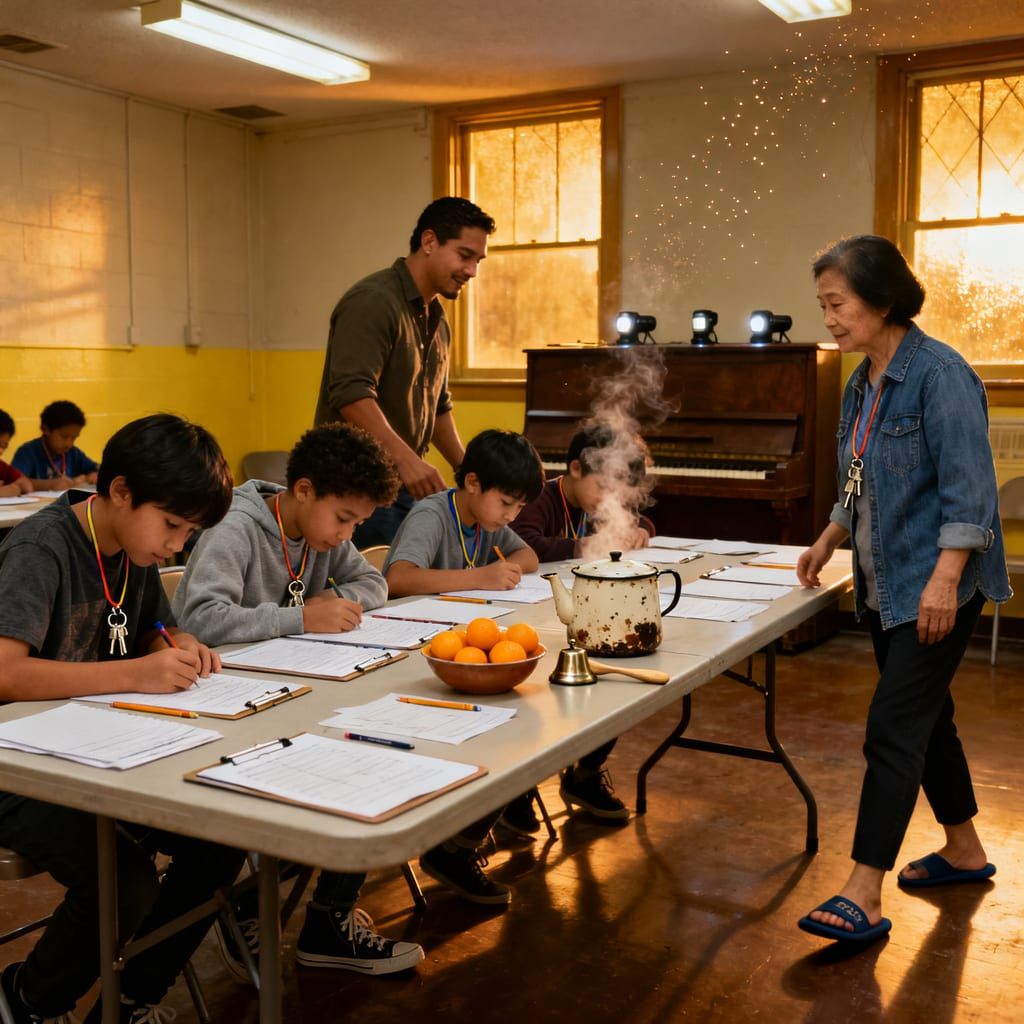
Rain made lace on the hallway light, thin and stubborn. Rafa stood with a damp grocery bag and watched the kids settle in where the paint bubbled and the bulb flickered like a tired eye. Keys hung on shoelaces around their necks-little tin medals, clinking when they shifted. Backpacks became pillows. Someone balanced math on a knee and lost the pen every few lines.
He remembered the tug of his own childhood key ring, the way metal meant you're on your own until the latch clicks again. Thirty-four and newly laid off from a design job that no one called back about, he was home in the middle of the day enough to notice a pattern: the hallway filled at four and thinned at seven, leaving candy wrappers and the ghost of homework undone.
On a drizzly Tuesday, he propped the laundry room door with a bottle of dish soap and laid out a paper towel banquet: granola bars, a bowl of clementines, his chipped kettle breathing cinnamon. A handwritten sign leaned against the rolling basket-Homework Club, 4-6 PM. Rules: snack first, homework second, then games.
He rang a wooden spoon on an aluminum measuring cup. The sound traveled like a hand extended.
They came because the Wi‑Fi was stronger near the breaker box. They returned because Rafa made a ritual out of the thin hours: question‑of‑the‑day index cards ("A sound you never forget?"), victory stickers for finishing a page, a bell at four that made the room feel like a universe with rules.
He drew a tiny whiteboard galaxy of tasks-Math, Reading, Science-and learned small constellations. Mei loved word problems, hated open‑ended anything. Luis needed the corner by the dryer's heat-a cocoon of hum-and the way to count without anyone watching. Nia asked for extra paper and drew a city of squares and windows, adding birds in the margins like they were late to someplace good.
He texted parents from his thrift‑store flip phone: Nia finished fractions; Luis needs new pencils; everybody tried the cinnamon tea. Replies ricocheted from kitchens and night shifts: thank u, god bless, be home by 6:30, you're an angel. He felt ridiculous and not at all. His palms warmed on the kettle handle. You can make a fence out of minutes, he thought. You can make a door.
Word spread the way steam does-soft at first, then everywhere. By the third week, a dozen kids leaned over worksheets beneath golden laundry bulbs. A neighbor paused on the stairs and left a bundle of pens. The deli owner slid in with a crate of bruised apples. A nurse mom arrived one Thursday and taught fractions with orange slices, the room perfumed with citrus and understanding.
The manager posted a notice on the bulletin board: Liability concerns. No gatherings in laundry room. The paper was crisp as a summons. The morning after, an envelope appeared under Rafa's door-anonymous complaint, typed neatly. He stood in his kitchen reading it while the kettle grew loud, then quiet.
That afternoon the club dissolved into the hallway. Kids balanced binders on their thighs; the light flickered; someone dropped a highlighter that slid to the stairwell and vanished. Rafa felt foolish, exposed, like a man who'd dared the rain to let up and been schooled by weather.
He taped the sign back up anyway, smaller this time, with a penciled question mark at the end. Homework Club, 4-6 PM?
He rang the bell softly, as if not to wake anyone, and the sound seemed to apologize for itself.
On the evening he was ready to say goodbye, Mrs. Lin from 3C pushed a plastic cart through the propped door. She wore her soft slippers and a cardigan tight at the wrists. A cat hair floated behind her like a flag of a tiny nation.
Clipboards. She had brought twenty clipboards, the old kind that bite. She set them down with authority and looked straight at him.
"I filed the complaint," she said, voice clean as glass. "It was too much. Noise, mess. And the laughter-" She paused, steadying a clipboard that had drifted. "Since my husband died, I cannot open the door. To that."
The dryers hummed, the bulb buzzed, someone sneezed at the end of the hall.
"But then it was quiet," she said, face softening by degrees. "Too quiet. I taught middle school thirty years. I know this-what you are doing. It is better to be afraid of noise than of silence."
Rafa felt his neck heat. Shame, relief, gratitude, something nameless that made him want to sit on the rolling basket and let his knees give.
"You lead," she said, with a nod like she was assigning homework. "I will cover your blind spots." From the cart she produced a folder, the kind with brass brads. "My church will let us use a basement room. Tables. Insurance. A piano that works on good days. Two blocks. Sign here."
He laughed-an astonished, boyish thing-and the sound hung in the linted air. "Mrs. Lin," he said, but she was already inventing a sign‑out sheet.
They migrated like a tiny parade, carrying the whiteboard like a banner. Keys clinked on shoelaces, sneakers squeaked. The church basement smelled like lemon oil and old hymnals. Sunlight came in on a diagonal and made dust sit up and show its shape.
Mrs. Lin pinned a volunteer schedule to the fridge with a magnet shaped like a whale. A teenager from 2A took Tuesdays. The deli owner claimed Wednesdays with bagels. A retired nurse wrote her name in tidy loops on Thursdays, brought a blood pressure cuff "just in case," and stayed to clap for spelling tests.
Rafa made a wall for tiny triumphs: crooked construction‑paper stars labeled with small victories. "Miguel read three pages without guessing." "Mei asked for help the first time." "Nia's birds learned perspective." He rang the bell at four, and Mrs. Lin beat him to it at 4:01 if he forgot.
On a medical form where a blank had always mocked him-Emergency contact-he wrote Homework Club. The letters looked too round, like they might roll away, but they held.
When his mother had surgery upstate, he left for a week. Anxiety gnawed. He sent no instructions. He returned to find a ladder of casseroles on his stoop-tinfoil shining like lake water-and a jar labeled Bus Fund half full of singles and quarters. Inside the basement, the rituals had kept their shape without him. The bell rang at four on the dot in Mrs. Lin's small, ironclad hand.
"You are late," she said, which meant everything was okay.
January scraped the sky raw. A storm shook loose the power and the room exhaled into darkness. The kids huddled by the piano with flashlights making cones of certainty out of air. Somewhere upstairs, someone played a radio a beat too loud, as if to stitch the block together.
They spelled words against the wall with their hands-dog, home, tomorrow-laughing when shadows stacked like mistakes. Breaths made little clouds. Mrs. Lin produced scarves from her bag, her widow's version of a cape.
When it grew late and a boy's father texted that he'd been detained at work, the room edged from noisy to tender. The boy's face flickered in flashlight beams, older suddenly.
Mrs. Lin sat on the piano bench and patted the space beside her. "Word problems," she announced to the room, and they groaned in chorus, a warm animal. "Listen." She tapped the wood with a knuckle. "Find what you know. Then ask a better question."
She said it like a teacher but also like a person who had learned this at a hospital bedside and a DMV and a funeral home. The boy nodded as if she'd handed him a coat.
Rafa watched the shape of the room-the cluster by the piano, the circle of light growing and shrinking with breath. He could feel the architecture of it in his bones, not the church basement or the rewired outlets but the way their minutes laid on top of one another until they were heavy enough to anchor.
By spring the windows unlatched easily and light landed longer on the tables. Homework still slouched into the room in backpacks, but it no longer slid off knees. They had corners for quiet, a table for noise, a ritual for the last five minutes when everyone shared one thing they got wrong and how they got through it.
The keys still hung on shoelaces, shiny from all the touching. But the orbit after school had shifted. Neighbors came to sit awhile, to show a life hack or a card trick. Someone tuned the piano and on good days it made a sound that felt like a window opening.
One Friday, Luis taped a tiny star under the bell: "For Rafa-asked for help." He blushed when Rafa saw, which only made the star brighter. Mrs. Lin hummed all afternoon, a private melody.
On evenings when the light thinned and dusk behaved itself like the start of something, they showed up without announcement. They rang the bell and the room answered. Rafa still felt the old pull of the key on his palm sometimes, the shadow of alone. But it didn't have the same weight. The door he'd wanted back then existed now, in lemon oil and clipboards and a wooden spoon against a bell.
He'd learned the systems quietly: set out the clementines, label the pens, text the parents, ask a better question. Keep the kettle on. Leave the sign simple.
On a day made of rain and small coats, a new kid appeared on the steps, her key big as a locket. She hovered at the edge. Rafa looked up from a mess of permission slips and met her eyes.
"Snack first," he said, lifting the bowl toward her. "Homework second. Then games."
She paused, listening for something she could trust. The bell rang at four. She crossed the space between them like it was always meant to be crossed, and placed her key on the table while she reached for a granola bar.
Outside, twilight pressed in at the windows. Inside, the room enlarged to fit them all. No one said what it was. They just showed up, every day at dusk, the bell ringing them into a home they were making, one ordinary square of time at a time.
Story audiobooks for children of all ages — a new one every day on Smarter Way Stories.