The Weight We Hold Together
In the soft hours before dawn, staying becomes its own kind of rescue
Read more →
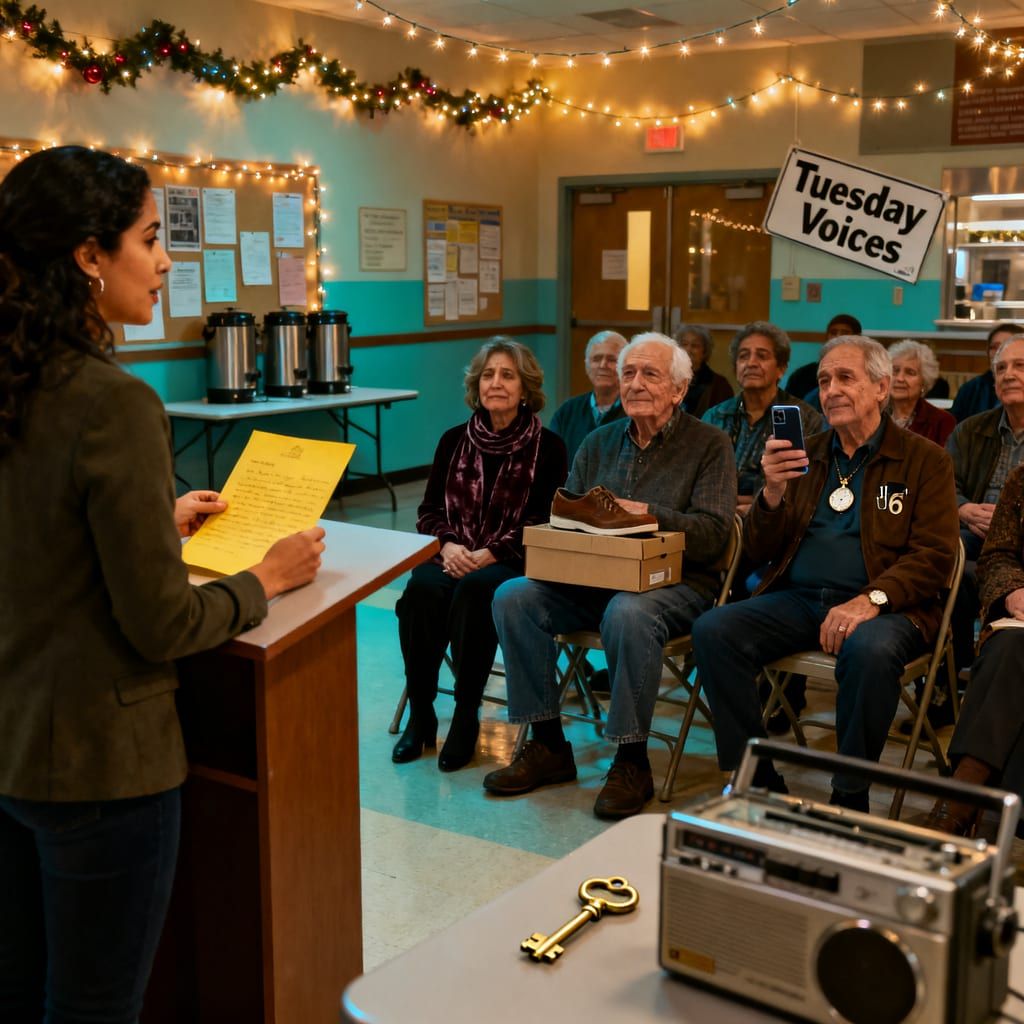
On Tuesdays the cafeteria smells like old coffee and library paste, and the folding chairs squeak as if they remember more than anyone else.
Lena sets out a circle of them, blue tape on the linoleum to mark the distance that makes conversation easy. She tests the mic she never ends up using and sets her recorder by the dented sugar caddy. The sign on the door-Tuesday Voices-hangs crooked, ferrying in a half-dozen faces that have begun to feel like family.
Ruthie comes first, velvet scarf wrapped twice despite the heat. "I brought a seam ripper for your soul," she tells Lena, then laughs, a sound like thread snapping.
Arthur arrives with a pocket watch he checks against the bus schedule. He times his sentences; Lena times his smiles.
Joy rolls in from the library with a phone clutched tight, font at 200% so her words march like parade banners. Mr. Kim, former math teacher, carries a thermos and speaks like chalk-precise, soft dust.
And then a new man slips in, eighty-something and stooped, hands cupped around a scuffed shoebox as if it were water in a drought. A brass key glows in his palm. He rubs it with his thumb the way people rub worry stones, the way people rub at names on headstones.
"Sal," he says when Lena asks. "I don't have stories. I have things that stayed."
"That's a story," Lena says, and the room leans forward a little.
She tapes a neon card to the whiteboard: Write about something you can't throw away.
They read. Ruthie's memory spills a river of hems and hymns-her mother's thimble, the ache behind a needle's eye. Arthur reads about a subway conductor's whistle tucked in a sock drawer, the way time sounds different when you hold it in your fist. Joy types a litany of screenshots she can't delete because they feel like proof she was somewhere, with someone.
Sal opens the shoebox. Receipts, all stacked and bound with a rubber band that has cracked and re-knitted itself a dozen times. New York receipts age to the color of tea; these have gone sepia with resolve.
"I don't write," he says, but he reads-names of diners, a locksmith, a florist, clean as beads on a string. Then, almost an accident, a fragment: "Eddie said if you put your ear to the city, you can hear the part meant for you."
Lena feels the room inhale. She hits record without looking.
He rubs the key. "There's a locker," he says, "Grand Central. I paid cash for the rental before they took them all away. This was eighty-seven. Eddie put... well. I couldn't keep the promise. My legs hate stairs. I don't know if it's even there."
"Write it down," Lena says, gentle. "Or dictate. We'll catch it."
After class, she scans Ruthie's faded photograph of a teenage hand on a Singer machine. She digitizes Arthur's pencil margins like cartographer's notes, Joy's dictated voice notes clipped with laughter. She moves like a small dam holding back a river, labeling, tucking, backing up, breathing with the hum of the outlet where her portable drive drinks power. The red light glows.
Outside, a heat lightning flickers. Somewhere, a storm changes its mind.
By morning, the basement smells like penny metal and pond water. The storm pushed the gutters to their knees, sent a bronze tide through the storage room and across the outlets like a hand wiping a table clean.
Lena squats in the half-light. The hard drive is warm, the cord slick. She plugs it in and feels that tiny electric hope in her stomach before the screen offers nothing at all. The files-the scanned snapshots of hands and faces, the line breaks and breath-are gone.
She sits on the bottom step, forehead on her knees, and hates herself for not having a second backup, for the cheap outlet strip, for every penny-pinched decision that was also a prayer.
When they arrive, she tells them. Her voice shakes, then steadies the way a ladder does when someone stands on it.
"I lost it," she says. "All of it. I'm so sorry."
Ruthie takes her hand in both of hers, thumbs like thimbles. "Honey," she says, "we wrote them. They're not gone."
Arthur looks to the clock and then to Lena. "We can make the 10:15," he says. "Leave the station late, we'll still arrive."
Joy scrolls furiously, font vast. "I email drafts to myself-old habit. Look." She holds up the bright parade: subject lines like breadcrumbs.
Mr. Kim clears his throat. "I, uh, copied two of Sal's paragraphs by hand. Practice. Read them before bed." He blushes. "I liked the way they sounded."
"Read them now," Lena says, and he does, voice chalk-steady, summoning the words like a spell. Eddie's name lands on the table like a cup of warm water.
They rebuild. Ruthie remembers Arthur's ending better than he does; he listens as if to a timetable from a different year. Joy finds a draft attachment, then another; she and Lena print and staple, paper steaming ink. Mr. Kim recites. The room writes and rewrites, a hive. The hum feels like forgiveness.
Sal arrives late, hair combed and re-combed. He carries the key wrapped in a diner napkin.
"I need a good knee," he says, sheepish. "And a friend who won't ask for the whole story first."
"I'm both," Lena says. She looks around the circle. "Anyone else up for stairs?"
Ruthie taps her cane. "I can hold a railing and a secret," she says.
"Grand Central," Arthur says, already calculating the escalators.
They go.
Grand Central's ceiling makes you lean back like a pilgrim. Stars painted turquoise, gold constellations that survived cigarettes and cranes and a hundred thousand glances that didn't quite look up.
Sal does not look up. He looks at the napkin and the key resting like an old tooth in his palm. Lena walks a half-step behind, as if catching would help if a memory tripped.
They find the corner of the lower level that time forgot-a bank of lockers that somehow escaped a policy change, grandfathered into a nook by sheer stubborn presence. A station agent with an old-timer's badge nods like he's seen ghost hunts before.
Sal's hand shakes. "I paid cash," he says, as if accounting might redeem a delay of decades. He fits the key. There is resistance-a tiny, prideful old machine refusing to be hurried-then a click like a throat clearing.
Inside, an envelope box, institutional brown. Under it, a folded paper with an embossed seal-deed copy, not an original, to a small property on the other side of the borough. A name Lena doesn't recognize at first.
Sal inhales, the sound private and enormous.
He doesn't reach for the deed. He reaches for the letters. Twelve, one for each month of a year Lena was two and living above a bodega that sold milk in glass.
They do not read there. They carry the box like a candle cupped against a wind.
They string Christmas lights across the cafeteria because that's what they have, because it makes the room feel like a backyard late in August when people don't want to go home yet. Donors appear, neighbors with Tupperware, great-nieces of regulars, a man who once took a Tuesday off and never came back until now.
Lena opens with the truth. "A storm came and took our archive," she says. "And then you gave it back to each other." She tells them about Mr. Kim's chalk memory, Joy's inbox ropes, Ruthie's seam-straight recall, Arthur's timetables finding new stations.
She holds up the key, the napkin now smoothed and folded with intention. "Sal brought this," she says. "He asked if I'd read one letter." She looks at him. He nods.
Lena reads.
The letter is ordinary and luminous the way ordinary things are. Eddie writes about a hat he bought on a day he felt unlike himself, a wide brim against a glare that hadn't let up in months. He writes about the subway and how no one looks up anymore-not just at the ceiling but at each other-and how that makes it easier and lonelier to be brave. He writes: I can't promise forever because time has been funny with us, but I can promise to be brave in the ways that count. I will look up. I will carry what you can't, and when you can, you can carry me.
The room listens. Someone coughs, someone laughs quietly at a line about a pretzel vendor who swears too poetically to be real. Lena's voice braids itself with paper and breath.
When she's done, there's that full second-the kind that means applause is a confession of relief-and then the clapping comes, fast and grateful.
The center director steps forward in shoes that squeak honesty. "An anonymous gift has arrived," she says, voice shaking. "It will repair our building, waterproof the basement, and fully fund Tuesday Voices for the next five years." She holds up a check the way people hold up a newborn.
Lena feels her chest loosen like a knot finally asked nicely.
After the cake, after the last chair is folded and the tape peeled off the linoleum like quiet thunder, she finds Sal by the bulletin board, fingers on a flyer for beginner salsa.
"I didn't read all the letters," he says without prompting. "Some are only for hands." He looks at his palms. "But enough."
She nods. "Thank you."
He shakes his head. "No. You proved it. You all remembered me before I even said my name." He takes a paper from his jacket-a photocopy from the locker. Lena sees it now: the LLC on the center's lease, the signature she'd skimmed a hundred times. Salvatore A. DiPietro, the quiet landlord behind an initial and a P.O. box.
"You-" she starts.
He shrugs, a small wave cresting. "I wanted to see if the place still deserved to exist. People don't always. Places don't always. But this one-" He gestures to the room, the lights gone off one strand at a time. "It listened back."
Lena presses his hand. The key between their skin warms.
That night, Lena sits at her kitchen table between a plant that insists on thriving and a pile of receipts she hasn't organized since tax season. She opens a new archive not unlike the old one but sturdier in ways that matter-two backups and a cloud, yes, and also a page for recreations, for the stories that were carried across by other mouths and not lost in translation but translated into something communal.
She scans the first letter with its careful loops, uploads audio from the reading where you can hear someone stirring coffee and the scrape of a chair and right before the applause, a small hum from Ruthie like an amen.
At the top of the page, she adds a line, a tagline that feels like a stitch taken and held: We keep each other alive by carrying each other's stories.
She saves. The red light on the new drive blinks once as if clearing its throat to sing.
Outside, the storm has spent itself. The streets shine like fresh coins. Somewhere, a locker door closes on air and is content.
On Tuesday, they'll come again-Ruthie with her scarf, Arthur with his watch, Joy with her banner-words, Mr. Kim with his chalk voice, Sal with a napkin folded down to a square-and Lena will set out the chairs and listen for what stays.
The sign on the door still hangs crooked. She leaves it that way. People see it and find their way in.
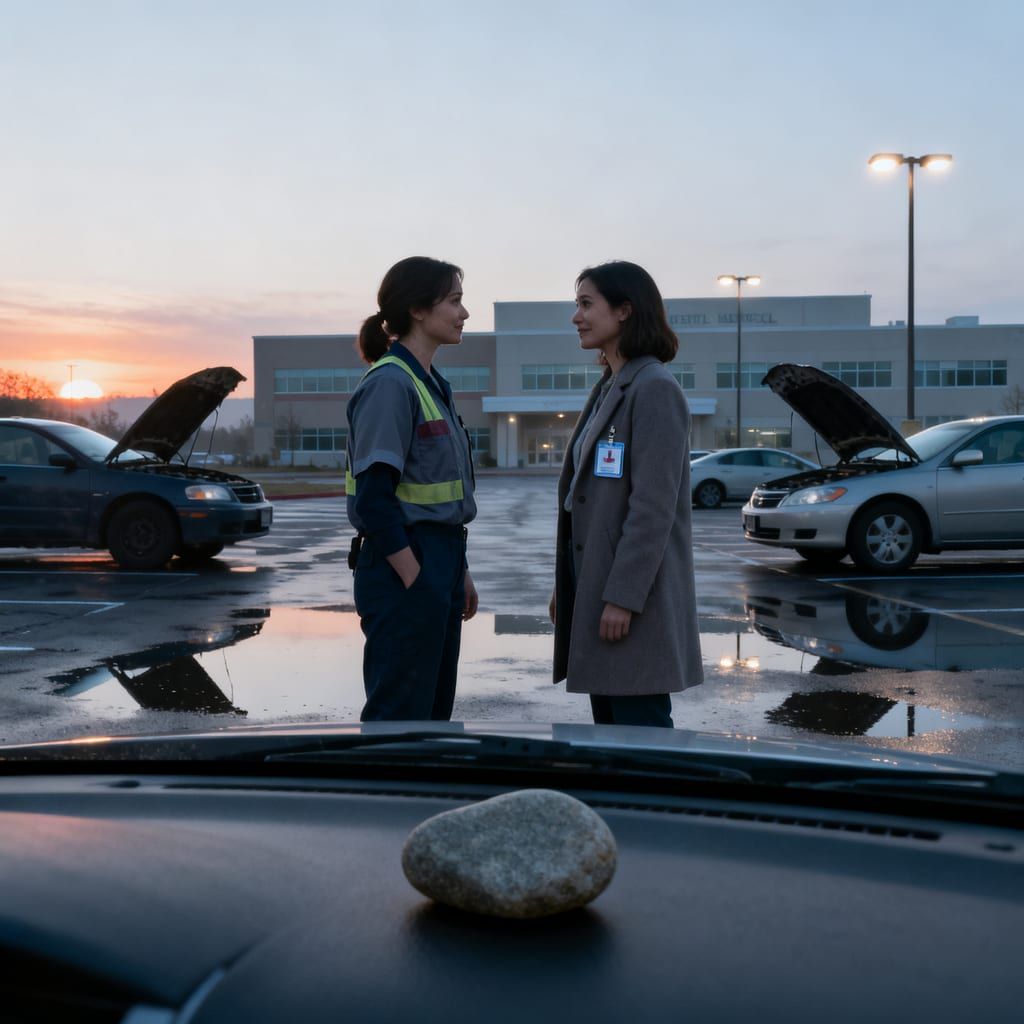
In the soft hours before dawn, staying becomes its own kind of rescue
Read more →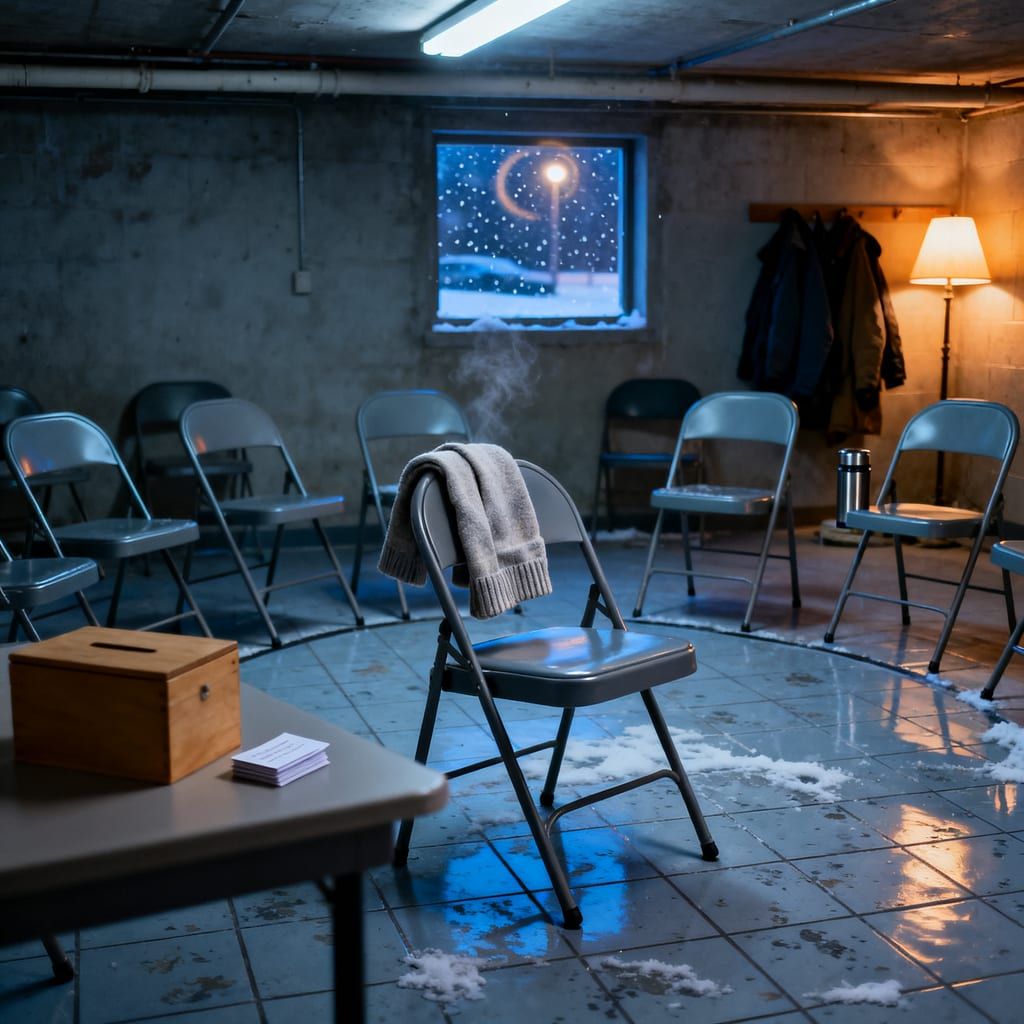
Story audiobooks for children of all ages — a new one every day on Smarter Way Stories.