Golden Hour, and the Hidden Heart
In the minutes that matter, a life you never meet is waiting.
Read more →
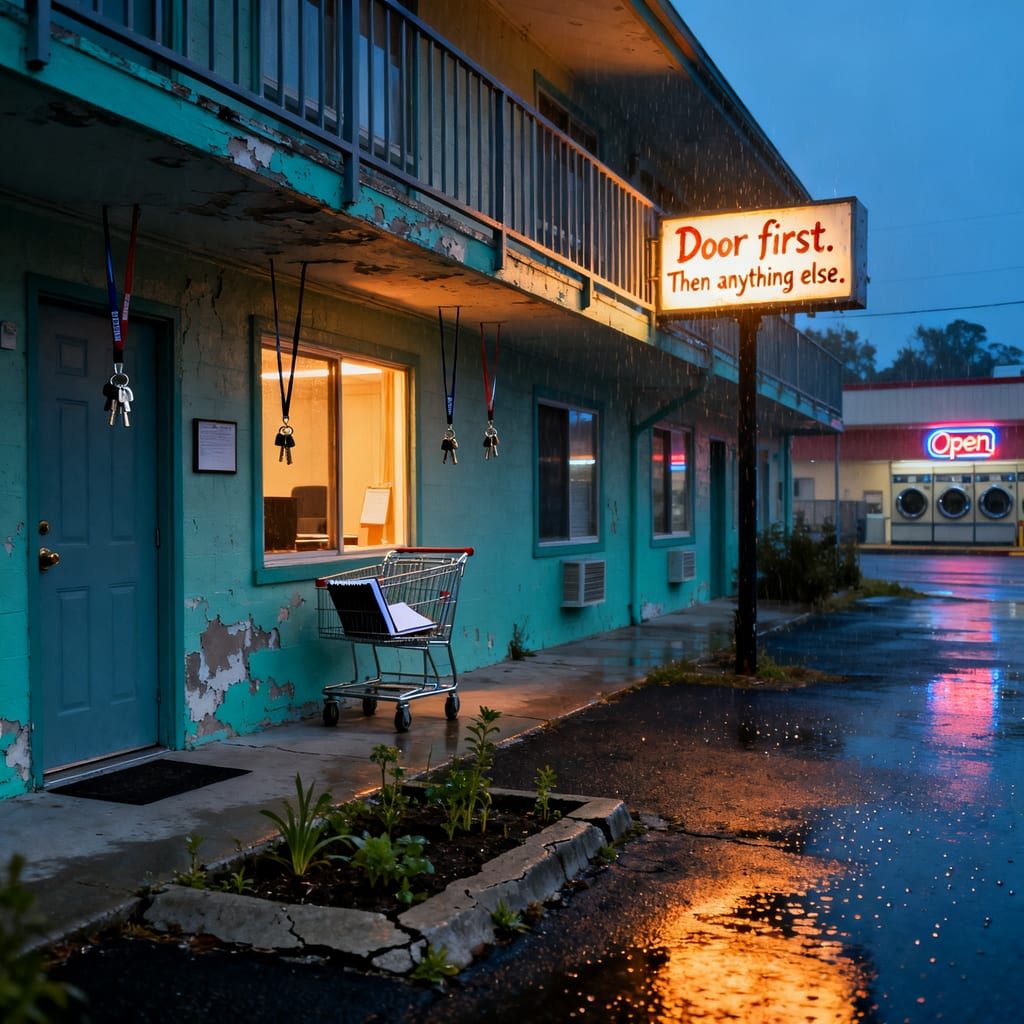
On the day the motel changed its name without changing its peeling paint, Imani pinned a hand-painted sign to the office door with blue painter's tape.
Door first. Then anything else.
The wind picked at the edges. Traffic hissed by on wet pavement. She stood back and stared at the words she'd written in her kitchen at two in the morning, the brushes drying in a coffee mug. The sign looked smaller here, against the long, low building that had once promised color TV! and king beds! to men with briefcases and unquiet hearts.
Her phone buzzed-another colleague's text: You're doing it out of order. Assessment, compliance, then maybe a mattress. She thumbed the screen dark and slid the phone into her back pocket.
She fished a ring of mismatched keys from her bag and felt the weight in her palm, cool and familiar as breath on a winter morning.
The first to come was a man with a dented pickup and a case of motor oil lined up like proud soldiers behind his seat. He introduced himself as Nate, though later the mail that began to arrive would be addressed to Nathaniel Arthur Ruiz, the first three names he claimed as though they were tools he might finally get to use.
"Any paperwork?" he asked, tentative.
"Photo of you," Imani said, "and a room number. That's it." She lifted the small Polaroid camera-one she'd bought on impulse at a yard sale-and waited for the soft whine, the click. "Safety for everyone. Keys before questions."
Nate blinked at the phrase like it was in a language he'd once spoken. "I can fix the squeaky sign," he offered, nodding toward the Vacancy/Vacancy light that was stuck in a perpetual half-truth.
"Later," she said. "First-"
"Door," he finished, and the word landed carefully between them.
That afternoon, a woman pushed a shopping cart filled with spiral notebooks and an electric kettle, hair clipped up with a pen. "I'm Lark," she said. "I sleep better when the fridge hums."
"So do fridges," Imani said, unlocking Room 3.
A mother and daughter arrived near dusk, the girl's backpack patched with constellation stickers. "Selena. That's Ava," the woman said. She looked like the word couch had become a verb that had worn her thin.
"You can put your names on your mailbox," Imani told them. "Sharpie's here."
A tall man in a hoodie stopped at the edge of the lot, hands in pockets. Sirens wailed blocks away, and he flinched before he could steady his face. "Darius," he said, voice gravelly. "Medic, once."
"Still," Imani said, offering Room 8.
By evening, the building sounded different. Not loud-nothing like celebration-but heavier in a good way. Showers hissed. A kettle chattered. Somewhere a cartoon theme song leaked through a thin wall, sweet and tinny as a childhood through-line.
The neighbors came with their eyes narrowed and their petitions already half-creased.
"This block has had enough," said a man in a baseball cap who'd lived across the street long enough to know which seasons buckled which asphalt.
"We're not a shelter," Imani said. "We're a motel." She let the word do its crossing work.
In the mornings she took breakfast to the rooms in a crate: hard-boiled eggs, toast triangles, oranges she'd bought wholesale and polished to make them look like something a person deserved. She knocked and waited, stood two feet back so no one had to choose between pride and hunger.
The small victories piled quiet as laundry. Nate ate at a table, not a steering wheel. Lark slept from 3 to 7 a.m. two nights in a row and wept about it privately, then turned up at the front desk with her hair combed and a question about whether she could sort the mail.
Selena and Ava argued about hot water like they'd always had enough of it-"You can't stand there forever," Selena would call, and the way she snapped the towel seemed like relief.
Darius tore up a rectangle of cracked asphalt with a shovel borrowed from the garden store that had once refused him a handout. He tucked beans under the dirt with a medic's care, as if coaxing a pulse to surface.
At City Hall, where she'd spent a decade navigating permits like prayers, her former coworkers pulled her aside. "Imani, there's a process," one said, lowering her voice as though the City's eyes were walls with ears. "Assessment, then compliance, then maybe-" She let the sentence deflate, unwilling to say bed in a hallway.
"The sequence is a story we tell ourselves," Imani said. "Sometimes the story is wrong."
The relapse rattled the block like a dropped pan. A young man who'd drifted in with Lark one evening, not staying, just orbiting, went cold and blue outside the ice machine. Someone screamed. Sirens-of course-grew teeth and tore across the street.
Darius moved before thought, a practiced choreography. "Naloxone," he barked.
Imani ran to the office, hands stupid with the small keyed lockbox. She jammed the code, then her thumb, then finally the box yielded. Darius worked in the crack between seconds. The man gasped, a wet fish sound, and the light took him back.
The next day, petitions bloomed on doorways like an unpleasant vine. Words like "loitering" and "liability" and "not zoned" sprouted thorns.
Imani didn't evict anyone. She bought outdoor lighting and installed it herself in a cold sweat on a ladder that wobbled like a foal. She stocked more naloxone and taped a how-to card above it. She found a night nurse willing to come for two hours a shift, cash, no questions, a woman named Miss Alma who had hands like forgiveness.
When she checked her dwindling savings account, there was a deposit she didn't recognize. The memo field read: For mornings.
"Anonymous, huh," Lark said when Imani showed her. "Maybe luck can keep a secret." She organized the lobby into a front desk without being asked-clipboards, a jar for spare change, a bowl for keys that weren't in use. "I can do the camera," she said. "You hate pointing it at people."
Nate took a screwdriver to the motel's many shrugged shoulders. He oiled hinges like he owed the world an apology and wanted to say it right.
At dawn, folded linens began appearing on the steps in stacks tied with twine. No note. Just the weight and the smell of soap.
The letter from the City sounded like someone had scraped the kindness out of a paragraph and left it to dry. Zoning violations. Provisional order to cease operations pending review. A hearing in thirty days.
Imani read it twice, then again, and thought of every code she'd ever memorized like a psalm. She pinched the bridge of her nose and went to Room 12 because it had the best afternoon light and because the carpet there didn't yet smell like other people's bad nights.
"We can go," Selena said quietly when the news bled through the building. "We'll survive. We always do."
"No," Ava said, chin lifting. "We live here."
On the morning of the hearing, the residents came as themselves, pressed and imperfect. No one had speeches. They wore their keys on strings around their necks, heavy as accomplishments. When they shifted, they clinked-small bells, a minor hymn.
The board members looked down a long dais and over a long nose. "Ms. Reyes, we need metrics," one said. "Outcomes. You know the drill."
Imani opened her folder. Inside, charts multiplied like guilt. She closed it again.
"Room 12," she said instead, and heard Lark inhale behind her, a surprised comma of sound.
"I was sixteen," Imani said, "and my mother was pretending not to cry. We had three trash bags and a television that wouldn't turn on without pliers. Someone paid for three nights here, at this very place, under this same slanted roof." She felt her voice steady, an old pier holding. "We slept. It was the first thing we did. No one asked for our story first. The door opened. That was the mercy."
She could have told them about mailboxes with names, about garden beans curling green fists into July, about a grocery stocker who fixed things until the motel squeaked less and he did too. She could have recited. Instead she watched the board's pens stop moving.
"Thank you," the chair said, not meaning We're done, but meaning something softer.
That night the sky went slate and then black, and the air pressed a hot palm over the city's mouth. Wind took the sign down and flung it into the parking lot where it skittered like a small animal looking for cover. The lights snapped off, and the motel exhaled all at once.
Water worked its way along old seams and announced itself in the office with a sudden, indelicate splash. Imani waded shin-deep in a decade of neglect, cursed in a tone she would have blushed to hear in daylight, and climbed onto the desk to reach the ceiling crawl space where she'd seen the plaster sag.
Her hand found metal: a small lockbox, rust like freckles across its lid. She worked the clasp with a butter knife. The box gave in a soft, exhausted way.
Inside, wrapped in a hand towel, was a letter addressed in a neat, looping hand.
To the woman who once slept in Room 12.
She knew before she opened it that it was for her. She read it by the double light of a camping lantern and lightning.
I knew your name when I saw the deed, the letter began. I am the man who owned this place when you and your mother came in like weather-fast, unexpected. Someone paid for your room. I did not do much, only kept the door open and the coffee hot. But I saw your mother sleep like a person who had been holding a building up with her back. When the county put the auction notice in the paper, I hoped whoever bought this would remember how a door felt when it opened. If it is you-and I think it is, because life has a sense of humor that isn't cruel-then consider this a receipt paid forward.
She pressed her palm flat over the page as if it might make the past steadier.
When the storm passed, the motel smelled like wet pennies and pine cleaner. The next morning, the linen stacks doubled, as if the wind had carried news.
At the reconvened hearing, the boardroom felt less like a courtroom and more like a place where people were temporarily keeping their coats on.
"I have your metrics," Imani said wryly, placing the rusted lockbox on the table. "But I brought something else." She told them about the letter, about the way a stranger had once made a door swing forward and not ask for anything back.
In the back of the room, the laundromat owner-who had never waved, just nodded-cleared his throat. He was a short man with a neck like a tree ring, solid and quiet. "For mornings," he said, raising his hand. "That was me." His voice made no performance of it. "I watched the late nights. I wanted to try the other part of the day."
The chair leaned back, and the fluorescent lights did their best to hum less cruelly. "We can offer a provisional variance," she said finally, as if the decision had been practicing in her mouth. "One year. Regular check-ins."
Lark smiled like a pocket secret. Nate closed his hand around his key. Selena put an arm around Ava, who was already drawing a garden on the edge of the agenda with a borrowed pen.
The beans sprouted and then failed in August heat. Darius shrugged and planted fall greens that lived like they meant it. Neighbors came with cuttings: spider plants that never learned to quit, rosemary that climbed fences, a jade plant in a chipped mug that fattened itself on neglect and then, flatteringly, on care.
The petitions thinned. Complaints turned into calls with actual questions: Do you need rakes? Can my kid get service hours sorting the pantry? The grocery store sent over day-old bread on Tuesdays and, tentatively, donuts on Fridays.
Miss Alma taught Ava how to take a blood pressure cuff without pinching skin. Lark handled the front desk like a conductor, clocking in with a flourish of pens and a quiet hello to everyone's name. Nate replaced the Vacancy light's innards so it could finally choose a side.
On a Sunday, Imani rehung the original hand-painted sign. The blue tape was gone; she framed it in weatherproof plastic and mounted it with screws. Door first. Then anything else.
She thought of her mother's hands-always tapping receipts into a neat stack, always making less look like more-and of the motel owner's letter, the way the word receipt had swung back and become, for once, not about debt but about proof.
That evening, a late summer rain started, the kind that soaked you gentle and did not apologize for it. The motel lights held. Someone laughed behind a door, a brief bark that spilled into something softer. A kettle hummed. The garden leaves silvered and then went green again.
Imani locked the office and walked the balcony to Room 12, pausing the way you do at a door you know by heart even when you have no reason to knock. She set her palm against it-wood, paint, a line of grain like a map. The feeling rose, not memory exactly, but muscle learning to unclench.
Keys first, she thought, and felt the rest of the sentence open up-as if the answers, patient and sly, were already turning toward the light.

In the minutes that matter, a life you never meet is waiting.
Read more →
A blue bench, a bell, and a stranger who cared enough to finish a sentence
Read more →
Story audiobooks for children of all ages — a new one every day on Smarter Way Stories.