Castling Behind Barbed Wire
A quiet move beneath fluorescent lights
Read more →
Before the city wakes, Nia opens the ledger. Its pages smell faintly of ledger paper and eucalyptus-the oil she rubs into her wrists when the nights run long. She writes in a clean, slanting hand: candles, phone calls, songs. Promises kept hold better than prayers, she's learned; they make small rooms feel steadier.
She checks the column she's added this winter-notes about light, about how people like it to arrive. "Dawn," she's written for Inez Rocha. "Blue hour. Window east."
A paper transfer ticket waits beneath the clip. She found it in a thrift store bin, edges frayed, city crest ghosted with a decade of fingers. She stamps the date with a quiet, satisfying click. Ink bleeds midnight into the rectangle: proof of passage, the old way.
Inez, at the hospice, insists on sitting up to work the crossword despite the clear tubes that loop her like delicate earrings. Her hair is cropped silver, neat. When Nia enters, Inez peels her eyes from 12-Down. "Finally," she says. "Someone who knows the difference between sympathy and a good pen."
".05 rollerball," Nia says, laying one on the blanket. "Black." Inez hums approval and taps the grid.
"Five-letter word for 'homeward path,'" she says.
"Route," Nia answers, because there are days honesty matters more than suspense.
When Nia asks, as she always does at the end of their first week, "What haven't you done that feels like yourself?" Inez doesn't hesitate. "My last run," she says. "Route 14. Dawn. Windows down, if the heater can take it." She glances at Nia like she's asked for a miracle and a bagel.
Nia smiles. "I've never-" She stops, because it sounds like refusal. "I'll see what can be done."
In her car after, she texts the name she'd circled twice: a transit supervisor with a reputation for rules. The call rings through with the flat hum of fluorescent-lit offices. She explains the hospice, the driver with the failing heart, the last ride, dawn light. The supervisor sighs the way people do when life asks them to be different from how they're paid to be.
"Insurance," he says. "Policy."
"Community," Nia counters. "Remembering who we are." She keeps her voice like winter water-clear, not cold.
She persuades him with details: early Sunday, no passengers, one loop, a driver who volunteers. She offers to sign forms that make the pen feel heavier in her hand. When he wavers, she tells him about the paper transfer she's stamped. The small absurdity cracks something. He chuckles, then coughs it away. "You didn't hear it from me," he says, "but Hector's on nights. He's soft for legends."
At midnight two days later, in a depot that smells like old coffee and rubber, Hector opens a roll-up door with a rumble that seems to raise the moon. "My aunt knew Inez," he says. "Called her 'the saint of the strollers.'" He pulls a bus with a sigh into the bay and pats its flank. "She's yours at first light."
Between those nights and the morning, Nia choreographs tenderness.
She books the window bed so east leaks in rose. She requests the white blanket that photographs clean, the one volunteers knit from a pattern that looks like waves. She coaches Inez and her daughter, Paulina, through their nearness like she's guiding a dance.
In the family room, they pour café de olla into a thermos that once traveled to softball games and parent-teacher nights. Cinnamon blooms in the steam; orange peel ghosts the air. They open the tin of photos and pull out Inez in uniform, cap angled just so, a bus full of schoolkids behind her making rabbit ears. "You were strict," Paulina says, half a laugh, half a memory's ache.
"Schedules keep days from falling apart," Inez says, and then, softer, "But so does waiting when someone is slow. I learned that after your father left."
They draft a list of names to call with tenderness: the neighbor who always shoveled Inez's steps before dawn, the dispatcher with a soft spot she pretended to hide, the woman from the bakery who once tucked a warm concha into Inez's hands at the end of a frozen shift. Nia writes each name like a bead on a thread, a litany of the living.
The morning arrives thin and blue. Breath ghosts in the depot. Hector stands by the bus doors, cap low, a travel mug steaming. Nia wheels Inez up the ramp; the chair clicks like a metronome.
"You brought me the Cadillac," Inez says, running her fingers along the cold rail. She leans toward the driver's seat. "I could parallel park this better than anyone in the West District, you know."
"So they say," Hector grins. He flips a switch. The doors hiss closed with the intimacy of a whisper.
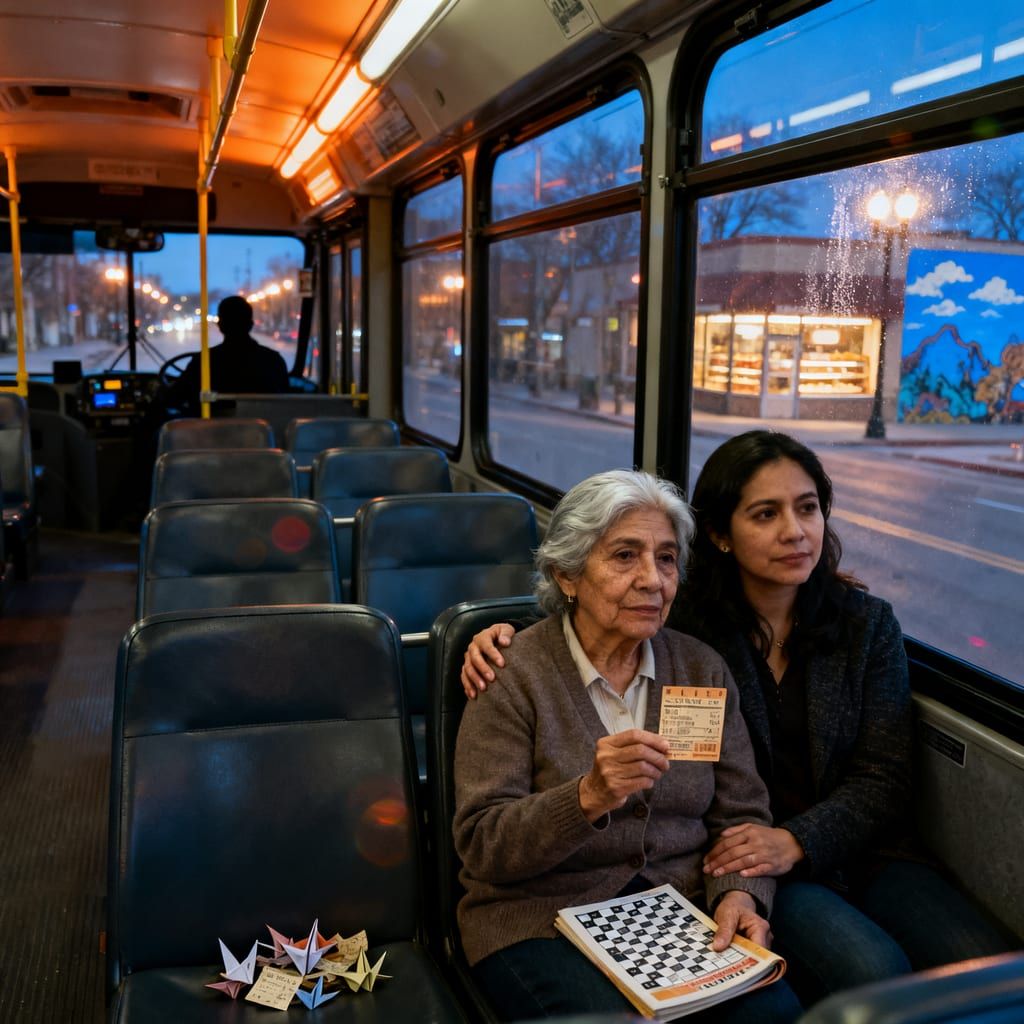
Nia presses the paper transfer into Inez's palm. The old rectangle disappears inside those knuckled fingers like magic. "Just in case they still check," Inez says, and the grin brightens the bus.
They roll into the street while the world is still half underwater. Frost feathers the curb. The heater coughs to life, filling the bus with dry warmth and the scent of metal. They take the route like a rosary-stop by stop, bead by bead.
At Mitchell and Third, the bakery windows glow. A woman in a flour-dusted apron comes out, cheeks pink, carrying a paper bag. She climbs aboard shyly, offers a sweet bread wrapped in a napkin. "For the driver," she says, eyes slick. "You told me once to raise my prices. I did, and I got to keep the lights on."
At Harbor and Eight, they slow by the mural-sky painted an impossible blue, the kind of blue that insists you look up. "They let us choose the colors," Inez says. "It was between that blue and a safer one. I argued until the foreman said, 'Fine, Rocha, dye the whole sky, but you're painting it.'" Her laugh is a pocketknife, sharp and fond. "So I did."
At the community center, a cluster waits with paper cups of coffee, breath rising like pale banners. One by one they step into the aisle. A man pressed into a suit too narrow hands over a paper crane folded from a bus schedule. A mother offers a faded ticket stub with numbers rubbed thin. A woman with a cane says thank you for the afternoon Inez waited while she buckled her toddler, shame burning her cheeks, and Inez waved away the horn of an impatient sedan with a queenly flick.
Nia watches the offerings stack on the empty seat behind them, a pile of small currency that feels like wealth.
Midroute, winter light turns buttery, soft as the inside of a roll. The city, mostly asleep, reveals the shape of its bones-lamp posts, porches, wires strung like low constellations. Nia moves to sit across from Inez. Her own breath steadies in time with the bus engine's hum.
"Once," Inez says, gaze on the window where her reflection blurs into sky, "I found a little girl at Central Transfer. She was crying like she was trying not to make sound. The kind of crying that hurts your teeth."
Nia stills.
"I pulled over. Called dispatch. The kid couldn't remember a phone number or a street, just that her mother's coat was yellow and had a missing button. We sat. I had peanut-butter crackers. We ate them slowly so it felt like a plan. When the mom came-" Inez shakes her head, a smile in it. "I can still hear that sound. Relief has a sound, you know?"
The bus keeps its own counsel, a steady thrum. Nia's hands find each other in her lap, twine.
"Yellow coat," she says, the words like a door she's nudged open a hundred times without noticing the knob. "Missing button. Central Transfer."
"'95, maybe '96," Inez murmurs. "Kid had a birthmark like a comma by her ear-"
Nia lifts her hair without thinking. The small brown mark, a whisper of punctuation.
Inez leans forward, knuckles shining. "No," she says, and then, delight flooding her tired face, "Well, look at that."
Air sluices out of Nia like a window rolled all the way down. She's back on a plastic seat with her legs sticking out, the itch of wool tights, the square taste of crackers, the way a stranger made the world into a holding place instead of a hole.
"I've wondered about you," Inez says. "Not always, not in a sad way. Just when the bus was quiet and the stops were coming true and the sky did that thing it does over Harbor. I'd wonder if you learned to like buses again."
"I..." Nia swallows against the sudden, warm ache. "I did. I like arrivals best. And the waiting. And the sitting. I make a life out of it."
Inez laughs, a softness that fills the aisle. "Of course you do."
The loop closes. The depot yawns open like a mouth; sun has found the top edges of the garage doors and set them to a low flame. Hector parks with precision born of repetition and love.
Inez fishes in the cardigan pocket that's all softness and tissue. She pulls out two quarters, their edges worn moon-thin. She slides them into the fare box. They clatter like an old song.
"You don't have to-" Hector begins.
"I do," Inez says, not unkind. "You pay respect."
She turns to Nia, the transfer tucked again into her palm. "My job," she says, "wasn't just getting people from here to there. It was keeping the days stitched together. One stop at a time."
Nia nods. Her throat feels like it's holding a small bird.
Back at the hospice, Nia angles the bed east. She draws the shade just enough to make a square of light on the blanket. She does not play the cello playlist she keeps for those who loved elegies. Instead, she presses play on a recording of bus engines idling, accelerations soft as a cat's purr, the high whirr of doors and the click-tick of turn signals-metronomes of public life.
Inez smiles without opening her eyes. "That's the song," she whispers.
When her breath shortens, Nia rests her hand on the back of Inez's, over the transfer, over the blue veins like rivers on a map. Paulina sits on the other side, thumb marking a page of the crossword, unsolved boxes like windows waiting for names. They do not rush. The room smells faintly of cinnamon oil and the ghost of diesel that has followed them back like a faithful dog.
When Inez goes, it is the way she hoped: with light moving across her coverlet as if calling last stop, with machines in the hall doing their quiet work, with a tiny square of paper warming under her palm.
Later, Nia stands in the tiny kitchen off the ward and washes the thermos. She watches the water sheet shiny over metal, the way it breaks and reforms. Hector has left a message saying the supervisor asked after her, asked whether it all went all right, and whether maybe the city might want to organize a program for last rides. Nia smiles at the thought of a policy that makes room for mercy.
She returns to her office, to the ledger. The page for Inez holds a neat list of everything Nia promised and checked off, each task its own stop. She turns the paper. On the clean side, in the column for "Next," she writes slowly. Only one sentence:
Make soft space for the living in every ending.
She closes the book and listens. Somewhere, a bus turns a corner-an exhale, a small effort, a continuation. Nia feels the gentle recalibration that comes when a long loop closes and reveals a map you didn't know you were drawing.
She bends, slips the stamped transfer into the ledger's pocket. It makes a brief, papery sigh, like relief.
Outside, the day ices into its ordinary brightness. A woman in a yellow coat walks past the hospice with a child who will take a bus someday and cry, perhaps, or perhaps not. Nia imagines a driver whose patient hands, whose waiting breath, will make the city feel like a place you can arrive in.
She picks up her coat, the one with the missing button she's never bothered to fix. She smiles at the omission. Not all things need mending. Some only need time and the kindness of a steady route home.

Story audiobooks for children of all ages — a new one every day on Smarter Way Stories.