Two Houses and One Quiet Heart
A daughter learns to read between the lines of a life split in two
Read more →
The cardboard sign had a hopeful tilt-GARAGE SALE in blue marker, arrow veering toward a driveway that shone like a river under the ten a.m. sun. Jonah slowed without meaning to. Saturday held its own list: a crib to assemble, a client call to dodge, strawberries to rinse and slice. Still, his hands were already turning the wheel.
He told himself it was habit. He told himself he was killing time before he was expected to become the kind of man who knew how to hang curtains straight. He parked behind a minivan spilling soccer balls and stepped into the heat, air sweet with cut grass and coffee gone cool.
On a folding table, mugs with slogans sat beside a neat row of paperbacks. A toddler dragged a purple sled over asphalt. An older woman with a wide-brimmed hat and a braid like a gray rope called out good morning, her voice clipped and warm at once.
He wandered past lamps and coats that still held the shape of their owners. Then he saw the crate. Faded stuffed animals slumped together, their fur worn to velvet, their seams surrendering. His breath thinned the way it did when you pass a corner and smell your grandmother's detergent: a story opening its eyes.
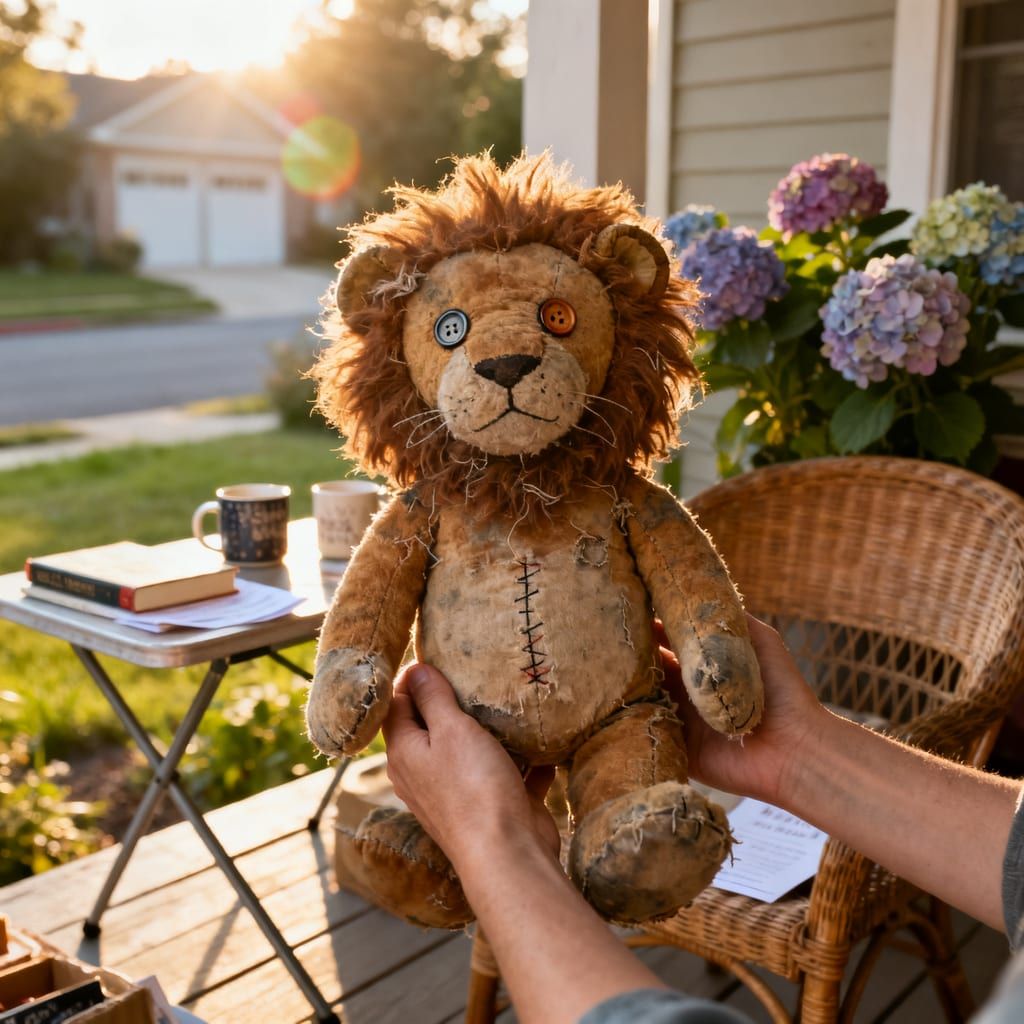
Half-buried was a lion with mismatched button eyes-one brown, one black-and a belly seam that swerved slightly left, a drunk little stitch along a pale patch of fur.
The seam was wrong like a memory is wrong, and because of that, it was right.
Jonah sank to his haunches, fingers hovering. He had watched that seam take shape by dome light, his mother's needle flashing as if it could teach the dark how to behave. He had counted the pricks-one, two, three-and learned then that mending sometimes looked crooked when you were doing it in the front seat of a Buick with everything you owned packed around your knees.
He picked up the lion. The fur stuck to his palms with old dust and the faintest smell of eucalyptus, or maybe that was just the past pretending to have a scent. His hands were shaking before he knew why.
"Dollar," the woman said gently. "Takes courage to pick the one with the funny belly."
He looked up. She was studying his face, not the toy.
"It can't be," he said, unsure whether he was speaking to her or the morning. "I lost him a long time ago."
She nudged a camp chair toward him with her foot. "You look like you've just recognized a ghost," she said. "Sit. I've got coffee on the porch. Easy porch, not the kind that asks questions unless you want it to."
The porch was cool in shade, boards smooth from a hundred summers. A chipped pitcher sweated on a table between two wicker chairs. A pair of wind chimes tinkled on a breath of wind that came and went like a thought.
"I'm Ruth," she said, pouring coffee into mismatched mugs. "Cream?"
"Black is fine," Jonah said, then added, "I'm Jonah." He set the lion on his knee, thumb finding the old crooked ridge like it was a worry stone under fur. "My mom sewed this. Or one that looks just-" He stopped. The words felt like wet parcels he had to carry carefully.
"People say that about faces," Ruth said. "Toys too, I suppose. There are only so many ways to stitch a home into something soft." She leaned back. "My husband ran the community center on Maple. Years ago now. We had bins of donations-coats, books, a toaster with a mind of its own. There was a box for toys. They came and went. Came back again. Like birds."
"Like this?" He held the lion. The button eyes met his, one eager, one resigned.
"I remember that one," Ruth said, nodding at the belly. "That seam. My boy, Micah, he laughed at it. Said it looked like the lion ate his courage sideways." She smiled without shining. "He used to keep it under his arm when the IV went in."
Jonah felt the world tilt, an elevator starting. "Your son-"
"Was funny even when he was afraid," she said simply. "He was good at bringing the sharp things down where they could be looked at. That toy came to us in a box with a note once, then disappeared, then found its way back with different stickers on its mane. It was always showing up when someone small needed a story to hold." She took a sip. "That's how I think of it. Some stories carry you, and some you carry. The best do both."
Jonah stared past the hydrangeas toward the street. A kid on a scooter skittered past, ankle bells jangling. Somewhere a dog barked at the postal truck as if the mail could be frightened away. His chest ached the way it did when he ran too hard and too fast without water.
"I'm going to be a dad," he said, surprising himself as much as her. "In April. I was just... looking for something small to put on a shelf. I didn't expect-" He swallowed. "We slept in our car once. More than once. I had this lion and then we moved and then-" He made a gesture with his free hand, a scatter of leaves.
Ruth watched him the way you watch a tide come in. "Well," she said softly, "maybe it wasn't lost so much as put to work."
He left with the lion and a slip of paper with Ruth's number. The car was an oven, the steering wheel scalding. He drove with the window down, letting the wind slap his forearm, his heart still somewhere on the wicker chair.
At home, he filled the sink with warm water and a capful of detergent that smelled like rain had an appointment. He swirled the lion gently, the bathwater greying. Sunscreen had left faint fingerprints on the eyelid seams; he brushed them clean. He thought of his mother's hands, chapped from dishwashing at the diner, the bandage on her thumb that week. He remembered her breath on his hair when the Buick fogged over, how she'd hum under her teeth, a melody that didn't ask him to join it.
As he blotted the mane with a towel, he felt it: a tuft that didn't sit right. A stitch tucked too far back, not in the belly but hidden in the mane like a secret.
He hesitated, throat tightening. Then he found the thimble in the junk drawer-why did he even have a thimble?-and worked the needle through the knot. The thread gave like a sigh. He eased the seam open with care until the mane parted enough to free a curled scrap of fabric, soft as old hope.
The writing was faded, blue ink blurred in places, but his mother's hand leaned a certain way on the y. He knew it immediately the way you know your own laugh in a crowded room.
For the next brave kid-this lion knows your name.
The date in the corner was the year the eviction notice had bloomed like mold under their door. Below the line, other hands had added first names over time, each in different inks and angles. Maya. Hector. Rae. A tiny heart beside Eli. Down near the bottom, neat and careful: Micah-Ruth's boy, with a small sun sketched to the right, its rays hardly more than eyelashes.
Jonah's hands found the counter. He brought the note up to his nose as if it might smell like the diner's coffee, like fries and bleach and his mother's cardigan. A laugh burst out of him, startled and wet, then folded into a sound he'd never made before.
He wiped his face and smoothed the fabric against the counter. One more space waited at the bottom like an open palm.
The porch was still shaded when he went back. Ruth looked up, then down at the way he was holding the lion and the scrap, and then up again. Her eyes softened along the edges.
"You found it," she said, not as a question.
Jonah handed her the fabric. "She wrote this," he said, his voice wobbling and catching like a porch swing with a rusty chain. "She-she meant to let it go." He exhaled. "She wasn't forgetful. She wasn't careless. She-" He searched for the word. "She was generous."
Ruth's thumb pressed the edge of the fabric, over the tiny sun. "Micah drew that. Said if he couldn't eat, the lion should eat the light for him." Her smile was gentle and ferocious. "He kept it through the worst days. Then one morning he told me, 'I outgrew scary. Not the bad stuff, Mom. Just the way it crawls under your bed.' And he asked me to put the lion back in the box. Make sure it kept moving."
The wind chimes let out a thin music. The neighbor's sprinkler ticked and turned. On the sidewalk, a teen scuffed past, earbuds in, a dog trotting with smug purpose.
"My mom used to say that too," Jonah murmured. "About scary. She said fear was like a cat: don't feed it at the table." He swallowed. "I've been so mad at her for years. For all the leaving. Today I feel-" He lifted his hands, then let them fall. "Different."
Ruth pulled a pen from behind her ear, the kind nurses favor. "There's room for a couple more," she said. "Seems right you should add yours."
He took the pen. On the soft square, beneath the names, he wrote: Jonah-found. The word looked quiet on the cloth, unafraid of itself.
"What's your baby's name going to be?" Ruth asked, almost idly, the way you ask about the weather because you care how it might change the day.
"We haven't decided," he confessed. "We're down to three. But she's been kicking like she can't wait. Like she's tapping from inside the wall." He smiled. "Can I pencil it? And we'll trace it later when she arrives?"
Ruth nodded. "That's how most things get written."
He wrote lightly: Park Baby-spring. Then, after a moment, he added a small sketch, not a sun-Micah's was enough-but a little wave, three lines rising and falling. Something that moved and kept moving.
Ruth watched him fold the fabric, watched him cradle the lion as if it were heavy in all the important ways. "You know," she said, "you can keep it as long as you like."
"I think that's how it works," he said, laughing softly. "As long as I like, and then longer than I think I can."
The afternoon light slid along the nursery wall the way honey finds the edge of a spoon. The room was half-finished: a splay of Allen wrenches on the carpet, a mobile of paper moons waiting to be hung. The crib leaned against the far wall like a quiet promise not yet spoken aloud.
Jonah stood by the bookshelf he'd rescued from the curb last spring and sanded until the grain felt like a good day under his palm. Beside a stack of board books-animals saying hello in block letters, colors that shouted-he made a space and set the lion there.
He threaded the fabric square back into the seam at the mane with tiny stitches, careful and crooked as memory. He finished and pressed the lion's head gently, listening for the small silence that comes when something is in the right place.
In the doorway, his wife, Nina, leaned one shoulder against the frame. Her hair was up and damp from a shower. She wore his T-shirt, sleeves rolled, and the curve of their daughter lifted the cotton as if the shirt was making room for a new definition.
"You disappeared," she said softly. "Everything okay?"
He turned, smiling in a way that made her straighten and smile back like mirrors. "I found an old friend at a garage sale," he said. He gestured to the shelf.
Nina crossed the room and lifted the lion by the arms. "Look at this guy," she said, amused. "His belly's drunk." She touched the mismatched eyes like she was greeting a person. "He looks like he knows a few things he won't brag about."
"Yeah," Jonah said, throat thick in a new, steady way. "He does."
Nina set the lion down, her gaze catching on the slight swell at the mane where the stitches hid a secret. "Should I ask?"
"In time," he said. "He's got a list. We're on it."
From the window, the day thinned into evening the way a flame thins a wick. The house settled-a small creak here, a pop there. Jonah pressed his palm to the shelf until he could feel the beat of his own hand come back through the wood. He thought of the Buick, of a diner sink, of a community center that smelled like gym shoes and crayons. He thought of a boy named Micah laughing at a crooked seam and a woman with a braid who knew how to pour coffee without pouring questions.
He thought of his mother folding a scrap of fabric under the mane and whispering, This lion knows your name.
The room didn't change. And yet.
He stood there a moment longer, then opened the toolbox. He fitted the crib screws snug, one after the other, until the wood made a soft, decisive sound that meant hold. He lifted the rail and tested it, then tested it again, because there are some things you check twice when the world has decided to trust you.
When he was done, he raised the window a fraction and let the evening come in-cut grass and warm asphalt and the first hint of someone's dinner. The mobile waited on the dresser, moons thin and bright. He would hang it later, a small sky to turn above a new set of eyes.
On the shelf, the lion sat with his crooked seam and unmatching gaze, looking out at a room that had not existed that morning. He was not there to keep the past. He was there, steady and ridiculous, to lean his weight into what came next.
Down the hall, Nina laughed at something on her phone, the sound carrying like a note that knew its way home. Jonah glanced once more at the lion, then at his hands, and felt them-bruised by old nails, ready for new threads-belong to what was being built.
Outside, the wind chimes in another yard tilted and sang.
A daughter learns to read between the lines of a life split in two
Read more →
A fog-draped night, two souls found, and the quiet shape of a life
Read more →
Story audiobooks for children of all ages — a new one every day on Smarter Way Stories.